articleOct 11, 2025
Fintech

Innovations in Financial Compliance and the Third Line of Defense

Discover how financial institutions are redefining regulatory compliance and internal audit through AI-driven tools to meet rising regulatory expectations in 2025.

Beyond financial crimes like money laundering, sanctions, and fraud, financial firms face a host of other financial compliance risks. According to PwC Global Compliance Survey (2025), cybersecurity and data privacy are top compliance agenda with  51% of respondents citing these as their highest priorities. Additionally, 71% expect to start digital transformation processes in this area over the next three years. It’s important to highlight that failure to manage these financial compliance risks properly can lead to heavy fines and severe reputational damage.

Key pillars of concern include:

  • Preventing insider trading and market abuse;
  • Accurate and timely regulatory reporting to authorities;
  • Internal conduct and employee-related risks include insider fraud, misuse of access, or unethical behavior;
  • Third-party risk management ensuring vendors and partners comply with regulatory and security standards;
  • Strong governance and regular enterprise-wide risk assessments (EWRA);
  • Data privacy compliance across all jurisdictions of operation;
  • Operational resilience and business continuity in line with regulations;
  • ESG compliance, including transparency in reporting, responsible investing, and adherence to sustainability regulations.


Key topics we’ll cover:


  • See how financial institutions are rethinking financial compliance to address new risks beyond financial crime, including cybersecurity, ESG transparency, and data privacy.
  • Discover how startups in Plug and Play’s ecosystem are using AI, automation, and analytics to streamline compliance reporting, third-party risk management, and regulatory tracking.
  • Explore how the evolving third line of defense is transforming internal audit functions through technology, collaboration, and continuous monitoring.
  • Find out how innovation in financial compliance is helping firms stay resilient, reduce costs, and maintain trust in an increasingly complex regulatory environment.


Beyond financial crime: Other financial compliance risks

We’re lucky to have a wide range of amazing startups in our network, even in complex areas like trade reporting. One great example is New Range, which offers an end-to-end solution for managing trade reporting compliance across multiple regulatory regimes. It automates key steps like data validation, exception handling, and submissions for rules under CFTC, SEC, EMIR, and MiFIR. By streamlining the entire process, New Range helps firms reduce errors and meet global transparency requirements with far less friction.

Also, we see that staying on top of constant regulatory changes is a challenge. New rules and updates from agencies come out all the time, and firms have to keep adjusting, often with tight timelines and growing costs. That’s why many are turning to smarter tools to keep up without stretching their teams too thin. One is Myriad AI, a Plug and Play portfolio company that uses AI to track regulatory updates and show what they mean in practice. It helps compliance teams stay ahead, work together more easily, and reduce the manual effort required to follow every legal or policy change.

Another big topic on the radar is third-party risk management, an increasingly critical part of financial compliance. With new regulations like DORA setting higher risk, security, and operational resilience standards, managing external vendors has become a lot more demanding. Financial institutions are now expected to keep a closer eye on their partners, which isn’t easy when dealing with dozens or even hundreds of them. That’s where our portfolio company Clarative steps in. Their platform helps teams stay on top of third-party risks, maintain compliance, and keep everything organized in one place. It’s a more efficient way to stay in control as regulatory pressure grows.

Agentic AI is starting to make waves in the compliance world, too. If your internal workflows feel messy, especially with lots of overlapping policies and requirements, Norm AI can really help. Their platform takes complex legal and regulatory rules and turns them into something structured and manageable. No more digging through spreadsheets or chasing down every little change. Norm’s AI agents handle the heavy lifting, flag potential issues early, and help keep your team on the same page. It’s a cleaner, more efficient way to stay on top of financial compliance as things grow

GET IN TOUCH

Ready to start your innovation journey?

Trends & innovations in financial compliance & internal audit: The role of the third line of defense

Internal audit functions in financial institutions, known as the “third line of defense,” are going through meaningful change. In the past, internal auditors mainly focused on reviewing controls and checking compliance after the fact, often working separately from daily operations. Today, their role is expanding. Auditors are increasingly expected to be trusted advisors, identifying issues and offering practical insights to strengthen risk management and business performance.

From Plug and Play’s view, this evolution also means the three lines of defense must work more closely. For example, in areas like anti-money laundering (AML), internal auditors are stepping in earlier, spotting risks, evaluating controls, and providing input that aligns with long-term goals. The updated IIA Standards encourage this kind of coordination across lines of defense. Also, we know that at the same time, internal audit must remain independent and objective, especially under heightened regulatory expectations. Managing this balance between alignment and independence is a core part of the evolving third line.

Innovation also involves entering internal audits in a real way. Tools like data analytics, robotic process automation (RPA), and artificial intelligence (AI) are helping teams move faster and cover more ground. Traditionally, audits relied on samples and reviewing a portion of data from a specific period. But modern platforms now allow auditors to review entire datasets and use AI to highlight unusual activity. For instance, software like MindBridge can analyze every transaction using machine learning and statistical models to detect potential risks that may be missed manually.

The future of financial compliance

At Plug and Play, we see this shift toward continuous monitoring and AI-driven auditing as a major opportunity. It’s not just about saving time; it’s about improving accuracy, expanding coverage, and responding faster to emerging risks. A 2025 Wolters Kluwer survey of over 4,000 audit professionals found that 39% were already using AI tools, with another 41% planning to adopt them within a year. This points to an 80% adoption rate by 2026. AI is being used across the audit lifecycle, from fraud detection and risk modeling to automated control testing.
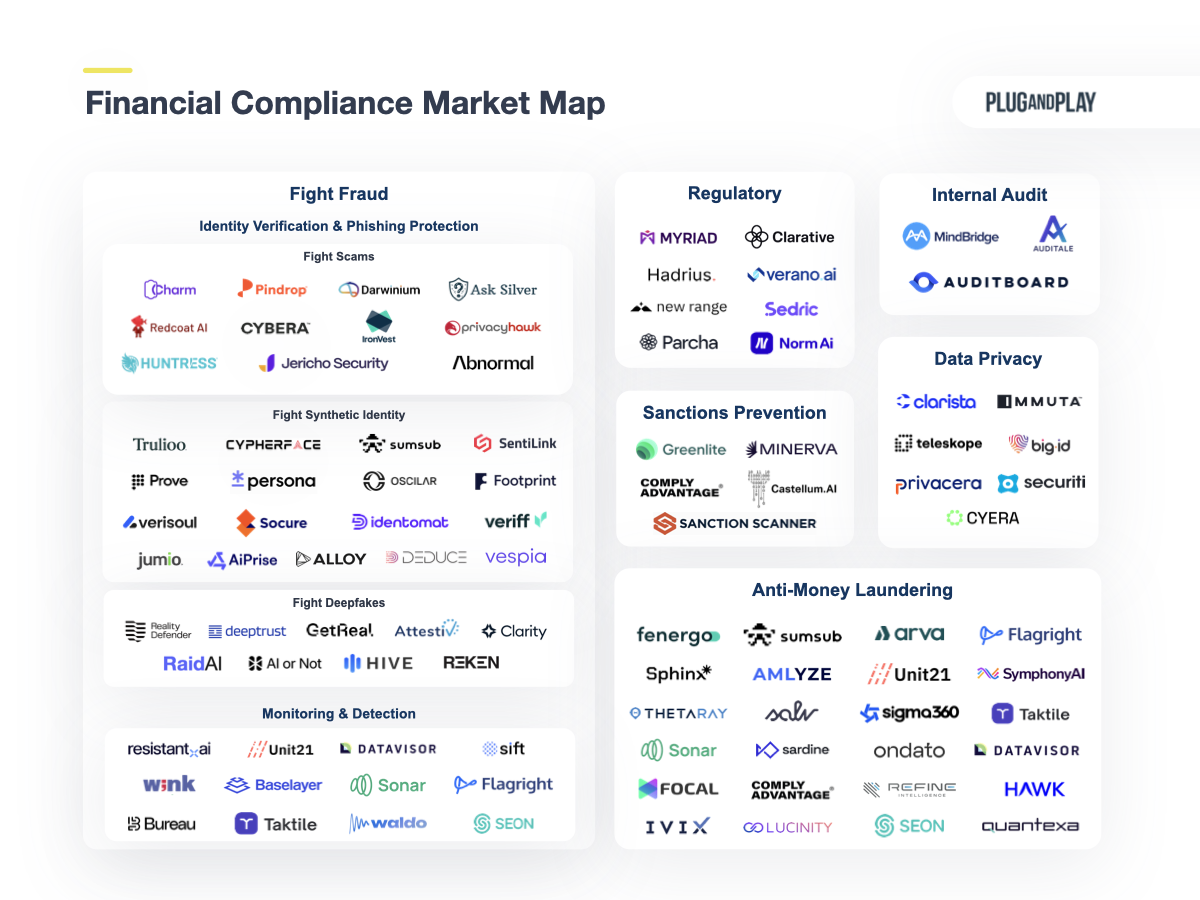
In line with this trend, we’re highlighting Auditale, a startup bringing AI into internal audit and financial compliance. Their platform focuses on areas like real-time compliance monitoring and operational quality assurance. By automating financial compliance reviews and control testing, Auditale aims to reduce operational audit costs by up to 70% and minimize regulatory risk exposure. From our perspective at Plug and Play, this kind of solution brings much-needed agility and modernization to an area long dominated by manual processes and legacy systems.

Internal audit is becoming more strategic, connected, and tech-enabled. Its core mission remains to help financial institutions stay safe, sound, and in compliance, but now, it’s doing so with smarter tools and deeper collaboration across the organization. We see internal audits not just as a control function but also as key enablers of resilience and innovation in financial services.

At Plug and Play, we believe that innovation in financial compliance isn’t just a nice-to-have but essential. From KYC and AML to sanctions, fraud, and internal audit, today’s regulatory environment demands smarter, faster, and more adaptive solutions. 

That’s why we work every day to connect financial institutions with the startups building those solutions. With over 100,000 startups in our network and 550+ corporate partners worldwide, we help our ecosystem stay ahead of evolving risks through pilot programs, tailored innovation tracks, and strategic investment opportunities. Financial compliance is complex, but with the right technology, it doesn’t have to be overwhelming.


GET IN TOUCH

Ready to start your innovation journey?
PLUG AND PLAY AROUND THE WORLD

Discover our global locations

We have a community of experts all over the world. We work as a bridge between Silicon Valley and the rest of the world, making innovation open to anyone, anywhere.

Sign up for our global newsletter