articleSep 27, 2025
Fintech

AML Compliance: What You Need to Know to Protect Your Business

Learn about the challenges of AML compliance, evolving money laundering tactics, and how AI-powered tools are transforming financial crime detection and compliance strategies.

Anti-Money Laundering (AML): Challenges & evolving tactics

When we talk about money laundering, one of the first things to know is that these are hidden crimes. They often go unreported, are hard to detect, and usually happen behind the scenes. In many cases, money laundering is a secondary crime. It doesn’t happen on its own, but follows serious offenses like drug trafficking, corruption, tax evasion, or fraud. It’s how criminals try to clean their dirty money.

An estimated 2–5% of global GDP is laundered annually. That’s roughly $800 billion to $2 trillion flowing through the system unnoticed. This staggering figure signals just how massive the issue still is, especially considering that less than 1% of illicit financial flows are seized by authorities. In other words, criminals manage to hold the vast majority of their illegal profits.

How AML compliance rules and technologies are evolving

Since 2004, the Financial Action Task Force (FATF) has expanded its 40 recommendations, adding rules to fight terrorist financing, setting standards for virtual assets, and including more technical guidance on how to implement these. These changes also show that to stay ahead, we must constantly adapt, innovate, and update our tools and strategies. What worked 10 years ago won’t cut it today. This is especially true as new technologies like AI reshape how we detect, investigate, and respond to financial crime.

In fact, both the US and EU are strengthening AML oversight. The EU has published a comprehensive AML/CFT legislative package that includes the AML 'Single Rulebook' Regulation, the AML Authority Regulation, and the 6th AML Directive (KPMG). The main objective is to harmonize AML rules across the EU and establish a powerful new regulator, the Anti-Money Laundering Authority (AMLA), to supervise high-risk entities directly.

Meanwhile, the US has begun implementing the Corporate Transparency Act, which requires certain foreign entities to report their true beneficial owners to a FinCEN database. This aims to reduce anonymity in corporate structures and is particularly helpful in combating tax evasion


GET IN TOUCH

Ready to start your innovation journey?

AML compliance rule changes & AI innovation

Although FinCEN recently postponed the effective date of the Investment Adviser AML Rule from January 1, 2026, to January 1, 2028, this rule will eventually extend AML requirements to a wider group of investment advisers, aligning them more closely with standards already applied to broker-dealers and banks. Despite the delay, the broader regulatory momentum clearly signals a shift toward tighter AML compliance across sectors.

At Plug and Play, we believe the next big shift will come from AI-powered tools. With the AI regulations, we see a clear opportunity to apply artificial intelligence to make AML and terrorism financing investigations faster, more innovative, and more effective. That’s why we’re building AI Centers of Excellence to help financial institutions explore and adopt cutting-edge technologies that make compliance not only stronger, but more scalable.

Common money laundering tactics & the cryptocurrency frontier

Financial institutions are required by law to maintain robust AML programs to detect and report money laundering and terrorist financing. Yet illicit networks constantly adjust their methods to evade detection. Common money laundering tactics include:

  • Structuring (“smurfing”): Breaking up large sums into many small deposits or transfers below reporting thresholds to avoid detection.
     
  • Shell companies & offshore accounts: Obscuring the true owner of funds by moving money through dummy corporations or foreign bank accounts in secrecy havens.
     
  • Trade-based laundering: Using fake invoices, over- or under-valued trade shipments, and other trade tricks to disguise criminal proceeds as legitimate business transactions.
     
  • Tax evasion & corruption: Often accompanying money laundering, as criminals hide untaxed or illicit wealth alongside moving the funds through the financial system.

A growing concern is the intersection of AML with cryptocurrency. Crypto has become a new frontier for money laundering. Illicit cryptocurrency transactions surged by over 80% in the previous year, highlighting the need for greater oversight of digital assets. FATF has recently called for urgent action on crypto-related risks, warning that many countries are still lagging behind in regulating virtual assets. In its June 2025 update, FATF revealed that fewer than one-third of jurisdictions assessed fully comply with its crypto standards. This means most countries have significant gaps in how they oversee crypto businesses.
With virtual assets being inherently borderless,
a weak link in one jurisdiction can create global vulnerabilities. Pressure on governments means that crypto institutions will soon be expected to operate under bank-level AML requirements. A good example is Block, which was fined $40 million for AML failures linked to its Cash App. The company let high-risk Bitcoin transactions go through without proper checks and built up a backlog of suspicious activity alerts that were never reviewed in time. Cases like this show that regulators expect strong compliance, even in the crypto world.

AI-enhanced compliance: Reducing false positives

Here’s another important point: many financial institutions are still stuck with old-school, rules-based systems to monitor transactions. These systems flag anything that crosses a predefined line: a large transfer, a strange location, or too many small payments. The problem? They’re not very smart. About 90% of those alerts turn out to be false positives. That means compliance teams spend most of their time chasing harmless activity instead of real threats. The result is wasted effort, alert fatigue, and costs — all while criminals continue to evolve. We believe it’s time to change the narrative. Money laundering reporting officers (MLROs) should be empowered with data-driven, AI-enhanced tools that help spot suspicious behavior faster, more accurately, and with far less noise. 

For example, Unit21 is a modern AML and fraud platform that delivers results. Companies using it have reported a 70% drop in fraud losses, investigations done 75% faster, and suspicious activity reports filed 66% quicker. That’s the power of smart tech doing the heavy lifting, so compliance teams can spend less time digging through false alarms and more time focusing on what matters.

Collaboration in financial crime prevention

One of the most exciting shifts we’re seeing in the fight against financial crime is the growing willingness to share data. At Plug and Play, we live and breathe collaboration — it’s at the heart of everything we do. We believe real impact happens when banks, fintechs, startups, and regulators unite as one ecosystem. That’s why we believe private-sector collaboration isn’t just helpful anymore, it’s essential. Take the U.S. 314(b) program, for example. It allows financial institutions to share information about suspicious activity legally. When that kind of intel is shared across organizations, it becomes a powerful tool for spotting complex money laundering schemes faster and more precisely.

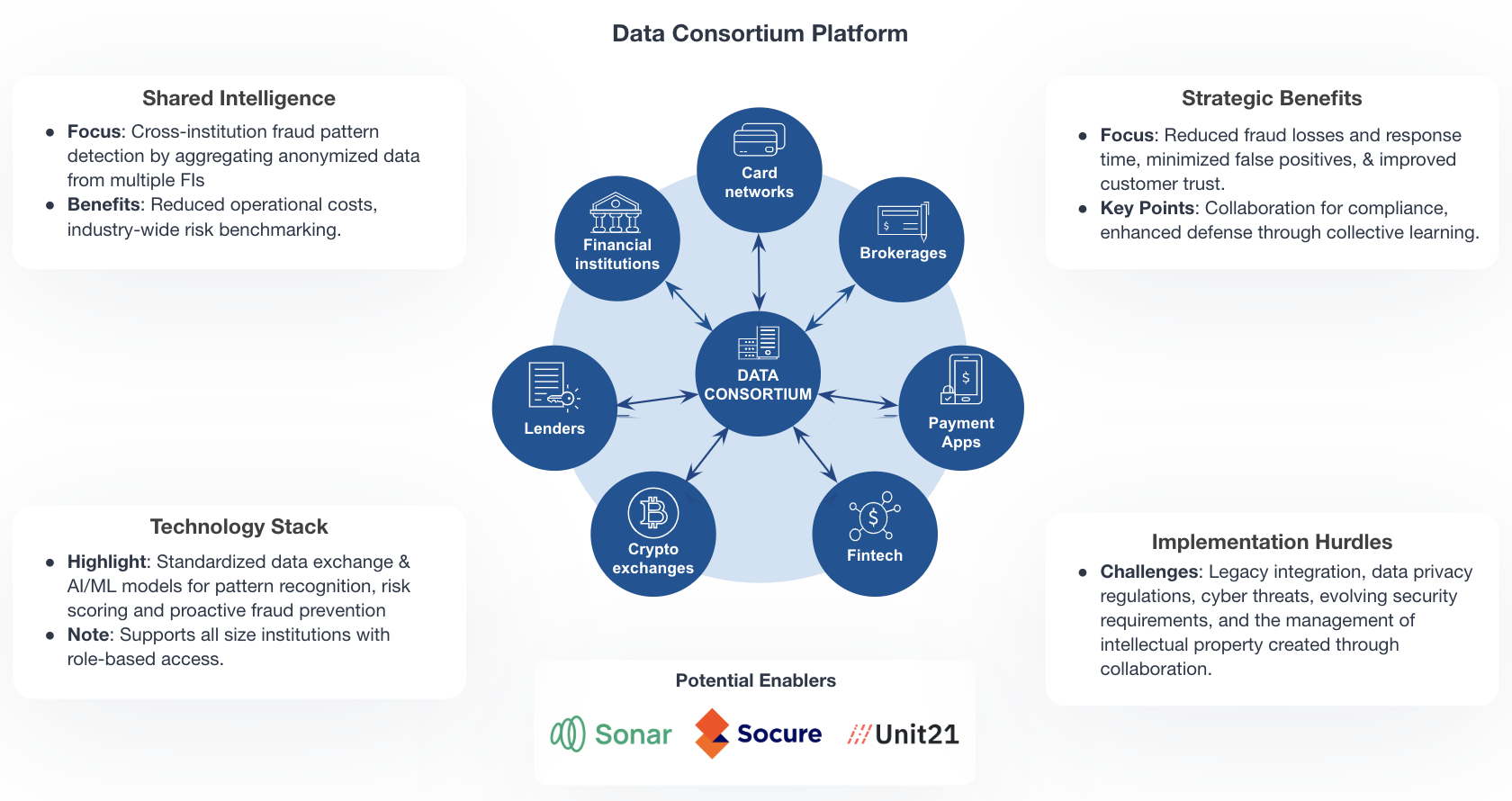
A standout example of this in action is Sonar, built by Sardine. It’s an independent data consortium that connects banks, fintechs, merchants, and crypto platforms, helping them share real-time insights into fraud and counterparty risk. The result? They can detect patterns no single institution could spot alone, like repeat scammers, money mule networks, and authorized push payment fraud.

 
Unveiling Megatrends & Predictions in Financial Services for 2025 & Beyond
Read Now

Sanctions compliance & geopolitical risks

Over the past few years, we’ve seen the world of financial sanctions shift dramatically. Sanctions compliance has taken on increased importance, especially as geopolitical tensions continue to escalate, from Russia’s war in Ukraine to ongoing instability in the Middle East. Now, China–Taiwan tensions are also in the spotlight, with the U.S. House passing the Taiwan Conflict Deterrence Act  — a bill that would require the U.S. Treasury to identify and disclose financial assets held by Chinese Communist Party elites if China takes military action against Taiwan. This measure shows how sanctions are being used proactively in international conflicts.

We believe that technology is key to staying ahead of sanctions risks and spotting potential violations before they become problems. While traditional players like Dow Jones, LexisNexis, Fiserv, and FICO have long offered screening tools, many of these systems still rely on manual processes and rigid rules, which often lead to a flood of false positives and wasted time.

In today’s fast-moving world, financial institutions and multinational companies are under mounting pressure to stay on top of constantly evolving sanctions rules. Agencies like OFAC in the U.S., alongside counterparts in the EU, UK, and beyond, are expanding restrictions, barring any business with blacklisted individuals, companies, and countries to cut off bad actors from the global financial system. Since Russia’s 2022 invasion of Ukraine, the EU has rolled out 18 consecutive sanctions packages, many of which also target Belarus for its support role. These ongoing efforts have added thousands of names to the EU’s restricted lists, including at least 2,500 sanctioned individuals and entities as of mid-2025. In fact, a 19th EU sanctions package has already been proposed, and for the first time, it will target crypto platforms by prohibiting cryptocurrency transactions.

To keep up with constant sanctions changes, ComplyAdvantage steps in. It’s a global sanctions and watchlist screening platform powered by AI and real-time data. The system pulls together sanctions lists, PEPs, and adverse media from over 60 jurisdictions. The result is sharper detection, fewer false positives, and compliance teams that can act in minutes instead of days.

AML compliance & sanctions in global supply chains

Transportation and logistics might not be the first thing that comes to mind when you think about sanctions compliance, but at Plug and Play, we know it’s one of the trickiest and most complex areas to manage in the entire sanctions landscape. Goods often pass through multiple countries and a long chain of transport partners, creating a tangled mess of paperwork that can stretch across hundreds of pages. Sanctions officers have to be incredibly detailed because bad actors don’t give up easily. They hide behind front companies, reroute goods through third countries, and use alternative currencies or payment systems to stay under the radar.

It gets even more complicated when dual-use items are involved, like microchips or machine tools that can be used for both civilian and military purposes. In 2024, the U.S. Treasury urged manufacturers to tighten their controls after discovering these kinds of goods were being diverted to Russia’s military. By early 2025, US investigators uncovered a covert payments network between Russian and Chinese firms, even sanctioning Keremet Bank in Kyrgyzstan for helping move money tied to banned shipments. It’s a clear sign that the rules are changing fast, and compliance teams need smarter, faster tools to keep up.

From sanctions screening to strategic advantage

Another tricky part is that overseeing the activities of subsidiaries within multinational groups can be highly challenging, especially when they operate across jurisdictions with strict sanctions regimes. A clear case was British American Tobacco, which agreed to pay $635 million to U.S. authorities after a Singapore-based subsidiary sold cigarettes to North Korea between 2007 and 2017, in breach of sanctions. The scheme involved falsifying documents to trick U.S. banks into processing transactions worth $74 million. The U.S. Department of Justice described this as the largest North Korea sanctions penalty in its history, underscoring how lapses in subsidiary supervision can expose global corporations to severe financial and reputational risks.

That’s where new players are stepping in. Castellum.AI, for example, is rethinking the approach with AI-driven tools and real-time data updates. Their platform delivers 94% fewer false positives, cutting Level 1 alert review time by 83%. It refreshes its data every five minutes, making it a real breakthrough for compliance teams trying to keep up with today’s fast-changing sanctions landscape. The stakes are high; failing to comply can result in hefty fines, loss of export privileges, or even criminal liability for the institution.

The fight against financial crime is getting more complex, but so are the tools to stay ahead. By adopting smarter technologies, from AI-driven monitoring to collaborative data networks, compliance teams can turn a costly burden into a strategic advantage.


GET IN TOUCH

Ready to start your innovation journey?
PLUG AND PLAY AROUND THE WORLD

Discover our global locations

We have a community of experts all over the world. We work as a bridge between Silicon Valley and the rest of the world, making innovation open to anyone, anywhere.

Sign up for our global newsletter