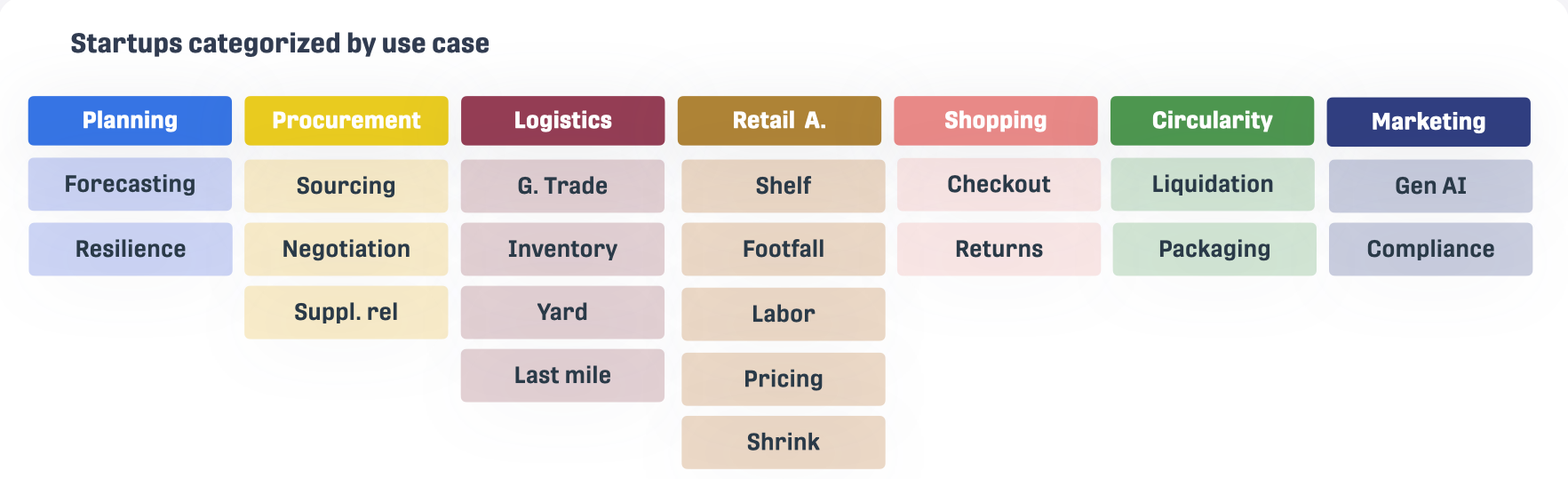
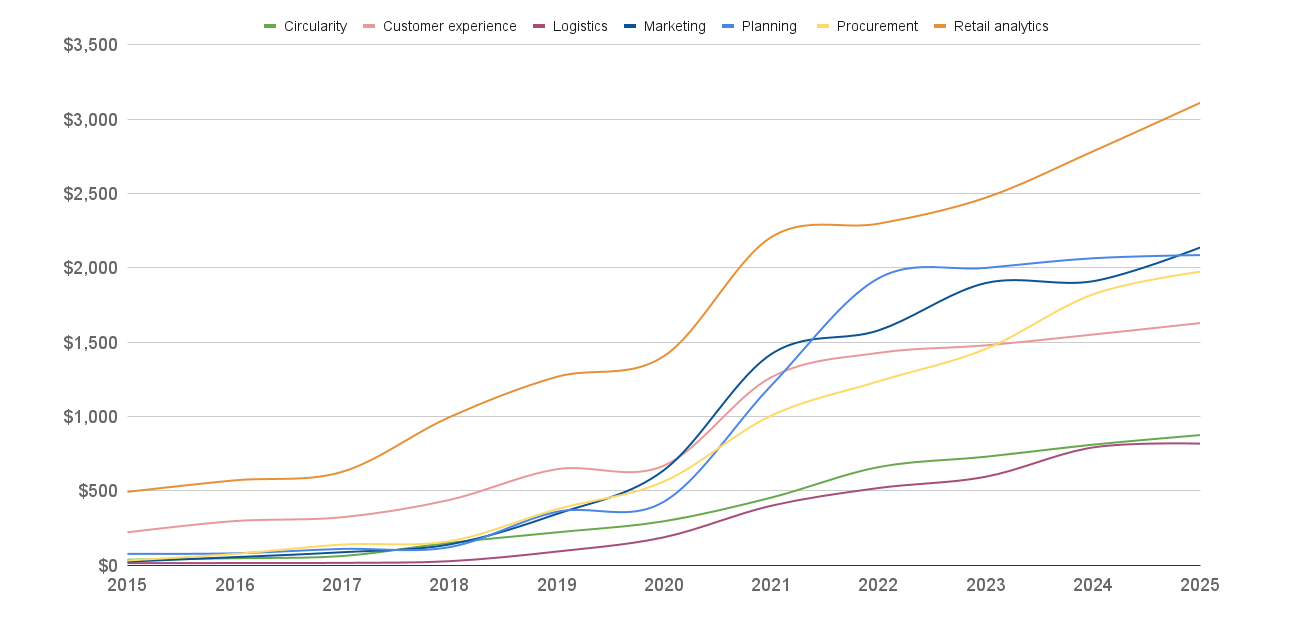
From market giants to new contenders in retail industry trends
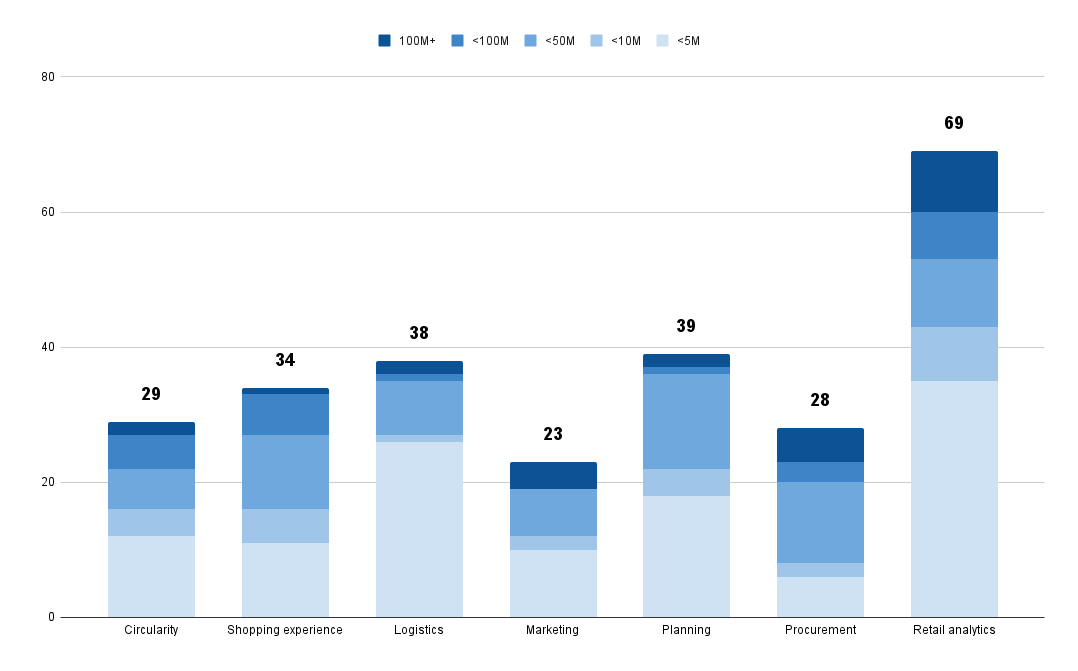
As noted above, the most mature categories are retail analytics and procurement, followed by Marketing, which includes four companies that have each raised over $100M, such as Contentful and Synthesia, both of which enable AI-generated content for retailer campaigns. In the coming years, some of these established players will face challenges in defending market share as foundational model capabilities rapidly advance. Conversely, other categories feature emerging technologies that are gaining traction by addressing real, still-unsolved problems and shaping retail industry trends.
Case studies: Retail industry trends 2025 in action
The more mature categories also feature the greatest number of case studies, underscoring their strong product–market fit and higher levels of adoption.
Planning case study
Roberto Cavalli overcame frequent stockouts, slow replenishment, and inefficient manual inventory processes by implementing Autone’s Rebalancing module, which reallocated stock in real time to high-demand stores. This move reflects broader retail industry trends toward automation, boosting annual revenue by 10% (~$3M), reducing stockouts by 75%, and improving productivity and availability significantly.
Procurement case study
Walmart used Pactum’s AI-powered chatbot to overcome the scalability limits of manually negotiating with over 100,000 suppliers, enabling automated, tailored negotiations. This approach shows how retail industry trends 2025 are transforming supplier relationships, cutting negotiation time from months to days, achieved a 68% agreement rate, delivered 3% average contract cost savings, and earned positive feedback from 83% of suppliers.
Retail analytics case study: Data-driven retail industry trends
ALDO used Pass_by’s analytics to assess ambiguous store performance by combining mall traffic, spending trends, demographics, and regression analysis to separate market factors from internal issues. It also mapped trade areas to e-commerce orders to reveal cross-channel value, which enabled data-backed investment decisions that avoided costly closures and strengthened customer experience. This is an example of retail industry trends driving data-backed decisions that avoided costly closures and strengthened customer experience.
Procurement: Multi-agent systems
A new frontier in procurement automation is the emergence of multi-agent platforms that reflect current retail industry trends for 2025. These platforms offer comprehensive solutions for vendor sourcing, onboarding, spending control, and contract management.
Startup highlight
- Work AI: Founded in 2024, raised 10M seed led by A* and lool ventures, with participation from First Minute Capital, FirsthandVC, Timeless Partners
- Magnetic: Founded in 2024, raised 5.5M seed led by Sequoia Capital, with the participation of First Momentum Ventures.
Logistics: Digital twins
While the concept of a digital twin has been a staple in manufacturing, its application in warehouse automation is a more recent yet vital development. Digital twin technology is transforming warehouses by creating virtual replicas of physical operations, enabling teams to visualize, monitor, and optimize their facilities in real time. Some solutions focus on spatially accurate, photo-realistic models built from on-site scans, ideal for planning layouts, tracking space usage, and improving safety compliance. Others take a data-driven approach, ingesting operational metrics to run AI-powered simulations that uncover bottlenecks, test process changes, and recommend cost-saving optimizations.
Startup highlight
- Claryo: Founded in 2022, raised 8M seed led by Noa Ventures, with participation from Plug and Play.
- Syncrato: Founded in 2023, bootstrapped
 Retail: Sensor-powered intelligence & retail industry trends
In today’s retail landscape, emerging sensor technologies are delivering real-time insights without relying on traditional cameras or invasive tracking. These privacy-centric systems capture rich, anonymized streams of in-store activity that can be analyzed from multiple angles. From one perspective, the insights reveal how shoppers move, engage, and buy, helping retailers boost sales and enhance the customer journey. From another, the same data uncovers patterns in staff performance, enabling teams to refine operations and deliver better service. Together, they offer a powerful, dual‑focus approach that drives both customer satisfaction and operational excellence.
Startup highlight
- Wayvee: Founded in 2023, total funding 6.2M, pre seed led by Tetrad VC.
- Aliado: Founded in 2025, part of Antler brazil accelerator
Circularity: Inventory recovery
Modern inventory recovery platforms are giving retailers a way to turn slow-moving or outdated stock from a cost burden into an asset. By seamlessly routing products either into secondary markets for resale or directly to nonprofit partners for donation, these systems unlock trapped working capital, reduce storage costs, and open the door to meaningful tax deductions. They also address a growing sustainability imperative, ensuring that usable goods are kept out of landfills and put back into circulation where they create value. In doing so, retailers can strengthen their financial performance, meet ESG commitments, and build customer goodwill by showing that excess inventory can have a second life.
Startup highlight
- Liquidonate: Founded in 2021, invested by Uncork Capital, Kapor Capital, Ganas Ventures & Laconia
- Sotira: Founded in 2022, invested by K5 Global, Unusual Ventures, Soma Capital, Night Capital, Ritual Capital
Marketing: Content compliance
As AI-generated campaigns grow, compliance solutions underscore retail industry trends in 2025 by ensuring brand consistency, faster approvals, and lower risk. New AI-driven review platforms integrate directly into creative workflows, automatically checking content against legal requirements, brand guidelines, and platform policies in real time. This not only speeds up approvals and reduces costly errors, but also safeguards against reputational and regulatory risks in an environment where content output is accelerating. For retailers, it means faster time-to-market, stronger brand protection, and the ability to scale campaigns without sacrificing quality or compliance.
Startup highlight
- GetGenAI: Founded in 2023, invested by Davidovs Venture Collective, Act One Ventures, a16z Scout Fund
- Mark OS: Founded in 2024, raised 4M from Plug and Play, Ascend, Ludlow Ventures, Four Acres Capital, Red Antler
Navigating retail industry trends: building the future of retail together
Since 2018, we have addressed over 400 corporate innovation challenges in the space and facilitated more than 200 pilots across the seven macro-categories outlined in this article. Whether you’re looking to optimize your supply chain, elevate your customer experience, or meet ambitious ESG goals, Plug and Play can help you navigate the innovation landscape, embrace the latest retail industry trends, and unlock new opportunities.