articleNov 3, 2026
Brand & Retail

Leveraging a Loyalty Platform for Customer Retention Strategies

Discover what an entrepreneurial ecosystem is, why it matters for enterprises, and how to tap into AI startup communities and university-backed innovation.


What’s inside?
 

  • 1. The transactional model & why it was built that way
  • 2. The shift is already underway
  • 3. Personalization loops in digital retail
    • Stage 1: Generic to segmented
    • Stage 2: Behavioral personalization
    • Stage 3: Predictive personalization
  • 4. Converting transactions into memberships: Building the modern loyalty platform
  • 5. The technology layer enabling the shift
  • 6. Why timing is everything for the loyalty platform advantage

Picture a member who joins a warehouse club to buy a television. They pay the annual fee, carry the TV home, and never return. Twelve months later, a renewal notice arrives. They do not actively cancel. The membership simply stops appearing to be worth keeping.

This is the defining failure mode of digital retail membership in 2026. It is not an acquisition problem. Across the United States, the average consumer now holds 8.2 active paid subscriptions and spends $1,887 per year on them, up from $1,416 the year before. They are willing to pay for memberships. What they are not willing to do is renew ones that do not show up for them between purchases.

Average monthly subscription churn has risen to 20%, and more than half of U.S. subscription businesses report that at least 10% of their subscribers are inactive. The gap between sign-up and sustained engagement is where the revenue is being lost, and the retailers who understand this principle are leading those who do not.


The question is not how to attract members. It is about making the membership feel worth keeping on days when no visits or purchases occur.


1. The transactional model & why it was built that way

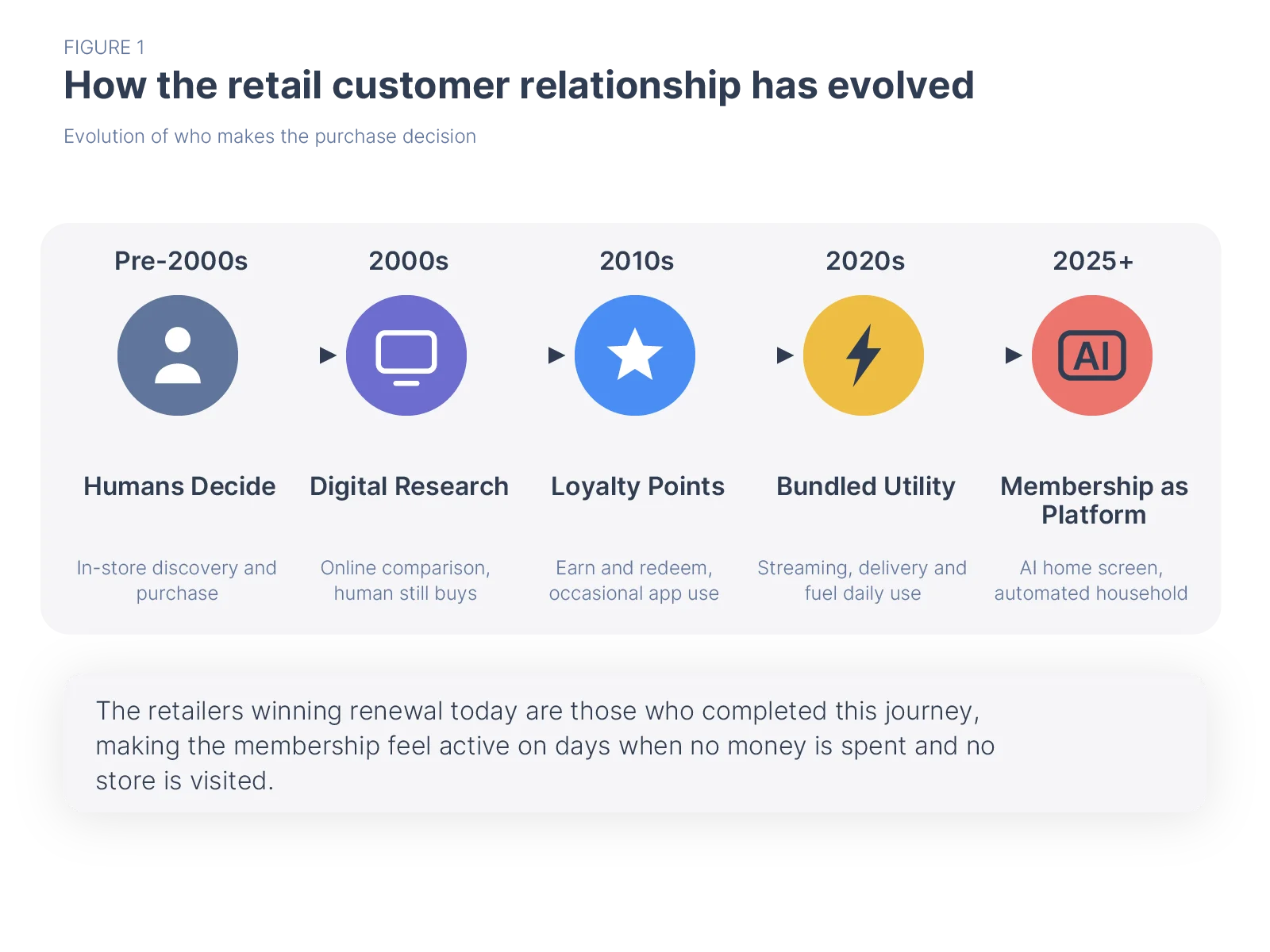
For most of retail history, the seller’s job ended at the point of purchase. Stores were designed around the physical visit: high-traffic floor plans, promotional signage, basket optimization. The customer was defined by what they bought on the day they showed up, not by who they are and their shopping behavior.
Previously, without a persistent digital identity, there was no practical way to know whether the person who bought a television in November was the same person who bought batteries in February. Customer retention strategies of that scale just did not exist at the time.
The rise of subscription models changed that dynamic. What began as a mechanism for customer affiliation (a way to formalize the relationship between a buyer and a brand) became the primary data collection infrastructure of modern retail. Every time a member renews, redeems, or interacts with a subscription, they generate a continuous data signal that isolated transactions never could. The membership became less about the discount and more about the data loop the loyalty platform creates.
Loyalty programs emerged in the 1990s as an early attempt to capture this dynamic, attaching a card number to a purchase history. But the model remained fundamentally transactional: earn points, redeem points, repeat.

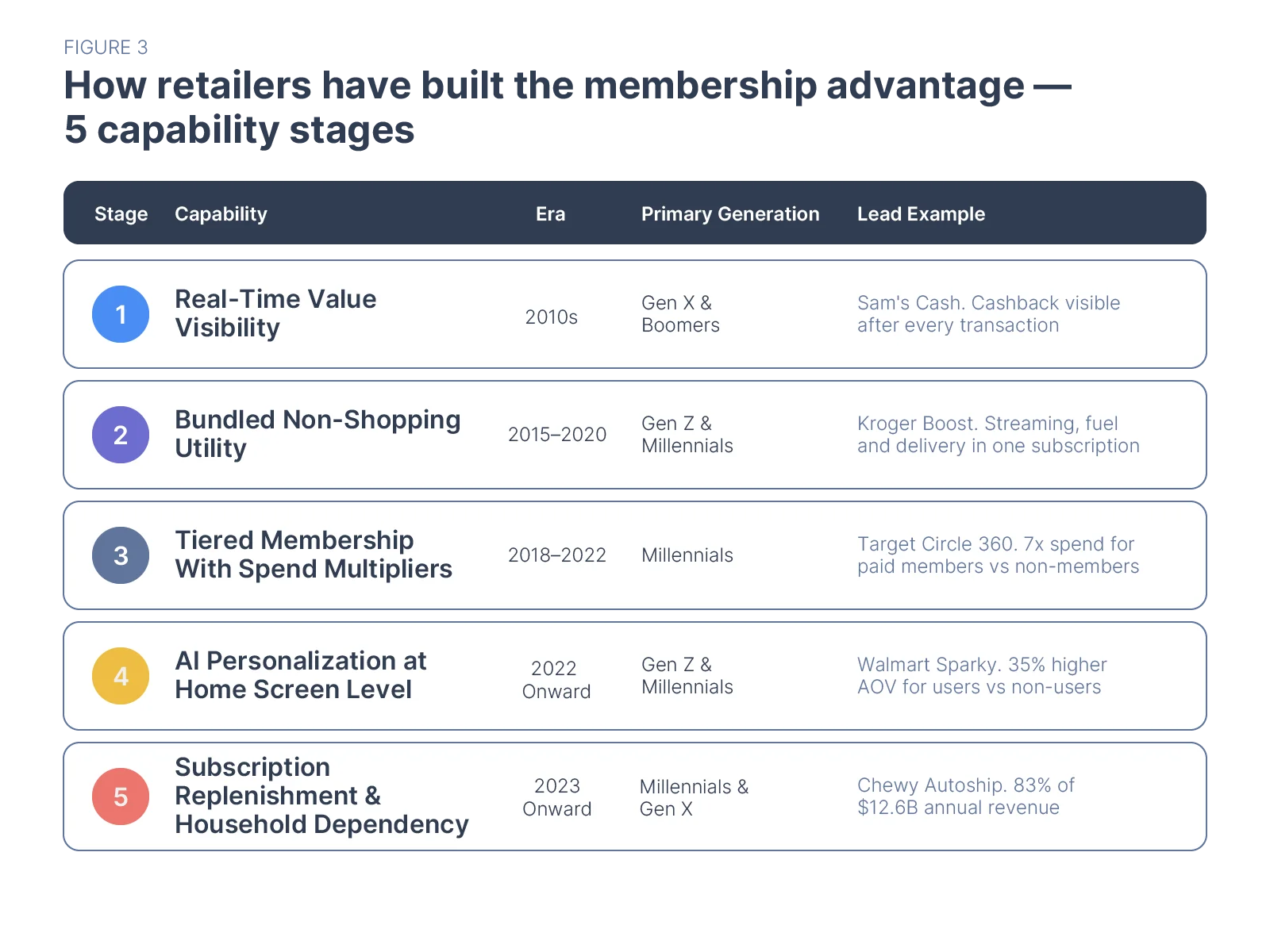
The shift from transaction to membership was not driven by a single technology. It was a consequence of retailers recognizing that subscription relationships generate data advantages. Once a retailer knows what a member buys, how often, at what price, and across which categories, every future interaction can be made more relevant. Competitors without that data history cannot replicate the experience, regardless of how competitive their pricing is.

The financial results of this shift are now measurable. Loyalty platforms and subscription programs with daily engagement mechanics report an average 5.3x return on investment, and 92.7% of program owners report positive returns. These returns are highest among retailers who have moved beyond points to bundled membership models with daily utility.


The question is not how to attract members. It is about making the membership feel worth keeping on days when no visits or purchases occur.


GET IN TOUCH

Ready to start your innovation journey?

2. The shift is already underway

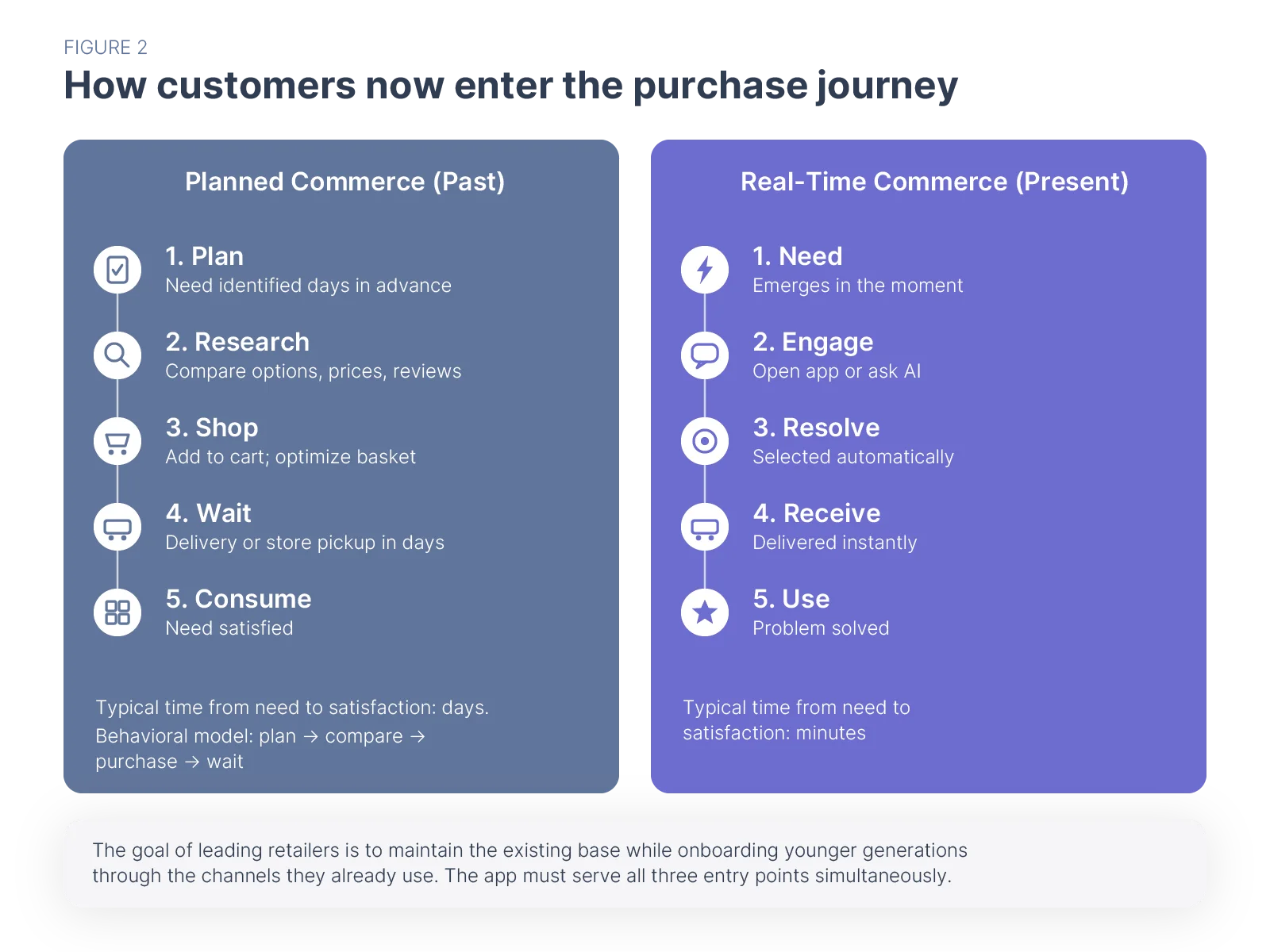
The retailers at the most advanced stages are not just retaining members at higher rates; they are also generating higher acquisition, spend, and retention. Different generations enter this journey at different points and respond to different mechanics. The focus is on maintaining the utility that retains existing members while adding digital and AI-native features that attract and retain younger cohorts, culminating in a loyalty platform with consistently broad reach.

Different generations arrive through different channels, but they all converge at the same point: the app. Whether a member discovered a product on social media, asked an AI assistant to resolve a need, or planned a shopping trip in advance, the app is the interface through which the membership delivers its value — the entry point changes while the destination does not.
The Walmart example makes the broader trend visible. The in-store and digital retail journeys are now converging through the app as the single interface. A member who arrives at a Walmart warehouse today is expected to have the app open before they reach the aisle: to unlock Scan and Go, to access their fuel discount, to use Sparky for product decisions. That convergence is not a feature. It is a data collection strategy.

Every in-store interaction that passes through the app becomes a signal the retailer can act on. Every one that does not is invisible. The retailers generating the highest spend multipliers and renewal rates are the ones who have made the app the thread running through both the physical visit and the time between visits.
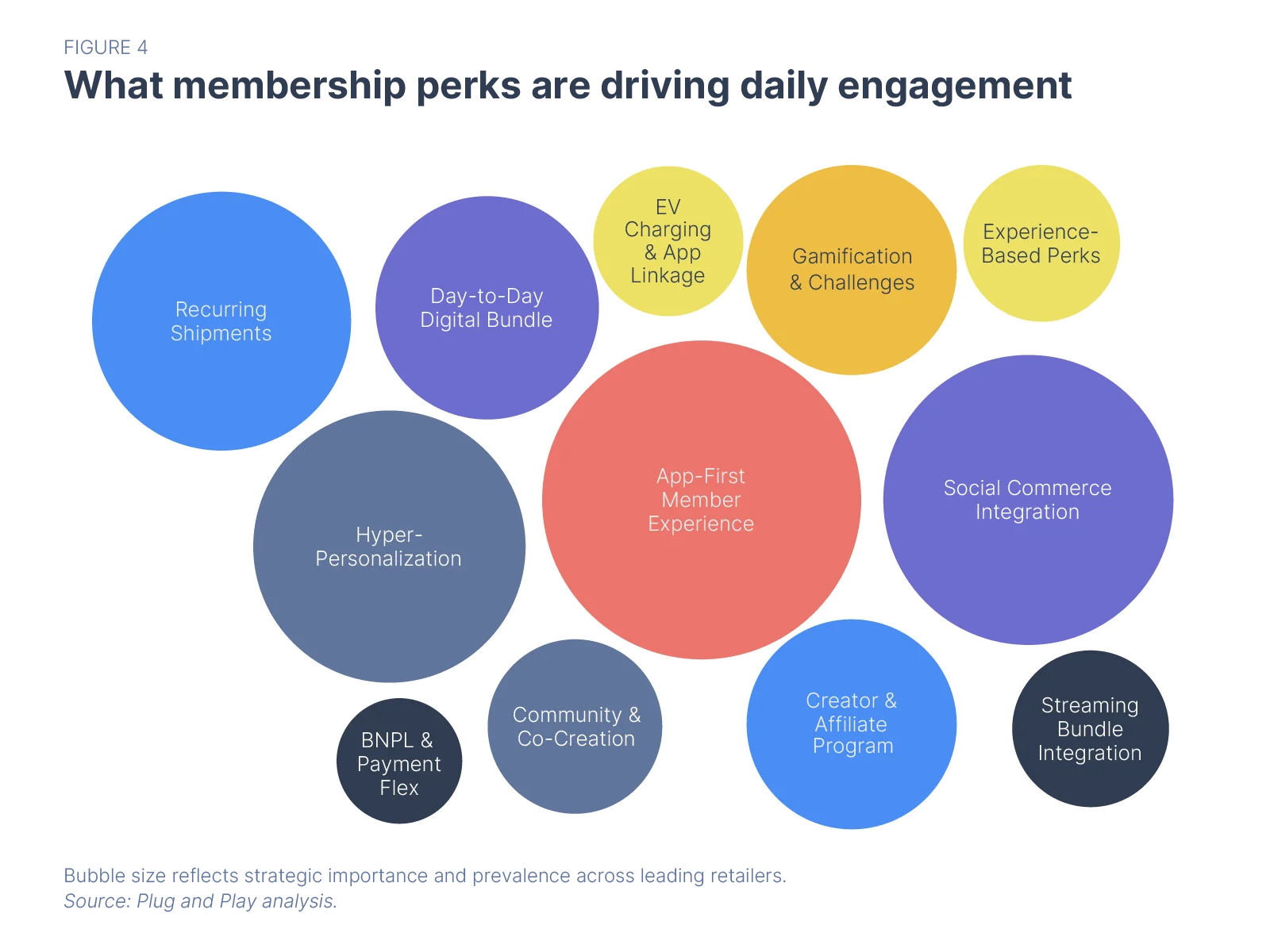
The bubble diagram maps the full range of mechanisms retailers are currently deploying to build daily engagement within their customer retention strategies. The largest bubbles reflect the mechanics generating the most measurable impact on renewal and spend. The smaller ones represent emerging plays growing in relevance, particularly for younger cohorts. The pattern across all of them is the same: every perk is a reason to open the app, and every app open is a data point that makes the next interaction more relevant.

3. Personalization loops in digital retail
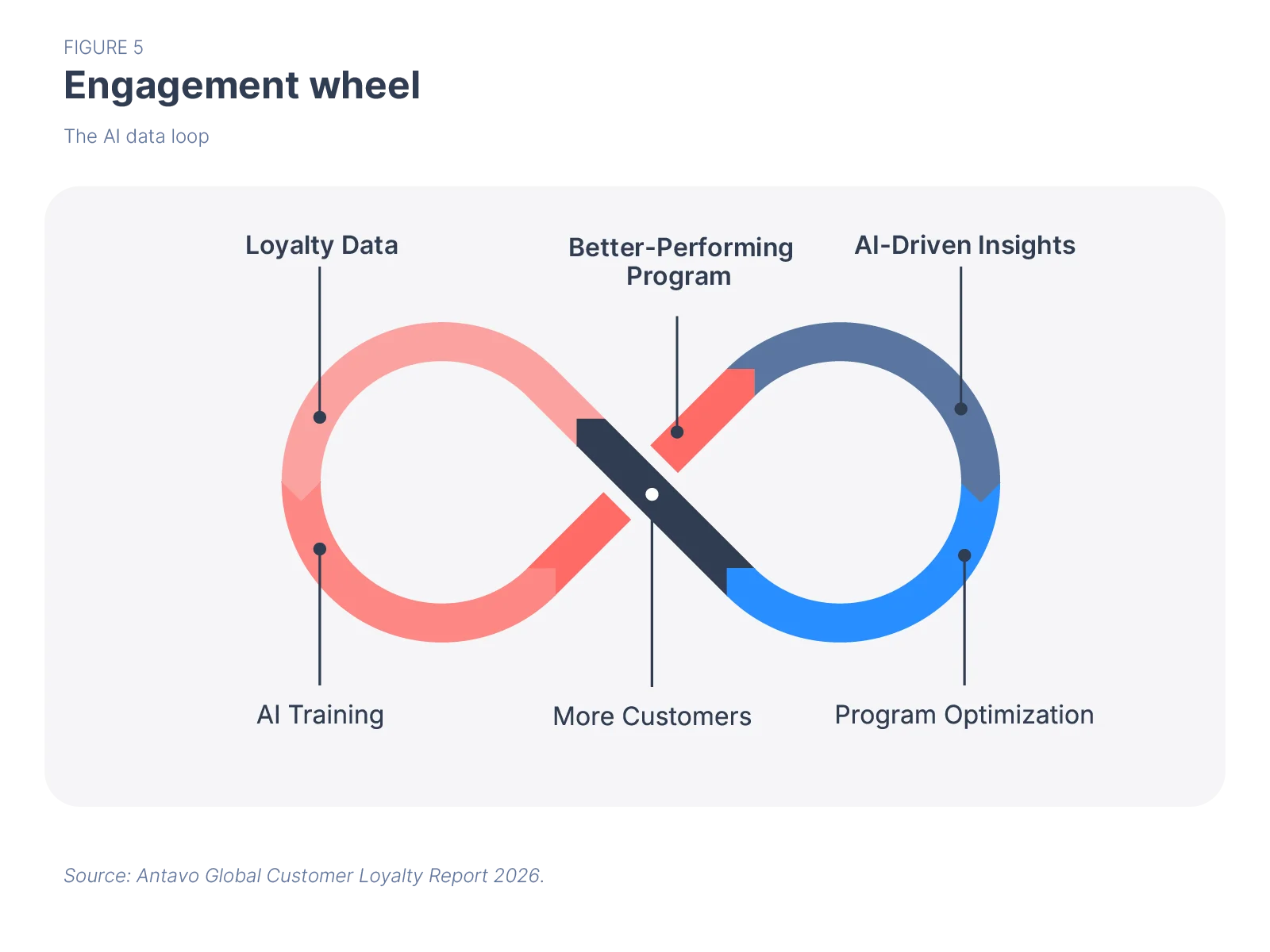
The retailers at the top of these capability stages share something beyond the specific features they have deployed. They have built a data loop. Every interaction a member has inside the app generates a signal. Every signal improves the relevance of the next interaction. The more relevant the interaction, the more frequently the member opens the app.
The flywheel illustrates why personalization is not simply a feature. It is a compounding structural advantage. A retailer that has been collecting first-party data through daily app interactions for three years has an intelligence base that a new entrant cannot replicate by deploying the same technology today. The data history is the moat.

Stage 1: Generic to segmented

Early personalization was cohort-based. No individual signal, just demographic inference. This reduces churn marginally but does not build the flywheel effect. Members see recommendations that feel okay rather than genuinely useful.

Stage 2: Behavioral personalization

Amazon Personalize now accounts for approximately 35% of Amazon’s total revenue through its recommendation algorithms. The principle applies at any scale: data specificity drives recommendation relevance, and recommendation relevance drives purchase frequency.

Stage 3: Predictive personalization

The app anticipates need before the member acts on it. Recurring shipment alerts and price-drop notifications for items in the member’s purchase history. At this stage, the member does not think of the app as a shopping tool. They think of it as something that manages part of their household. Canceling it creates friction in their daily activity, reinforcing the loyalty platform model.
The demand signal is already documented. 62% of Gen Z and Millennials prefer to shop using AI-powered tools, ahead of the overall consumer rate at 51%. Six in 10 Millennials have more faith in AI shopping tools than store associates for unbiased advice.

4. Converting transactions into memberships: Building the modern loyalty platform

The evidence across retailers points to four distinct mechanics. No single one creates the flywheel effect alone.
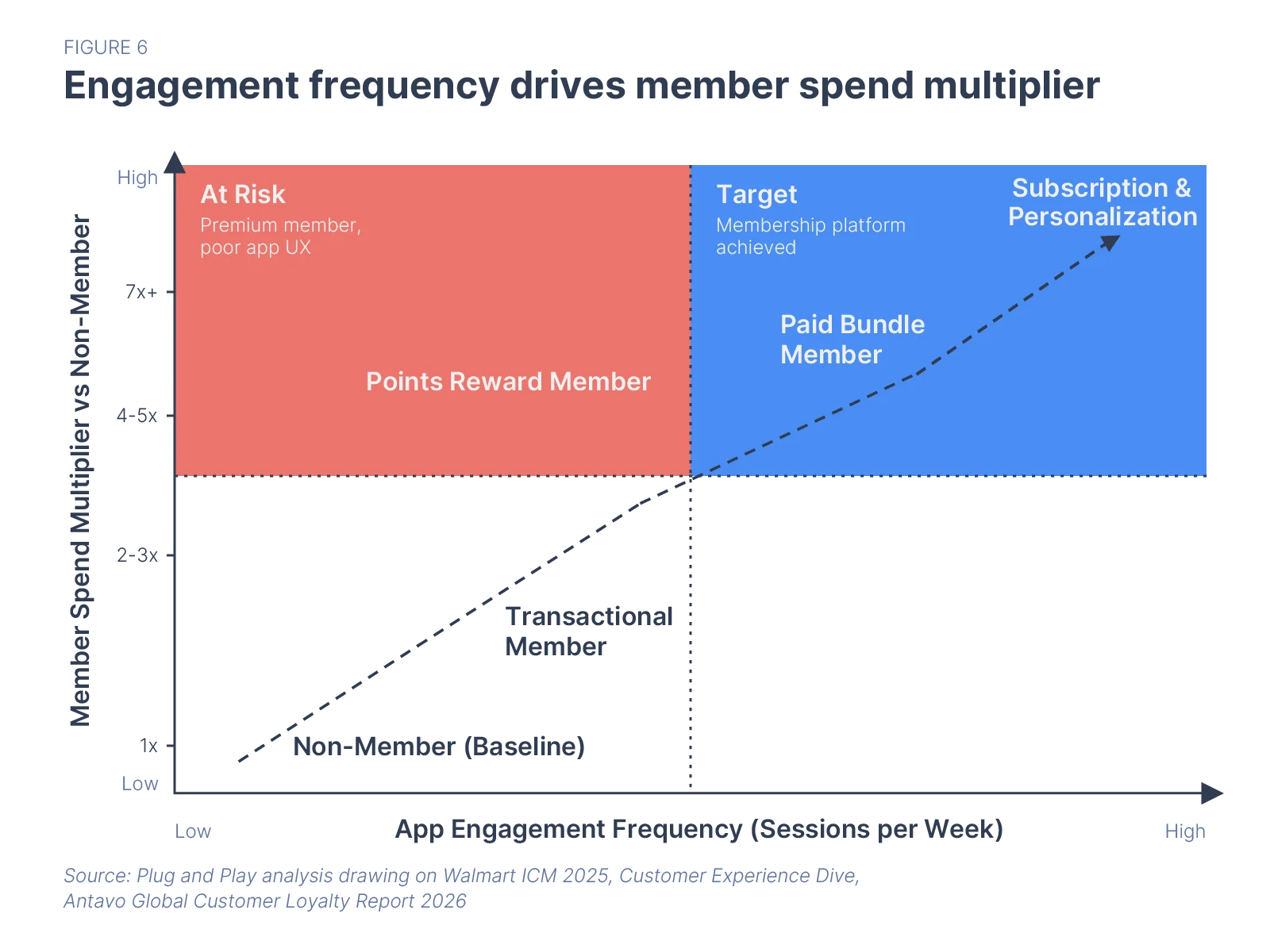
The matrix shows the relationship between how frequently a member engages with the app and their spending relative to a non-member. The trajectory is consistent across all the retailer data in this report: engagement frequency and spend multiplier move together. The mechanics below are what drive that movement.

Mechanic 1: Real-time value visibility

The membership benefit must be visible at the moment it is earned, not accumulated invisibly and revealed once a year. This is the lowest-complexity move and consistently produces the clearest lift in renewal.

Mechanic 2: Daily non-shopping touchpoints

Streaming access, fuel savings, and event ticketing. The goal is to make the membership feel active on days the member is not spending money. These are passive benefits: the membership shows up for the member without any action required. Retailers who have built these touchpoints see users who engage daily and renew at higher rates.

Mechanic 3: Automated household dependency

Subscription replenishment and recurring shipment automation convert a discretionary membership decision into a household infrastructure dependency. A member who has automated their pet food, cleaning supplies, and vitamins through a single membership is not evaluating whether to renew. They are evaluating whether to disrupt a system that is running smoothly. This is structurally different from passive touchpoints: the member has set something up that now runs without them, and canceling it breaks a dependency rather than just a habit. The friction of cancellation replaces the friction of renewal.

Mechanic 4: Predictive personalization that compounds

The data a membership accumulates over time is its most durable competitive asset. A retailer that knows a member’s purchase cadence, category preferences, price sensitivity, and life stage can surface more relevant recommendations than any competitor without that history. This advantage compounds: the longer a member stays, the more relevant the experience becomes, and the more likely the member is to continue.

RELATED EBOOK

The Future of Commerce Report
Download Now ->

5. The technology layer enabling the shift

Building a membership platform is not primarily a technology problem. It is a strategic and operational decision. The ability to retain the existing customer base while onboarding younger, more digitally native cohorts will determine which retailers hold the most durable competitive position.

Churn prediction & early intervention

The most valuable moment to retain a member is before they have consciously decided to lapse. The most effective loyalty platforms model individual members’ behavior across online and offline touchpoints to identify disengagement signals before renewal decisions are made.

Enabling startup

Scowtt: A predictive AI platform that transforms underutilized CRM data into growth engines for marketing optimization and automated sales.

Subscription automation & replenishment

Deploying recurring shipment capability requires an integration layer that manages cadence preferences, payment processing, churn prediction within active subscriptions, and save-offer logic when cancellation intent is detected. Without this layer, subscription programs operate manually and cannot scale.

Enabling startup

Stay AI: An AI-driven subscription optimization and churn mitigation. Personalizes subscription portals, optimizes delivery cadences, and automates churn-prevention campaigns based on individual member behavior.

Personalization infrastructure

AI-powered home screen curation, basket recommendations, price monitoring, and predictive push notifications all require a unified first-party data layer. The capability is only as good as the data feeding it. The loss of data whenever a member is redirected to an external service is a lost opportunity for personalization quality.

Enabling startup

Amperity: AI-powered CDP with patented identity resolution across first-party data silos. Creates a unified member profile for hyper-personalized marketing and disengagement detection.

Conversational commerce & frictionless renewal

The renewal decision itself is a moment of friction. Natural language interfaces that resolve service requests, answer questions, and process renewals natively within the app significantly reduce this friction.

Enabling startup

Sierra: Helps businesses to build and deploy AI agents that communicate with users across channels such as chat, voice, email, and messaging.

6. Why timing is everything for the loyalty platform advantage

The strongest membership programs make the benefit visible in real time, create daily reasons to engage beyond the shopping trip, and accumulate data that makes every interaction more relevant than the last. The app is the infrastructure that connects the physical visit and the digital relationship into a single experience. The retailers who have built that convergence are already generating spend multipliers and renewal rates that their competitors cannot replicate without years of data history. The tools exist. The decision is timing.

FAQs about the entrepreneurial ecosystem

How can retailers turn their app into a daily engagement tool rather than just a shopping channel?

Retailers with the highest spend multipliers and renewal rates use their app to connect in-store visits and the time between them. Every perk gives customers a reason to open the app, and every open produces data that makes the next interaction more relevant. Plug and Play’s Brand & Retail program connects retailers with vetted startups building loyalty, engagement, and retail technology. We can help you quickly pilot these tools and find the right mechanics for your customers, including younger cohorts.

Why is personalization a lasting competitive advantage, and how can retailers start building it?

Personalization works like a flywheel. Each interaction generates a signal, each signal improves the next interaction, and the more relevant the experience, the more often members return. A retailer that has gathered first-party data for years has an intelligence base that new entrants can’t replicate, making data history the moat. Plug and Play can introduce you to startups and corporate, government, and university partners that specialize in data infrastructure, AI-driven recommendations, and personalization engines, so you can start building your data loop sooner.

How can retailers move from basic segmentation to predictive personalization?

Progress comes in three stages: cohort-based segmentation, behavior-driven personalization, and predictive experiences like recurring shipment alerts and price-drop notifications. By then, the app is part of how members run their households. Plug and Play’s innovation programs and global network help retailers find, test, and scale the technologies behind each stage without building everything in-house. To explore what a partnership could look like for your organization, get in touch with our team.

GET IN TOUCH

Ready to start your innovation journey?
PLUG AND PLAY AROUND THE WORLD

Discover our global locations

We have a community of experts all over the world. We work as a bridge between Silicon Valley and the rest of the world, making innovation open to anyone, anywhere.

Sign up for our global newsletter