
What is Innovator's Dilemma?
Let’s go back in time: the Innovator’s Dilemma concept first came to business leaders’ attention in a 1995 article titled ‘Disruptive Technologies: Catching the Wave’ by Clayton Christensen, published in the Harvard Business Review. Then, in 1997, came ‘The Innovator’s Dilemma’ book, which grew to become a seminal work for innovation enthusiasts and businesses looking for a new perspective.
Innovator’s Dilemma: How Companies Fix Innovation Challenges
Concepts such as “disruptive innovation”, which continue to underpin much of modern business strategy today, originated in this book. At its core is a long-lasting question that still resonates with business leaders today: Why do so many companies falter when they’re at the height of their success? Let’s take a closer look.

This represents a dilemma for established companies heavily invested in their current products and customers, who could do everything possible to serve them the best way possible. However, as emerging technologies arise, two risky scenarios also emerge:
- Ignoring new technologies might mean they risk being overtaken by disruptors.
- Investing in disruptive innovations can be risky or seem unattractive, as they initially offer lower profit margins or serve smaller markets.
In this context, successful companies must achieve a tricky balance of sharpening their instinct to detect and develop trends and technologies while knowing exactly when to abandon old ways of doing business.
RELATED ARTICLE: Innovation Glossary: Learn the Language that Fuels Change — Explore the Innovation Glossary and master key terms driving change in today’s rapidly evolving landscape!
The Innovator’s Dilemma chart
The Innovator’s Dilemma chart is best described as an S-curve. It illustrates the most common progression of disruptive innovations over time. The curve:
- Presents a slow start, representing a time when technology is still being experimented with and developed, so only early adopters are interested.
- Gains traction in a period of rapid growth of interest, as performance improves and market adoption accelerates.
- Grows into maturity, reaching a ‘plateau’ scenario where growth slows down. This signals the need for new innovations.
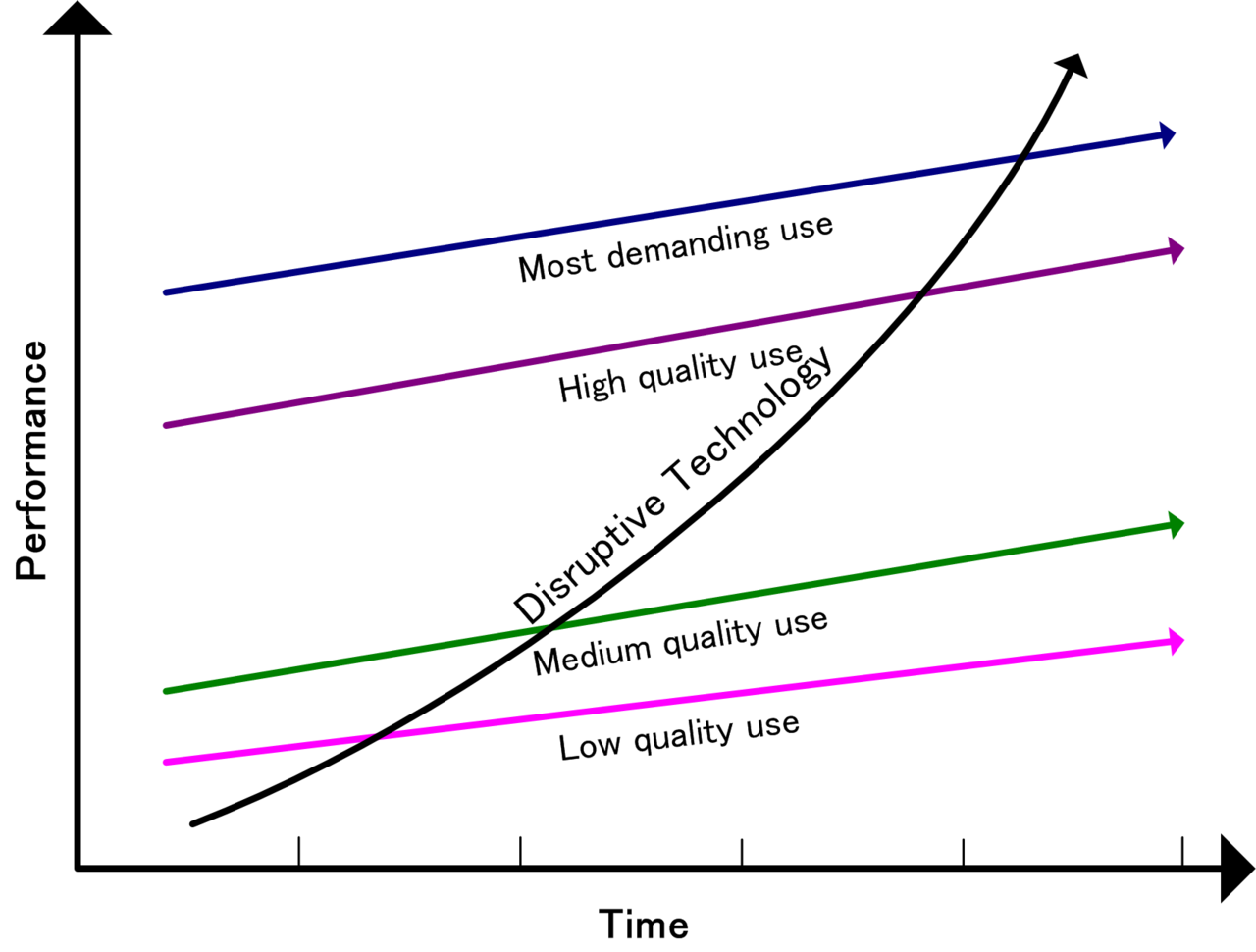
CREDIT: Megapixie at Wikimedia Commons
The Innovator’s Dilemma chart shows the importance of identifying the right moment to invest in a new opportunity — one that may not be as mature as a company’s core competence, but offers a long-term strategic advantage.
Innovator’s Dilemma examples
A profile on Clayton Christensen published in The New Yorker described his initial focus on technologies he had seen evolving over his life: from 8-inch disk drives replacing 14-inch disk drives in early computers to hydraulic backhoes replacing steam shovels in excavators, both of which initially offered lower performance. The profile also mentions Christensen’s view of Sony’s transistor radios in the 1950s: ‘A terrible radio, you could barely make out the music for the static, and it had no chance of competing against the nice big RCA or Zenith consoles.’ However, they succeeded in attracting teenagers, ultimately taking over the market.
Another specific case noted by Christensen was Toyota. The Japanese company introduced Corona cars in the USA in the late 1950s. Smaller and less powerful, these cars weren’t seen as a serious threat by the big automakers at the time, but they were attractive for customers seeking economical options. This put competitors in the classic Innovator’s Dilemma: compete at the lower end or stay focused on their core? Over time, Toyota steadily improved its quality, evolving to ultimately offer cars that compete with some American models.
Other widely discussed Innovator’s Dilemma examples include:
- Kodak: While the company invented the digital camera back in 1975, Kodak didn’t capitalize on it, deciding to continue staying focused on its core film products. The company filed for bankruptcy in 2012 and now operates after significant downsizing and shifts in its business model.
- Blockbuster: The leading video rental chain in the USA until the early 2000s, Blockbuster failed to recognize and adapt to the disruptive technology Netflix started offering in 2007: streaming services.
How to avoid the Innovator’s Dilemma?
There are 4 pillars to mitigate risk. Clayton Christensen proposed that companies can avoid succumbing to the Innovator’s Dilemma by building separate structures from their core business focused on exploring and scaling potential disruptive innovation options.
While this movement represents the key toward minimizing the chances of being overtaken by disruptive technology, our innovation experts at Plug and Play have broken down some of the step-by-step actions that can be taken:
1. Strategy
Companies looking to avoid facing the Innovator’s Dilemma must build a clear innovation strategy that allows them to generate their innovation vision and a truly comprehensive innovation portfolio.
This innovation portfolio should take into account that there are three types of innovation projects:
- Horizon 1: These are innovation projects aiming at maintaining and defending the core business. Close to classic R&D projects, here both technology and use case are known. This means uncertainty levels are minimal, and the likelihood of success is relatively high.
- Horizon 2: This type of project looks at experimenting with emerging trends related to the core business. As such, either a new tech or a new use case is explored here.
- Horizon 3: These projects aim at generating truly disruptive or transformative innovation, and involve examining a new technology and a new market use case. They are characterized by high uncertainty, so companies should approach such projects with caution, especially at the early stages. As such, this is typically the realm of proof of concepts and other ‘low-stakes’ testing protocols.
Generally speaking, companies should aim at investing the majority of their innovation resources in ‘Horizon 1’ projects, as these build trust and credibility in what innovation can bring to the organization. Additionally, as a rule of thumb and in order to target the Innovator’s Dilemma, businesses should aim at investing 10% of their innovation resources in projects that fall under the ‘Horizon 3’ category. In the case of ‘Horizon 2’, these projects usually help as a stepping stone towards ‘Horizon 3.’
A varied approach that provides a balance between immediate and future opportunities and can thus become a fundamental pillar against the Innovator’s Dilemma.
Ready to lead innovation from within? Discover the fundamentals of corporate innovation through practical, expert-led sessions, Mastering the Art of Corporate Innovation, designed to equip you with the tools and knowledge to drive change in your organization.
2. Capabilities
The second pillar against the Innovator’s Dilemma emphasizes the importance not only of choosing the right projects but also of choosing the right way to innovate. How? By creating capabilities to maximize value from innovation.
As a rule, the following four aspects are the key cornerstones of achieving this:
- Developing innovation governance: Companies should aim to implement a governance model that encourages both top-down and bottom-up innovation. A decentralized model involves diverse business units working on innovation and typically generates more ‘Horizon 1’ type of projects. On the other hand, a centralized structure typically veers towards ‘Horizon 3’, as a separate innovation unit tends to be less proximity to the market. The solution? Adopting a hybrid between decentralized and centralized innovation structures that allows for a varied innovation portfolio.
- Right-sized resources: It’s key for companies to offer adequate resources and incentives to explore, experiment, and exploit innovation opportunities.
- Master process excellence: Companies must become excellent at developing end-to-end, fast-track innovation processes and tools. The goal? To fail as fast and as efficiently as possible — because the sooner innovations can show their value (or lack thereof), the better. This allows big companies to speed up their intelligence so that, instead of doing 2-3 innovation projects per year, they can do 30-40.
- Use tailored measurements: Establish innovation KPIs and other tailored measures to objectively determine success or failure.
3. Culture
Beyond the technical, organizations looking to avoid the Innovator’s Dilemma must also rewire their culture and expectations around innovation. At this point, the goal is to build an innovation culture that embraces failure, fosters creativity, and supports execution.
Let’s take a closer look at the need to embrace failure. The key here is to reframe it as a learning opportunity. To do so, some steps to take include:
- Creating a shared understanding of likely failures. This means promoting transparency around mistakes as a strategy to develop a learning culture while also preventing others from making the same mistakes.
- Generating chances for people to detect and analyze failures, creating further learning opportunities around mistakes.
- Setting boundaries to create a safer innovation environment for those participating. A key example here might be Google’s 20% policy, which encourages workers to use 20% of their working time for ‘passion projects’ — a measure that has resulted in key movements such as the development of Gmail.
Facing the Innovator’s Dilemma? Stuck in your innovation journey or unsure of how to take it to the next level? At Plug and Play, we help our partners unlock their innovation potential by walking hand in hand in developing the best practices for their innovation journey.
Ready to take the next step? Practice the art of corporate innovation with our Corporate Innovation Training Sessions or talk to our innovation experts.