
Artificial Intelligence (AI) has evolved from a helpful tool to a key part of business strategy, and now, strong AI regulation, AI ethics and governance are essential for building responsibly. Across industries, AI is helping companies make better decisions, streamline operations, and create entirely new ways of doing business. However, this rapid growth has brought an equally swift response from regulators worldwide.
For global corporations and innovation-driven organizations, AI is no longer just a source of opportunity but also a growing source of legal, ethical, and reputational risk. As new regulations take place, organizations need their AI efforts to drive innovation and meet growing standards for compliance, AI explainability, and responsible deployment.
This isn’t some far-off concern; it’s already here, and companies must be ready.
Global AI regulation, ethics & governance: A new standard for innovation
The pace of AI regulation is picking up quickly. In 2024, the European Union passed the AI Act, which created the first complete set of rules worldwide on how AI should be used and regulated. AI systems are classified into a four-tier risk assessment framework — prohibited, high-risk, limited risk, and minimal risk — based on their respective compliance responsibilities. The greater the risk, the stricter the requirements, especially around transparency, data quality, documentation, and human oversight.
Let’s take a quick look at AI regulations worldwide. The United States relies on federal guidelines. The federal government issues executive guidance, while states like California and New York propose their AI-specific laws.
In Asia, China has taken a more centralized approach, enforcing strict rules around generative AI, content labeling, and algorithmic transparency. South Korea passed its Basic AI Law in December 2024, which will go into effect in 2026. Singapore has built strong risk management frameworks, while Japan provides practical guidance around AI safety and copyright protections.
In Latin America, Brazil’s national AI framework (Bill No. 2338/23) awaits final approval. Saudi Arabia has released ethical and generative AI guidelines to promote responsible development.
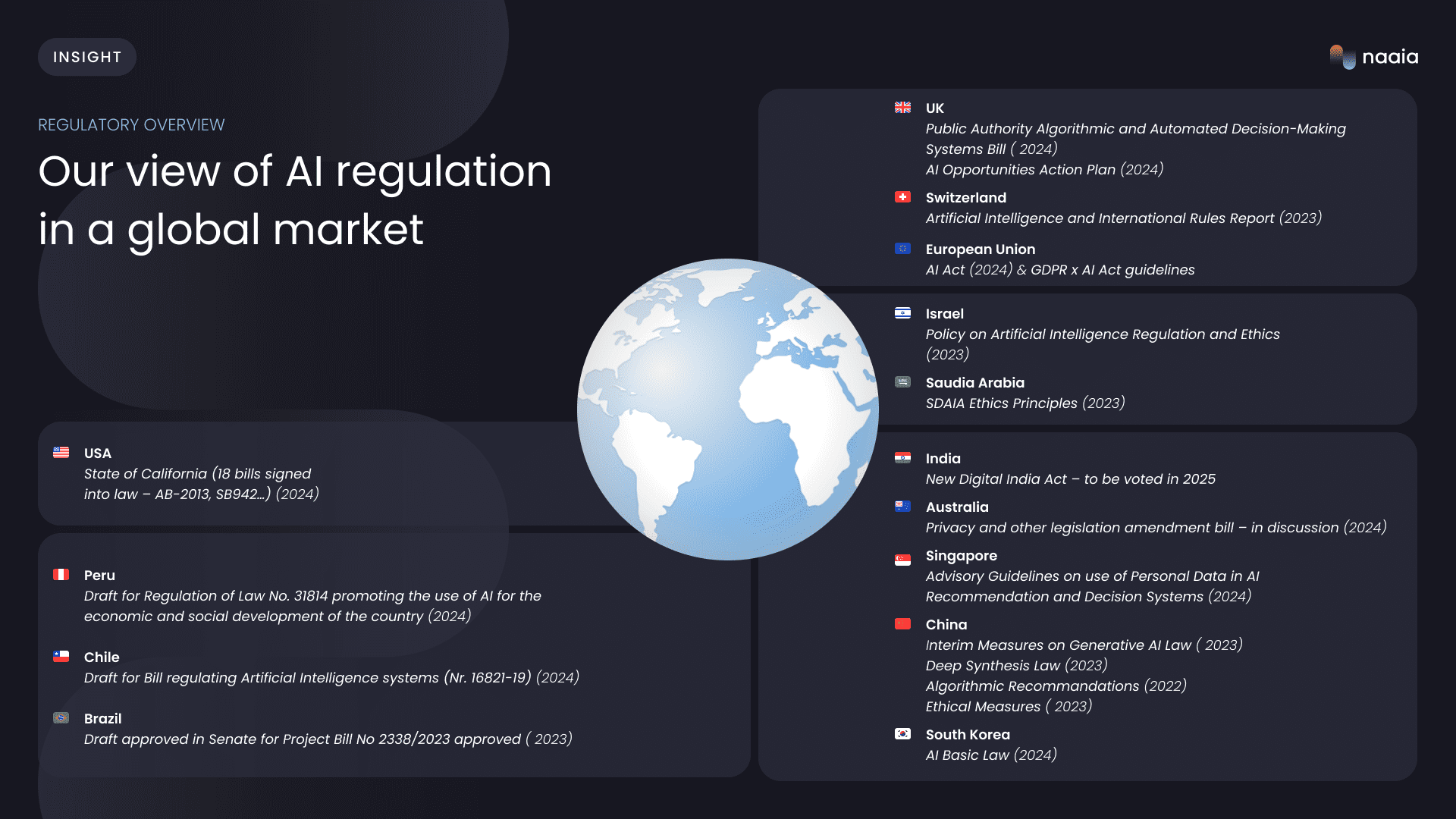
CREDIT: The 2025 Worldwide State of AI Regulation by Naaia
The result is a complex and still evolving mix of regulations. Multinational organizations must navigate this complexity with a unified compliance strategy rooted in AI ethics and governance, balancing local requirements with global consistency. Legal, compliance, and technology leaders must now work in tandem to ensure that AI innovation is both scalable and legally defensible.
Even with varying cultural and legal approaches, several common themes are emerging globally. These six trends show how the governments are trying to balance innovation with accountability:
- Shared Core Principles: Most governments are following a similar set of values, often based on OECD and G20 guidelines — things like protecting human rights, being transparent, supporting sustainability, and making sure AI is used ethically.
- Risk-Based Approach: Regulations are proportionate to the level of risk — low-risk applications face minimal requirements, while high-risk uses trigger strict oversight.
- Sector-Agnostic + Sector-Specific Rules: Regulators are developing both general AI frameworks and targeted rules for specific industries to address unique use cases.
- Policy Alignment: AI regulations are being shaped alongside broader digital priorities like data privacy, cybersecurity, and intellectual property protection.
- Private-Sector Collaboration: Regulatory sandboxes are being used to involve industry in shaping practical, safe, and innovation-friendly AI rules.
- International Cooperation: More countries are working together to manage the shared risks of powerful generative and general-purpose AI systems.
Global trends in AI regulations
- Central Beliefs: The AI regulation and guidance being considered aligns with the core principles for AI established by the OECD and supported by the G20. These principles encompass respect for human rights, a focus on sustainability, transparency, and robust risk management.
- Risk Strategy: The mentioned jurisdictions are implementing a risk-based approach to AI regulation, customizing obligations based on perceived risks to core values, with compliance requirements proportionate to the level of risk.
- Industry-Specific: Some jurisdictions are addressing AI’s diverse use cases by implementing both sector-agnostic and sector-specific rules, recognizing the need for tailored regulations in certain industries alongside general guidelines.
- Policy Alignment: Jurisdictions are developing AI regulations in alignment with other digital policy priorities, such as cybersecurity, data privacy, and intellectual property protection, with the EU adopting the most extensive approach in integrating these aspects.
- Private Sector: Many jurisdictions are utilizing regulatory sandboxes to facilitate collaboration between the private sector and policymakers, aiming to develop rules that encourage safe and ethical AI while considering potential risks associated with higher-risk AI innovations that may require closer supervision.
- Internationalization: Countries are engaging in international collaboration to address shared concerns about the potential risks to safety and security posed by powerful new generative and general-purpose AI systems, working together to understand and mitigate these uncertainties.
AI ethics & governance: From concept to core operating principle
The ethical risks associated with AI are no longer hypothetical. Cases involving algorithmic bias, exclusionary decision-making, and data misuse have underscored the consequences of deploying AI systems without robust ethical safeguards. These risks are particularly acute in sectors such as healthcare, financial services, employment, and law enforcement.
As a result, regulatory bodies are embedding AI ethics and governance into legal frameworks. But compliance alone is not sufficient. Leading organizations are moving beyond high-level ethical statements to institutionalize ethical AI practices throughout the innovation lifecycle.
This includes:
- Creating cross-functional ethics committees to review sensitive AI use cases.
- Adopting bias detection and mitigation protocols during model development.
- Embedding fairness assessments in procurement and vendor evaluations.
- Ensuring that teams developing AI systems reflect diverse perspectives and operate with clear accountability.
Treating AI ethics and governance as a compliance requirement rather than a branding tool signals to stakeholders that the organization is committed to building trustworthy, human-centric systems. Ethical alignment is not a limitation — it is a foundation for sustainable AI adoption.
AI Centers of Excellence: Key functions & benefits
An AI Center of Excellence (AI CoE) is a dedicated team or structure that centralizes AI expertise, guiding organizations in identifying use cases, developing infrastructure, and managing implementation roadmaps. It ensures AI projects align with strategic goals and deliver measurable business value.
Benefits include standardized best practices, streamlined execution, stronger cross-functional collaboration, and better governance. An AI CoE also helps scale AI efficiently, manage external partnerships, and develop in-house talent, building a foundation for long-term AI success.
At Plug and Play, we’re launching AI Centers of Excellence together with corporations, governments, universities, and foundations to accelerate AI adoption, innovation, and talent development.
These centers offer structured programs — from accelerators to AI literacy and strategic partnerships — helping corporations, startups, governments, and academic institutions embed AI into their core. By bridging local ecosystems with a global network, our AI CoEs position regions as leaders in technology and economic growth.
Discover all of our AI CoE initiatives here.
AI explainability: The end of the black box
As AI systems grow more complex, stakeholders are demanding greater transparency and interpretability. AI explainability — the ability to understand and communicate how an AI system produces its results — is now a regulatory, operational, and reputational imperative.
Under frameworks like the EU AI Act and emerging U.S. guidance, explainability is mandated for high-risk systems. This includes AI used in hiring, lending, medical diagnostics, and law enforcement. Enterprises must be prepared to provide understandable, audit-ready explanations for decisions made by algorithms, especially when those decisions impact people’s lives or rights.
Best practices in explainable AI include:
- Utilizing interpretable models where possible (e.g., decision trees, rule-based systems, linear regressions).
- Applying model-agnostic explanation tools (e.g., SHAP, LIME) for black-box models.
- Developing model cards and documentation pipelines that capture key assumptions, performance metrics, and ethical considerations.
AI explainability is not just a technical challenge. It is a business enabler. Transparent systems create trust for employees, customers, regulators, and investors, enabling broad adoption and reducing friction for accessing information across the enterprise.
AI applications: Assessing risk, maximizing value
The regulatory landscape for AI is inconsistent. Some use cases are also more heavily scrutinized than others due to their impact on people and society. This means organizations must categorize AI use cases based on their associated risk and criticality to the business.
A comprehensive AI governance model should categorize use cases as follows:
- Prohibited or restricted use cases: Examples include real-time facial recognition in public places, social scoring systems, and ways to manipulate otherwise negatively influenced vulnerable people.
- High-risk applications: This includes AI used in employment decisions, credit scoring, healthcare diagnostics, and educational assessments. These systems require impact assessments, traceability, transparency, and human oversight.
- Limited or minimal risk applications: These include chatbots (with disclosure), personalization engines, internal document classification, and predictive maintenance tools.
Organizations must implement a systematic risk assessment methodology to identify where stricter controls are needed and where innovation can proceed with lighter-touch governance. High-risk systems, in particular, should undergo rigorous review, documentation, and continuous monitoring.
Important principles in AI regulation, ethics & governance
To ensure AI systems are both effective and responsible, organizations must adopt strong governance principles that build trust and accountability. This starts with explainability — users should be able to understand how and why an AI system makes decisions. Equally important is accountability, with clear processes in place to address errors or unintended consequences. AI must also be designed with safety and security in mind, protecting users and safeguarding data from unauthorized access. Transparency is key to building stakeholder confidence, while fairness and inclusiveness ensure AI outputs are unbiased and equitable for all. Reliable systems depend on reproducibility and robustness, allowing AI to function consistently even under pressure. Finally, strong data governance ensures privacy and responsible data use throughout the AI lifecycle. Together, these principles help organizations use AI in ways that are not only compliant but also aligned with broader social values.
Enterprise AI governance: From project to policy
Enterprise-wide AI ethics and governance is what turns scattered AI projects into a consistent, strategic approach that scales. Without it, efforts can feel disconnected, with different teams using AI in different ways, making it harder to stay compliant, effective, and aligned with company goals. That’s why more organizations are putting strong governance frameworks in place to bring structure, clarity, and accountability across the board.
This often starts with executive oversight, assigning ownership to leaders like a Chief AI Officer or embedding it into roles like the CIO or CTO. It also means setting clear AI policies and standards that guide everything from data sourcing and model development to fairness, documentation, and AI explainability. For external tools and partners, third-party management ensures that anything brought in meets the same ethical and regulatory standards.
Through proper lifecycle management, companies can track their AI models from development to deployment and even retirement, keeping tabs on performance, updates, and outcomes. And just as important, education and enablement make sure teams across legal, technical, and business units have the tools and knowledge they need to use AI responsibly. In short, AI governance isn’t just about control; it’s the foundation that helps innovation grow in the right direction.
How Plug and Play helps enterprises use compliance as a strategic capability
As the leading innovation platform, connecting startups, corporations, venture capital firms, universities, and government agencies, Plug and Play is accelerating digital transformation through the adoption of AI and emerging technologies.
Our mission is to drive innovation by connecting entrepreneurs, corporate partners, public sector academia, and learners to drive AI innovation, literacy, and economic growth. Our AI Centers of Excellence worldwide help transform regions into recognized AI leaders by establishing strategic hubs that connect local innovation with global opportunities.
AI regulation is not a temporary constraint. It marks the arrival of a new operating environment in which trust, accountability, and transparency are essential to competitive advantage.
Organizations that embed compliance, ethics, and explainability in AI strategies will mitigate legal and reputational risk and differentiate themselves as leaders in responsible innovation. They will be better positioned to scale AI initiatives, attract high-value partnerships, and maintain long-term stakeholder trust.
The AI regulation era is here. Those who treat compliance as a strategic capability — not a defensive posture — will lead the next generation of intelligent enterprises.