How Fortune 500s Lead in Generative AI & AI Governance
We explored how Fortune 500 companies are scaling enterprise generative AI across core business functions — and how strong AI governance is helping them move from experimentation to enterprise-wide impact.
With AI governance now a top priority for enterprises, in 2023, we were asking what generative AI could do. In 2025, we’re asking how fast it can scale and how to govern it.
Enterprise generative AI has crossed the threshold from experimentation to execution. Once confined to innovation labs and content generation pilots, it is now embedded in the core systems of Fortune 5000 enterprises, particularly in functions like R&D, software engineering, and customer service, where content generation and synthesis add tangible value. Meanwhile, broader enterprise AI adoption continues to transform data analytics, forecasting, and decision-making.
Yet, for most organizations, AI deployments remain fragmented, especially with generative models, lacking orchestration, governance, or alignment with strategic goals. Today’s key challenge is not access to technology, but the ability to scale responsibly and competitively under strong AI governance.
In this executive insight, we explore:
Where AI and generative AI are delivering measurable enterprise value
How to evaluate and select AI platforms suited for strategic scaling
What leading firms are doing differently to capture outsized returns
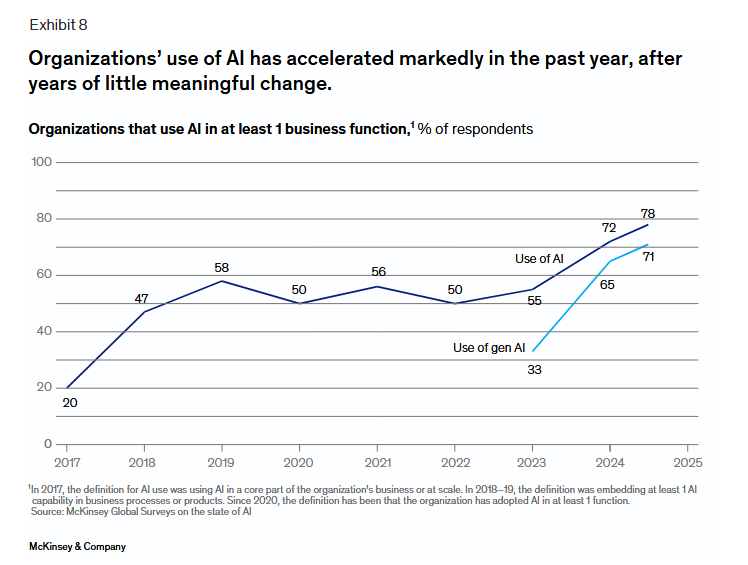
71% of organizations have adopted generative AI in at least one business function. But the early adopter window is closing. Generative AI is no longer a differentiator; it’s becoming infrastructure, much like cloud or ERP platforms were a decade ago. Companies that treat it as a standalone tool risk falling behind. Those that embed enterprise generative AI directly into their operating model will lead.
Framework: The 5 domains where generative AI creates value
These enterprise use cases are categorized into a framework called VITAL: five domains where generative AI is driving transformation at scale:
Domain
Description
Examples of Business Impact
Value Creation
Accelerating product design, IP, and services
40% faster R&D cycles in pharma and automotive
Information Intelligence
Unlocking insights from unstructured data
3x increase in enterprise search relevance
Team Enablement
Augmenting human work across functions
Up to 50% productivity boost in software teams
Automated Interactions
Enhancing customer and employee experiences
70% deflection in support volume via AI agents
Level-Up Decisioning
Supporting leaders with real-time analysis
Generating strategic memos from live data sources
Let’s explore each domain with real-world examples from the Silicon Valley June 2025 Summit:
1. Value creation in R&D & product innovation
Generative AI is collapsing the traditional product lifecycle curve — accelerating ideation, simulation, and iteration at scale.
Where product innovation once followed a linear progression, concept, prototype, test, and refine, generative AI enables a nonlinear, highly parallelized model. Engineers and designers now leverage AI to explore thousands of permutations in minutes, validate structural integrity through AI simulations, and optimize for material cost, sustainability, and manufacturability before building a single prototype.
Strategic implications
Shorter time-to-market: Faster cycles mean earlier launches and increased competitiveness.
Sustainability by design: AI-optimized designs consume fewer materials, reduce waste, and lower carbon footprints, advancing ESG goals.
Platform synergy: Integrating 3D modeling and digital twin ecosystems (e.g., NVIDIA Omniverse, Dassault Systèmes) streamlines cross-functional R&D collaboration.
Example: BMW
BMW streamlines vehicle design and engineering processes using generative design and AI simulation tools from Dassault Systèmes and NVIDIA Omniverse. The company reports significant reductions in prototyping time and material usage, leading to more sustainable manufacturing.
2. Information intelligence & knowledge management
Most enterprises have oceans of unstructured data. Enterprise AI powered by large language models (LLMs) helps turn that data into usable institutional knowledge.
Internal knowledge systems: research reports, technical documentation, emails, and meeting transcripts have long resisted traditional search and classification. These models bring contextual understanding — surfacing nuanced answers, summarizing across sources, and enabling human-like dialogue with institutional memory. This isn’t just search; it’s strategic intelligence on demand.
Strategic implications
Faster decisions, fewer bottlenecks: Teams spend less time searching and more time acting.
Institutional memory: LLMs preserve knowledge across employee turnover.
Data monetization: Internal data becomes a competitive differentiator, not just a liability.
Example: Morgan Stanley
Morgan Stanley partnered with OpenAI to develop an internal GPT-powered assistant that enables financial advisors to query 100,000+ research documents instantly. The system has significantly reduced the time spent searching and interpreting data, thereby improving client response times.
3. Team enablement & internal automation
Generative AI is emerging as a real-time copilot for white-collar work, especially in content-heavy roles like coding, writing, and documentation. In other functions like finance or legal, AI more broadly supports automation, accuracy checks, and drafting support.
Instead of replacing knowledge workers, generative AI is redefining their workflows. In software engineering, finance, marketing, and legal operations, GenAI helps draft first versions, detect errors, and automate documentation. It bridges skill gaps, elevates junior talent, and allows senior staff to focus on complex judgment.
Strategic implications
Productivity multiplication: Teams do more with less, enabling headcount stability amid demand surges.
Democratized expertise: Complex tasks (e.g., SQL queries, legal clause drafting) become accessible to non-experts.
Talent leverage: Junior talent becomes more autonomous; senior talent is freed to lead transformation.
Example: GitHub
GitHub Copilot writes code faster and completes tasks with significantly fewer errors. Copilot is now deployed across engineering teams at companies like Airbnb, Shopify, and Mercado Libre, where productivity gains translate directly to faster product cycles.
4. Automated interactions & experience redesign
GenAI powers a new generation of customer and employee interfaces, conversational, multimodal, and hyper-personalized.
Unlike traditional rule-based chatbots, today’s AI platforms remember past interactions, adapt tone and content in real time, and interface across email, chat, voice, and even video. In customer service, HR, and IT support, GenAI automates interactions without degrading the experience, and in many cases, improving it.
24/7 responsiveness: Always-on assistants deliver instant answers across time zones and platforms.
Experience innovation: Enterprises can now build brand-defining experiences around AI interfaces.
Example: Klarna
Klarna’s AI assistant has achieved impressive results, handling approximately 66% of customer service chats, around 2.3 million conversations in its first month, and equivalent to the workload of 700 full-time agents. It has also reduced repeat inquiries by 25% and cut resolution times from 11 minutes to just 2. Operating across 23 markets and supporting over 35 languages, the assistant is expected to contribute an estimated $40M profit improvement in 2024.
5. Level up decision-making for the C-Suite
Enterprise AI adoption, including generative tools, is emerging as a cognitive partner to executive leadership — synthesizing data, surfacing insights, and drafting materials. While GenAI enables rapid document generation and summarization, other AI systems support real-time analytics and scenario modeling.
From board decks to strategy memos to regulatory updates, executives are inundated with complex, cross-functional information. GenAI helps senior leaders process that data at machine speed, generating high-level summaries, scenario comparisons, and decision frameworks. It enables the C-suite to be faster, more data-informed, and more forward-looking.
Strategic implications
Accelerated governance: AI-generated briefs and memos compress board cycles.
Scenario foresight: Leaders can stress-test strategies with AI-assisted modeling.
Example: Goldman Sachs
Goldman’s GS AI Assistant enables investment teams to generate 95% of IPO prospectus drafts, competitive intelligence summaries, and market insights within minutes, down from days or weeks. As of early 2025, over 10,000 employees leveraged it for memo generation and rapid analysis, freeing senior teams to focus on strategy and execution.
The platform imperative: Choosing the right AI stack
As enterprise generative AI becomes a layer in the enterprise stack, the choice of AI platform is now a board-level decision. Scalability and trust depend on a robust foundation guided by strong AI governance. Key evaluation dimensions include:
Dimension
Why It Matters
Security & IP Control
Regulatory and brand risk are rising
Customization & Fine-Tuning
Domain specificity drives accuracy and ROI
Integration APIs
Seamless orchestration across systems
Governance Tooling
Required for audit, explainability, and compliance
Model Flexibility
A mix of open weights and closed APIs ensures adaptability
Caution: A misaligned platform choice can lock your team into technical debt, data silos, and regulatory exposure.
What winning enterprises are doing differently & questions to ask to get results
The most advanced organizations are executing what we call a SCALE model for responsible enterprise AI adoption and execution:
Strategic alignment: AI efforts ladder up to business goals
Cross-functional ownership: Not just IT, but also involved in product, legal, and HR
AI governance: Policies, training, and ethical reviews in place
Learning loops: Feedback mechanisms to fine-tune outputs
Enablement at the edge: Empowering employees with AI-powered tools
The SCALE Framework is based on synthesized practices from McKinsey, BCG, and Microsoft.
To translate this into action, C-level leaders should ask:
Platform fit: Do our current AI platforms align with our security and compliance needs?
Scaling strategy: Are we scaling GenAI in isolated use cases or orchestrating across the enterprise?
Talent readiness: Do our teams have the AI fluency and upskilling resources to innovate responsibly?
Governance maturity: Have we implemented responsible AI policies with traceability and controls?
New value creation: Are we leveraging GenAI where it makes the most strategic impact, and using traditional AI where it’s better suited?
Embedding generative AI & AI governance as core enterprise capabilities
Generative AI is no longer a future-looking experiment, but is a foundational enterprise capability. In 2025, the winners will be those who move beyond fragmented pilots and treat AI governance as a strategic lever for responsible scaling.
Success doesn’t require hundreds of use cases. It requires choosing the right platform, enabling your people, and committing to enterprise generative AI with purpose and accountability.
Generative AI won’t replace leaders — but leaders who understand and govern it will replace those who don’t.
Whether you’re piloting your first GenAI use case or scaling enterprise-wide adoption, Plug and Play can connect you with the right innovators, platforms, and partners to move faster, with AI governance built in. Contact us to start building responsibly.