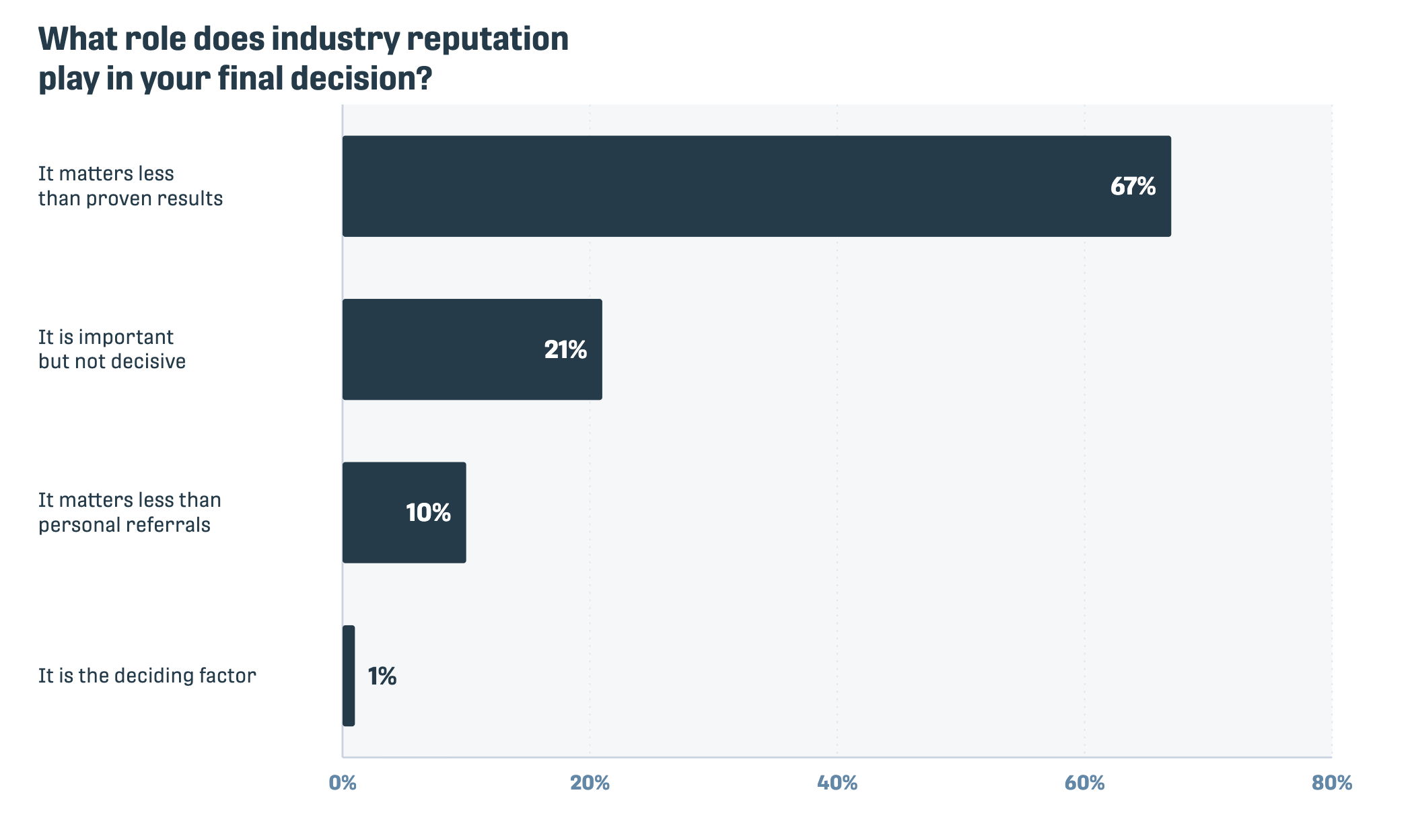
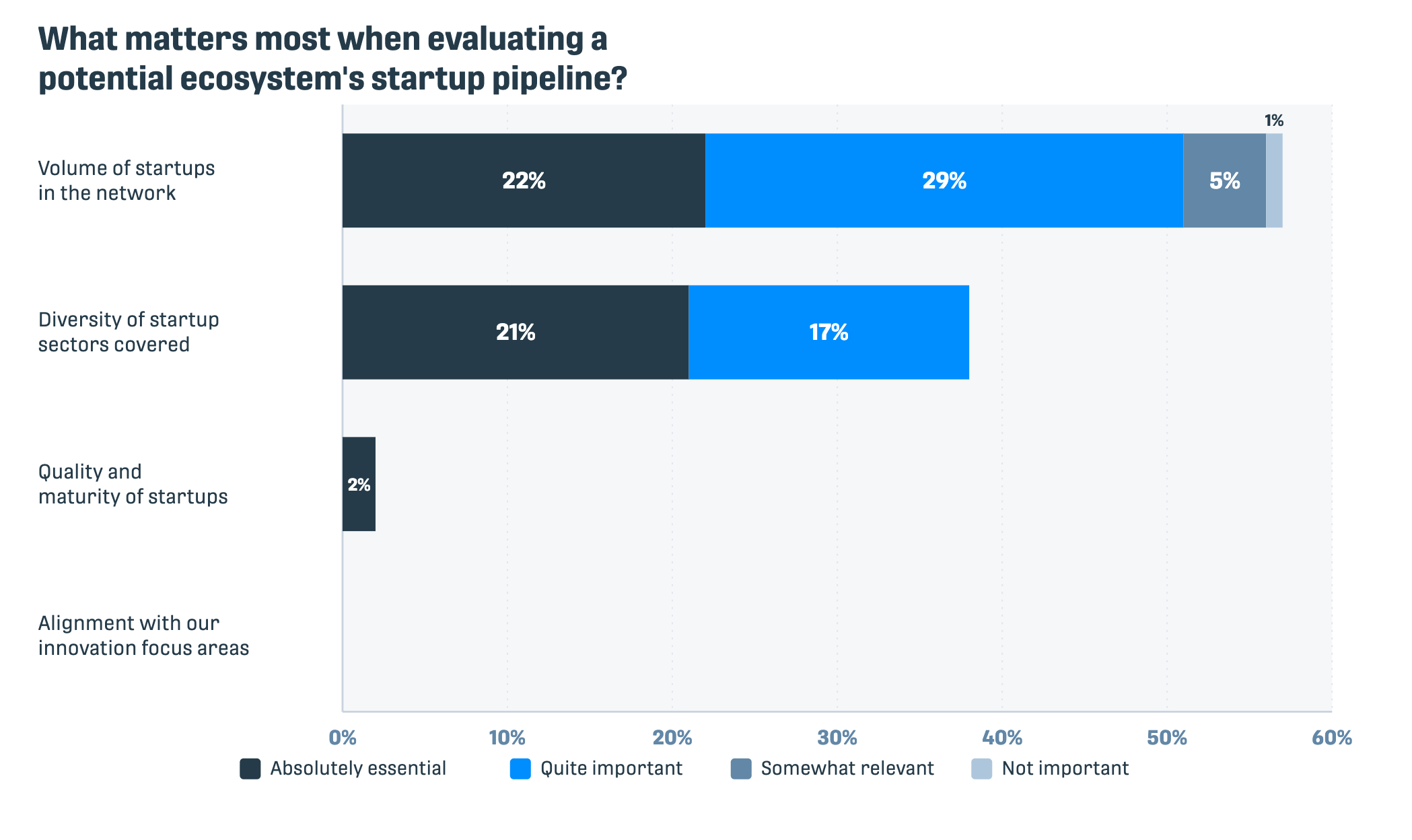
What support do corporate innovation leaders expect during the engagement process?
During the engagement process, 63% of corporate innovation leaders consider strategic guidance from innovation experts a critical form of support, and 21% find it very helpful, while 7% find direct access to startup founders a very helpful form of support, and 9% find this type of support somewhat useful during the engagement process.
Innovation needs more than an introduction:
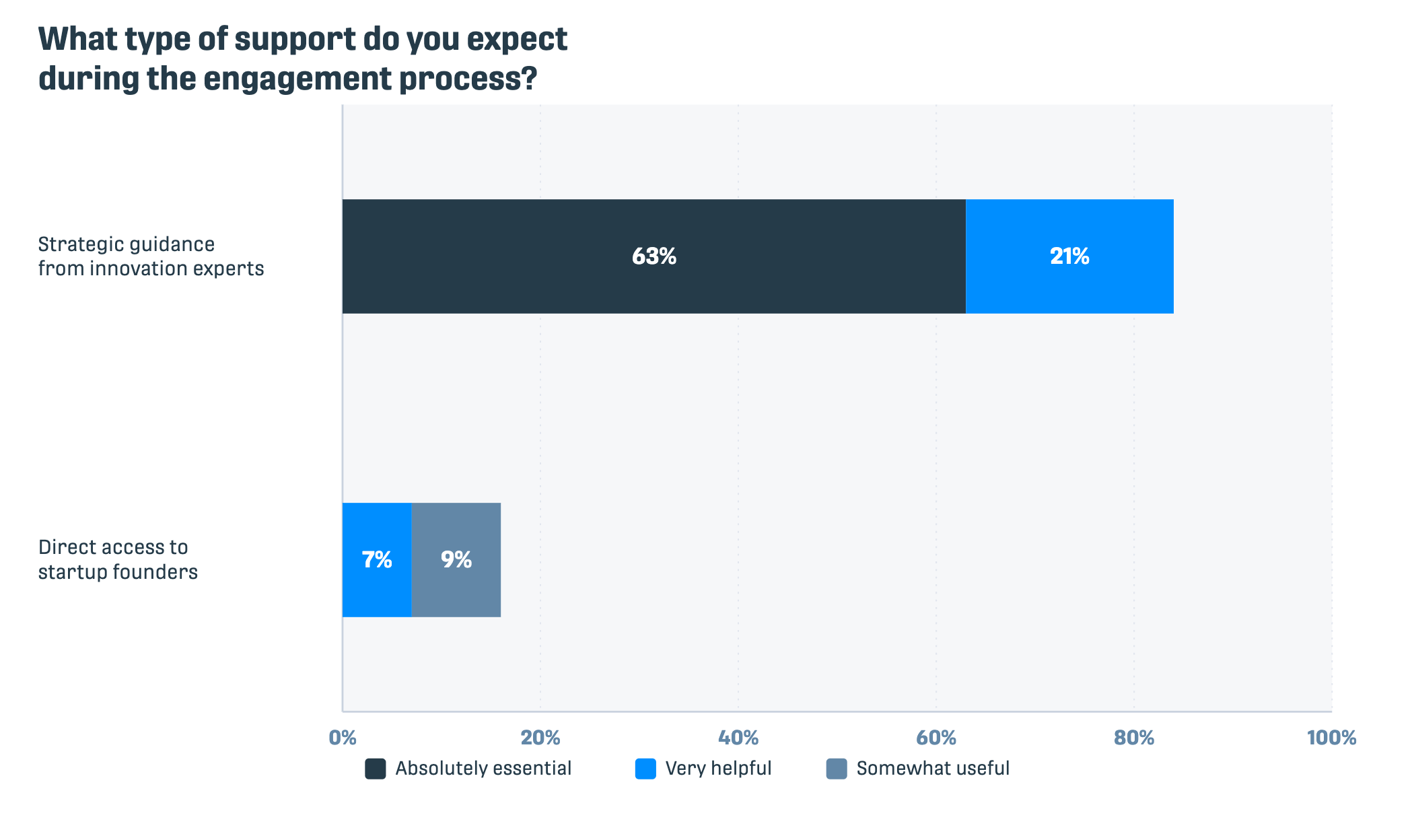
Strategic guidance from innovation experts is the support that corporate innovation leaders value most during the engagement process. 63% say this support is absolutely essential, and 21% say it’s very helpful.
Expert input helps leaders define the problem more clearly, assess which opportunities deserve attention, and connect external innovation with internal priorities, budgets, and decision-making processes. It also provides them with support when comparing unfamiliar technologies or evaluating whether an idea can move beyond an initial pilot.
Direct access to startup founders is very helpful for 7% and somewhat useful for 9%. Founder conversations can provide a clearer view of a startup's product, business model, technical roadmap, and long-term ambition. They also create space for leaders to ask detailed questions that may not be answered in a pitch deck or introductory meeting.
That said, access alone doesn’t guide the wider engagement. Corporate innovation leaders still need help interpreting what they hear, testing the opportunity against business needs, and deciding what should happen next.
What is the corporate innovation leaders’ biggest challenge when comparing different top open innovation ecosystems?
A lack of transparency on outcomes is a significant challenge for 47% of corporate innovation leaders when comparing different ecosystems, 38% battle with limited visibility into past results, and 14% find unclear pricing and engagement models the most significant challenge.
The details that providers leave out are most needed:
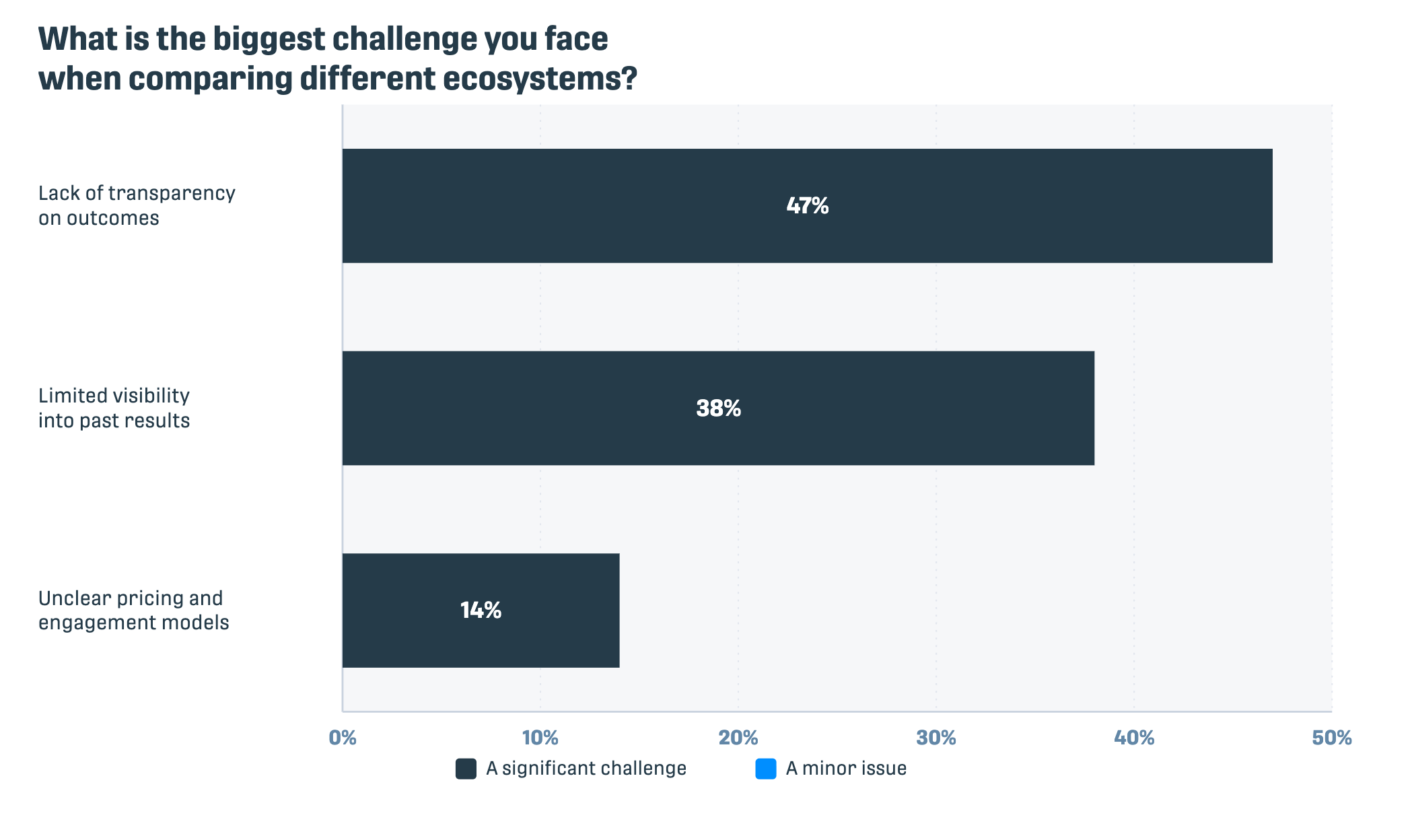
The biggest challenge corporate innovation leaders face when comparing different ecosystems is how clearly providers explain what they’ve delivered and how engagement will work. The World Economic Forum argues that collaborative ecosystems may now be central to successful competition in a fragmenting economy, which raises the stakes for making the right choice.
Lack of transparency on outcomes is a significant challenge for 47% of our audience and a minor issue for less than 1%. Broad success claims don’t give leaders enough detail to understand what changed, how progress was measured, or how much of the result came from the ecosystem engagement itself.
Limited visibility into past results is a significant challenge for another 38% of corporate innovation leaders. Even when providers discuss outcomes clearly, leaders still need access to enough previous work to compare experience across different organizations, priorities, and types of engagement.
Unclear pricing and engagement models create a significant challenge for 14%. Without a clear view of costs, responsibilities, timelines, and the support included, leaders can’t judge overall value or anticipate the internal resources required. Greater clarity helps establish whether an engagement is workable, not simply whether it’s affordable.
How do corporate innovation leaders describe their experience with their current top open innovation ecosystem platform?
92% of corporate innovation leaders describe their experience with their current ecosystem platform as giving mixed results, depending on the program, 7% are satisfied with their current ecosystem but are still open to alternatives, and 1% are actively seeking a replacement platform, while leaders are not discussing being underwhelmed by the outcomes delivered.
The relationship is only as strong as the last program:
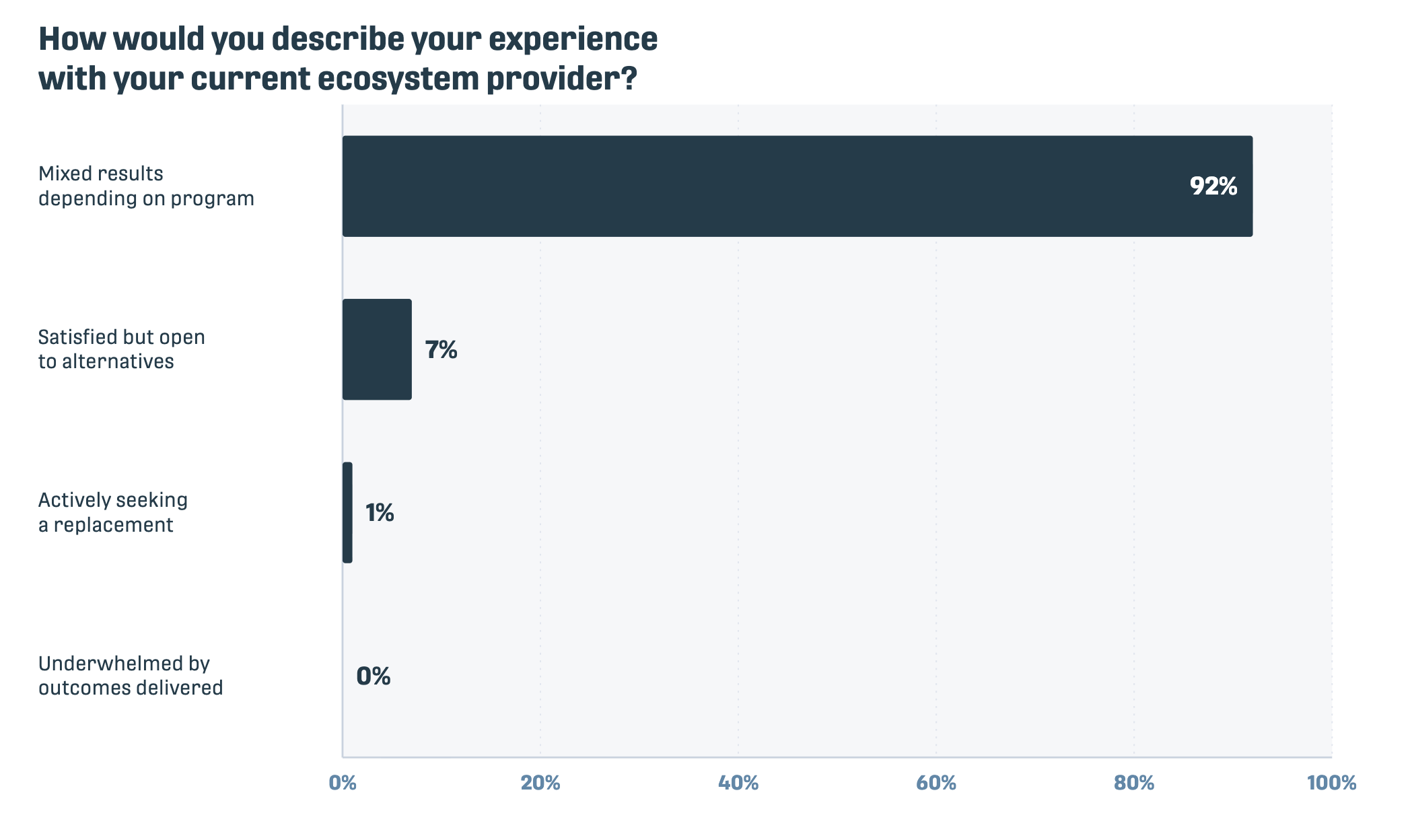
At 92%, the overwhelming experience corporate innovation leaders have with their current ecosystem platform is that they’re getting mixed results, depending on the program. Performance can vary with the relevance of the startups involved, internal readiness, execution, and the goals of each initiative. Leaders are therefore assessing individual programs rather than reaching a verdict on the entire provider relationship.
Another 7% of corporate innovation leaders are satisfied but open to alternatives. Their provider is likely delivering enough value to retain the business, although leaders still have reason to compare different networks, capabilities, or approaches that could strengthen future programs.
Replacing providers is not a priority
Only 1% of our audience is actively seeking a replacement. Changing providers means rebuilding relationships, transferring knowledge, securing internal support, and potentially disrupting programs already underway. Unless the wider relationship has broken down, improving weaker initiatives is likely to be more practical than starting again elsewhere.
Being underwhelmed by the outcomes delivered didn’t come up in the online conversations analyzed. This is likely because mixed results describe the experience more accurately than outright disappointment. A provider can deliver uneven performance across programs without leaders viewing the entire engagement as unsuccessful.
What would make corporate innovation leaders switch to open innovation ecosystem platforms?
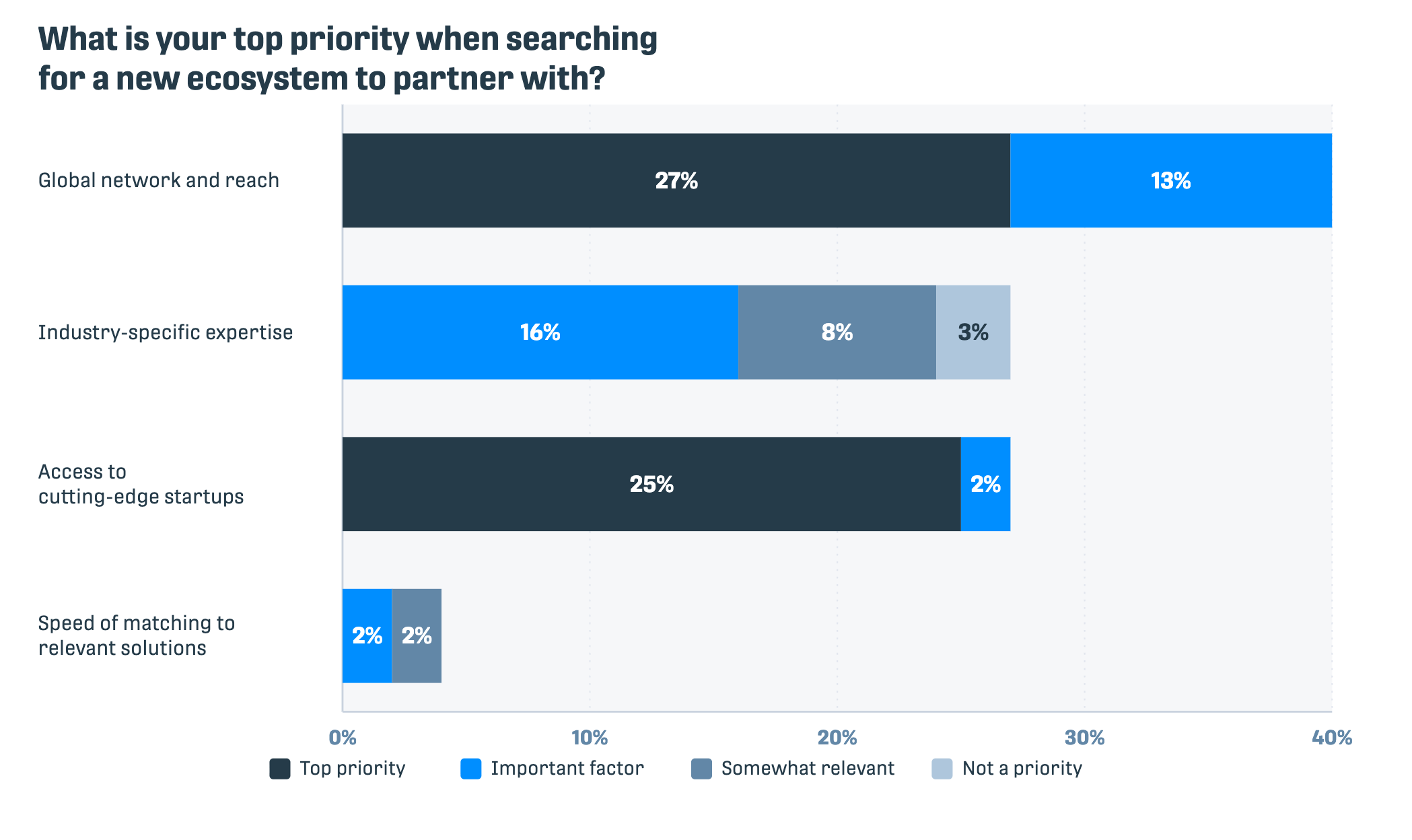
Stronger global network capabilities would strongly influence 27% of corporate innovation leaders to switch ecosystem platforms, but this isn’t a factor for 4%, a better alignment with strategic goals would strongly influence 17% and be a minor consideration for 20%, while better access to relevant startups would be a deciding factor for 5%, a strong influence for 4%, a minor consideration for 20%, but not a factor for 4%; lastly, 1% would be strongly influenced to switch ecosystem platforms if a more competitive pricing structure was offered.
The next provider has to offer more than a fresh start:
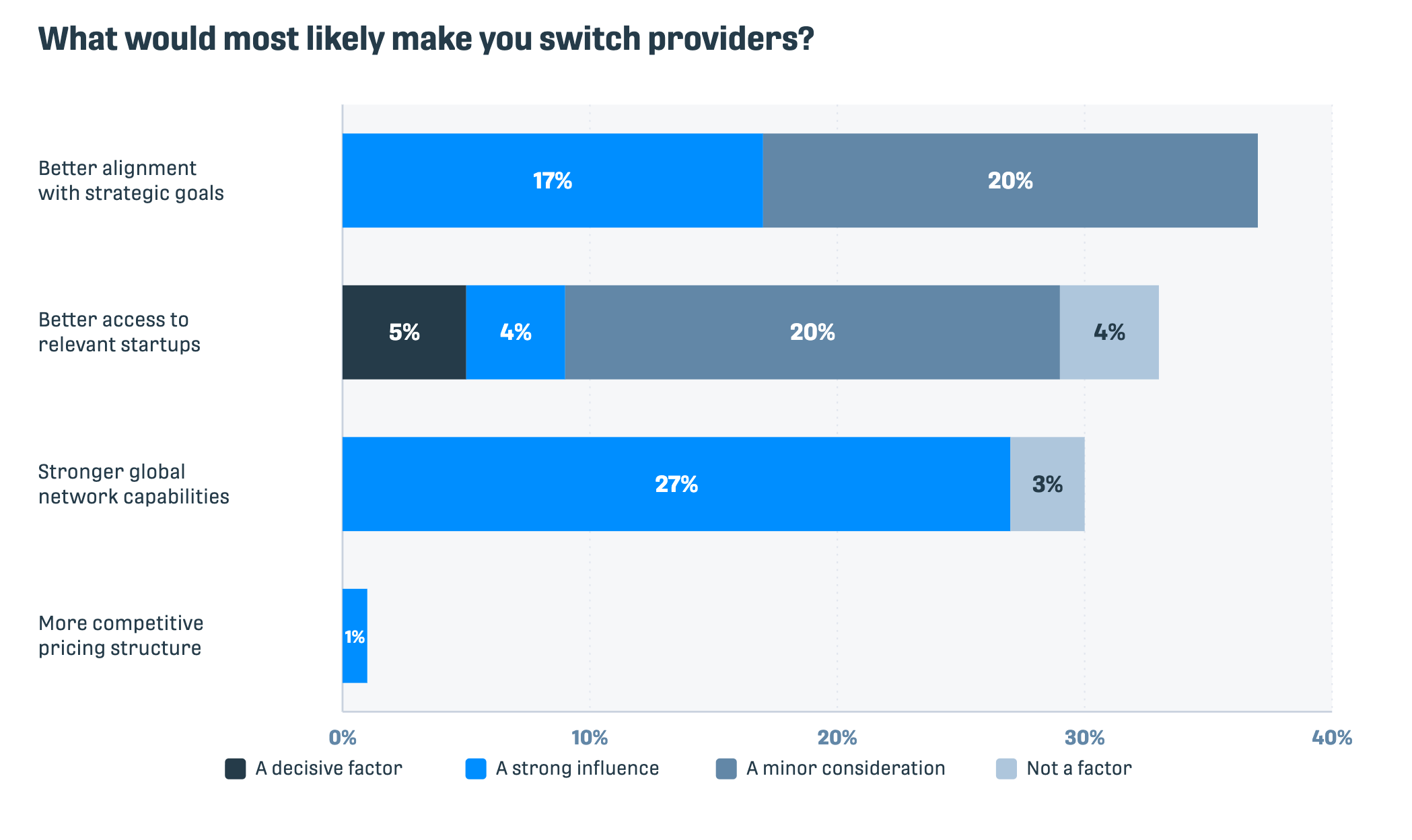
Stronger global network capabilities have the greatest influence on whether corporate innovation leaders switch providers. They’re a strong influence for 27%, although 3% don’t consider them a factor. A broader international reach can open access to startup communities, technologies, expertise, and markets that the current provider may not cover.
Better alignment with strategic goals is a strong influence for 17% and a minor consideration for 20%. Research into open innovation partner selection found that complementarity, compatibility, and trust are important when choosing the right partner. Alignment, therefore, extends beyond shared objectives. A prospective provider must add capabilities the organization lacks while fitting its priorities and way of working.
Pricing holds minimal power
Better access to relevant startups is a decisive factor for 5% of corporate innovation leaders, a strong influence for 4%, a minor consideration for 20%, and not a factor for 4%. Switching becomes more attractive when a provider can consistently surface opportunities that connect with current business needs, rather than simply offering a larger pipeline.
More competitive pricing has a strong influence on only 1%. Lower fees carry limited weight when moving providers also means rebuilding relationships, transferring knowledge, and changing established processes. Leaders need a stronger strategic or practical gain before accepting that disruption.
What industry do corporate innovation leaders work in?
54% of corporate innovation leaders work in manufacturing and industrial industries, 25% in financial services and banking, 17% in the technology and software sector, and 3% in healthcare and life sciences.
Major industries are carrying a heavy innovation load:
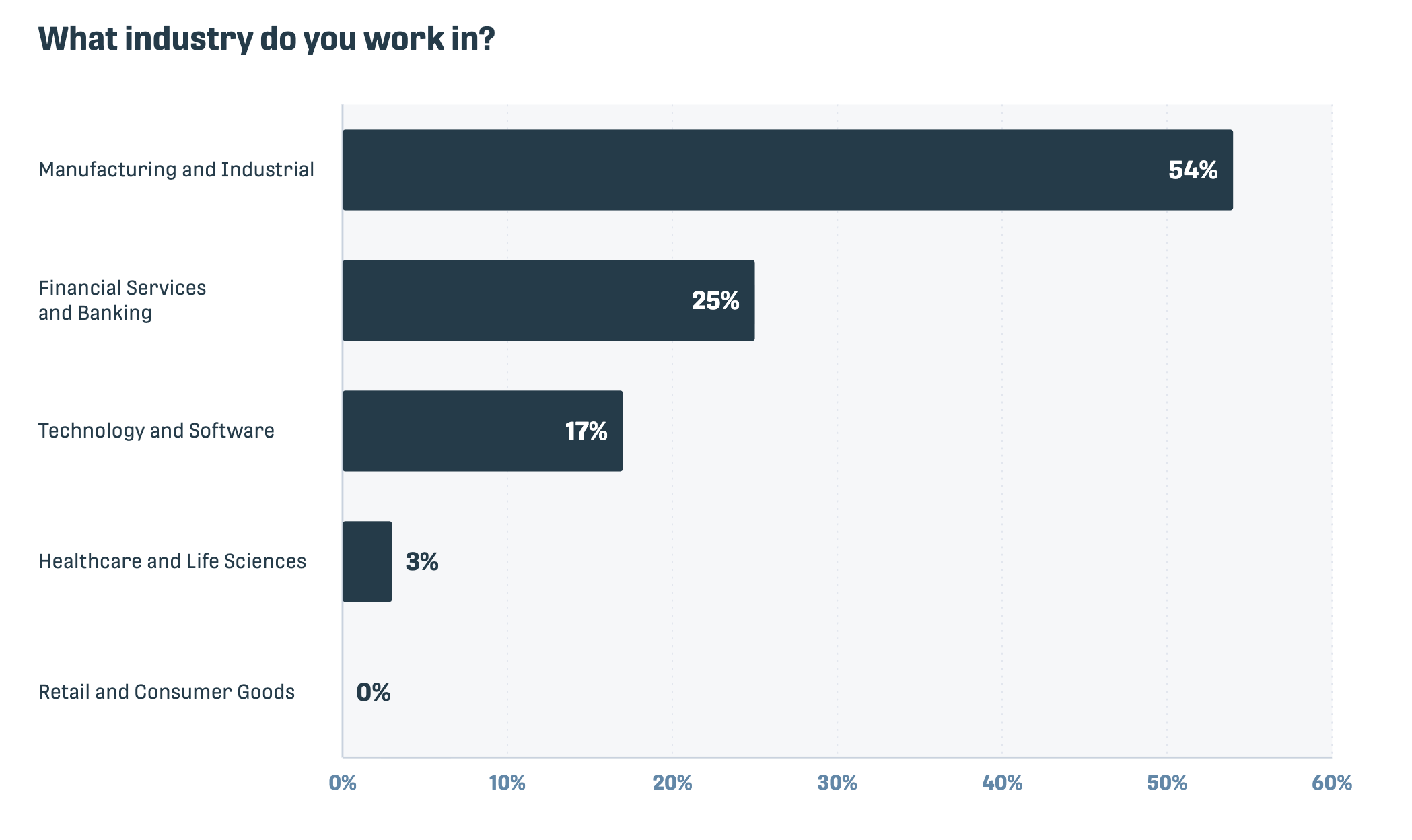
54% of corporate innovation leaders in our audience work in the manufacturing and industrial industry. In the US, this sector employs around 15 million people, which represents 9.3% of total employment. Another 25% of corporate innovation leaders work in financial services and banking, which employs more than 6.7 million people in the US.
A further 17% work in technology and software. Even with strong internal technical capabilities, these organizations can leverage external ecosystems to access emerging technologies, specialized knowledge, and commercial opportunities beyond their existing networks. In comparison, just 3% of our audience works in healthcare and life sciences, even though these industries thrive on innovation.
The retail and consumer goods industry didn’t come up in the online conversations analyzed. However, this absence doesn’t mean the sector isn’t pursuing open innovation; it only means it wasn’t represented in the discussions behind these findings.
What is the current job title of corporate innovation leaders?
Among corporate innovation leaders, 68% hold the title of Chief Innovation Officer, 31% are Directors of Open Innovation, and the remaining 1% serve as Head of Corporate Venturing.
Innovation leadership has reached the C-suite:
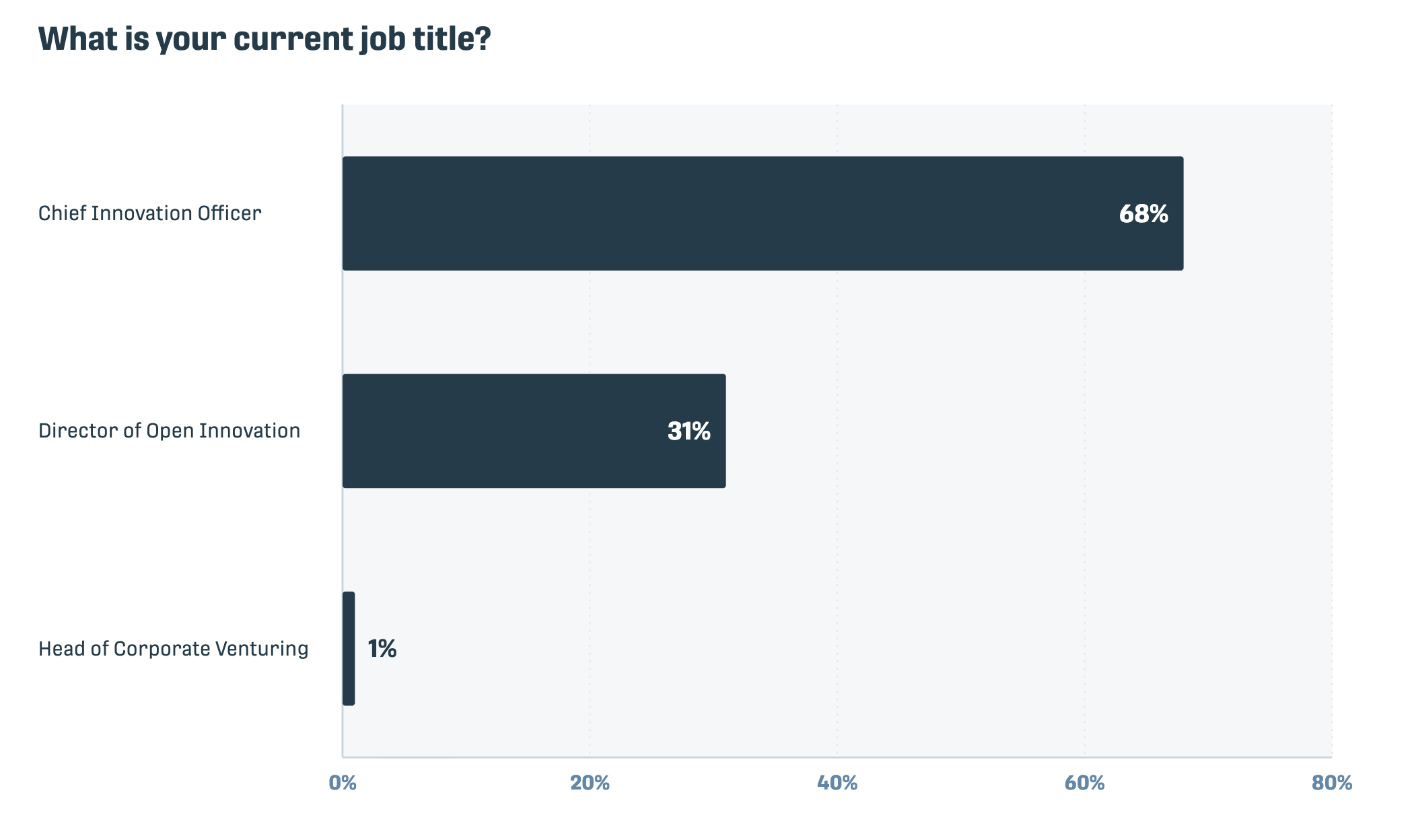
Chief Innovation Officer is the current job title for 68% of the corporate innovation leaders in our audience. The role places innovation at the executive level, giving leaders the authority to connect external opportunities with wider business priorities, investment decisions, and long-term growth plans.
Another 31% are Directors of Open Innovation. Their work is more directly focused on finding external ideas, developing partnerships, and helping selected opportunities move from initial interest into active programs. The title also points to open innovation becoming a defined leadership function rather than an additional responsibility attached to another department.
Only 1% are Heads of Corporate Venturing. The role is typically found in organizations with a dedicated venture arm, investment budget, and formal mandate to build or back startups, so fewer companies need the title.
In which city are corporate innovation leaders located?
61% of corporate innovation leaders are based in Boston, 15% in San Francisco, 13% in Austin, 9% are based in Los Angeles, and 2% in New York City.
Innovation leadership clusters where ideas, capital, and expertise collide:
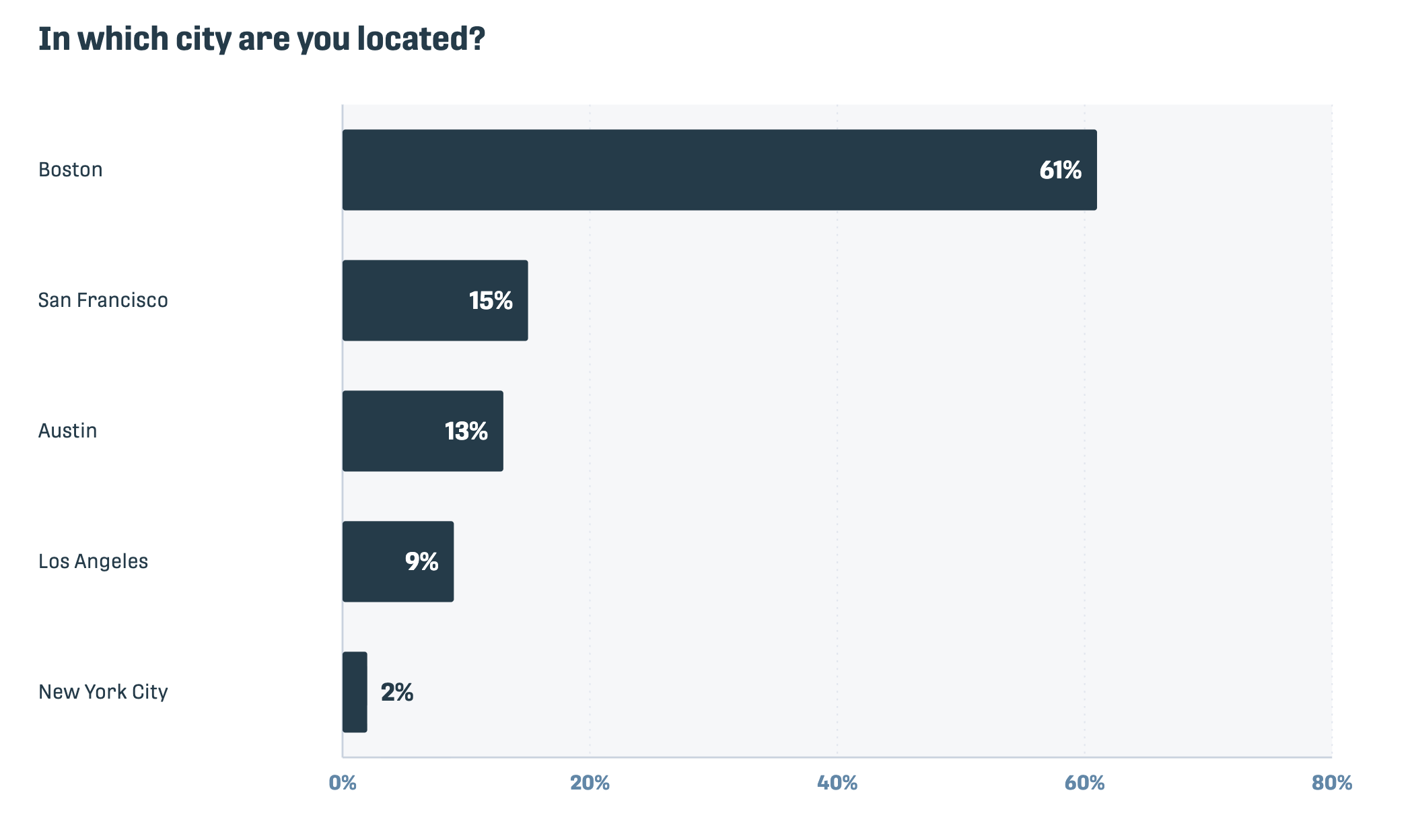
The five cities where corporate innovation leaders in our audience are located have all recently been named among the top 10 startup hubs in the United States.
Boston leads by a wide margin, with 61% of our audience based there. Its concentration of universities, research institutions, biotech companies, accelerators, and venture capital gives leaders direct access to scientific expertise and startup activity.
Another 15% are in San Francisco. Silicon Valley’s deep venture capital network, major technology companies, and close links between universities and industry make it a natural base for leaders tracking emerging technologies.
Austin is home to 13%. Its growing technology workforce, university talent, and major events such as SXSW create regular opportunities to connect with founders, investors, and new ideas.
A further 9% are based in Los Angeles. The city’s mix of technology, media, entertainment, gaming, and health tech gives innovation leaders access to a particularly varied startup community.
New York City is the location for 2%. Its strengths in finance, fintech, media, healthcare, and access to a large customer market still make it an important innovation center despite its smaller presence here.
The future of corporate innovation ecosystems
These opinions show that open innovation ecosystems are judged on far more than the size of their networks. Corporate innovation leaders are looking for partners who can provide access to new ideas, demonstrate their value, and provide the guidance needed to move opportunities forward.
The strongest relationships combine reach, relevance, trust, and practical support, giving companies a better chance of turning external innovation into sustained business growth.
Methodology & data
Sourced through our partner’s social listening platform using publicly available data from an independent sample of 220,188 opinions of corporate innovation leaders in the USA across X, Quora, Reddit, Bluesky, TikTok, and Threads. Responses are collected within a 95% confidence interval and 5% margin of error. Results are derived from what people describe online and from opinions expressed, not from actual questions answered by people in the sample.