articleJan 27, 2026
Supply Chain

The Gen AI Divide: Why Most Companies Fail to Capture Generative AI Value

Over the past two years, generative AI for business has become unavoidable. From factory floors to finance departments, the technology has captivated boardrooms, headlines, and investors alike. It’s been billed as the next trillion-dollar revolution, a force capable of reshaping how industries work, create, and collaborate.
 

That promise remains elusive in the supply chain. Generative AI in supply chain has yet to deliver at scale, revealing what many now see as the GenAI divide: a gap between early excitement and real enterprise impact. The most ambitious initiatives are trapped in pilot purgatory, impressive demonstrations that never scale.

Gen-AI Divide Highlights

The Paradox

The gen AI promise is stalled in "pilot purgatory"; 70%+ of supply chain leaders have not deployed it, confirming a 95% pilot failure rate.

The Barrier

Failure is structural, driven by the ROI trap (difficulty justifying spend in cost centers) and data fragmentation that fuels severe vendor fatigue.

Investment Shift

Capital has moved past simple "copilots" to Agentic AI — systems focused on autonomous, end-to-end workflow execution.

Enterprise Mandate

Success requires a pivot to partnership (not procurement), prioritizing pilots with clear P&L impact and front-loaded compliance (SOC 2).

Startup Survival

The new moat is verticalized AI. Startups must master one complex workflow with precision and treat compliance as a core feature.

The technology isn’t the obstacle. The first wave of generative AI for business focused on copilots and chatbots, tools that unlocked data and made information easier to access. Now, a more capable second wave, Agentic AI, has emerged. These systems go beyond questions and answers; they execute workflows, from managing invoices to coordinating shipments — the theorized promise for end-to-end AI automation.

With such powerful potential, one would expect widespread success; some industry reports confirm this. McKinsey’s State of AI 2024 found that 60% of supply chain leaders reported revenue increases from gen AI.

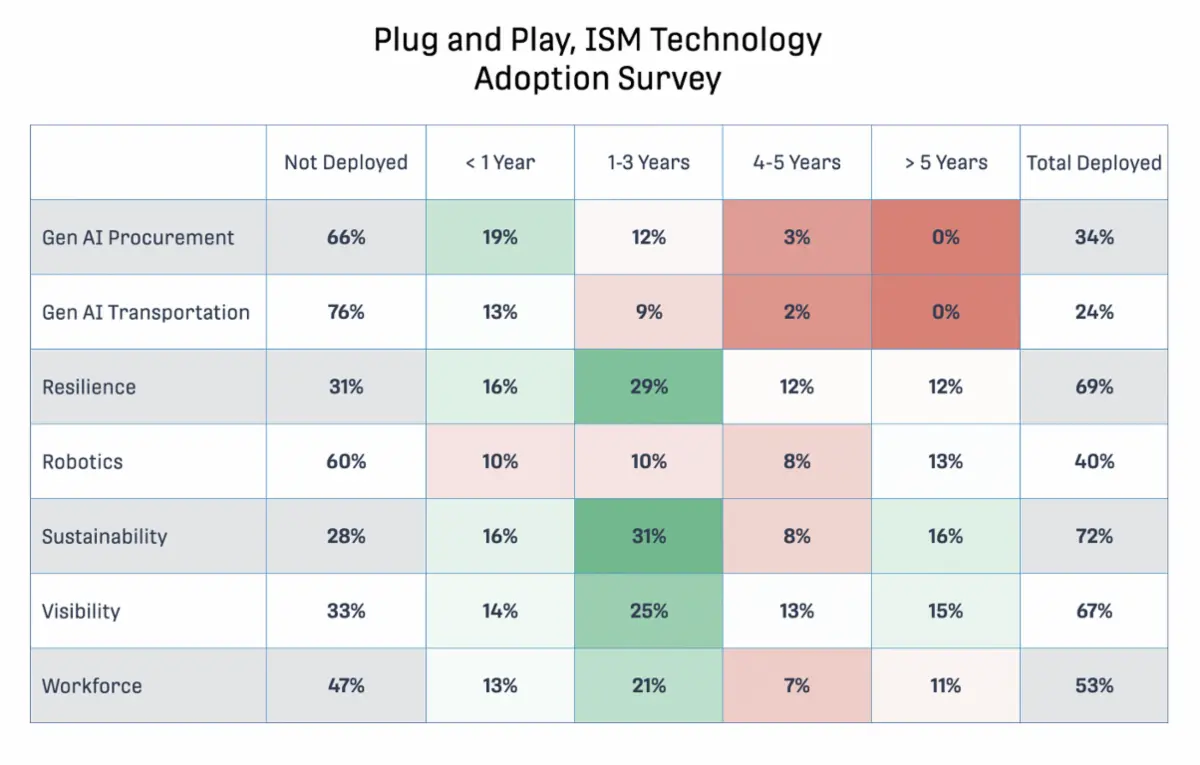
However, adoption still lags. Generative AI in supply chain operations remains limited in practice. Plug and Play’s 2025 survey with the Institute for Supply Management (ISM) reveals a profound lack of deployment: 66% of companies have not deployed gen AI in procurement, and 76% haven’t deployed it in transportation. The hype has outpaced the reality, reinforcing what many now describe as the gen AI divide.

Source: These figures are based on our Q2 2025 survey of over 300 senior supply chain leaders, conducted by Plug and Play in partnership with the Institute for Supply Management (ISM).

Diagnosing the gen AI divide: Why 95% of pilots fail

The gap between promise and performance in generative AI for business is structural. The disconnect is not just about slow adoption but systemic failure. Everyone’s talking about MIT’s State of AI in Business 2025, where only 5% of generative AI projects reach full deployment.

This failure rate is especially pronounced in the supply chain, where a unique mix of structural and operational challenges makes generative AI in supply chain particularly difficult to implement at scale. When supply chain leaders explain why, three recurring themes emerge.

  • The ROI trap: Supply chain operations are seen as cost centers. Budgets face scrutiny, returns must be immediate, and projects compete with customer-facing priorities. When capital tightens, AI initiatives are often the first to stall, especially if previous funding was spent on visible but low-impact copilots that deliver minor productivity bumps but fail to touch P&L outcomes.

     
  • The data dilemma: Logistics data is fragmented, unstructured, and siloed across ERP systems, warehouse software, and legacy trackers. Much of it still lives in PDFs, emails, and spreadsheets. When advanced models meet that reality, it becomes difficult for generative AI for business to prove value quickly in real-world environments.
  • Vendor fatigue: Procurement teams face a flood of indistinguishable pitches. Dozens of startups promise identical outcomes, including automated sourcing, optimized routing, and predictive analytics. Often, they are built on the same foundation models. Too many pilots, little differentiation, and constant overpromising have eroded trust, reinforcing the gen AI divide and making decision-makers increasingly cautious.

Why partnerships drive generative AI for business success

Breaking this cycle requires a shift in mindset, from procurement to partnership. Enterprises that succeed with generative AI for business treat startups as co-developers, not vendors.

This partnership model changes outcomes. Instead of chasing generic innovation, companies define measurable goals such as reducing invoice cycle time, lowering detention fees, and improving fill rates, then co-design targeted pilots to achieve them. This is especially critical for generative AI in supply chain, where success depends on aligning models with real operational workflows. Startups gain access to cleaner data and real feedback, giving their models time to adapt and evolve around specific enterprise environments.

A strong example is the collaboration between Mitsubishi Electric and Facilis, winner of the 2024 Mitsubishi Electric Innovation Challenge. Together, they co-developed an AI-powered visual inspection system that achieved over 99% defect detection accuracy and delivered an estimated $5 to $10 million in annual savings. What began as a pilot at Mitsubishi’s Nagoya Works has evolved into a multi-unit design partnership, demonstrating how shared ownership of outcomes turns a proof of concept into lasting transformation.

Scaling generative AI for business depends on trust more than technology. And trust is understandably slow to develop when most enterprises are still crystallizing their AI governance and policies.

“The industry is slowly seeing this exact shift in mentality. At 1PL, we’ve been using this partnership-first approach with automakers, allowing us to triage and target specific P&L objectives from the start rather than promising intractable productivity uplifts.”

— Mohit Raj, CEO, 1PL

Bridging the gen AI divide: What enterprises can do differently

The enterprises that move beyond pilots in generative AI for business share a disciplined approach.

They front-load compliance, completing SOC 2 certification, data-handling reviews, and cybersecurity checks before deployment. Early diligence prevents months of re-approval cycles later.

They design pilots around impact, not exploration. The aim is to prove one quantifiable metric: hours saved, dollars captured, or errors reduced. Simple trial agreements with 30 to 60-day timelines that tie directly to measurable outcomes earn faster credibility. 

They plan for scale from day one. Winning pilots integrate cleanly into existing workflows without requiring massive infrastructure overhauls, a critical factor for scaling generative AI in supply chain environments.

They favor depth over breadth. Horizontal AI tools rarely succeed in supply chain management; verticalized solutions that demonstrate a deep understanding of your sector and integrate with existing Standard Operating Procedures (SOPs) deliver lasting value.

They champion their data. The adage “garbage in, garbage out” has never been more relevant. Providing startups with high-quality data from the start is essential for successful generative AI for business deployment.

These operational habits may seem incremental, but they are the difference between experimentation and transformation.

What startups must learn to survive in generative AI for business

For startups, the challenge is proving reliability before capability. Enterprise buyers want confidence as much as innovation in generative AI for business.

That begins with compliance as a core feature, investing early in certifications and transparent data practices. It continues with low-friction pilots that integrate easily and deliver measurable outcomes within 60 days.

Mastering enterprise workflows is critical. A deep understanding of Standard Operating Procedures (SOPs) ensures alignment with existing processes; without it, deployments stall and ROI targets slip, especially in generative AI in supply chain use cases.

Flexibility in data ingestion is equally important. Many supply chain companies lack direct API access (ex., Carrier software), so startups must handle diverse data sources and formats to obtain necessary data and demonstrate real value.

ROI must be visible, not theoretical. Each product feature should link to a specific number: time, cost, or waste reduced. Without that connection, GenAI tools risk becoming interesting demonstrations that never reach adoption.

And focus matters. Startups that earn enterprise trust are those that solve one complex workflow with precision. As one investor put it, “Horizontal AI is a feature; vertical AI is a company.”

Supply Chain, Logistics & Advanced Manufacturing Annual Report | 2025

Supply Chain Annual Report | 2025
Download Now

The agentic future of generative AI for business

Despite today’s bottlenecks, progress is accelerating. Agentic AI, systems capable of executing multi-step workflows autonomously, is redefining what’s possible in generative AI for business.

These models move from static insights to data augmentation and manipulation. They can analyze data, draft purchase orders, route shipments, and close the feedback loop with minimal human input. For generative AI in supply chain, this signals a genuine step toward end-to-end automation.

Startups focused on workflow orchestration are already attracting serious capital. Investors are shifting attention from model complexity to operational outcomes.

Conclusion: Closing the gen AI divide

The gen AI divide isn’t necessarily a failure, but a miscommunication of expectations and capabilities.

For enterprises, the task is to approach AI as an evolving partnership, not a procurement exercise. For startups, it’s to translate technical innovation into measurable impact.

Supply chains are too complex, costly, and human to stay manual much longer. Organizations that learn to deploy generative AI for business with discipline and trust will define the next era of industrial performance.

The trillion-dollar promise of AI still stands. What’s changing is who knows how to deliver it.

FAQs: Generative AI

What is the gen AI divide?

The gen AI divide refers to the growing gap between early experimentation and real enterprise impact. Many companies are running pilots, but very few are successfully scaling generative AI into production environments.

Why do most generative AI pilots fail?

Most pilots fail because they focus on exploration rather than measurable outcomes. Without clear ROI, clean data, and alignment with existing workflows, generative AI projects often remain stuck in “pilot purgatory.”

Why is generative AI for business struggling to scale in supply chains?

While interest in generative AI for business is high, most implementations stall due to structural challenges. Fragmented data, unclear ROI, and vendor fatigue make it difficult for companies to move beyond pilot programs into full deployment.

How can enterprises successfully implement generative AI in supply chain operations?

Successful companies treat generative AI as a partnership, not a procurement exercise. They define clear business metrics, ensure data readiness, and design pilots that can scale within existing systems from day one.

What should startups focus on to succeed in generative AI for business?

Startups need to prioritize reliability, compliance, and measurable ROI. The most successful companies focus on solving one specific workflow deeply, rather than offering broad, horizontal solutions that lack differentiation.

How can Plug and Play help companies scale generative AI for business?

Plug and Play connects enterprises with vetted startups, helping them move from pilots to scalable deployments. By facilitating partnerships, aligning solutions with real business outcomes, and supporting implementation, Plug and Play helps companies turn generative AI initiatives into measurable impact.

GET IN TOUCH

Ready to start your innovation journey?
PLUG AND PLAY AROUND THE WORLD

Discover our global locations

We have a community of experts all over the world. We work as a bridge between Silicon Valley and the rest of the world, making innovation open to anyone, anywhere.

Sign up for our global newsletter