articleOct 21, 2026

The State of Corporate-Startup Partnerships in 2026: What Startups Say Needs to Change

Corporate-startup partnerships are important to growth, but startups say the processes behind them are struggling to keep pace. New research from Plug and Play examines what 203 startup founders want from corporate partners, where partnerships break down, and what could make them work better.


What’s inside?
 

  • The state of corporate-startup partnerships
  • What startups actually want from corporate partners
  • The corporate-startup speed gap
  • The pilot-to-commercialization challenge
  • Budget as a signal of commercial intent
  • Executive sponsorship & the ownership problem
  • Strategic fit matters more than corporate prestige
  • Why partnerships fall apart
  • What corporations misunderstand about startups
  • Building a better partnership model
  • Closing perspective
  • Methodology & respondent distribution

For startups, working with large corporations can open doors to new customers, markets, and long-term growth. And despite the challenges that can come with these relationships, startups continue to see corporate partnerships as an important part of their growth strategy.

In a recent Plug and Play survey of 203 startups, 88% said corporate partnerships will be very important or critical to their growth over the next 12 months. That confidence extends beyond future expectations. More than 94% said they would probably or definitely encourage another startup to pursue corporate partnerships, while nearly 94% would work with their most recent corporate partner again.
But the value startups see in these partnerships does not mean the process is working as well as it could. More than 86% identified slow decision-making and procurement cycles as a major challenge, pointing to a disconnect between the speed and commercial urgency startups operate with and the processes large organizations use to engage them.
The findings show that startups are not pulling away from corporate partnerships. Instead, they are becoming clearer about what they need from them. Revenue, faster decisions, early conversations about budget, strong executive sponsorship, and long-term alignment all emerge as important pieces of a successful partnership.
“Corporate-startup partnerships have never been more critical to driving real innovation at scale. This survey makes clear that both sides are hungry for deeper, more intentional collaboration, and the data gives us a roadmap to get there. The takeaways here are too important to ignore.” — Sobhan Khani, President, Plug and Play
The opportunity now is to understand where friction remains and what both sides can do to build relationships that create lasting commercial value.


The state of corporate-startup partnerships
 

Corporate partnerships remain a significant part of the startup growth strategy. Nearly 88% of startups consider partnerships very important or critical to their growth over the next 12 months, underscoring the role large organizations can play in helping startups reach customers, enter new markets, and create new commercial opportunities.
That importance is already reflected in the level of engagement between startups and corporations. Nearly 73% have pursued a pilot or proof of concept, while about 70% have pursued a commercial or revenue partnership. Rather than relying on a single model of collaboration, startups are engaging with corporations across different stages, from initial validation to more established commercial relationships.
The outlook is also overwhelmingly positive. More than 94% would encourage another startup to pursue corporate partnerships, while nearly 94% would work with their most recent corporate partner again. Those numbers are particularly notable because corporate-startup relationships are not always easy to navigate. High levels of continued interest suggest that the challenges startups encounter have not diminished the underlying value they see in working with large organizations.
The state of corporate-startup partnerships is therefore not one of declining interest. Partnerships remain important, widely pursued, and, in many cases, worth pursuing again. What is changing is what startups expect from these relationships. As partnerships become more closely tied to growth, startups are also becoming clearer about the value they expect from corporate partners.

GET IN TOUCH

Ready to start your innovation journey?

What startups actually want from corporate partners

Startups are looking for tangible business outcomes from corporate partnerships. More than 78% say revenue or paying customers are among their biggest needs from partners, making commercialization a clear priority.
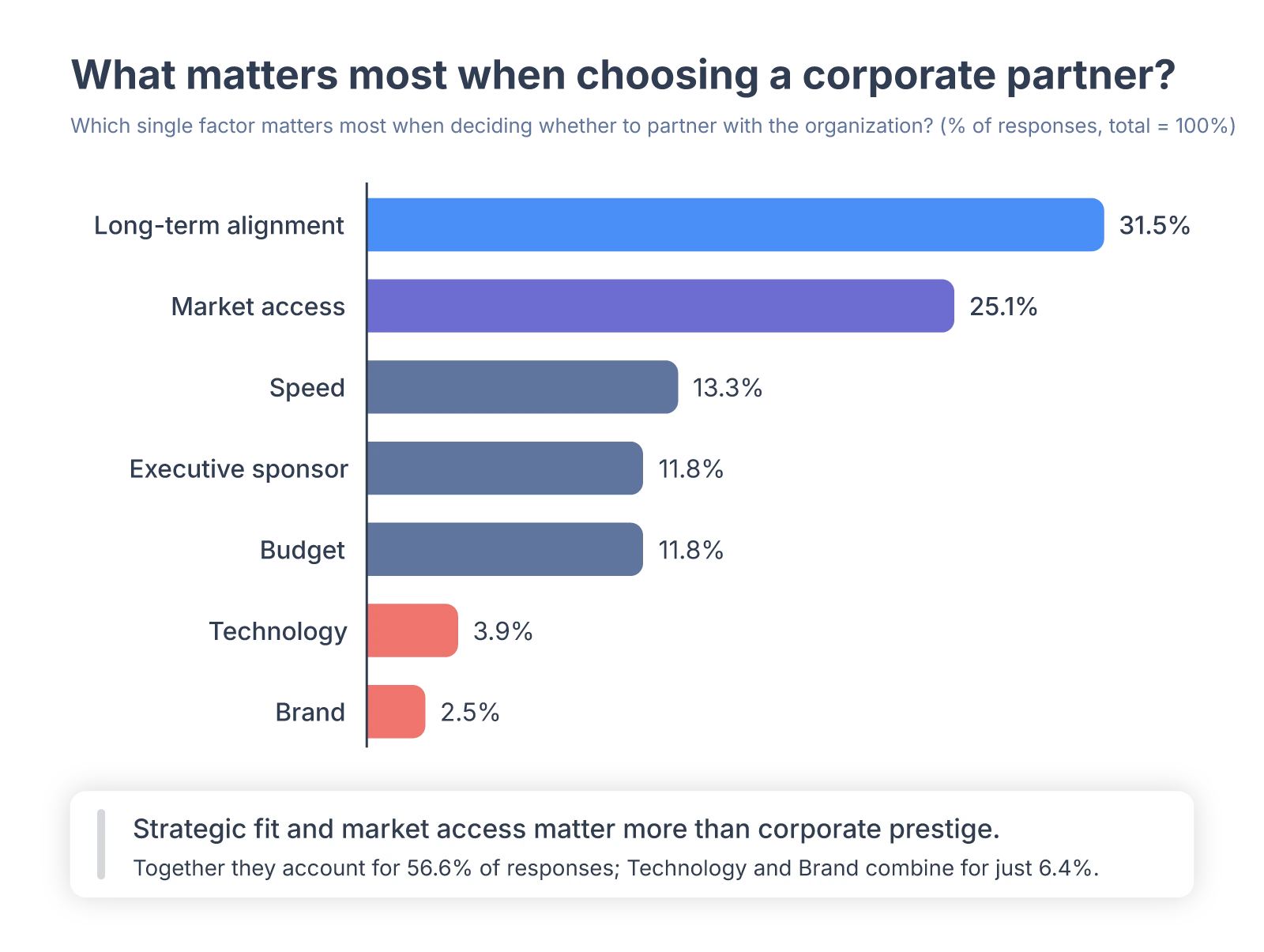
Long-term fit matters just as much. When choosing the single most important factor in a corporate partner, 32% prioritize long-term alignment, and 25% choose market access. Brand and technology rank near the bottom at just 3% and 4%, respectively. The difference suggests startups are less concerned with the name attached to a partnership than with whether that relationship can help them reach customers and grow their business.
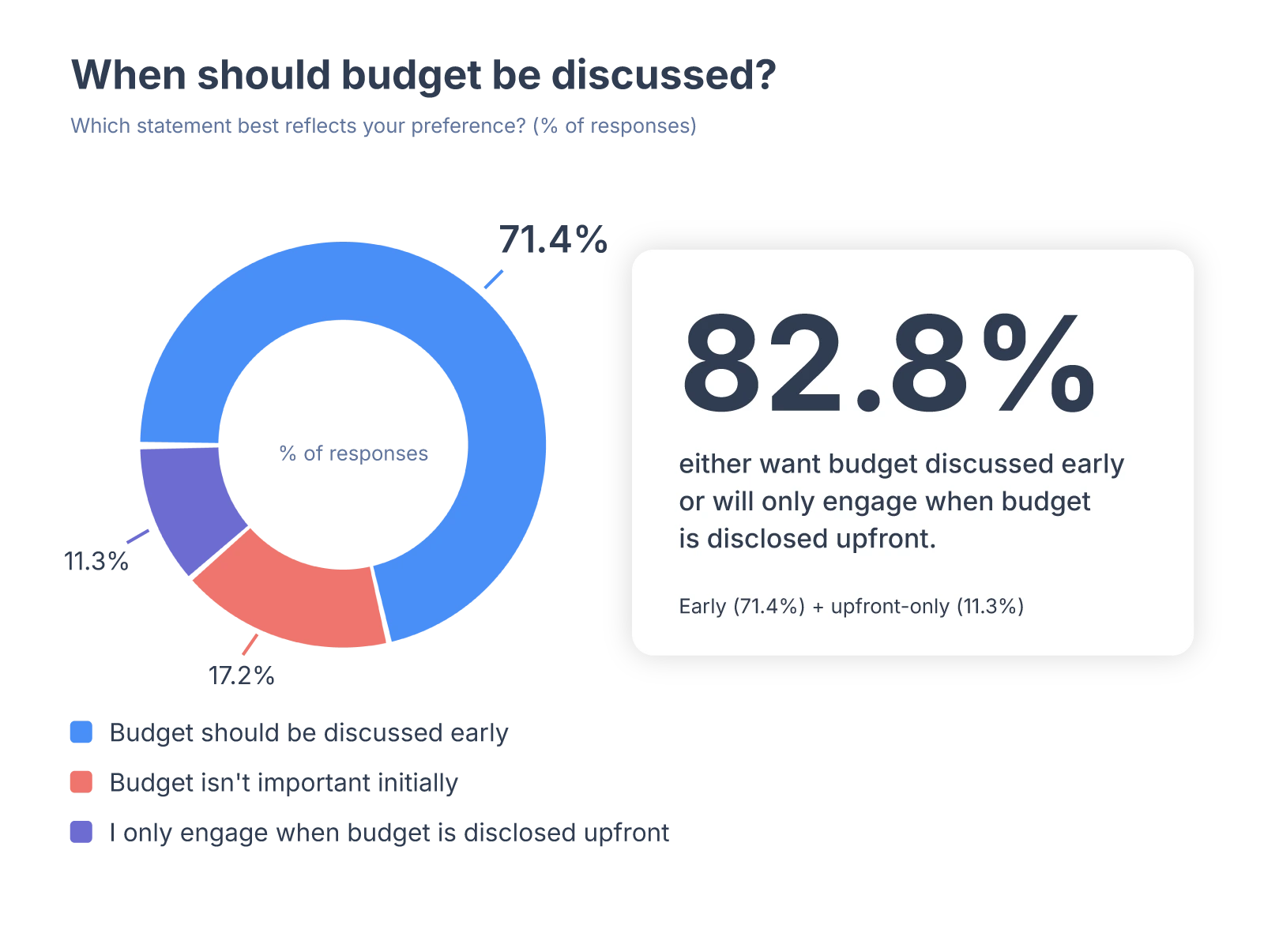
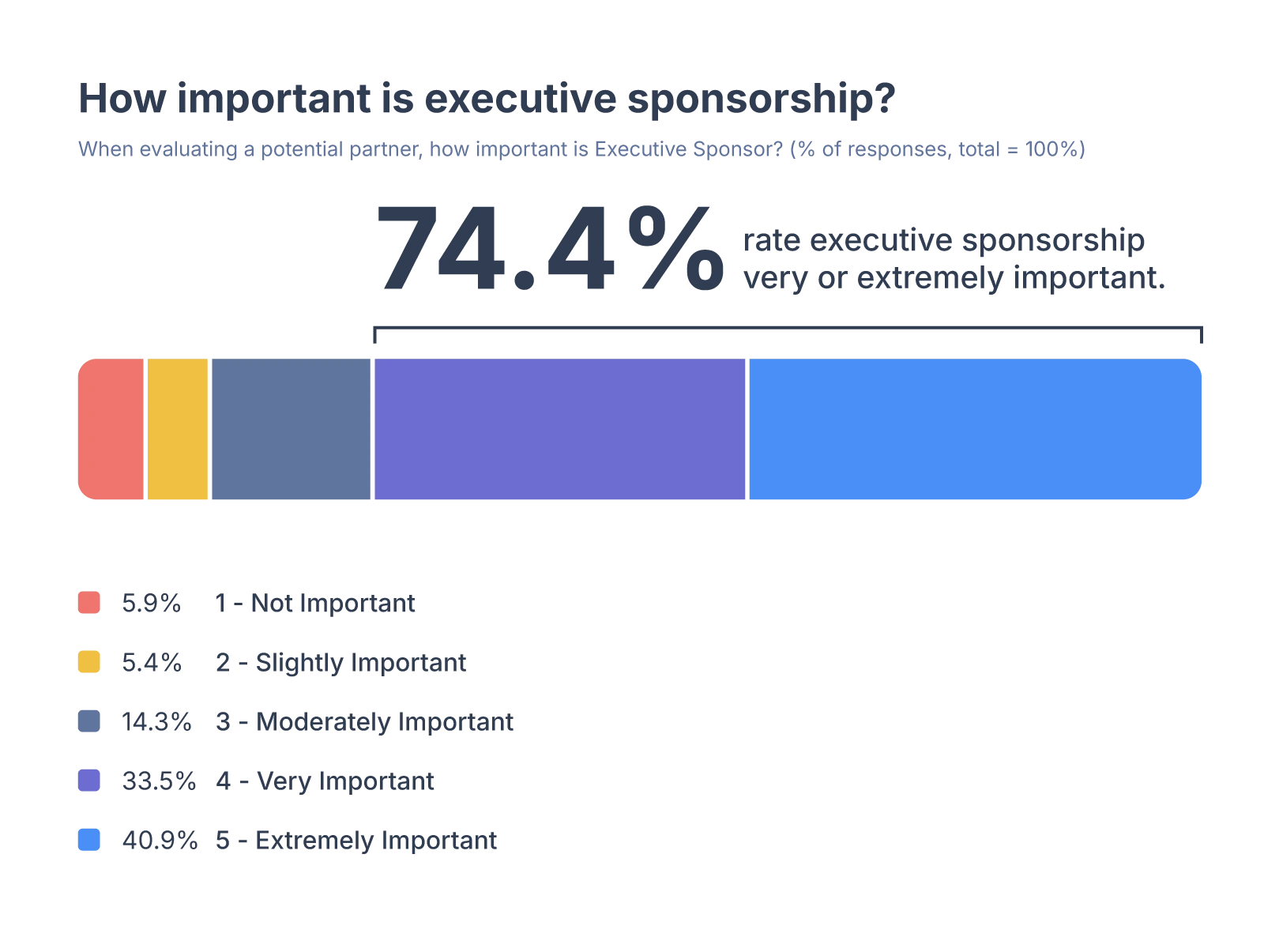
Startups also look for signs that a potential partner is prepared to follow through. Nearly 74% rate executive sponsorship as very or extremely important, while 83% want the budget discussed early or disclosed upfront. Both can signal whether an opportunity has the internal support and resources to progress beyond initial conversations.
Together, these priorities point to a straightforward expectation: startups want partners that can provide commercial value, share their long-term direction, and have the internal commitment to move an opportunity forward.

The biggest barrier is speed

The clearest source of friction is speed. More than 86% identify slow decision-making and procurement cycles as a major challenge, making it the most common challenge startups face when working with large organizations.
The issue appears consistently across the findings. More than 38% say organizations simply move too slowly, 36% identify faster decisions as the one thing they would most like to improve, and 18% say slow decision-making alone could cause them to walk away from a partnership.
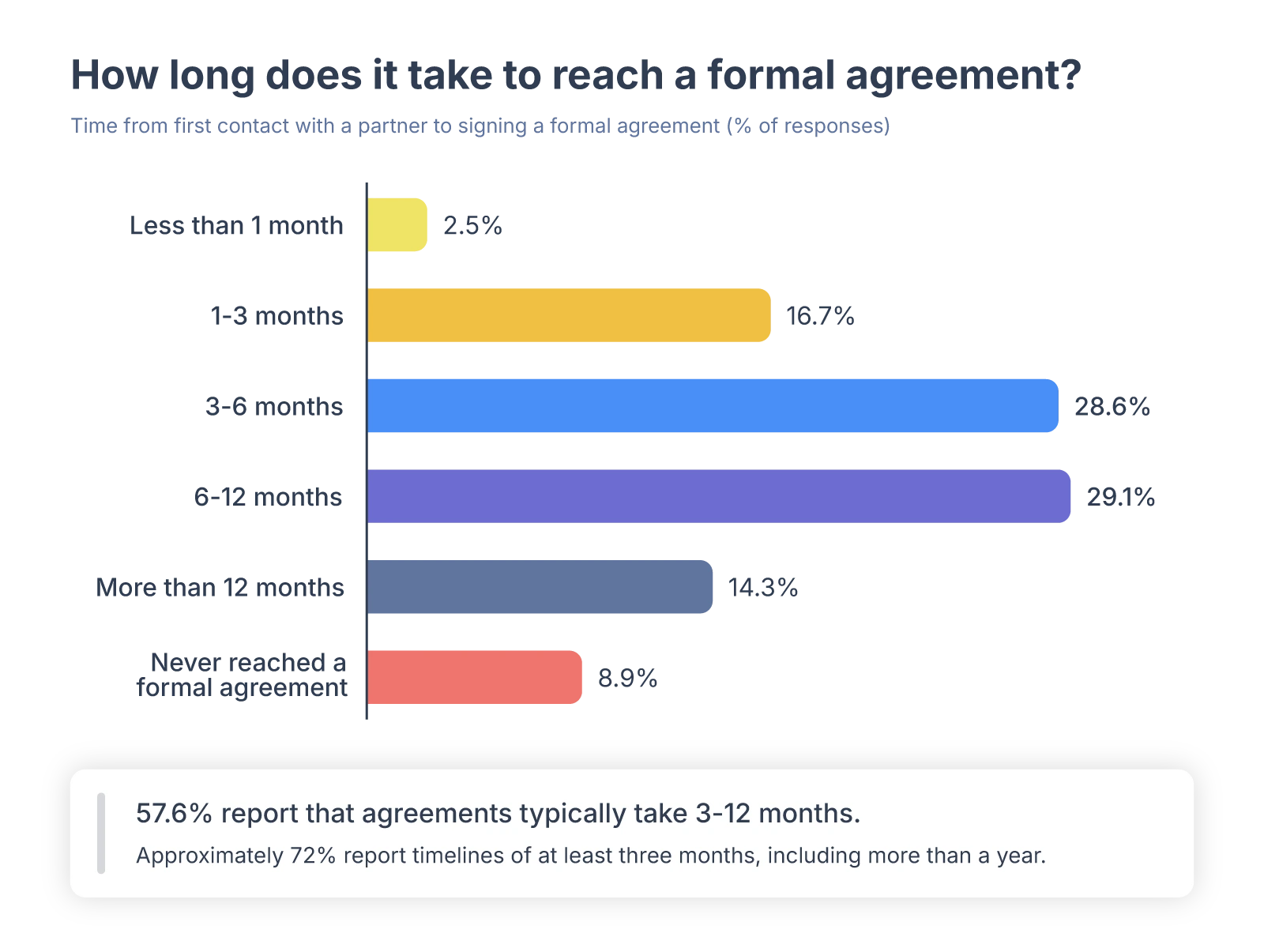
Those concerns become clearer when looking at actual timelines. Nearly 58% say reaching a formal agreement typically takes three to 12 months, while another 14% report waiting more than a year. For early-stage startups, that delay carries a real cost. More than 70% have 10 or fewer employees, and a similar share are seed or pre-seed, meaning months spent navigating approvals can consume limited time and resources that could otherwise go toward product development, fundraising, or customers.
Corporate processes exist for a reason, but the mismatch in operating speed can make otherwise promising partnerships harder to sustain. Creating clearer decision points, ownership, and timelines can help preserve the rigor large organizations need without leaving startups waiting indefinitely.

From pilot to commercial partnership


Pilots remain one of the most common ways startups and corporations begin working together, but what happens afterward varies significantly. Some startups report converting most of their pilots into commercial agreements, while others see few or none progress beyond the testing stage. The challenge is not the pilot itself, but whether both sides enter it with a clear path toward what comes next.
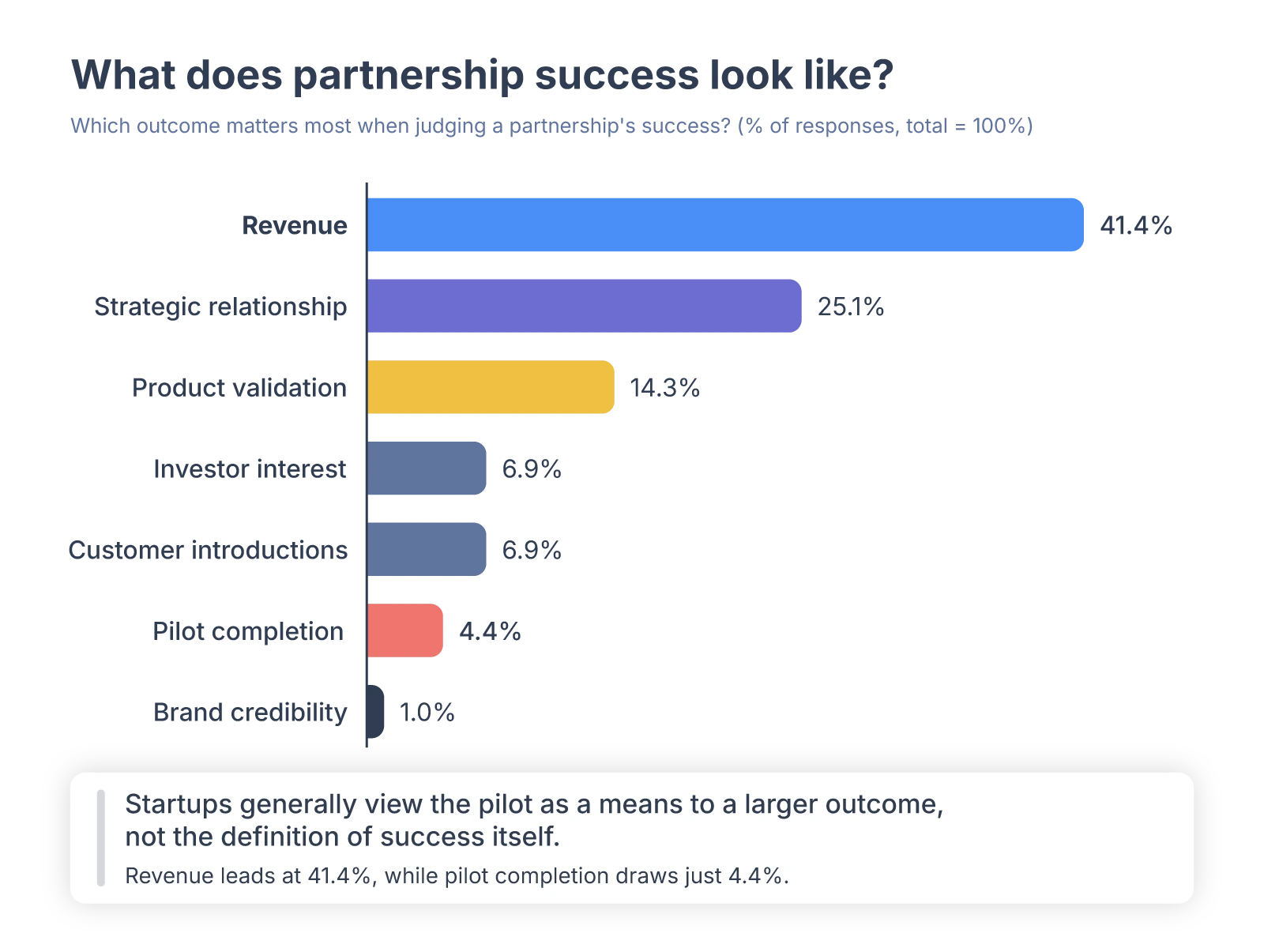
For startups, that destination is increasingly commercial. More than 41% define revenue as the single most important measure of partnership success, compared with just 4% who choose completing a pilot. A successful test can demonstrate that a solution works. Still, its long-term value depends on whether that validation can lead to deployment, a customer relationship, or another meaningful business outcome.
The strongest pilots, therefore, have a destination in mind from the beginning. Defining what success looks like, who makes the decision, and what happens after the pilot can help both sides avoid a successful experiment that ultimately has nowhere to go.


Budget as a signal of commercial intent


For startups, budget is more than a financial detail. It is an early signal of whether a corporate opportunity has a realistic path forward. More than 82% of startups want budget addressed early, including 11% that will only engage if it is disclosed upfront.

That preference reflects the economics of startup participation. Pilots, technical integrations, and customized demonstrations require time and resources, often from small teams. When funding remains uncertain, startups can spend months validating a solution without knowing whether the corporation has the ability or intention to become a customer.

Budget clarity does not necessarily mean corporations need to commit before evaluating a solution. It gives both sides a clearer understanding of whether an engagement is exploratory or tied to a funded business opportunity. For startups, that distinction can determine whether a partnership is worth pursuing.


RELATED READING

Proof of Concept Tips for Corporate-Startup Partnerships
Read Now ->

Executive sponsorship & the ownership problem


Corporate partnerships need someone internally who can keep them moving. Nearly 74% of startups rate executive sponsorship as very or extremely important, while one-third identify a lack of executive sponsorship as a major challenge.

The issue is not simply having a senior leader attached to a project. Startups need someone within the organization who can maintain momentum, navigate internal priorities, and connect the partnership with the people who ultimately control the budget and make decisions. This becomes particularly important when an engagement spans multiple teams or lasts several months.

Without clear ownership, even promising partnerships can stall as they move through a large organization. For corporations, determining who is accountable for advancing an opportunity can be just as important as selecting the right startup in the first place.


Strategic fit matters more than corporate prestige
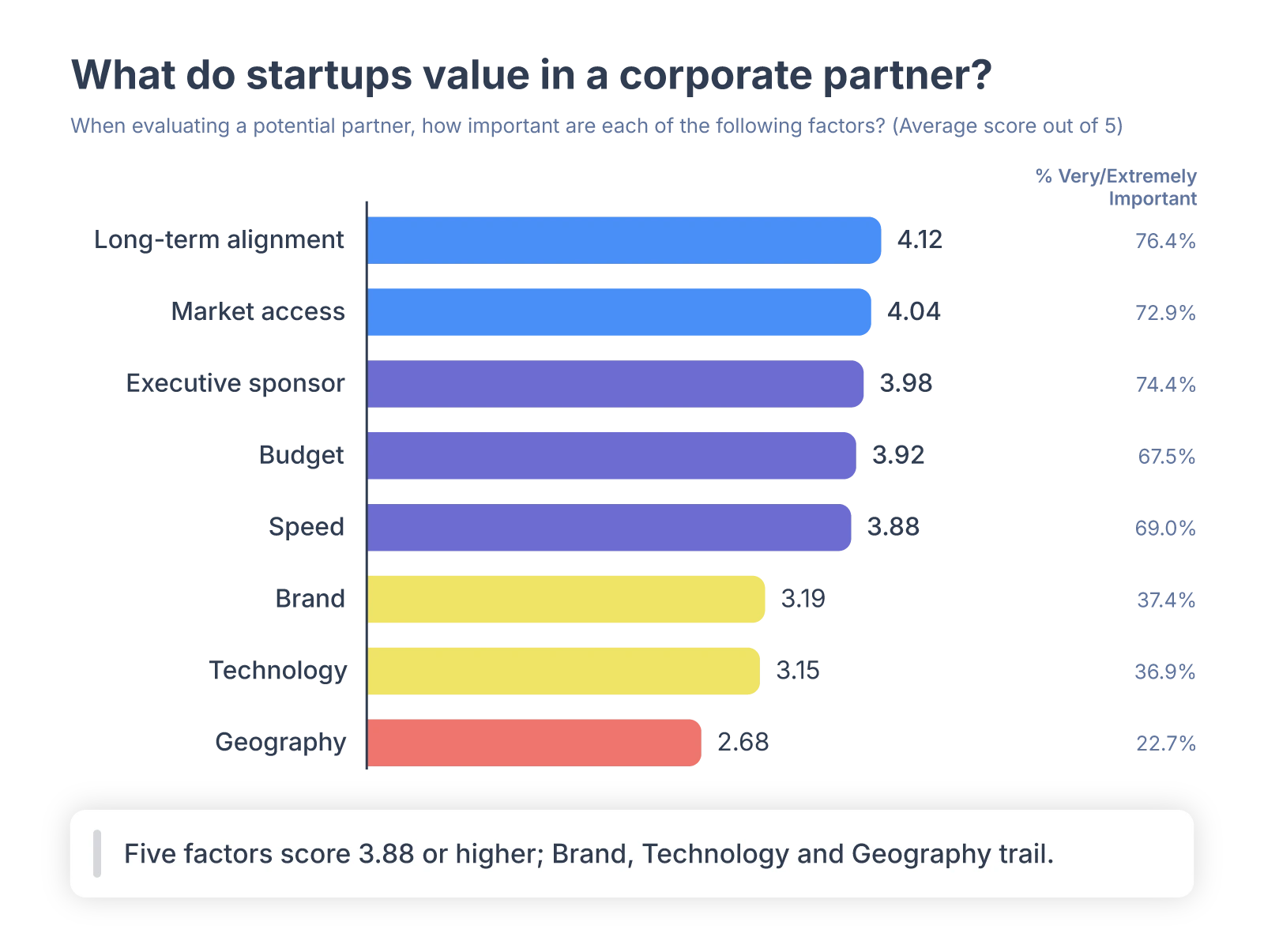
For startups, the value of a corporate partner has less to do with the name attached to the partnership and more to do with where the relationship can lead. Long-term alignment is the most frequently selected factor when startups choose what matters most in a corporate partner, at 32%, followed by market access at 25%. Brand and technology rank far lower, at just 3% and 4%.

The difference reflects what startups stand to gain from these relationships. A recognizable corporate name can provide credibility, but credibility alone does not create a sustainable partnership. Startups are looking for organizations whose priorities align with their own and that can provide access to customers, markets, or opportunities they may struggle to reach independently.

Long-term alignment can also make a partnership more resilient. When both sides understand how a startup's solution connects to the corporation’s broader priorities, there is a stronger rationale for continuing the relationship beyond a single project or pilot.

For corporations, this creates an opportunity to compete for promising startups on more than reputation. A clear business need, relevant market access, and a credible path to a longer-term relationship may ultimately be more compelling than the corporate logo itself.


Why partnerships fall apart
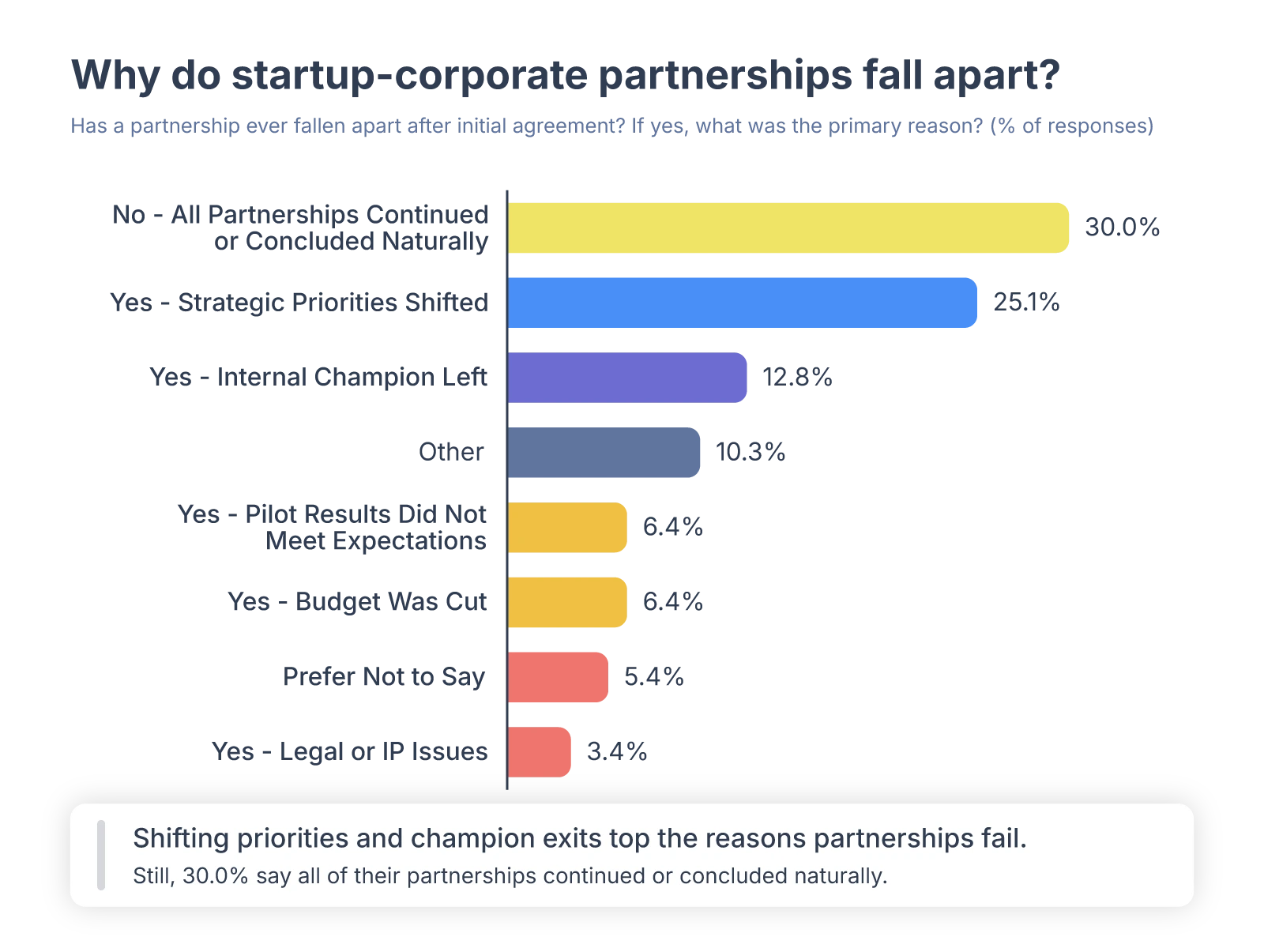
Corporate-startup partnerships do not always end because the technology fails. In fact, the most common reason partnerships have fallen apart is a shift in the corporation’s strategic priorities, cited by 25%. Another 13% have seen a partnership end after an internal champion left the organization.

These breakdowns highlight a risk that can be difficult for startups to control. A solution may perform as expected, but a reorganization, a leadership change, or a new business priority can alter the rationale for the partnership. For startups that have already invested months in an engagement, that can mean losing an opportunity for reasons unrelated to their product or performance.

This is also why strategic alignment and broad internal ownership matter. A partnership tied to a clear business priority and supported by more than a single champion has a better chance of surviving organizational change. Corporations cannot eliminate shifting priorities, but they can be transparent when circumstances change and avoid leaving startups investing resources in an opportunity that no longer has a path forward.

What corporations misunderstand about startups
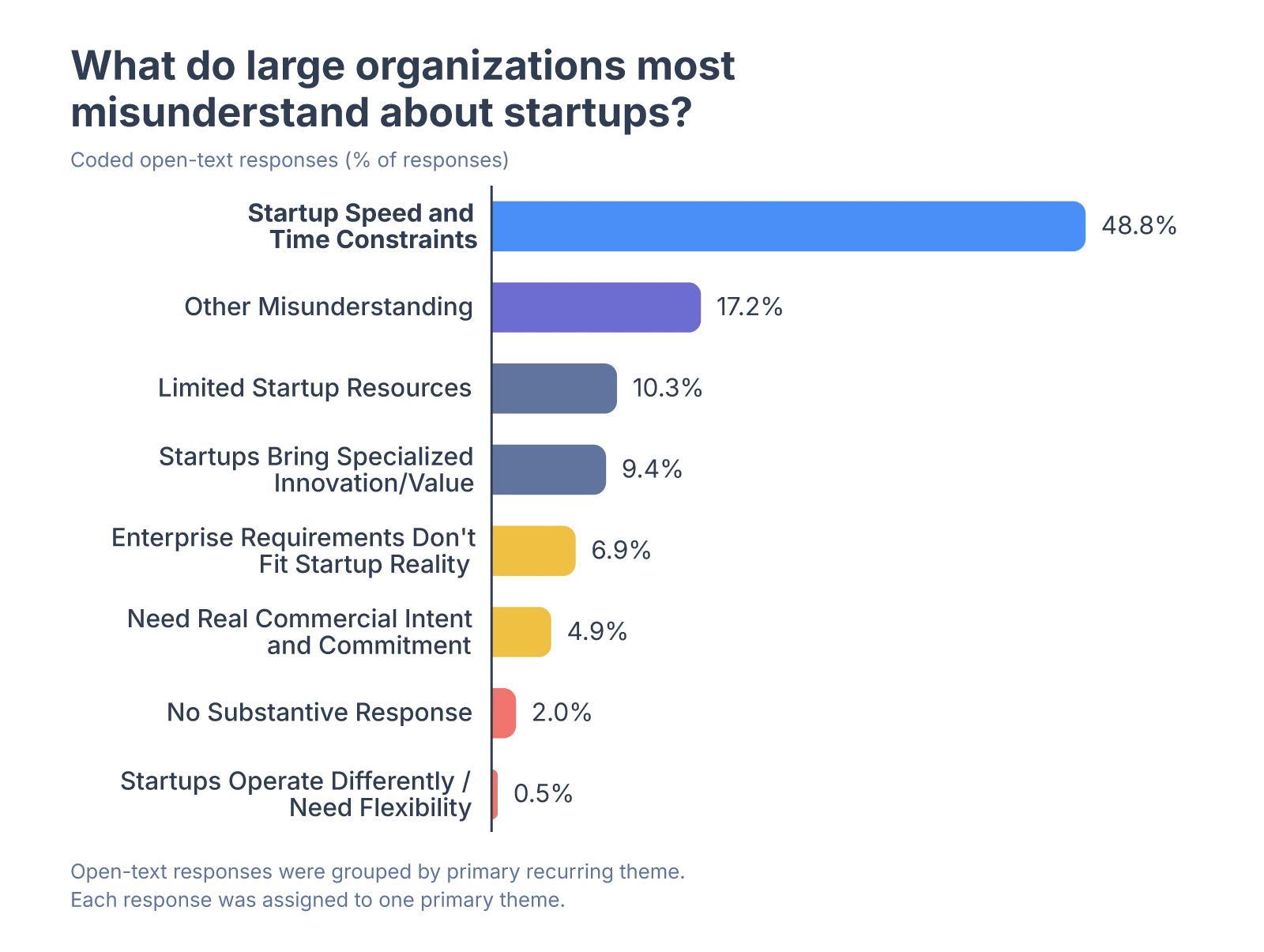
One of the clearest themes is that corporations and startups often operate on fundamentally different timelines, with nearly half of the responses about what corporations misunderstand about startups centering on speed and time constraints. For early-stage companies, delays are not simply inconvenient. They can directly affect hiring, fundraising, product development, and runway.

That difference is partly structural. More than 70% of the startups represented have 10 or fewer employees, and a similar share are at the seed or pre-seed stage. A request that may seem relatively small within a large organization, such as another technical demonstration, a security review, or a round of stakeholder feedback, can require a meaningful share of a startup’s available resources.

This does not mean corporations should lower their standards. Startups entering enterprise environments still need to demonstrate that their products are secure, reliable, and capable of delivering value. The challenge is making sure each additional requirement serves a clear purpose and moves the partnership toward a decision.

Understanding that difference can change how corporations structure engagement. Clear requirements, consolidated feedback, and predictable decision points can preserve necessary diligence while reducing unnecessary demands on smaller teams.

The broader lesson is not that startups simply want corporations to move faster. They want corporate partners to understand that time itself is a resource, and early-stage companies have much less of it to spare.

Building a better partnership model

The findings do not suggest that corporations need to eliminate procurement, shorten every pilot, or take on unnecessary risk. They point instead to a need for greater clarity throughout the partnership. The strongest models connect startup engagement to a real business need, establish ownership and budget early, set clear expectations for validation, and define what happens when a solution succeeds.

That structure can make a measurable difference. It gives corporations room to evaluate new technologies while giving startups enough certainty to commit their limited resources. Most importantly, it turns the pilot from an endpoint into one stage of a larger commercial process. 

Partnership in Practice

Mitsubishi Electric × Facilis

Industry: Manufacturing / Industrial AI
Partnership: AI-powered visual inspection
Outcome: Pilot → deployment → commercial agreement

Results:
>99% detection accuracy
15% reduction in defects
<60ms inference per image

Partnership overview: Plug and Play connected Mitsubishi Electric with Facilis through the Mitsubishi Electric Innovation Challenge. After launching a pilot in January 2025, the companies reviewed results in May, moved into deployment in August, and signed a commercial agreement in September that expanded the relationship across multiple divisions.

Kajima × Archetype AI


Industry:
Real Estate & Construction
Partnership: AI-powered construction site video analysis
Outcome: Business need → startup connection → proof of concept → paid partnership

Results:
11,957 videos analyzed
662 targeted clips identified
<60 seconds to retrieve relevant footage

Partnership overview: Kajima identified a need to make construction-site videos easier to search for and analyze in August 2023. Plug and Play connected the company with Archetype AI the following month, and the teams developed a proof of concept around that specific business challenge. Kajima ultimately became Archetype AI’s first paid design partner.

These examples show what a more intentional partnership model can look like in practice. The technologies and timelines differ, but both began with a defined corporate need and created a structured path for the startup to prove its value. The goal is not to make every partnership follow the same process, but to make sure both sides understand where the process is intended to lead.

Closing perspective

Corporate-startup partnerships remain an important path to growth, but their value depends on more than bringing the right companies together. The findings point to the importance of clearer expectations, committed internal ownership, and a defined path from initial engagement to commercial opportunity.

Startups and corporations will continue to operate at different speeds and with different constraints. Strong partnerships recognize those differences rather than trying to eliminate them, creating a structure that gives corporations the confidence to validate new solutions while giving startups enough clarity to invest their time and resources.

The appetite for collaboration is already strong. The opportunity now is to build partnerships that turn that interest into lasting value for both sides.

Methodology & respondent distribution

This research presents responses from 203 startup leaders on their experiences, priorities, and challenges when partnering with large organizations. The respondent base is heavily founder-led, with 91% identifying as founders or co-founders and another 7% representing the C-suite.

The sample skews toward early-stage companies: 49% are seed-stage, 22% are pre-seed, and 17% are Series A. By company size, 71% have 1 to 10 full-time employees, and approximately 97% have 50 or fewer employees. Respondents span multiple industries and markets, with the U.S. representing the largest single market at 41%.

The research examined partnership activities and goals, pilot conversions, corporate friction points, decision criteria, partnership breakdowns, and expectations for future growth. Qualitative responses were grouped by primary recurring theme to identify broader patterns across responses.


A note on multi-select questions

Several questions allowed respondents to select more than one answer. Percentages for these questions are calculated using the 203 respondents as the denominator, not the total number of selections. As a result, percentages may total more than 100%.

Data collection was conducted by Plug and Play in 2026.

FAQs about corporate-startup partnerships

What makes corporate-startup partnerships succeed or fail?

The most effective partnerships start with a clearly defined business problem and a structured path from initial engagement to commercial opportunity. Without committed internal ownership on the corporate side and transparent expectations from the start, even promising collaborations stall. Plug and Play's partnership model is built around these principles, connecting corporations with vetted startups around specific challenges and creating the conditions for pilots to convert into lasting value, as seen in partnerships like Kajima and Archetype AI.

How do corporations and startups bridge the gap between their different speeds and constraints?

Corporations and startups operate on fundamentally different timelines and with different resources. Strong partnerships try to emphasize those differences and build structure around them. Plug and Play works with 550+ global partners across 25+ industries to create frameworks that give corporations the confidence to validate new solutions while giving startups the clarity they need to invest their time and resources effectively.

How can our organization start building more intentional corporate-startup partnerships?

The first step is identifying a specific business need with clear success criteria, then finding a structured way to connect with startups that can address it. Plug and Play's team works directly with corporate partners to move from that initial diagnosis to a defined pilot and ultimately to a commercial partnership. Contact us to explore how our platform can help your organization build partnerships that create lasting value.

GET IN TOUCH

Ready to start your innovation journey?
PLUG AND PLAY AROUND THE WORLD

Discover our global locations

We have a community of experts all over the world. We work as a bridge between Silicon Valley and the rest of the world, making innovation open to anyone, anywhere.

Sign up for our global newsletter