Direct Market Access
If you’re looking to expand your startup to international markets, the importance of direct market access cannot be overstated. This immersive approach provides insights into the local business environment, consumer behavior, and cultural nuances that are impossible to fully grasp through secondary research alone.
By engaging directly with the market, you can make more informed decisions and strategic adjustments, ensuring a smoother and more successful market entry. From helping your startup adapt to meet local needs to fostering trust with potential partners and clients, there is truly no substitute for the practical knowledge gained from being on the ground and experiencing the market dynamics firsthand.
The Power of Networking
Networking is a cornerstone of the startup ecosystem, particularly when venturing into foreign markets where having the right connections empowers startups to gain support, visibility, and credibility within a new industry. Our GIA program facilitates this process by providing participants with direct market access for a week. There, founders have various opportunities to network through office hours, in-person meetings and networking mixers with influential corporates, conglomerates, government agencies and venture capitalists.
Encouraging founders to take every chance to connect with the community, Fajardo stresses its singular importance and references Albert-László Barabási's book, The Formula. Barabási, a Hungarian-American physicist best known for his work in Network Science and social dynamics, posits that a key predictor of future success is one's ability to actively work on expanding their network. With an extensive network, you can enhance your startup’s brand equity and increase the likelihood of encountering serendipitous opportunities.
As established figures within their respective industries, mentors can introduce you to valuable contacts that can elevate your startup’s growth potential, such as potential investors, partners, and clients.
Leveraging Market Access Programs
Understanding the nuances of international markets can be challenging for newcomers. This is where our mentors play a crucial role–with a wealth of firsthand experience in these regions, they can provide strategic advice on navigating local regulations, cultural differences, and market dynamics.
To tap into the expertise of mentors, explore market access programs such as our Global Innovation Alliance (GIA) program, which features over 120 mentors from a variety of backgrounds.
RELATED EBOOK: Plug and Play Innovation Academy — A dynamic program offering tailored learning paths — ranging from masterclasses to Executive MBA modules — to help professionals drive innovation and lead transformative change. Sign up now to accelerate your career and become a catalyst for innovation!
Finding the Right Mentor
The ideal mentor can provide invaluable insights, support, and connections, but finding this match can sometimes be tricky. We’ve come up with some tips to help you simplify this process:
Identify Your Startup’s Needs
Before seeking a mentor, identify the specific skills, knowledge, or connections that would be most beneficial to your startup.
Research Potential Mentor’s Background
Through professional networks like LinkedIn and industry events, look for mentors with experience and expertise relevant to your industry or business challenges.
Assess Fit
Rodgers recommends interviewing the mentor to ensure that you can communicate effectively with each other and that there is genuine interest in you and your company.
With these steps, you’ll gain a better understanding of areas where your mentor can make the most significant impact, allowing you to better align your needs with their capabilities to make for a constructive and effective mentorship.
Cultivating A Successful Mentor-Mentee Relationship
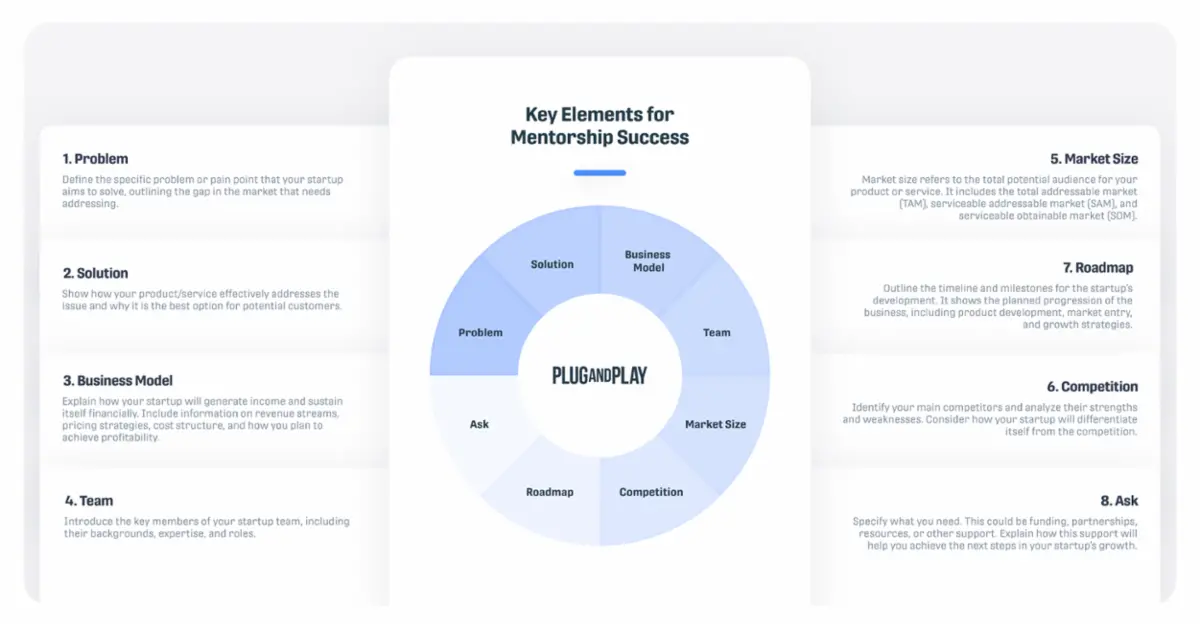
Individuals may have different interpretations of what constitutes success. To ensure that your goals are aligned with your mentor’s, Rodgers suggests setting key performance indicators (KPIs) together to track progress along your startup’s growth objectives roadmap. While industries might vary, the core needs of most startups are generally similar. It is essential to establish a clear foundation, focusing on key elements such as the Problem, Solution, Business Model, Market Size, Competition, Team, Roadmap, and Ask.