articleFeb 25, 2026
Brand & Retail

How to Improve Brand Visibility in AI Search Engines (GEO Guide & Startups)

As generative AI platforms like ChatGPT, Gemini, and Perplexity rapidly reshape how consumers discover, evaluate, and purchase products, brands must rethink visibility through generative engine optimization (GEO) to ensure they are cited, trusted, and chosen inside AI-driven conversations.

This article was written by Philipp Hödl, Senior Associate at Plug and Play, where he leads innovation activities for brands and retailers across Europe. The insights were developed with the support of Matt Haley, Head of Brand Partnerships at Profound, who works with some of the world’s largest brands to design AI-first content and data strategies, measure LLM citation and answer-engine performance, and turn AI discovery into higher-quality traffic and conversions. Contributions also came from Sjoerd Brouwer, Director of Technology Portfolio Management & Innovation at Mandarin Oriental Group, who drives a future-fit technology portfolio aligned with group strategy and enterprise architecture, prioritizing innovation through emerging technologies including generative AI adoption.


Brand LLM visibility: What’s inside?


  • Why AI brand visibility matters today
  • Best ways to improve brand visibility in AI search results
  • AI brand visibility tools and startups
  • Case studies: How corporations team up with startups to improve brand visibility in AI search results


GET IN TOUCH

Ready to start your innovation journey?

Why AI brand visibility matters today

Consumer discovery is undergoing its most significant transformation since the rise of Google, and the shift to AI-mediated search is happening faster than most brands realize. Generative AI tools, such as ChatGPT, Perplexity, Gemini, and Amazon Rufus, are rapidly becoming the starting point for consumer research. Instead of clicking through webpages, people now receive direct, conversational answers that summarize the internet for them. As Matt Haley, who leads Brand Partnerships at Profound, puts it: "Answer engine optimization isn’t some future trend to keep an eye on — it's already reshaping how brands get discovered.” Sjoerd Brouwer from Mandarin Oriental Group adds that for luxury or high-touch brands, if AI assistants do not “know” the brand in depth, they risk flattening the brand voice or hallucinating details. GEO ensures that discovery reflects brand-specific nuances and preserves the authenticity of the guest experience.

For teams asking how to monitor LLM visibility of their brand, early GEO programs supported by an AI brand visibility optimization tool can reveal current citations and help improve brand visibility in AI search engines without disrupting existing workflows.

A key reason that matters now is the explosion of zero-click behavior. AI answer engines increasingly satisfy user intent inside the chat interface itself, meaning visibility no longer depends on whether someone scrolls through search results. It depends on whether the model cites you at all. Instead, being included in AI-generated answers functions as an endorsement signal. Models select brands that demonstrate authority across multiple sources — forums, news articles, product feeds, structured data — and early citations compound over time. Brands that appear consistently across multiple LLMs gain reinforced visibility, creating a structural advantage over competitors.

Early indicators show that over 80% of users now rely on AI-generated summaries to make purchase decisions. Traditional search traffic could decline sharply as users rely more on AI for recommendations. Nearly half of users say LLMs provide higher-quality recommendations than legacy systems.

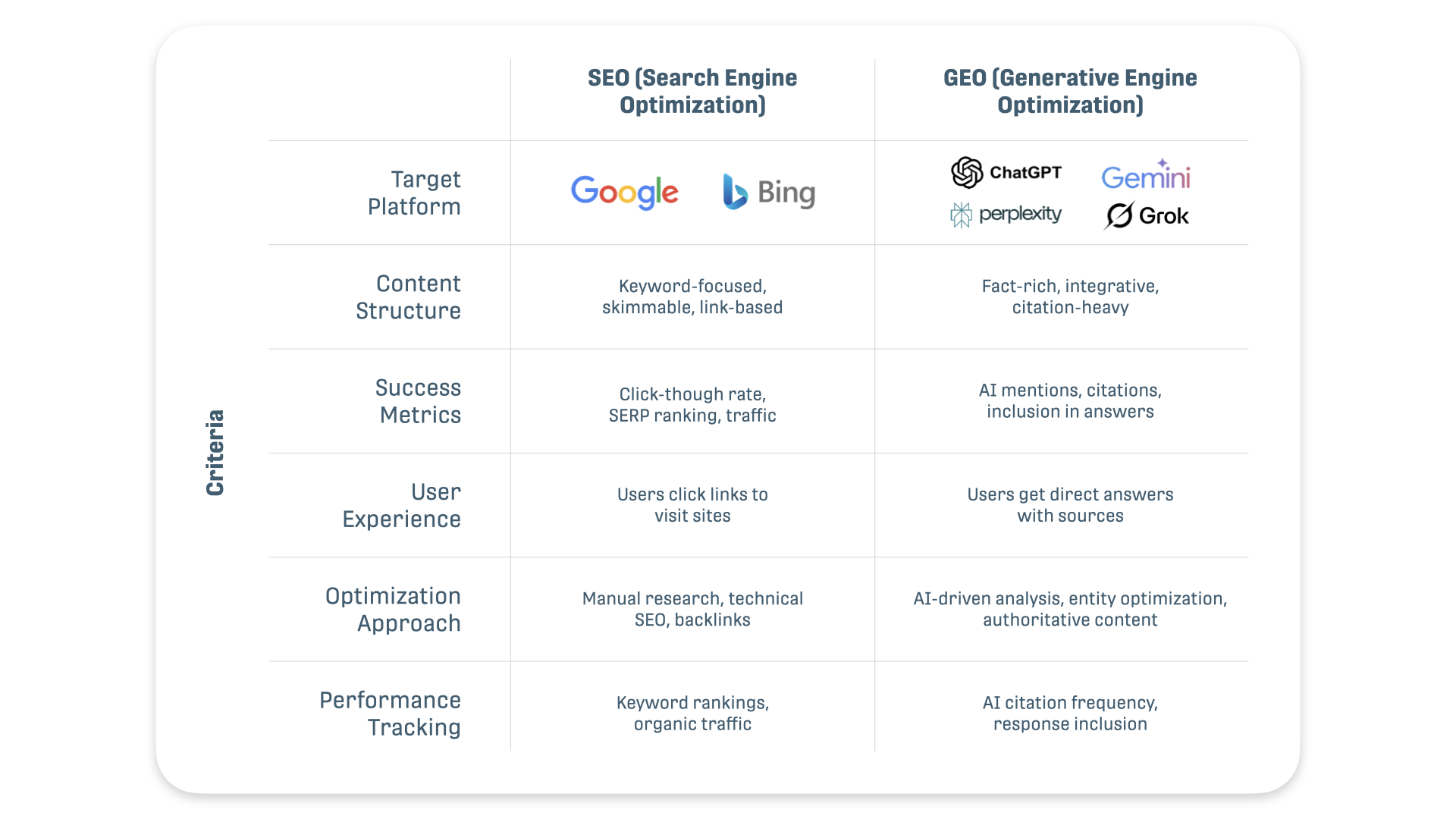
Another major reason GEO matters today is the growing gap between SEO and GEO, as seen in Image 1.

Image 1

Brands are no longer optimizing for predictable rankings on a single search engine, but for multiple generative systems that differ in how they structure responses, what signals they trust, how they measure authority, and how users interact with them. In GEO, the "results page" is not a list of links; it is a single synthesized answer where only a few brands appear. This shift radically compresses competitive space and creates a winner-take-all dynamic. Matt notes that AI models like ChatGPT or Gemini do not rank websites like Google. Instead, they synthesize answers by citing brands with established authority across diverse sources, meaning traditional ranking strategies are insufficient. Brouwer emphasizes that acting early also provides a first-mover advantage: early GEO adoption not only improves visibility but also ensures AI systems learn and preserve the brand's voice, minimizing the risk of commoditization or generic representation.

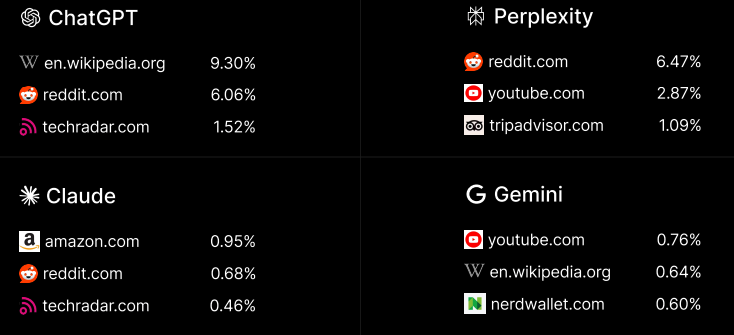
This competitive pressure is intensified by the fact that every LLM is essentially a different species, as shown in Image 2 below.

Image 2

Unlike traditional search engines, generative engines are built on diverse data sources, each with its own retrieval patterns and citation tendencies. One model may rely heavily on Wikipedia, another on Reddit, another on news articles or product feeds. The fragmentation means that early adopters who manage to appear consistently across multiple LLMs can see measurable impact: some brands are already seeing growth from AI-generated referrals. This fragmentation turns GEO into a multi-platform discipline where consistency, structured data, and authority must be cultivated across several environments. As Matt explains, brands that move first benefit from compounding visibility: repeated citations reinforce authority across multiple LLMs over time, strengthening brand influence and long-term discoverability.

This is now central to brand AI visibility and LLM brand visibility across categories.

The urgency grows further when considering how LLMs are reshaping the consumer buying journey. Generative assistants now influence the earliest and most decisive phases of decision-making: information and evaluation. A majority of consumers rely on AI summaries to research products, and over 58% of individuals use AI answer engines during product research or purchase journeys. A large share of their decision is made before they ever visit a website. In fact, 64% of the buying decision happens inside these platforms, and 80% of those who purchase something rely on AI answer engines for at least half of their decision-making. Instead, because AI influences decisions early, users arrive better informed and pre-qualified, increasing the quality and likelihood of downstream conversions (Matt Haley, Profound). AI is becoming the advisor that replaces many early-funnel interactions traditionally owned by search, media, and brand content. Brouwer adds that in high-stakes journeys, particularly luxury or multi-step planning scenarios, AI should augment trusted advisors, with human verification as a safeguard to maintain accuracy and service quality.

Although most shoppers still leave LLMs to finalize their purchase, this behavior is quickly changing. In-chat purchasing is already here, with platforms like Perplexity, Snap, and ChatGPT introducing features that bring checkout steps inside the conversation. Currently, 24% of users go to Google to complete purchases, and 54% go directly to commerce channels, yet 70% of Google users made at least half of their decisions inside the AI platform. As this becomes more common, the visibility provided by LLMs will translate directly into sales with fewer steps and less friction. Brands with clean product data, accurate descriptions, and strong authority signals will disproportionately benefit.

All of this creates a moment of strategic urgency. Early movers who invest in GEO are becoming the trusted sources LLMs repeatedly draw from. Because authority in these models compounds over time, those who delay risk being locked out of key categories as the models continue to learn from and reinforce the same trusted brands. Studies show that 90% of retailers are already investing in GenAI visibility, demonstrating the competitive necessity of early adoption. Waiting means losing ground in systems that memorize their preferred sources. Brouwer notes that early GEO adoption also lays the foundation for internal AI tools, such as concierge agents, ensuring consistent brand representation both externally and within operational systems.

In short, GEO matters today because generative AI has already begun reshaping how consumers discover, evaluate, and choose brands. Visibility inside these models determines who gets surfaced, who gets recommended, and increasingly, who gets the sale. For many journeys, if an LLM does not mention you, you effectively do not exist.

 
2025 Company Performance Report
Read Now ->

Best ways to improve brand visibility in AI search results

As brands grapple with the rise of AI-driven discovery, three emerging areas are shaping how they perform in generative ecosystems: LLM visibility, content & website optimization, and paid ads. Each area represents a critical lever to ensure your brand is discovered, cited, and recommended by AI systems, ultimately influencing consumer decisions and sales.

LLM visibility

At the forefront of AI optimization is understanding how your brand is seen by LLMs. In the AI ecosystem, mentions and citations are the new currency of visibility, but behaviors vary across platforms and industries. Some LLMs prioritize forums, others blogs or news sources. Reddit, for example, is the #1 source for Perplexity and #2 for ChatGPT, illustrating how a single discussion thread can outweigh an entire blog in influence.

Citation share is emerging as the new PageRank in the AI era. A few websites, including Wikipedia, YouTube, Reddit, Quora, and Reuters, account for a significant portion of citations attached to AI answers. High-influence sources, primarily social media platforms and user-generated content, dominate how LLMs perceive authority, while moderate sources like news outlets (Reuters, CNN, BBC, NYTimes) can be influenced through marketing and PR, and low/no-influence domains are largely academic or technical. Overall, 74% of the most-cited domains are susceptible to marketing influence, highlighting a major opportunity for brands to shape AI perception. Sjoerd Brouwer emphasizes that visibility is not only about frequency of citations but also about teaching AI the brand's nuanced voice. Without encoding context, sensory cues, and differentiators in AI-readable content, assistants may flatten or misrepresent the brand, which is especially critical in luxury or high-touch sectors.

Brands must monitor AI citations and ensure their URLs and website structures are optimized. Sampling practices matter: asking the same prompt hundreds of times can reveal variance in AI responses. About 50% of LLM responses rely purely on training data, meaning brands not in the model risk being invisible.

Modern AI visibility tools now allow brands to track an AI Visibility Score, monitor trending prompts, understand sentiment, and identify opportunities to be cited in relevant threads or media sources. It is important to distinguish between mention share (how often a domain is cited) and impression share (citation frequency weighted by visibility context), because a few citations in high-visibility summaries can drive outsized authority. Brouwer adds that successful LLM visibility strategies should prioritize match quality over sheer mention volume, ensuring that AI surfaces the right property or experience for a stated intent. Measuring the correctness, richness, and emotional resonance of citations can be as important as raw visibility metrics.

The concentration of citations creates a virtuous cycle: brands in the top quartile for web mentions receive over 10x more citations in AI Overviews than the next quartile. Increased citations compound authority, visibility, and downstream traffic, while others are left behind. Modern CMOs can direct budget toward PR, earned media, and strategic social/community engagement to leverage this compounding effect. Sjoerd highlights that LLM visibility also extends to operational alignment: consistent language across content, assistants, and internal tools ensures that external citations reflect the brand accurately and reduces the risk of misrepresentation in AI outputs.

This sub-trend emphasizes that GEO is no longer just about appearing in search results; it's about actively shaping how AI interprets and references your brand, while staying aware of competitor mentions, share of voice, and the broader citation ecosystem. Early movers can gain measurable advantages in brand recognition, AI-driven referrals, and high-converting traffic.

Content & website optimization

Visibility alone is not enough; AI must be able to access and interpret your content. LLMs read both owned and external content, so websites must be structured to allow AI crawlers to extract relevant information. Content that is blocked by JavaScript, loads slowly, or is presented with cryptic URLs can be instantly disqualified from citations. Profound Research shows that sites with JavaScript-heavy content, thin affiliate pages, content farms, pages that fail to load quickly, or cryptic URLs like "/a8d7f-ethical-92j3k" receive zero citations. This highlights how technical implementation directly impacts AI visibility, even before content quality is considered.

Many leaders ask about the best ways to improve brand visibility in AI search results; start by removing JavaScript blockers, clarifying URLs, and accelerating page delivery, so answer engines can parse your content cleanly.

Optimizing content for LLMs involves more than accessibility. Matt Haley recommends a technical playbook: treat your product feeds and pages as if they are speaking directly to the model, use semantic URLs, fill every product attribute field, write concise meta descriptions under 150 characters, structure H1s like natural questions, and front-load paragraphs with core insights so the engine can lift them cleanly. Semantic URLs, such as "/best-crm-for-startups," perform significantly better, receiving 11.4% more citations than generic IDs. Meta descriptions that "spoil the answer" by summarizing content upfront can improve AI comprehension, while forums with genuine discussion, particularly Reddit, signal authenticity to LLMs. Brouwer emphasizes that technical optimization should also encode brand nuance, contextual differentiators, sensory cues, property "vibes," and unique experiences, so AI can represent the brand accurately rather than as generic content. Structured narratives capturing nuance, not just amenities, reinforce brand voice across both external and internal AI systems.

Content freshness is another critical factor. Posts published within the last 30 days are weighted three times more heavily than older content, underscoring that regular updates are more valuable than historical authority alone. AI models also favor pages containing specific data, numbers, or comparisons, which allow them to provide accurate and actionable answers to user queries.
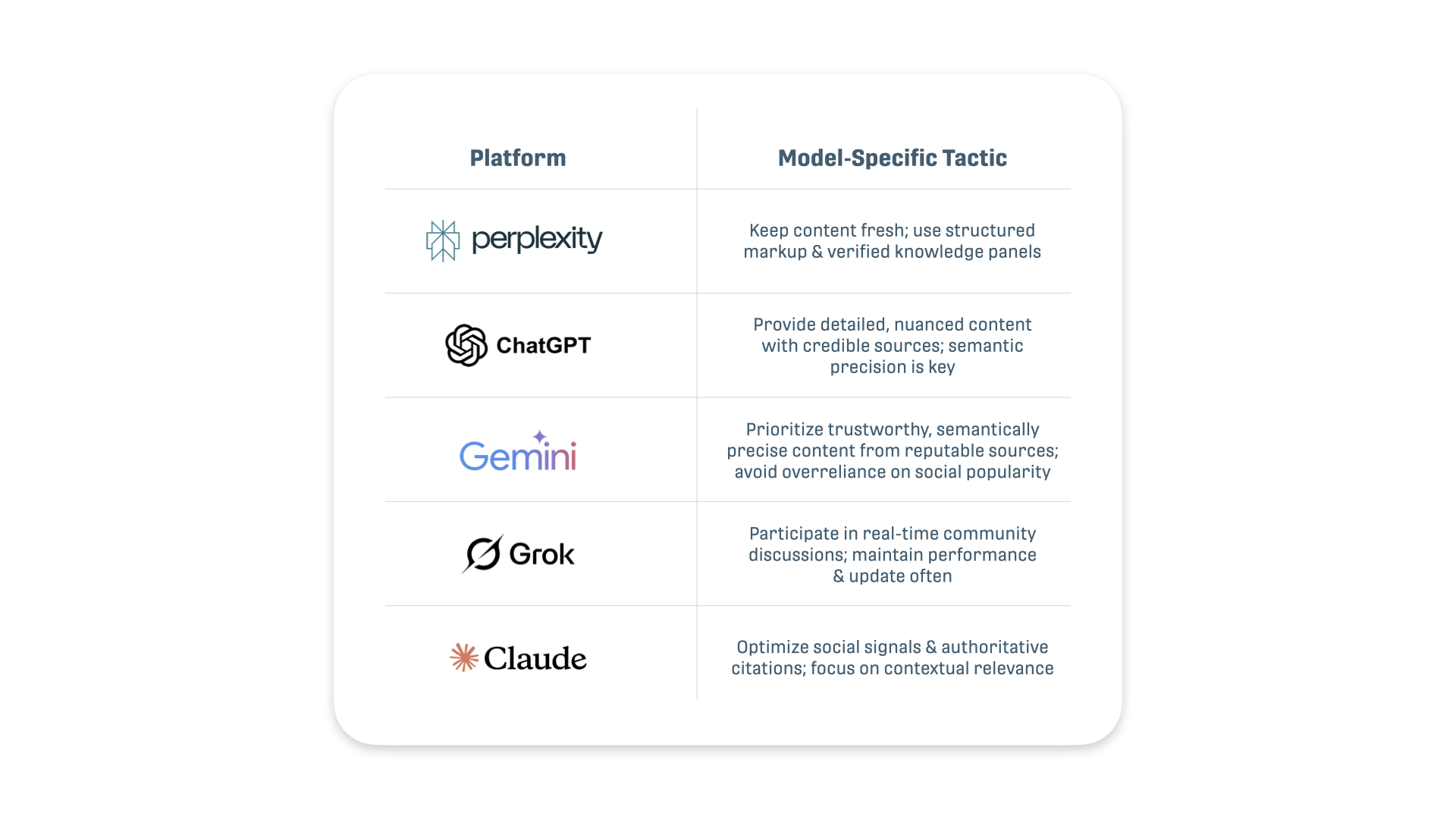
                            Image 3


Brands need to continuously track how their content is crawled and interpreted across multiple LLMs, including ChatGPT, Gemini, Claude, and Perplexity. Proven practices include analyzing millions of citations to generate content templates, optimizing existing pages, and creating purpose-built content for Answer Engines. Monitoring daily visibility for target prompts ensures that sites remain relevant and discoverable. By positioning their content as a trusted, authoritative source, brands can maximize their citations and influence across the growing ecosystem of AI-powered recommendations. Brouwer notes that consistent language across content, AI outputs, and internal tools (e.g., concierge agents) is a key measure of operational excellence. GEO isn't just about external visibility; it ensures that internal AI systems use the same curated content to provide accurate, brand-consistent guidance.

In short, Content & Website Optimization for LLMs is not just about SEO best practices. Matt Haley suggests that it's about applying a rigorous technical playbook to make every page and feed speak clearly to AI models, so your content can be trusted, parsed, and cited consistently.

Paid ads

AI-driven platforms are creating a new frontier for advertising. Paid placements are evolving into highly contextual, native formats that integrate directly into conversational responses, blending seamlessly with user interactions. Platforms such as ChatGPT, Perplexity, and Gemini are introducing sponsored product suggestions, carousel-style ads, and shoppable cards that appear organically alongside user prompts. Ads may also appear as brief sponsored sessions, where users watch a short clip to unlock extra features, or as recommendations that complement AI-generated answers without undermining trust.

Targeting in AI environments leverages conversation context and user intent, enabling brands to deliver highly personalized messaging based on what the user is actively asking. For example, a user searching "best gifts for toddlers" could see a sponsored toy retailer suggested as a follow-up or recommended answer. This represents a shift from traditional keyword-based targeting to intent-driven, contextually embedded ads.

Metrics for AI advertising also differ from traditional models. Performance is measured less by clicks and more by engagement quality, conversational depth, and AI-assisted interaction value. Payment models are evolving toward cost-per-impression (CPM), pay-per-resolution (completing a sponsored step), or affiliate conversion, reflecting the unique nature of AI engagement.

Early movers who integrate conversational ad readiness, adapting tone, creative assets, and messaging for AI recommendations, gain a distinct advantage. Strengthening AI content ensures ads are supported by credible information, improving the likelihood that LLMs will surface your brand. Monitoring AI search behavior and tracking where your brand appears allows marketers to refine campaigns and focus on high-impact placements, especially by pairing campaigns with an AI brand visibility tool to quantify lift from conversational placements. Brouwer emphasizes that in high-stakes or luxury contexts, AI-driven ads should augment trusted advisors rather than replace them. GEO-driven ad strategies must deliver relevance at the exact moment of intent while maintaining brand authenticity, and human verification or oversight can be applied where errors would damage trust.

Looking ahead, ad placements in platforms like ChatGPT, Gemini, and Claude are expected to become mainstream soon. These will not be traditional banners but contextual product suggestions designed to drive conversions inside AI conversations. Brands that experiment early, integrate ads with authoritative content, and align their messaging with conversational flows will gain measurable advantages in visibility, citations, and direct engagement. Premium ad-free experiences and subscription-based models may also emerge, requiring agile strategies to stay ahead in the AI advertising landscape.
 

AI visibility tools and startups every brand should know about


1. Profound

Year: 2024 | HQ: New York, USA

  • Total funding & investors: $155M from investors, including Sequoia Capital, Khosla Ventures, South Park Commons, Kleiner Perkins, SV Angel

  • Description: Profound helps brands increase their visibility across AI-powered search and shopping platforms by providing actionable insights, AI-optimized content creation tools, and detailed analytics on how AI mentions and ranks their products. Their platform empowers companies to track, analyze, and improve their presence across multiple AI engines, driving measurable engagement and conversions.

  • Why we like them: We like Profound for its robust AI shopping and content optimization features, extensive client base and regional coverage, first-mover advantage with over 650 customers, and access to the largest real-user prompt dataset -all supported by a dedicated customer success team.

2. Evertune AI

Year: 2024 | HQ: New York, New York, USA


  • Total funding & investors: $19M from investors, including Felicis, NextView Ventures, Eniac Ventures, Sarfraz Maredia, Jonathan Carson.

  • Description: Evertune is a generative engine optimization (GEO) platform that helps brands boost visibility and reputation across AI search platforms like ChatGPT, Gemini, and Claude. It delivers AI-driven insights on brand perception, competitor benchmarking, website optimization, and content strategy, enabling leading enterprises to turn AI search into a measurable growth channel.

  • Why we like them: We like Evertune for its exclusive training data and citation access backed by OpenAI, Google, and Meta scientists, its high-volume, reliable prompt capability (1M/month vs. competitors’ 150/day), enterprise-grade website optimization, and actionable, data-driven recommendations, all at a scalable $3K/month plan.

3. Bonafide

Year: 2024 | HQ: San Francisco, California, United States


  • Total funding & investors: $4M from investors, including Plug and Play, IAGi Accelerator.

  • Description: Bonafide is a generative commerce enablement platform that allows brands to control, validate, and distribute accurate product content across the generative AI ecosystem. By serving as the trusted information exchange for AI apps and chatbots, Bonafide helps brands increase discovery, relevance, and purchase influence as traditional search declines.

  • Why we like them: We like Bonafide for its differentiated focus on accuracy and data ownership, its ability to reduce misinformation across AI outputs, and its centralized system for delivering validated brand content to AI applications. As generative commerce accelerates, Bonafide’s “always-on” intelligent companion gives brands control, visibility, and influence in a channel where buying decisions increasingly happen.

4. Peec AI

Year: 2025 | HQ: Berlin, Germany

  • Total funding & investors: $29.1M from investors, including Antler, Singular, The Twenty Minute VC, identity.vc, Angel Invest.

  • Description: Peec AI is an AI search analytics platform that helps marketing teams track, analyze, and improve brand performance across AI search engines through key metrics like visibility, position, sentiment, and sources. By monitoring prompts, competitor rankings, and citation patterns across LLMs, Peec AI turns AI search insights into actionable growth strategies.

  • Why we like them: We like Peec AI for its clear, marketer-friendly analytics, strong enterprise adoption (1,500+ teams), and ability to translate complex AI search behavior into practical recommendations. Its prompt tracking, multi-model rankings, citation mapping, and seamless exports give brands a powerful, data-driven system to stay ahead as AI platforms rapidly replace traditional search.

5. Brandlight

Year: 2024 | HQ: New York, USA


  • Total funding & investors: $35.8M from Cardumen Capital, G20 Ventures, and Pelion Venture Partners.

  • Description: Brandlight provides an AI-driven platform for monitoring, analyzing, and optimizing how brands appear across AI-powered search and discovery channels. Their platform empowers enterprises and agencies to measure AI visibility, track attribution, and implement data-driven strategies to improve brand presence, engagement, and business outcomes.

  • Why we like them: We like Brandlight for its enterprise-grade platform and recognition as a market leader, white-glove support, SOC 2 Type II compliance, and proven ability to drive measurable outcomes for Fortune 500 brands. Their focus on visibility intelligence, attribution, and actionable AI insights makes them a trusted partner for global CMOs and marketing leaders.

AI brand visibility case study

Ramp x Profound

Ramp, a financial automation platform, used Profound’s Answer Engine Insights to dramatically improve its visibility in AI-driven search for the accounts payable category. Within one month, Ramp increased AI visibility from 3.2% to 22.2% (7x), improved its competitive ranking from 19th to 8th, and doubled total citations across major AI models.

Challenge

As AI search adoption accelerated, now influencing B2B buying behavior and powering 5%+ of all queries, Ramp identified a significant gap: its accounts payable solution had low visibility in AI-generated answers. To compete, Ramp needed to understand how AI engines perceived and surfaced AP content.

Approach

Using Profound, Ramp analyzed LLM behavior, uncovering that AI engines heavily cited automation-related and comparison-style content — topics underutilized in traditional SEO. Ramp then created targeted pages optimized specifically for AI answer engines, including AP software comparisons and AI-in-AP content designed to meet full-query intent.

Results

The strategy delivered rapid, measurable impact:

  • 300+ citations from just two new pages within 30 days
  • 7x increase in AI visibility (3.2% → 22.2%)
  • Ranking jump from #19 to #8 in accounts payable visibility
  • Clear differentiation through AI-optimized content outperforming traditional SEO content

AI brand visibility frequently asked questions (FAQ)

What is generative engine optimization (GEO) and how is it different from traditional SEO?

GEO focuses on being cited inside AI-generated answers rather than ranking on a page of links. In AI-mediated search, consumers receive a single synthesized response that shows only a few brands, and inclusion functions like an endorsement. LLMs don't rank pages like Google; they synthesize from sources and cite brands with established authority across diverse inputs (forums, news, product feeds, structured data). Because each LLM is a "different species" with unique data and citation habits, GEO is a multi-platform discipline. Early GEO also helps models learn and preserve your brand voice, reducing the risk of generic, flattened representation, especially critical for luxury and high-touch brands.

Why is LLM visibility so urgent for brands right now?

Consumer discovery is rapidly shifting to AI answer engines (ChatGPT, Perplexity, Gemini, etc.), driving a surge in zero-click behavior where decisions are made inside the chat. Early indicators show 80%+ of users rely on AI summaries for purchase decisions, 58% use AI engines during research, and 64% of the buying decision now happens within these platforms. In-chat purchasing is emerging, so citations will translate more directly into sales. Authority compounds: early citations reinforce future visibility across models, creating winner-take-all dynamics. With 90% of retailers already investing in GenAI visibility, waiting risks being locked out as models continue to learn from the same trusted brands.

Which sources and signals do LLMs trust most and how can brands influence them?

High-influence sources include Wikipedia, YouTube, Reddit, Quora, and Reuters; Reddit is the #1 source for Perplexity and #2 for ChatGPT, making authentic forum discussions disproportionately powerful. Overall, 74% of the most-cited domains are susceptible to marketing influence (e.g., PR and earned media), so brands can strategically shape perception. Track AI citations and distinguish mention share (how often cited) from impression share (how often cited in high-visibility contexts). Sample prompts repeatedly to spot variance; about 50% of LLM responses rely purely on training data, so if you're not in the model, you risk invisibility. Compounding is real: brands in the top quartile for web mentions get 10x more AI Overview citations. A practical example: Ramp, focused on automation and comparison-style content favored by LLMs, achieved 300+ citations in 30 days and a 7x visibility lift via Profound.

What content and technical steps improve the odds of being cited by LLMs?

Make your site AI-readable and fast: avoid JavaScript-blocked or slow-loading content and cryptic URLs; such pages tend to receive zero citations. Use semantic URLs (e.g., "/best-crm-for-startups"), which see 11.4% more citations. Write concise meta descriptions under 150 characters that "spoil the answer," structure H1s like natural questions, and front-load paragraphs with core insights so engines can lift them cleanly. Keep content fresh: posts from the last 30 days are weighted 3x and include specific data, numbers, and comparisons. Beyond structure, encode brand nuance (sensory cues, differentiators, "vibes") so assistants don’t flatten your voice. Maintain consistent language across external content and internal tools (e.g., concierge agents) to reinforce accuracy and representation.

How are paid ads evolving in AI answer engines, and how should brands prepare?

Ads are becoming native, contextual elements inside conversations: sponsored suggestions, shoppable cards, carousel units, and brief sponsored sessions that accompany user prompts. Targeting is intent-driven, based on conversation context (e.g., "best gifts for toddlers" triggers a relevant sponsored follow-up). Success metrics shift from clicks to engagement quality, conversational depth, and AI-assisted value, with payment models like CPM, pay-per-resolution, and affiliate conversion. To get ready, develop "conversational ad readiness": adapt tone and creative for AI answers, ensure authoritative content underpins ads (so models surface you credibly), and monitor where and how you appear. In high-stakes or luxury contexts, use human verification to protect trust while delivering relevance at the exact moment of intent.

How can Plug and Play help us work with GEO/AI search startups to improve brand visibility in AI search engines?

Plug and Play helps retailers identify and vet high-potential GEO and AI brand visibility startups, then turn them into structured pilots tied to clear KPIs (e.g., LLM brand visibility, citation share, AI-driven referral traffic, and conversion quality). Retailers get faster access to relevant solutions, AI brand visibility tools, AI brand visibility optimization tools, and content/data partners, plus support with partner matchmaking, pilot scoping, and stakeholder alignment across marketing, ecommerce, and data teams. The goal is to de-risk experimentation, shorten time-to-value, and build a roadmap of startup partnerships that measurably improve visibility in AI search results. Interested in getting started? Contact us. 

GET IN TOUCH

Ready to start your innovation journey?
PLUG AND PLAY AROUND THE WORLD

Discover our global locations

We have a community of experts all over the world. We work as a bridge between Silicon Valley and the rest of the world, making innovation open to anyone, anywhere.

Sign up for our global newsletter