To find out what 335,712 opinions of corporate innovation leaders in the U.S. were about executive AI communities, we used AI-driven audience profiling to synthesize insights from online discussions over 12 full months, ending September 24, 2026, with a high level of statistical confidence. The results include how leaders engage with executive AI communities, where they see the greatest challenges, and how these communities influence AI investment.
articleOct 16, 2026
Executive AI Community Statistics: U.S. 2026
Executive AI communities give corporate innovation leaders a space to exchange practical insights, assess emerging technologies, and learn from peers facing similar challenges. As organizations move from AI experimentation towards wider adoption, these communities can also influence how leaders approach governance, investment, and implementation.

Index
- Methodology and data.
- 98% of corporate innovation leaders rarely participate in executive AI communities; 2% participate annually; and no one mentions attending them weekly.
- 86% of corporate innovation leaders are members of 2-3 executive AI communities, and 14% are members of 4-5 communities.
- For 27% of corporate innovation leaders, learning AI best practices is a top priority when joining executive AI communities, and this is an important goal for 32%; discovering AI startups is an important goal for 34%; and for 7%, networking and talent is a top priority for joining these communities.
- According to 15% of corporate innovation leaders, agentic AI workflows are the main focus in executive AI community discussions; 46% agree they are a frequent topic, and 9% say they are sometimes mentioned, while 2% point to generative AI copilots as the main focus; 14% say they are frequently mentioned, 10% say they are mentioned sometimes, and 2% say they are rarely discussed; while fewer than 1% agree that product and R&D and operations and supply chain are the use cases that dominate talks in executive AI communities.
- 32% of corporate innovation leaders are running AI pilots, 23% are exploring use cases, 21% have reached enterprise-wide AI deployment, 13% have AI-first operations in place, and 11% are scaling select use cases.
- In 22% of corporate innovation leaders’ firms, the CIO or CTO is clearly responsible for AI governance; 31% agree they are likely responsible; 8% say they have some involvement; 18% agree that their risk or legal teams are clearly responsible for AI governance; 13% say these teams are likely responsible, but 2% say they are not, while 2% put innovation leadership firmly in control and 3% agree they are likely responsible.
- EU or AI Act exposure is the most challenging AI compliance area for 50% of corporate innovation leaders, but it is manageable for 9%, while 30% find copyright and IP challenging, 2% find it manageable, and 2% don’t find this part of compliance hard at all, and 5% battle with industry-specific regulations.
- For 20% of corporate innovation leaders, unclear business ownership is a possible blocker to AI startup pilots discussed in executive AI communities; 36% agree this is a minor blocker, but 32% don’t think it is a blocker; 6% agree that startup maturity concerns are a possible blocker for AI startup pilots; and 4% feel the same about procurement delays, with a further 1% citing these delays as a major pilot blocker.
- 54% of corporate innovation leaders find that executive AI communities help to close the performance monitoring AI governance gap, but 18% find the help only somewhat relevant, 6% cite these communities as essential for closing the model risk framework gap, and a further 9% agree they are helpful in this area. In comparison, 12% find these communities helpful in closing the compliance gap created by the use-case approval process.
- 100% of corporate innovation leaders are very uncomfortable sharing their insights in executive AI communities.
- 37% of corporate innovation leaders most want the topic of AI agents in production to be covered in executive AI communities, and 53% would like to see this topic covered; however, for 4%, it is not their main interest, while 1% prioritize seeing pricing and licensing covered, 2% would like to see this happen, and another 2% are not interested in this topic.
- For 100% of corporate innovation leaders, executive AI communities have a moderate influence over their AI budget.
- According to 44% of corporate innovation leaders, executive AI communities’ main focus by 2027 will be on agentic AI; 46% think this will be an important focus, but 8% think it will become less important, and 3% don’t think it will be a focus at all.
- 50% of corporate innovation leaders attend the most executive AI communities on the West Coast, and the other 50% attend these communities in the Northeast.
- What the data tells us.
Methodology and data
Sourced through our partner’s social listening platform using publicly available data from an independent sample of 335,712 opinions of corporate innovation leaders in the U.S. across X, Quora, Reddit, Bluesky, TikTok, and Threads. Responses are collected within a 95% confidence interval and a 5% margin of error. Results are derived from what people describe online, from opinions expressed, not actual questions answered by people in the sample.
The findings in this report do not come from the Plug and Play (PNP) ecosystem. They are not based on PNP corporate partners, startups, or members, and they do not reflect PNP’s own data or views.
How often do corporate innovation leaders take part in executive AI communities?
98% of corporate innovation leaders rarely participate in executive AI communities; 2% participate annually; and no one mentions attending them weekly.
Taking part is not a regular occurrence:
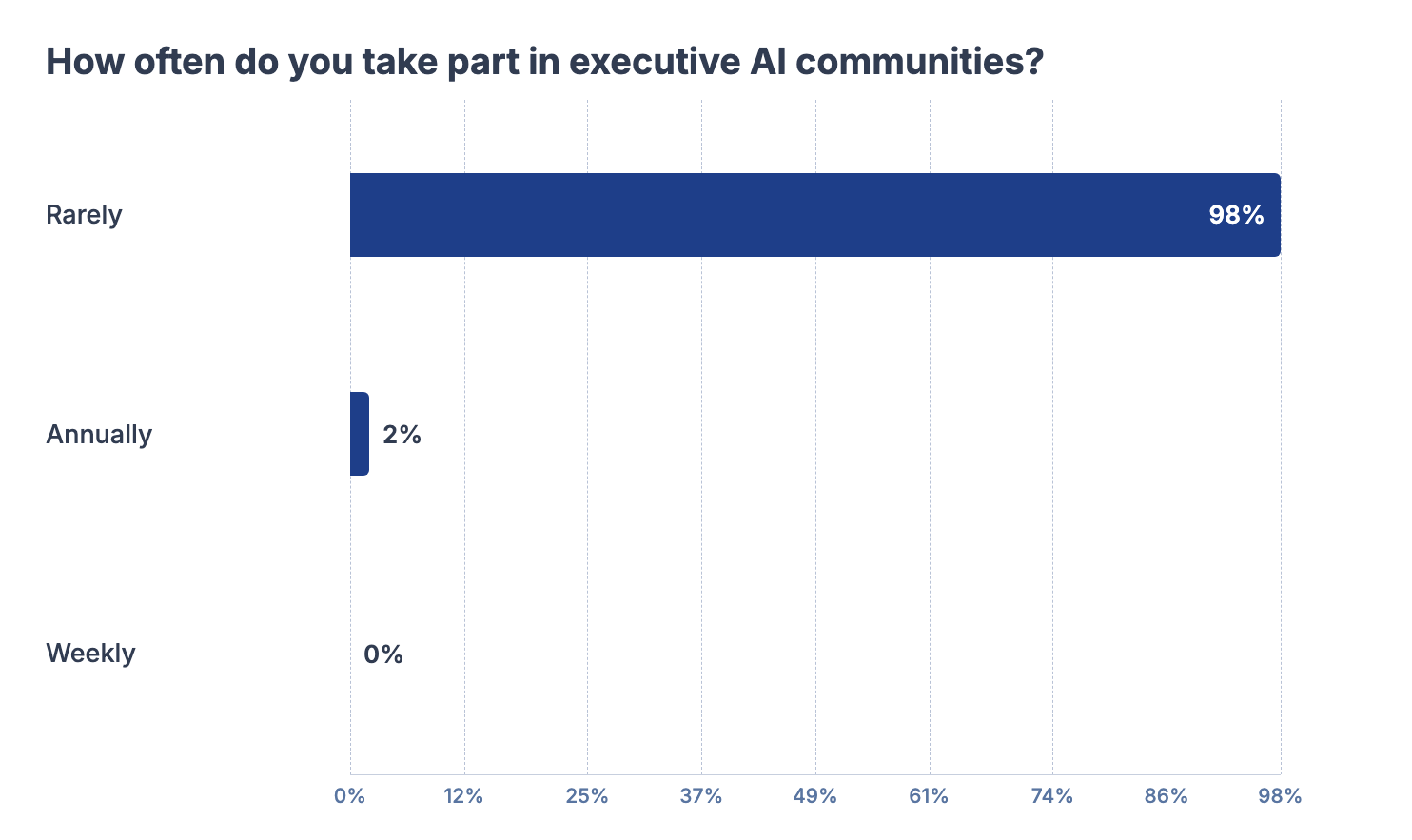
Corporate innovation leaders in the U.S. display a clear pattern in their participation in executive AI communities. 98% take part rarely, meaning they engage only occasionally or as needed, rather than making these communities a regular part of their routine.
Clearly, while leaders recognize the value of peer connections, they tend to prioritize other channels for day-to-day decision-making, relying on internal teams and trusted advisors rather than frequent community interaction.
Only 2% of corporate innovation leaders participate annually, indicating that a small group treats executive AI communities as a yearly checkpoint, perhaps in conjunction with major strategy reviews or budget cycles.
Finally, 0% engage in executive AI communities weekly, suggesting these communities aren’t built for high-frequency updates but for deeper, high-signal conversations that don’t require constant attendance.
More regular engagement could give innovation leaders greater access to practical knowledge from others facing similar AI challenges. Executive communities can offer trusted peer perspectives that help separate useful information from the hype and noise surrounding artificial intelligence. This explains why most leaders may choose to participate selectively rather than constantly, focusing on the quality of insights over the number of touchpoints.
How many executive AI communities are corporate innovation leaders members of?
86% of corporate innovation leaders are members of 2-3 executive AI communities, and 14% are members of 4-5 communities.
More than one community membership is common:
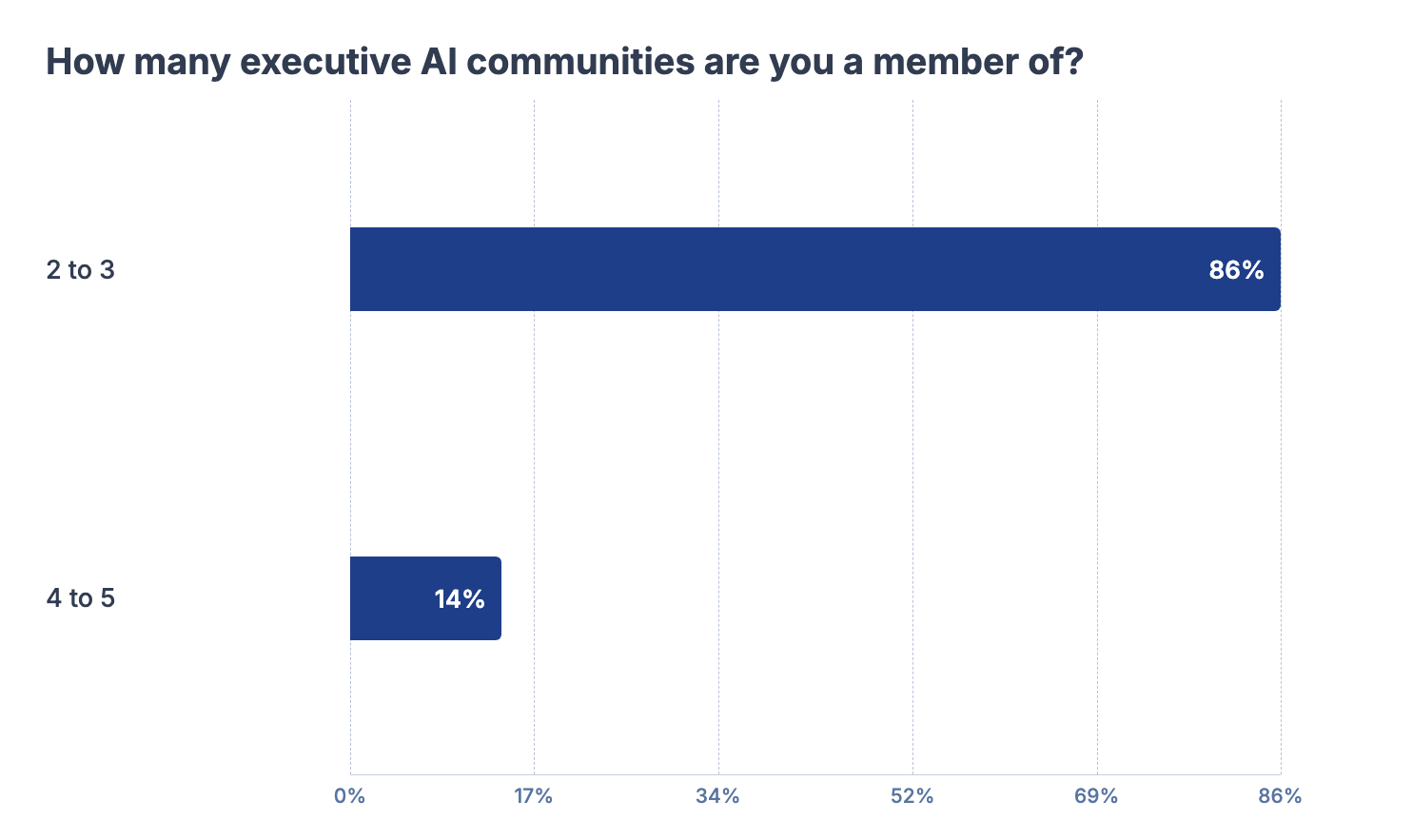
Corporate innovation leaders tend to maintain membership across a small number of executive AI communities. A substantial 86% of our audience belongs to 2 to 3 communities, suggesting that most people engage with a few peer networks rather than relying on a single source of executive AI knowledge.
By limiting their memberships to a small handful, these leaders can build stronger relationships, engage more meaningfully in discussions, and extract higher-quality insights without spreading their attention too thin. This approach aligns with the idea that trusted peer networks work best when participation is intentional and consistent, not scattered across many groups.
The remaining 14% of corporate innovation leaders are members of 4 to 5 executive AI communities, representing a smaller group with broader connections across these networks. These leaders likely seek broader exposure to diverse perspectives, industries, or specialized topics offered by different communities. Being part of more groups can help them spot emerging trends faster or connect with a wider range of experts, though it may also require more time to stay active in each space.
What is the main goal of corporate innovation leaders in joining executive AI communities?
For 27% of corporate innovation leaders, learning AI best practices is a top priority when joining executive AI communities, and this is an important goal for 32%, discovering AI startups is an important goal for 34%, and for 7%, networking and talent is a top priority for joining these communities.
Priorities differ by weight and type:
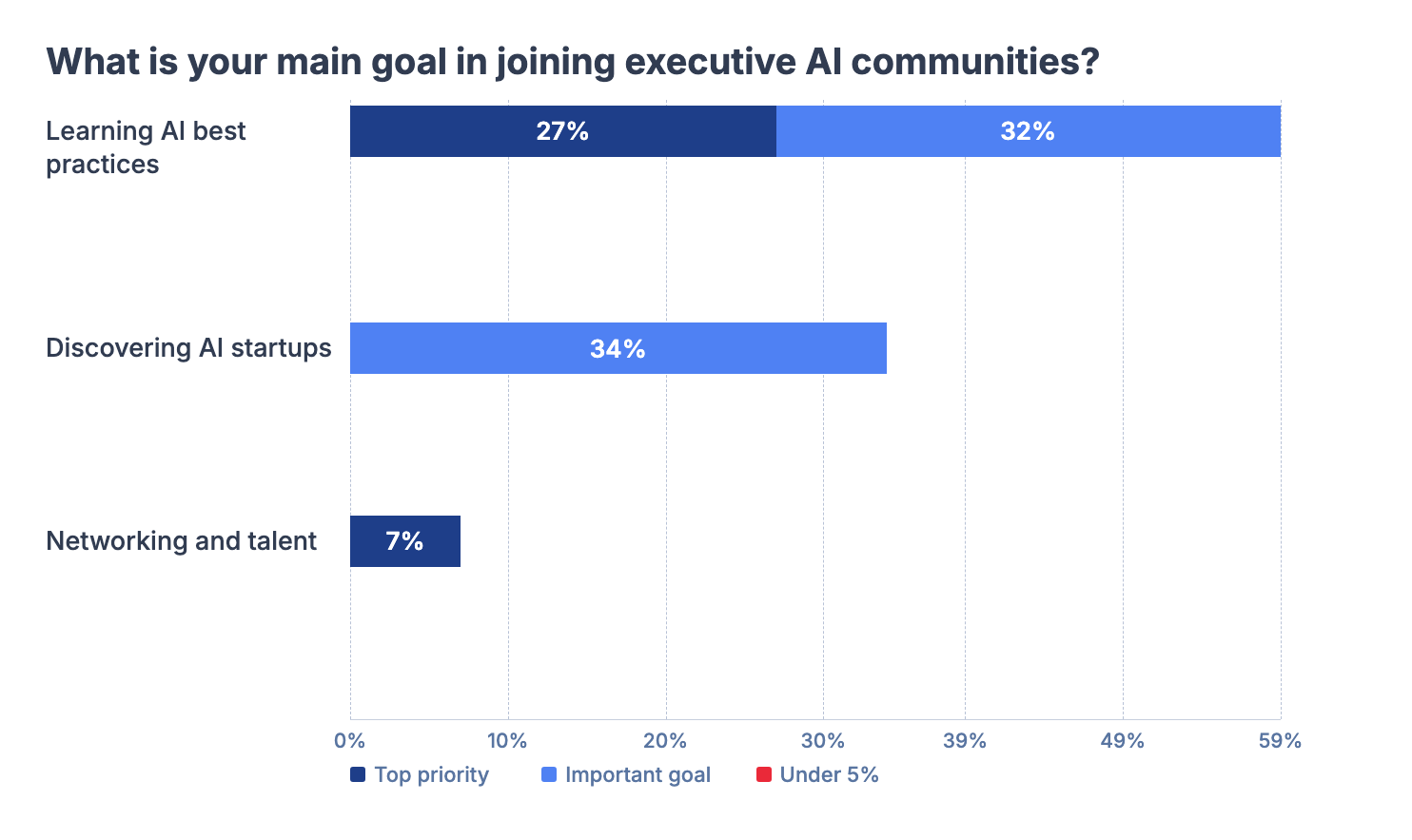
Learning how to apply AI effectively is a major reason corporate innovation leaders join executive AI communities. Learning AI best practices is a top priority for 27%, while another 32% consider it an important goal. These figures demonstrate that practical knowledge is central to community participation, with nearly three-fifths placing some importance on improving their understanding of effective AI approaches.
Discovering AI startups is also a clear objective, with 34% of leaders identifying it as important. This points to interest in finding new companies, technologies, and potential sources of innovation beyond established providers. For corporate innovation leaders, community connections can create opportunities to learn about emerging AI developments alongside practical experience from peers.
Networking and talent are a top priority for 7%, making it a smaller focus than learning best practices or discovering startups. The emphasis on practical AI knowledge also fits with McKinsey’s analysis of CEO involvement in AI, which describes senior leadership as an important factor in how organizations approach and implement AI. The range of goals illustrates that executive AI communities support both knowledge-building and connections to emerging opportunities.
Which AI use cases dominate talks in executive AI communities among corporate innovation leaders?
According to 15% of corporate innovation leaders, agentic AI workflows are the main focus in executive AI community discussions; 46% agree they are a frequent topic, and 9% say they are sometimes mentioned, while 2% point to generative AI copilots as the main focus; 14% say they are frequently mentioned, 10% say they are mentioned sometimes, and 2% say they are rarely discussed; while fewer than 1% agree that product and R&D and operations and supply chain are the use cases that dominate talks in executive AI communities.
AI use case discussions vary:
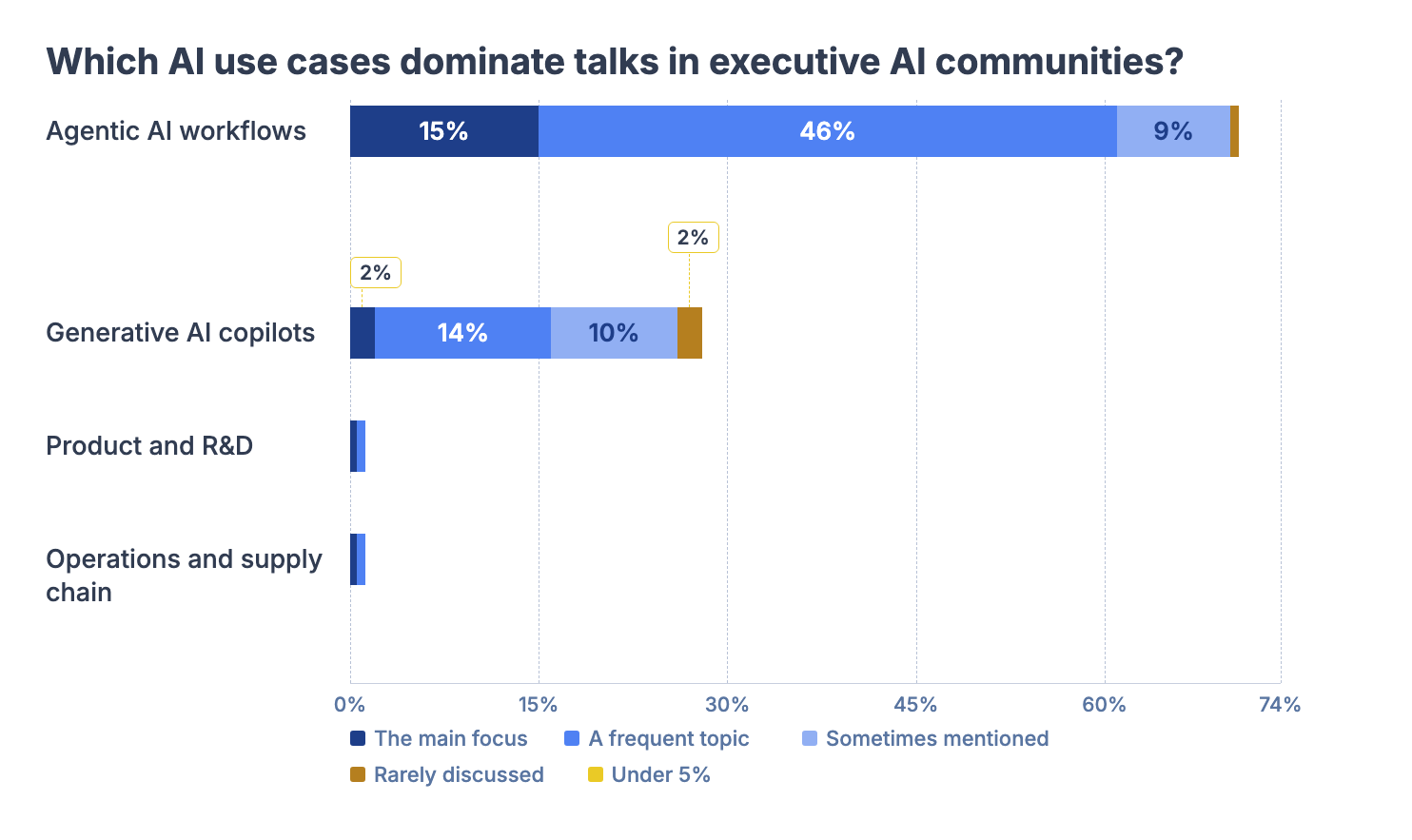
PwC’s research on AI agents reports that roughly 88% of U.S. executives plan to increase AI budgets to support agentic workflows. This explains why agentic AI workflows dominate conversations in executive AI communities. They are the main focus for 15% of corporate innovation leaders and a frequent topic for 46% of them. Another 9% of our audience mentions them sometimes, while less than 1% rarely discuss them.
Generative AI copilots receive less attention by comparison. They are the main focus for 2% of corporate innovation leaders, a frequent topic for 14%, and sometimes mentioned by 10%. A further 2% of leaders rarely discuss them, suggesting that copilots remain part of executive AI conversations but do not receive the same level of attention as agentic workflows.
Other business applications have very limited visibility in these communities. Product and R&D are the main focus for less than 1% of corporate innovation leaders and a frequent topic for less than 1%. Operations and supply chain follow the same pattern, with fewer than 1% identifying them as the main focus and fewer than 1% discussing them frequently.
How would executive AI communities rate the AI adoption stage of corporate innovation leaders?
32% of corporate innovation leaders are running AI pilots, 23% are exploring use cases, 21% have reached enterprise-wide AI deployment, 13% have AI-first operations in place, and 11% are scaling select use cases.
Adoption of AI is widespread:
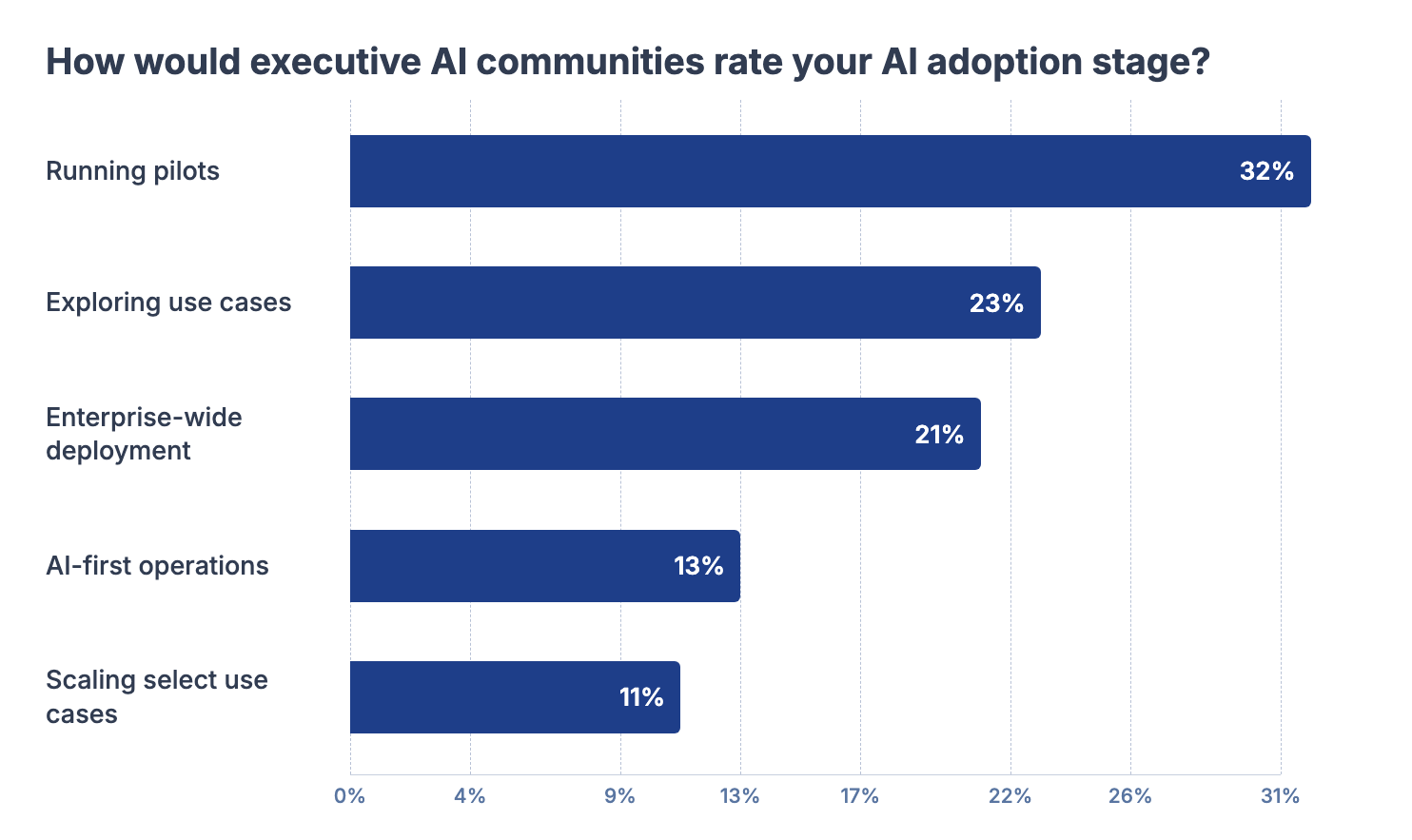
Executive AI communities see corporate innovation leaders at varied stages of AI adoption, with the largest group, 32%, still running pilots. This confirms that many organizations are actively testing AI solutions in controlled environments before committing to broader rollout.
Another 23% of corporate innovation leaders are exploring use cases, meaning they are in the discovery phase and identifying where AI can create value without launching formal pilots. Together, these two groups account for more than half of the leaders, indicating that experimentation and early-stage learning remain common.
Enterprise-wide deployment accounts for 21% of our audience’s opinions, indicating that a solid minority have moved beyond testing and are using AI across multiple departments or functions.
At first, operations account for 13%, indicating that these leaders have begun initial live implementations but are not yet scaling. The smallest segment, 11%, is scaling select use cases, showing focused expansion in areas where AI has already proven effective.
This distribution aligns with broader economic data showing U.S. business AI adoption reached approximately 22% in mid-2026, with most organizations lingering in early assistive stages rather than full enterprise-wide scaling, according to the Federal Reserve’s monitoring of AI adoption in the U.S. economy.
Who owns AI governance in firms where corporate innovation leaders are active in executive AI communities?
In 22% of corporate innovation leaders’ firms, the CIO or CTO is clearly responsible for AI governance; 31% agree they are likely responsible; 8% say they have some involvement; 18% agree that their risk or legal teams are clearly responsible for AI governance; 13% say these teams are likely responsible, but 2% say they are not, while 2% put innovation leadership firmly in control and 3% agree they are likely responsible.
Owning governance is divided:
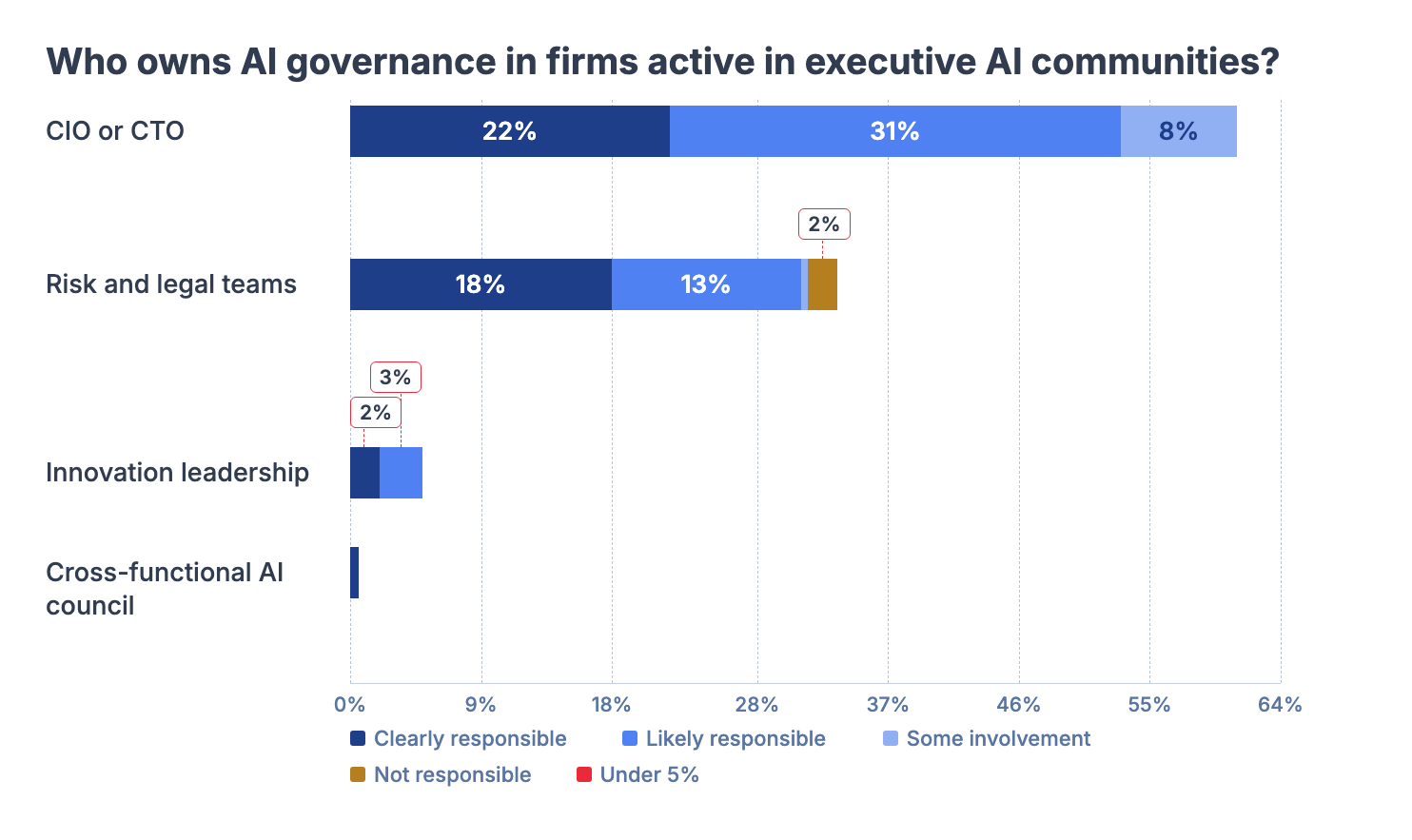
AI governance is most often connected to technology leadership among firms where corporate innovation leaders participate in executive AI communities. CIOs or CTOs are clearly responsible in 22% of cases and likely responsible in another 31%. A further 8% of corporate innovation leaders report some involvement, giving technology leadership a role across three levels of responsibility.
Risk and legal teams also have a defined role, although their involvement is less concentrated. They are clearly responsible in 18% of cases and likely responsible in 13% of cases. Fewer than 1% of our audience report any involvement, while 2% say these teams are not responsible. This reveals that governance extends beyond technology leadership to cover risk, compliance, and legal considerations.
Innovation leadership has a smaller direct role, with 2% of corporate innovation leaders describing it as clearly responsible and 3% as likely responsible. A cross-functional AI council is clearly responsible in less than 1% of cases. This structure indicates that AI governance can involve several parts of an organization, with technology and risk functions carrying the greatest responsibility. At the same time, innovation teams and cross-functional groups contribute in more limited roles.

The State of Innovation Readiness 2026
Read Now -> Where do organizations really stand on innovation? We surveyed over 1,000 professionals from corporations, government bodies, and universities to find out. Download the full report to get the insights.
Which AI compliance area is the hardest for corporate innovation leaders, according to executive AI communities?
EU AI Act exposure is the most challenging AI compliance area for 50% of corporate innovation leaders, but it is manageable for 9%; 30% find copyright and IP challenging, 2% find it manageable, and 2% don’t find this part of compliance hard at all, and 5% battle with industry-specific regulations.
AI compliance poses a myriad of challenges:
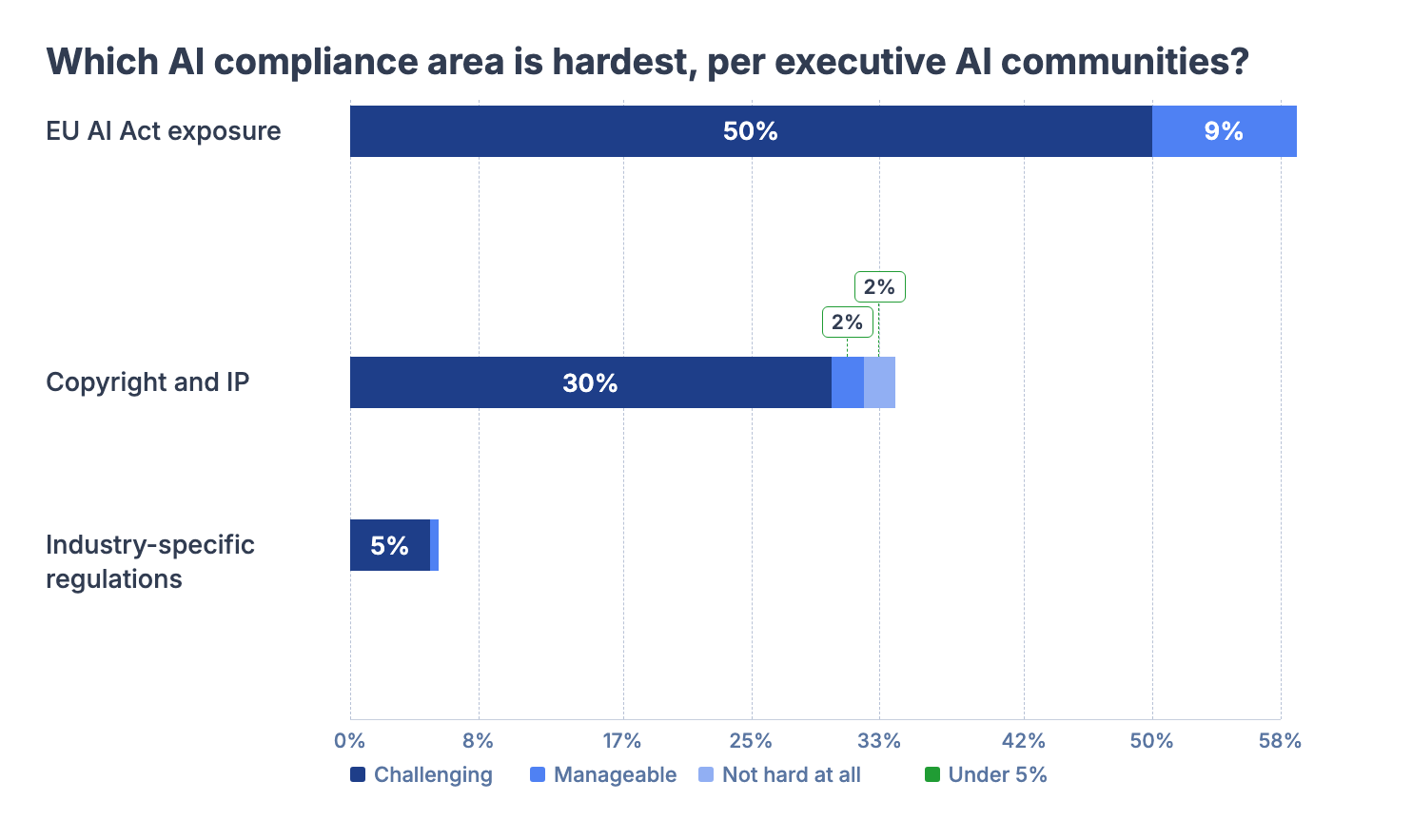
Corporate innovation leaders identify EU AI Act exposure as the most difficult compliance area, with 50% calling it challenging and only 9% viewing it as manageable. This sharp divide reflects the complexity of meeting new European requirements around risk classification, transparency, and documentation, especially for firms operating across borders.
The regulation demands careful alignment of AI systems with strict standards, which can strain resources and require significant adjustments to existing workflows. Leaders navigating these rules often turn to specialized guidance, such as the AI Act Explorer, to understand obligations and reduce uncertainty.
Copyright and IP issues rank as the second toughest hurdle, with 30% of corporate innovation leaders finding them challenging, 2% seeing them as manageable, and another 2% saying they are not hard at all. This illustrates that while many struggle with questions around training data, content ownership, and licensing, a small group feels confident in their approach.
Industry-specific regulations present less difficulty overall, with 5% of our audience labeling them challenging and less than 1% calling them manageable. The lower figures suggest that sector-based rules, while important, are often clearer or more familiar to leaders than the broader range of global AI compliance requirements.
What do corporate innovation leaders think blocks AI startup pilots discussed in executive AI communities?
For 20% of corporate innovation leaders, unclear business ownership is a possible blocker to AI startup pilots discussed in executive AI communities; 36% agree this is a minor blocker, but 32% don’t think it is a blocker; 6% agree that startup maturity concerns are a possible blocker for AI startup pilots; and 4% feel the same about procurement delays, with a further 1% citing these delays as a major pilot blocker.
Blockers come in different shapes and forms:
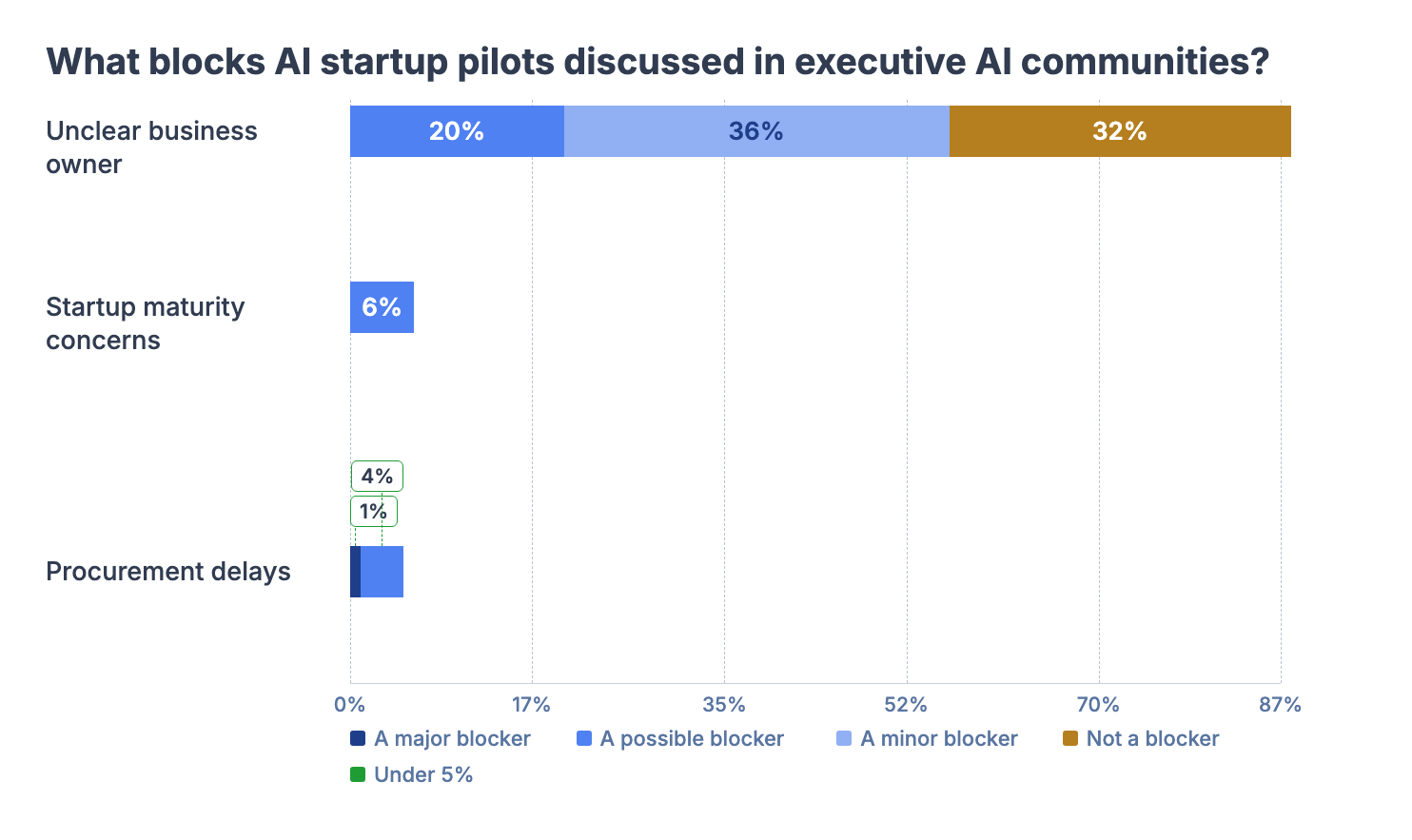
Unclear business ownership is a notable barrier for corporate innovation leaders when discussing AI startup pilots. It is a possible blocker for 20% and a minor blocker for 36%, while 32% do not consider it a blocker. This spread signifies that clear ownership can influence how smoothly pilots progress, helping connect them to practical goals and keep decisions moving.
Startup maturity concerns appear less often, with 6% of our audience identifying them as a possible blocker. Questions about whether an AI startup is ready to meet business needs can arise, but they are not a leading concern. Procurement delays have an even smaller role, with 1% describing them as a major blocker and 4% as a possible blocker.
The relatively low procurement figures contrast with wider evidence that AI pilots can remain in testing for extended periods. Zapier’s research on AI pilots found that 38% of companies had their longest-running AI pilot under test for more than a year, while 41% of stalled pilots cited IT infrastructure, data quality, or system integration issues. These factors show why moving from a pilot to broader use can involve challenges beyond choosing a startup.
What AI governance gap do executive AI communities help corporate innovation leaders close?
54% of corporate innovation leaders find that executive AI communities help to close the performance monitoring AI governance gap, but 18% find the help only somewhat relevant, 6% cite these communities as essential for closing the model risk framework gap, and a further 9% agree they are helpful in this area, while 12% find these communities helpful in closing the compliance gap created by the use-case approval process.
Communities play a role in closing crucial gaps:
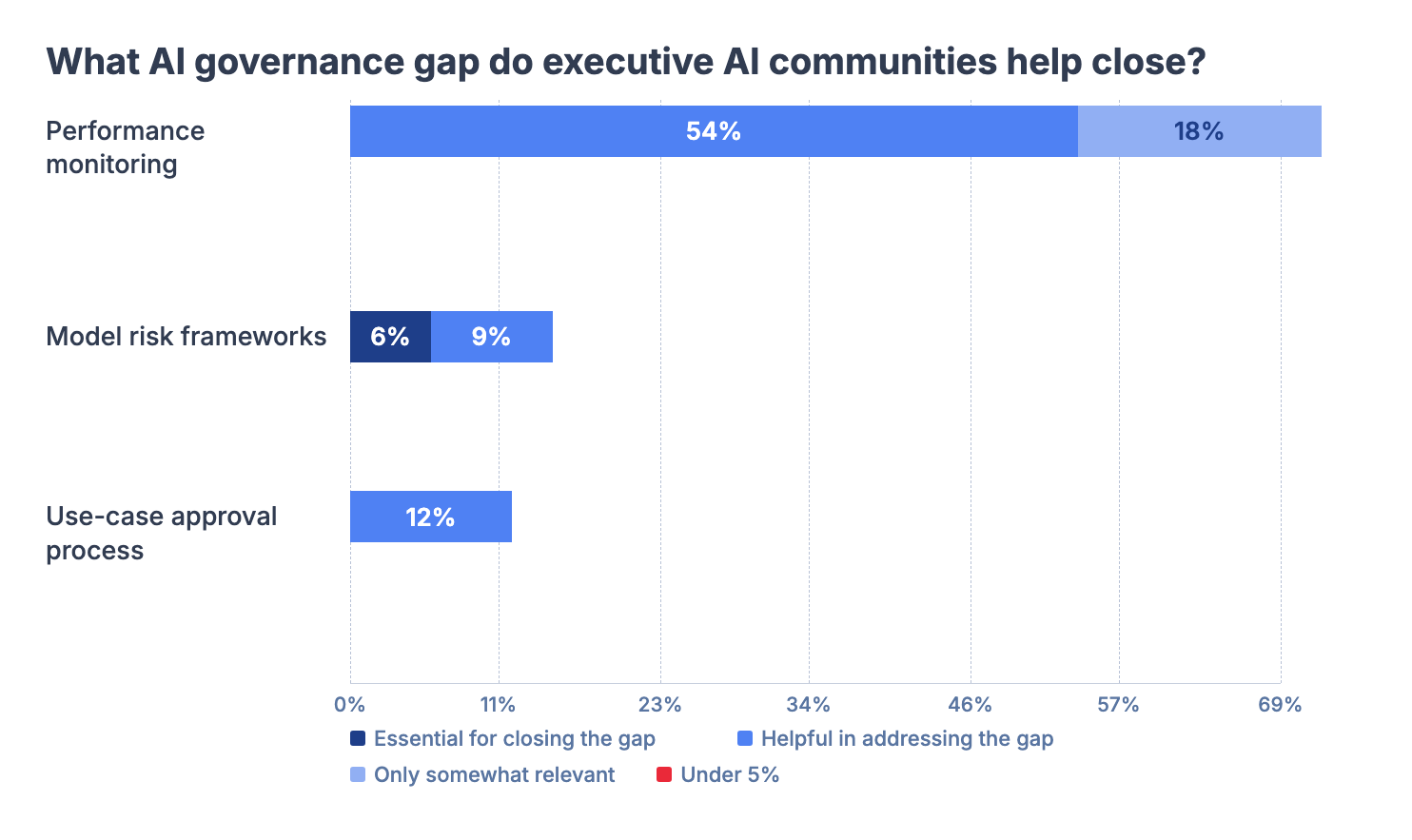
Executive AI communities play a strong role in helping corporate innovation leaders close the performance-monitoring gap. A clear majority (54%) find these communities helpful in this area, while another 18% of our audience sees them as only somewhat relevant. This demonstrates that peer networks provide practical guidance on tracking AI system outcomes, measuring ROI, and ensuring models continue to deliver value after deployment. Leaders benefit from shared metrics, dashboards, and real-world examples that make performance oversight more actionable and less theoretical.
Model risk frameworks are seen as relevant, with 6% of corporate innovation leaders calling them essential for closing the gap and 9% viewing them as helpful. This smaller but still weighted share indicates that while not every leader prioritizes formal risk structures, those who do see executive communities as valuable sources of templates, audit approaches, and governance best practices.
Use-case approval processes are seen as helpful by 12% of leaders, suggesting that communities provide useful input on evaluating, prioritizing, and greenlighting AI initiatives before they move into production.
How comfortable are corporate innovation leaders sharing insights in executive AI communities?
100% of corporate innovation leaders are very uncomfortable sharing their insights in executive AI communities.
Discomfort in sharing is unanimous:
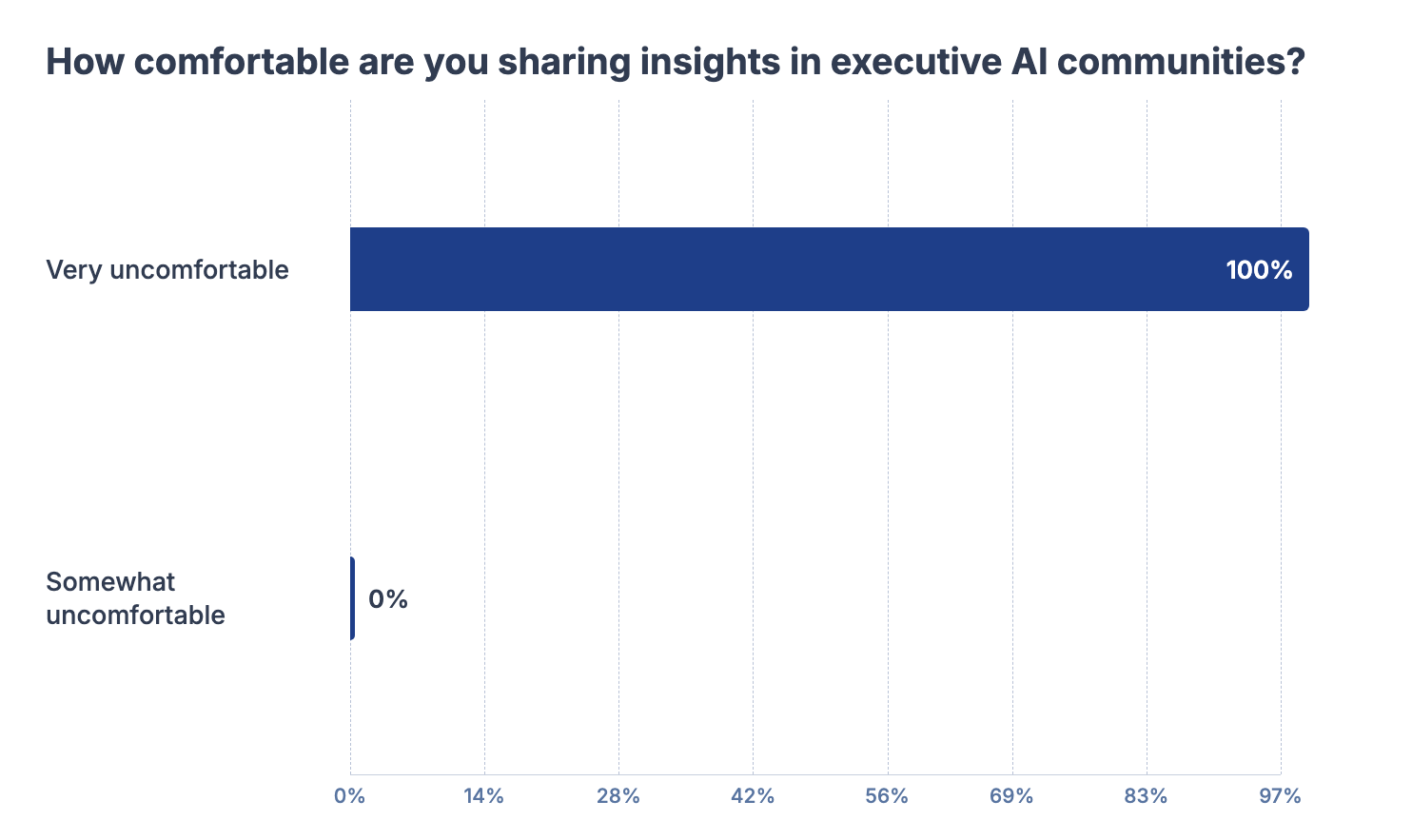
This chart reflects only the people in our sample who addressed this particular topic, not all 335,712 opinions analyzed. Results are based on opinions expressed online.
Corporate innovation leaders report clear discomfort when sharing insights in executive AI communities. A full 100% are very uncomfortable discussing or sharing their insights, while no one in our audience describes themselves as somewhat uncomfortable.
The strength of this result is important when considering the purpose of executive AI communities. Peer discussions can provide opportunities to exchange practical experiences, but open participation depends on people being willing to discuss what they are learning, testing, and encountering.
When every corporate innovation leader represented feels very uncomfortable sharing insights, the value of those conversations can be limited by a lack of open exchange.
The issue also connects with the broader discussion around how organizations approach AI-driven innovation. The Harvard Business Review discussion on how AI is changing innovation considers the wider challenges leaders face as AI changes the pace and nature of innovation.
For executive communities, creating conditions for leaders to share practical experiences is particularly relevant as organizations move through different stages of AI adoption.
Which AI topic do corporate innovation leaders most want covered in executive AI communities?
37% of corporate innovation leaders most want the topic of AI agents in production to be covered in executive AI communities, and 53% would like to see this topic covered; however, for 4%, it is not their main interest, while 1% prioritize seeing pricing and licensing covered, 2% would like to see this happen, and another 2% are not interested in this topic.
One topic takes the lead:
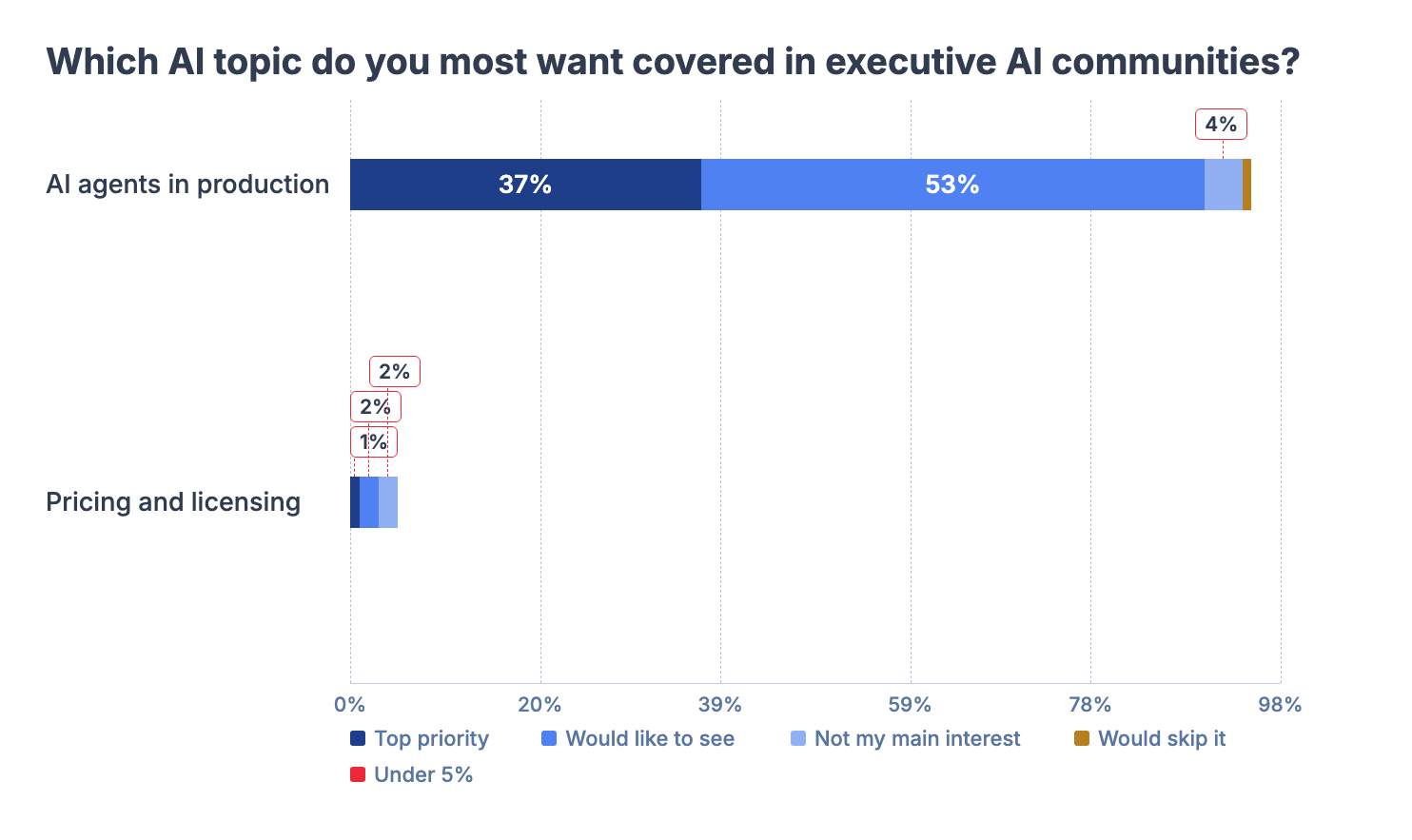
AI agents in production are the distinct priority for corporate innovation leaders seeking topics in executive AI communities. They are a top priority for 37% of our audience, while 53% would like to see them covered. Only 4% say the topic is not their main interest, while less than 1% would skip it altogether.
The strong demand for production-focused content points toward a practical stage of AI adoption. Rather than focusing only on what AI agents can do, corporate innovation leaders want to discuss how these systems work in real business environments. This also connects with the earlier focus on agentic AI workflows, which appeared as the leading subject in executive AI community discussions.
Pricing and licensing receive much less attention. Just 1% of corporate innovation leaders consider the topic a top priority, while 2% would like to see it covered. Another 2% say it is not their main interest, revealing that commercial considerations remain relevant to a small group but are not a leading topic overall.
How do executive AI communities influence the AI budget of corporate innovation leaders?
For 100% of corporate innovation leaders, executive AI communities have a moderate influence over their AI budget.
Budget influence is evident but not overpowering:
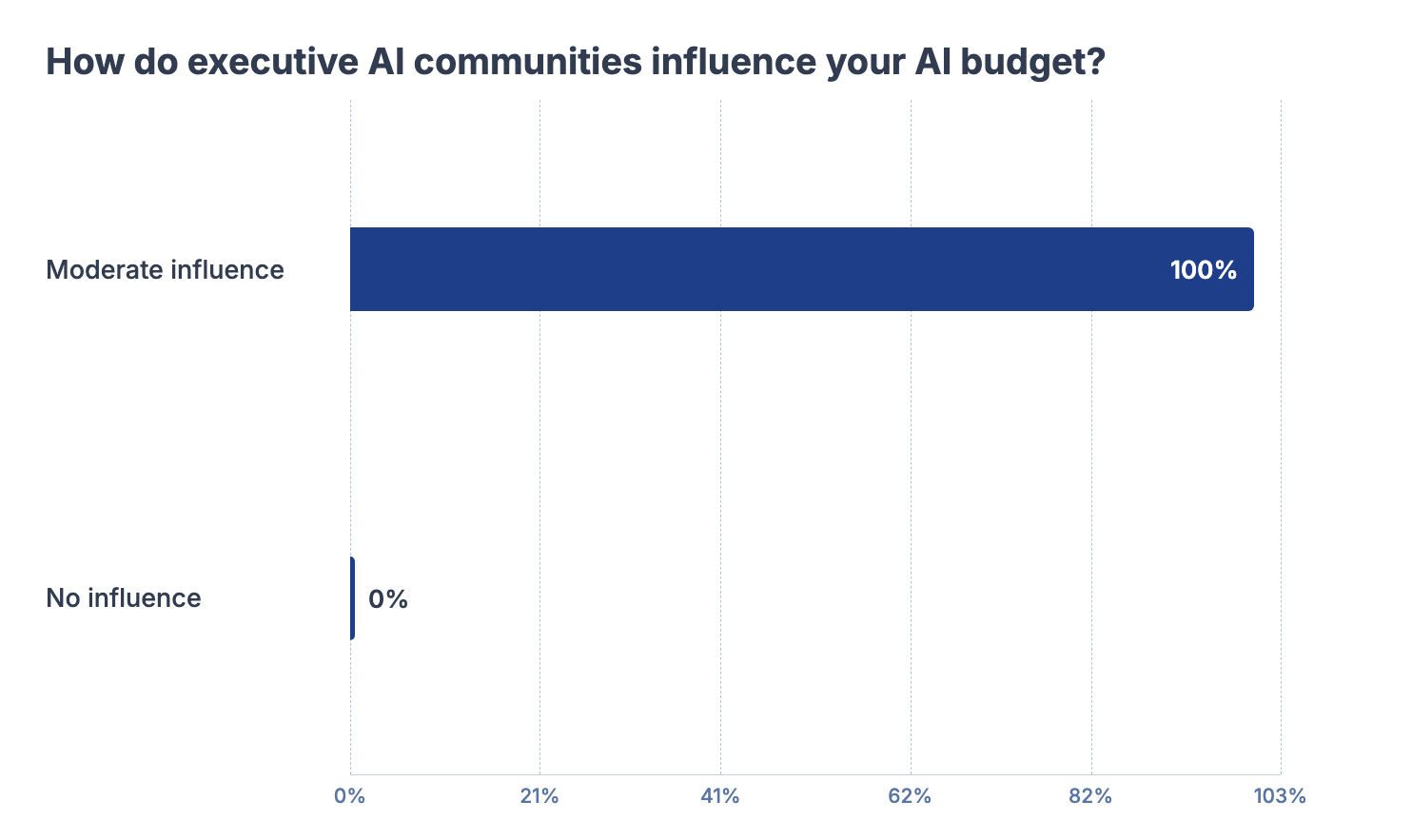
This chart reflects only the people in our sample who addressed this particular topic, not all 335,712 opinions analyzed. Results are based on opinions expressed online.
Executive AI communities exert a moderate influence on the AI budgets of corporate innovation leaders, with 100% reporting this level of impact. This universal rating shows that while these communities do not dictate spending decisions, they consistently shape how leaders think about priorities, vendor choices, and investment timing.
Peer insights help leaders justify budget allocations, identify high-value use cases, and avoid costly missteps, making the influence steady and meaningful without being overpowering. With 0% saying these communities have no influence, the data confirms that peer exchange always touches budget discussions in some way.
The scale of current AI spending provides useful context for this influence. U.S. companies spend an average of $11.5 million per year on enterprise AI, while average spending per employee is $2,068.
With budgets already at significant levels, insights shared through executive AI communities can inform how organizations set priorities, select applications, and plan future investments. Financial decisions can therefore incorporate peer knowledge alongside factors such as business needs, technology requirements, and the expected value of AI initiatives.
What will executive AI communities focus on most by 2027, according to corporate innovation leaders?
According to 44% of corporate innovation leaders, executive AI communities’ main focus by 2027 will be on agentic AI; 46% think this will be an important focus, but 8% think it will become less important, and 3% don’t think it will be a focus at all.
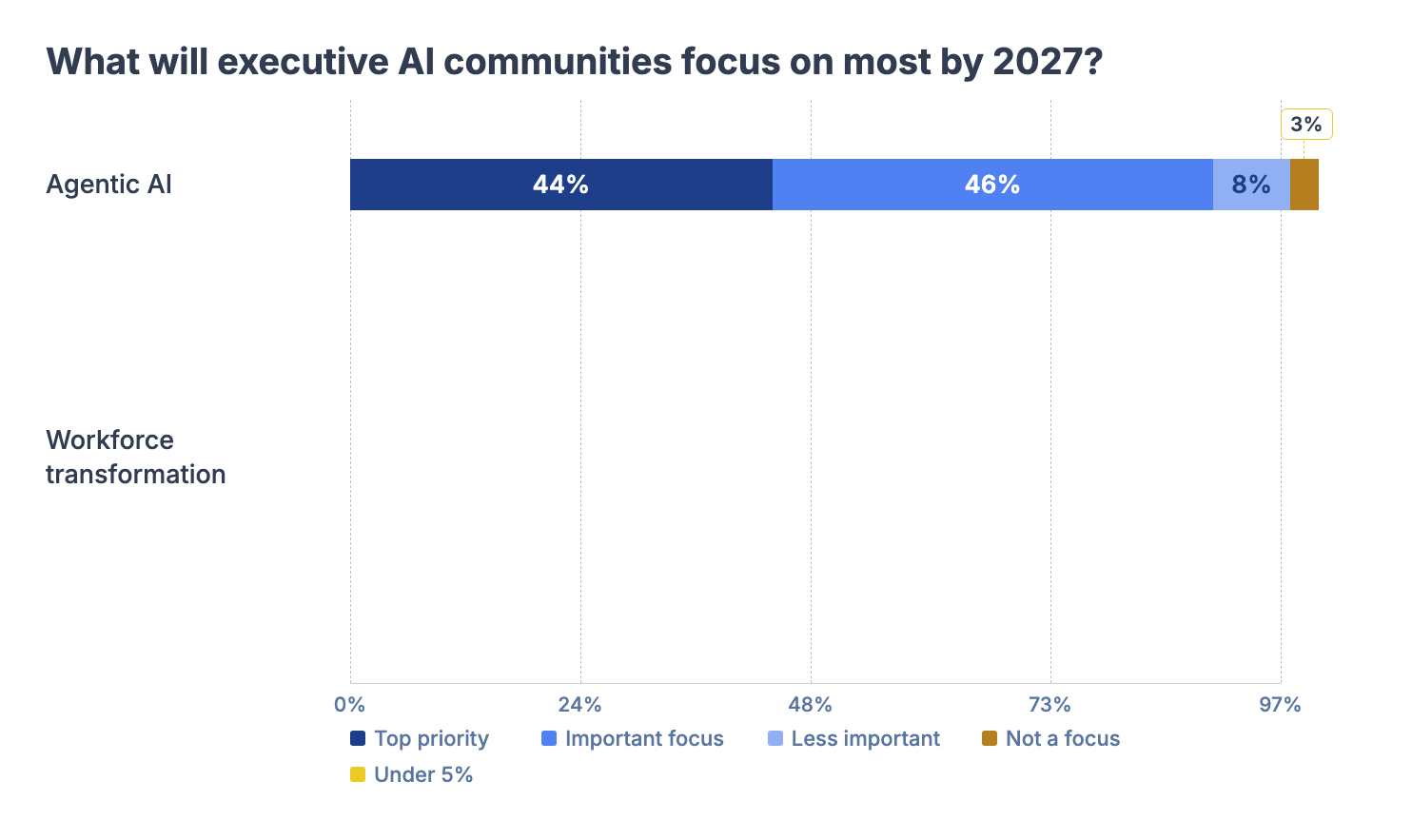
Percentages are rounded to the nearest whole number, so the total may add up to slightly more than 100%.
Agentic AI is set to dominate executive AI community discussions through 2027. It is a top priority for 44% of corporate innovation leaders, while another 46% consider it an important focus. A further 8% see it as less important, and just 3% do not expect it to be a focus. This means the topic is relevant to almost the entire group, with only a very small share of the group placing it outside their priorities.
The strong focus on agentic AI reflects growing attention on systems that can carry out tasks with greater independence. However, increased interest also necessitates careful evaluation as organizations move from experimentation to wider use. Gartner’s analysis of agentic AI projects indicates that more than 40% could be canceled by the end of 2027, citing issues such as unclear business value and rising costs.
Workforce transformation receives no responses in this conversation, so it does not appear to be a focus among the corporate innovation leaders represented here. The data points to executive communities concentrating heavily on the technology and its practical development over the coming period.
Which U.S. region hosts the most executive AI communities that corporate innovation leaders attend?
50% of corporate innovation leaders attend the most executive AI communities on the West Coast, and the other 50% attend these communities in the Northeast.
Community hosts are evenly divided:
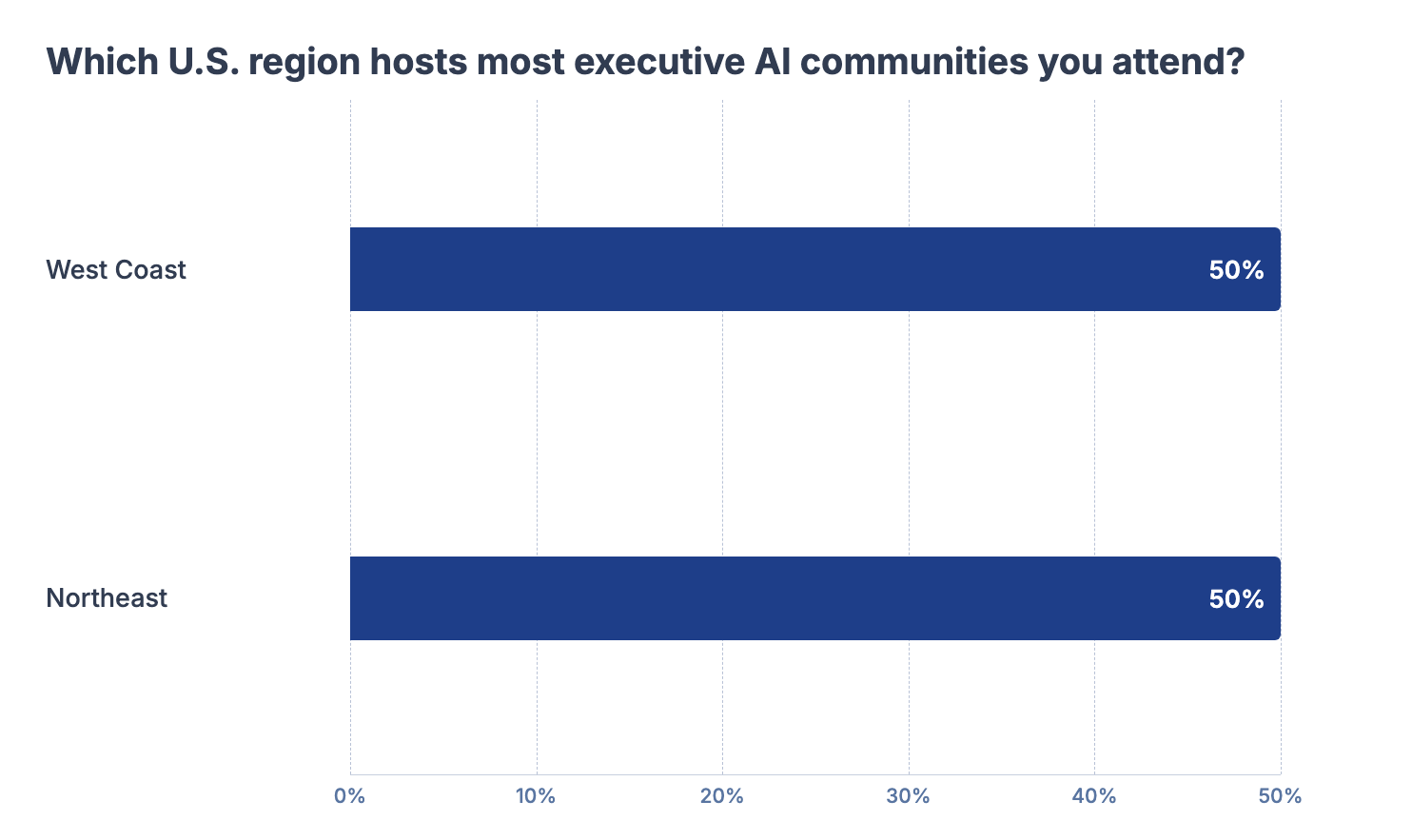
Because the number of opinions on this topic is smaller than the full sample, results may appear more uniform than they would across a larger group.
Corporate innovation leaders attend executive AI communities evenly split between two key U.S. regions. The West Coast hosts 50% of these gatherings, drawing on its deep ties to Silicon Valley, major tech firms, and a dense network of AI startups and investors. This region offers direct access to cutting-edge research, venture capital, and product teams shaping the future of artificial intelligence.
The Northeast also accounts for 50%, leveraging strengths in finance, healthcare, academia, and enterprise technology hubs like New York and Boston. Together, these two coasts form the core geography for high-level AI peer exchange in the United States.
The equal split shows that leaders value both innovation ecosystems for different reasons. The West Coast provides proximity to product builders and emerging technologies, while the Northeast connects AI strategy to regulated industries, capital markets, and research institutions.
This balance illustrates that AI adoption is no longer confined to a single sector or location but thrives where technology meets real-world business scale. These regional strengths help to shape where executive communities form and how they drive practical AI deployment across industries.
What the data tells us
These statistics show that corporate innovation leaders use executive AI communities selectively, primarily to gain practical knowledge, discover emerging AI opportunities, and inform investment decisions. Agentic AI is the dominant theme, with a strong interest in moving AI agents from experimentation into production.
Governance and compliance remain significant challenges, particularly around performance monitoring and global requirements. However, limited willingness to share insights may restrict the value of peer exchange. Looking ahead, executive communities are expected to remain focused on practical agentic AI adoption and implementation.

PLUG AND PLAY AROUND THE WORLD
Discover our global locations
We have a community of experts all over the world. We work as a bridge between Silicon Valley and the rest of the world, making innovation open to anyone, anywhere.