
With the proposed Financial Data Access (FiDA) regulation, open insurance nears reality in Europe. Part of the broader open finance concept, it puts the insurance industry on the precipice of a significant transformation. Customers (B2B and B2C) will be in control of their data. Their informed consent is needed to share data. This urges incumbents (data holders) and other players (data users) in the insurance sector to start preparing for the new reality by adjusting their operations to new data usage and sharing practices in schemes that need to be developed. FiDA will bring huge benefits to customers and the industry.
Policy in progress: Open insurance paving the way for industry transformation
Open insurance is a concept that promotes the sharing and utilization of data across different organizations through a regulated, transparent framework. This concept is inspired by the successful implementation of open banking, where financial data is shared between banks and third-party providers to create a more integrated and user-friendly financial ecosystem.
At its core, open insurance involves using APIs to facilitate the secure exchange of insurer-held data with authorized third-party providers. This can include data about policies, customer claims history, and other relevant information that can help enhance services and create new products. The goal is to increase transparency and improve innovation within the industry. By opening up data in a controlled manner, insurance companies can collaborate more effectively with tech companies, startups, and other financial service providers to offer a more personalized and efficient service to consumers.
Open insurance’s 3-tier structure
Open insurance operates through a three-tier structure:
-
The base layer of insurance products and services,
-
A middle API layer for connectivity and capability delivery
-
And a top layer that fosters collaboration and scene integration with business partners.
This setup supports on-demand, highly digital, and flexible solutions. The model adopts an “away game” strategy to extend insurance reach and integrate services deeply, with information sharing and privacy safeguards as fundamental elements.
Why open insurance is gaining traction in Europe now
The concept of open insurance has returned to the forefront of discussion due to recent regulatory efforts by the European Commission to extend data access rules to the insurance sector. These developments are part of a broader discussion on the role of data in the insurance industry.
Technological advancements and regulatory frameworks underpin the facilitation of open insurance. The proposed FiDA regulation by the European Commission is particularly pivotal. It sets the groundwork for standardized data-sharing practices, allowing insurers to share both personal and non-personal information with third parties, with specific exclusions for sensitive products due to consumer protection concerns.
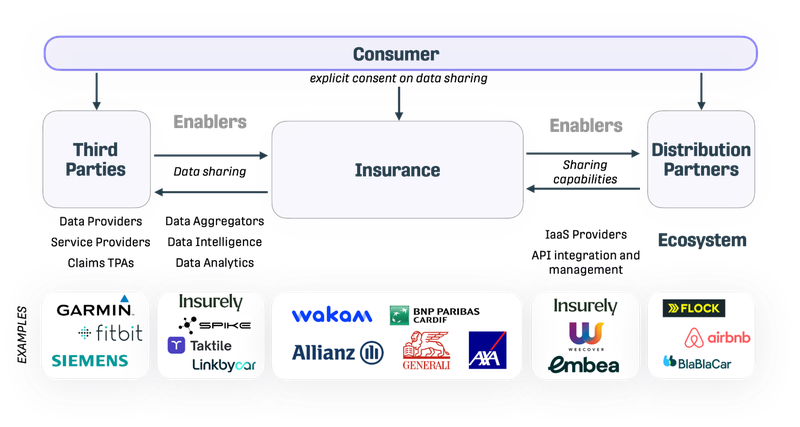
A few companies are actively testing innovative business models in response to the evolving standards introduced by open insurance and the emerging realities of open data ecosystems. These adaptations leverage the increased transparency and interoperability:
-
Insurance as a platform: Acts as a comprehensive hub that provides access to an extensive selection of insurance and non-insurance services from insurers and third-party providers.
-
Example: BNP Paribas Cardif now includes Lemonade’s rental insurance in its portfolio, showcasing its expansion to incorporate third-party offerings.
-
-
Open insuring: Offers platforms that supply crucial infrastructure services for the insurance industry, including risk assessment and claims management.
-
Example: Allianz’s API portal features a broad range of insurance products designed to meet the varied requirements of different market participants.
-
-
Insurance as a service: Enables the integration of insurance products on third-party platforms, facilitating a smooth and cohesive customer experience.
-
Example: BlaBlaCar has integrated Axa’s insurance products into its platform, enhancing user access to insurance services.
-
From open insurance to open finance: Redefining financial ecosystems
You have probably heard of the open banking concept before. In Europe, it was first introduced almost 10 years ago, in 2015, when the European Parliament passed a PSD2 (Payment Services Directive 2) and adopted it in 2018. Put simply, it was a revolutionary implementation that allowed banks to give third-party service providers access to and control customers’ personal and financial data through API. It led to the creation of new companies such as Yapily, Truelayer, Token.io, and many more. They have changed the way we engage with financial systems today, allowing for banking data aggregation, which can be used for different purposes, ranging from seamless onboarding, money management, one-click payments and checkouts, value-added services at the point of sales, and insights into our financial behavior across the channels.
Open banking has been and continues to be a driving force for innovation in the financial industry. In 2020, Europe counted over 12 million open banking users, which is expected to reach over 63 million in 2024. On the one hand, open banking improves the customer experience by enabling the secure and seamless sharing of financial and personal data with third parties, such as fintechs, but also with adjacent industries, resulting in access to new, innovative products and limited effort to access them. On the other hand, it gives both banks and other financial service providers insight into the economic situation of their customers, enabling them to provide personalized offers and value-added services.
But what are the implications of open banking (and, more broadly, open finance) for the insurance industry? The nature of data sharing is applicable across industries, including insurance. It opens the doors for innovators to enter the market and disrupt the status quo, enabling hyper-personalization and product customization, which is important in insurance products. Given the widespread adoption of the technology among banking users, there is no doubt that insurance customers will follow the trend. The number of open insurance users is forecast to reach 75 million by 2024. If we assume that 50% of the adoption will be in Europe (which is the case with open banking, making Europe the largest user of open banking), the number of users will be around 37m.
The introduction of PSD2 in 2015 set the stage for a seamless sharing of payment account data with third-party payment service providers and revolutionized how we use fintech products today. The directive is strictly focused on the payments ecosystem. Yet, its implementation laid the foundation for the new regulations, enabling the broadly understood open finance and, thus, open insurance. We are talking about GDPR (General Data Protection Regulation, adopted in 2016 and applicable since 2018), FiDA (proposal was published in June 2023 and likely to be taken through parliament in late 2024 or the beginning of 2025), as well as PSD3 & PSR (Payment Services Directive 3 & Payment Services Regulation, proposed in 2024), which prepare the ground for clear and more transparent open insurance framework. The forthcoming regulations will require insurance companies to establish unified data-sharing methods with third parties. Looking ahead, the implementation of FiDA, leveraging what was learned from PSD2, will be pivotal for the insurance industry.
Driving transformation: Tech and legislation in open insurance
Open insurance revolves around the seamless flow of data. Its framework relies on two fundamental pillars: advanced technology and robust legislative frameworks. By harnessing the power of data flows, open insurance aims to revolutionize the insurance industry by promoting transparency, efficiency, and enhanced customer experiences.
Revolutionizing the insurance industry through technology
The initial pillar focuses on technological readiness, emphasizing the importance of reaching a significant level of technological advancement and integration to drive the progress of open insurance. APIs — like in open banking enabled by third-party developers — have been available for insurance providers for a long time. However, their adoption levels at each step of the value chain remain low, with insurance providers predominantly resorting to APIs in policy servicing and administrative support domains. Some of the use cases here would be retrieval of policy data or billing account management. The next most popular part of the value chain for insurance providers to integrate API into appears to be sales and distribution, which essentially means embedded insurance offerings. This kind of API could tackle insurance purchases or customer communications.
Hence, there is still room to expand API adoption. That’s where we see the crucial role of insurtech startups in bringing value to insurance providers. By being plugged into each step of the value chain, startups could solve multiple pain points for insurers and drive up overall adoption levels. On top of that, the agility of standalone tech-driven solutions allows for a faster pace of innovation and shortened time to market.
One example could be SPIKE (USA/Europe, seed), which offers an API that gathers data from wearables and IoT devices. The platform is tailored for Digital Health platforms and insurance providers with the vision of becoming the largest health data provider. Open insurance would empower Spike to ensure that the data shared between the devices and the partners/clients is compliant and safe. That will enable a streamlined customer experience and more personalized offerings delivered by insurance to their clients based on accurate health data.
Another example is Taktile (USA, series A), a software platform that allows businesses to build, run, and evaluate automated decision flows quicker and more data-driven than ever. Taktile could enhance data accuracy and streamline insurance cases’ real-time risk assessment process through an open insurance data-sharing framework.
Breaking down the EU Commission’s milestone legislation for open insurance

Despite the multitude of startups in the space, open insurance has been slowed by the pillar outstanding — legislation. June 2023 marked a significant milestone for open insurance, with the EU Commission passing the first draft of FiDA. This legislation mandates insurers to open specific data sets to third parties and gives customers an overview of how their data is shared via specially designed dashboards. Specific insurance sectors could gain greater advantages from the legislation due to its exclusion of health-related aspects, like safeguarding highly sensitive personal data.
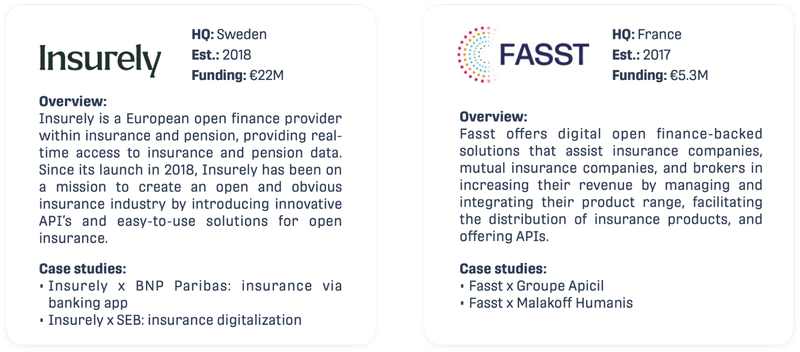
A Swedish startup, Insurely believes that the legislation will boost innovation in the insurance sector, allowing for a range of new products and services. Due to the transparency of personal data flows and interactive digitized experiences, policyholders will likely become more loyal to and satisfied with their insurers. Last but not least, third-party data will allow insurers to tailor their products to the needs of individual customers based on their needs.
While the legislation fills the missing piece of open insurance and aims to benefit both customers and insurers, crucial parts could influence the degree of changes and positive outcomes for the industry. For example, the most diverse customer data volumes lie within tech companies like Apple, Meta, etc. These prominent tech players, also called “gatekeepers,” could apply for a permit to access insurers’ data. Still, insurers have not yet established a structured method to access third-party providers’ data. Currently, insurers can only benefit from each others’ data but not from the data held by tech incumbents. Going one step further, the question is whether Apple will ever be willing to open up its health data to insurers versus utilizing it themselves to launch competing product offerings. If not, can amended legislation really impose this?
Florian Graillot of astorya.vc raises an even bigger question — the notion of data, which is not as straightforwardly defined in the FiDA for insurance providers. Insurers primarily hold declarative data on their policyholders, unlike banks that deal with transactional data. The potential mutual benefits of data sharing between these parties have yet to be fully realized.
As Harold Mahadew of the Dutch Association of Insurers points out, open insurance is a game-changer and all about collaboration. Therefore, establishing extensive partnerships with insurtech firms is not just nice to have for insurance companies but nearly a must to innovate at speed and introduce new data-driven products and services for the benefit of customers is closer than we think. On top of the legislative framework, he expects collaboration to introduce new premium services. However, as we already saw with open banking, the first mover wins, and that is why we are continuing the article with a deep dive into two startups that offer holistic solutions for open insurance.
Open insurance startups you should keep on your radar
When we look at the opportunities that open insurance is creating in the insurance industry, it is clear that it is opening doors for startups to drive innovation in the space. These companies are using the principles of transparency in data sharing, interoperability, and a customer-centric approach to enable a new era of insurance services and experiences. Two European startups stand out when discussing the first movers adopting open insurance: Insurely from Sweden and Fasst from France.
Paving the way for customer-centricity
Open insurance marks a natural progression in the financial sector, akin to the transformative journey initiated by open banking. Fueled by technology and regulation, it promises a revamped insurance landscape of transparency, accessibility, and innovation. Insurers must pivot towards an API-centric approach to thrive in this digital era, forging strategic partnerships and leveraging shared data to deliver personalized products and services. Ultimately, open insurance represents a shift towards a more collaborative, customer-centric ecosystem, offering insurers opportunities for growth and differentiation in an evolving digital landscape.