To find out what 1,176,763 opinions of corporate innovation leaders in the U.S. were about corporation innovation, we utilized AI-driven audience profiling to synthesize insights from online discussions over 12 months, ending on June 22, 2026, to a high statistical confidence level. The results uncover how organizations are approaching innovation, where they are investing their efforts, and the priorities shaping the next generation of business growth.
articleJul 16, 2026
Corporation Innovation Statistics: U.S. 2026
By analyzing 1,176,763 opinions of corporate innovation leaders, trends become clear. Examine the latest statistics impacting US business innovation.
Innovation has never been more important, but the way that organizations pursue it is changing. Companies are looking beyond in-house ideas, embracing new technologies, and building stronger partnerships to stay ahead in increasingly competitive markets. At the same time, leaders face growing pressure to prove the value of innovation while balancing risk, investment, and long-term growth.

Index
- 33% of corporate innovation leaders rate their organization’s innovation maturity as established with proven processes, 33% are in the early or exploratory stage, 22% are already innovation-led, or market leaders, and 11% are still developing structured programs
- 93% of corporate innovation leaders outsource to external partners, while 6% have adopted a hybrid model for their innovation team, and 1% have decentralized across business units
- Defending against disruption is an important goal for 22% of corporate innovation leaders, but this isn’t a main focus for 50%. And it’s not a priority for 12%, while driving new revenue streams is a top priority of corporate innovation programs for 8%, and another 8% are aiming to build long-term strategic optionality and improve internal processes
- Dedicated innovation funds are a significant contributor to 87% of corporate innovation leaders’ programs, and the main funding source for 7%, while external grants or partners are only the main source of funding for 1%, and contribute significantly for a further 1%, and corporate R7D budgets are used significantly by another 1%, and play a minor role in funding for the remaining 1%
- Innovation budget expectations for the coming year show a limited appetite for flat spending, with fewer than 2% of corporate innovation leaders explicitly expecting budgets to remain unchanged, while 40% actively dismiss the idea, expectations around budget cuts carry more weight, with 9% already planning reductions and a further 18% leaning toward lower spend, although 7% do not consider cuts and 3% firmly rule them out
- 69% of corporate innovation leaders have allocated less than 10% of their budget to AI-related initiatives, 10% have dedicated between 10 and 25%, 15% between 25-50%, and for 15% more than 50% of their budget is going towards AI
- 25% of corporate innovation leaders’ top priority right now is cybersecurity, it’s a strong focus for 48%, and not a main focus for 14%, with another 10% stating it’s not a priority for them, while just 1% are putting a strong focus on artificial intelligence, and no one is prioritizing sustainability or climate tech, or automation and robotics
- For 38% of corporate innovation leaders, AI has not made any real changes to their strategies as yet, 32% agree that this technology has led to moderate adjustments, 26% have seen a major shift in priorities, and 5% feel it’s only had a minor influence so far
- 53% of corporate innovation leaders are uncertain about their confidence in their organization’s AI roadmap, 46% don’t have a clear roadmap whatsoever, and only 1% feel very confident, and a further 1% are somewhat so
- 40% of corporate innovation leaders’ teams use generative AI like Claude or ChatGPT sometimes, 2% say it’s their top choice, and 8% rarely use it, while 1% use custom models as their top choice, and 6% use these sometimes, and 3% sometimes use predictive analytics platforms, 39% are not using any AI tools currently
- For 42% of corporate innovation leaders, corporate venture capital is a strong option for external innovation engagement, but it’s not a focus for 34%, while 24%’s main approach is university or research partnerships. And 1% agree that a corporate accelerator or incubator is a strong option for engagement
- 53% of corporate innovation leaders run a formal accelerator program as a core strategy to working with startups, 24% use the core strategy of ad-hoc scouting and pilots, 10% see this as an important approach, and 8% consider it a minor approach, while 2% have limited to no startup engagement as their core strategy, and 7% deny this is their approach
- 51% of corporate innovation leaders primarily source promising startups via accelerator programs, 39% rely on VC or investor networks, and 10% on internal scouting, while no one mentions inbound applications in this context
- Venture capital firms definitely deliver the most value for 23% of corporate innovation leaders’ efforts, and 26% agree they add significant value; however, 19% feel the value they add is limited, and 15% say they deliver little value, compared to the 10% who cite startup accelerators as delivering value, and 4% who share the same sentiments about universities and research labs
- 93% of corporate innovation leaders’ teams manage more than 30 active startup partnerships, while just 7% manage between 1 and 5, putting the majority on the higher end of the scale
- 51% of corporate innovation leaders pilot new emerging technologies quarterly, 40% do so annually, 5% rarely, and the remaining 5% are continuously piloting new tech
- For 51% of corporate innovation leaders, it typically takes between 3 and 6 months to move an idea from concept to pilot, and for 49%, it takes between 6 and 12 months
- Approval bottlenecks are a major obstacle for 27% of corporate innovation leaders’ cycles, somewhat of a blocker for 46%, and a minor issue for 22%, while legacy IT systems cause major obstacles for 5%
- Revenue from new products is a very important KPI for corporate innovation leaders when measuring success, and somewhat important for 20%, and for 40%, speed to market is a very important evaluation metric
- Cost savings is used by 40% of corporate innovation leaders to measure ROI on investments, 14% use strategic learning value, and 6% direct revenue impact, but the remaining 40% don’t formally measure ROI
- For 10% of corporate innovation leaders, less than 5% of annual revenue comes from products or services launched in the last three years, 56% say they get a small portion here, but 8% get almost none, while those earning more than 30% of their revenue number 16% who get a significant portion, 8% a small amount, and 2% with virtually nothing
- Insufficient budget is a significant barrier for 60% of corporate innovation leaders, it’s the main barrier for 4%, a minor barrier for 5%, but not a barrier for 4%, while a risk-averse culture hinders 23%, 2% significantly challenged by slow internal processes, and 2% don't find a lack of executive sponsorship any kind of barrier whatsoever
- Sustainability innovation is the top opportunity for 42% of corporate innovation leaders, and 13% see it as a promising future area, while AI-driven products are the biggest opportunity for 21%, promising for 8%, and less important for 2%, and ecosystem or startup collaboration is tops for 6%, and new business models lead the way for 4%
- Budget cuts are the biggest risk for 4% of corporate innovation leaders going into 2027, 37% see these cuts as a significant risk, and 53% as a minor one, while talent shortages are a significant risk for the remaining 5%
- U.S. corporate innovation leaders shaping the next wave of innovation
- About the data
How do corporation innovation leaders rate their organization's innovation maturity?
33% of corporate innovation leaders rate their organization’s innovation maturity as established with proven processes, 33% are in the early or exploratory stage, 22% are already innovation-led, or market leaders, and 11% are still developing structured programs.
Maturity levels are generally higher than lower:
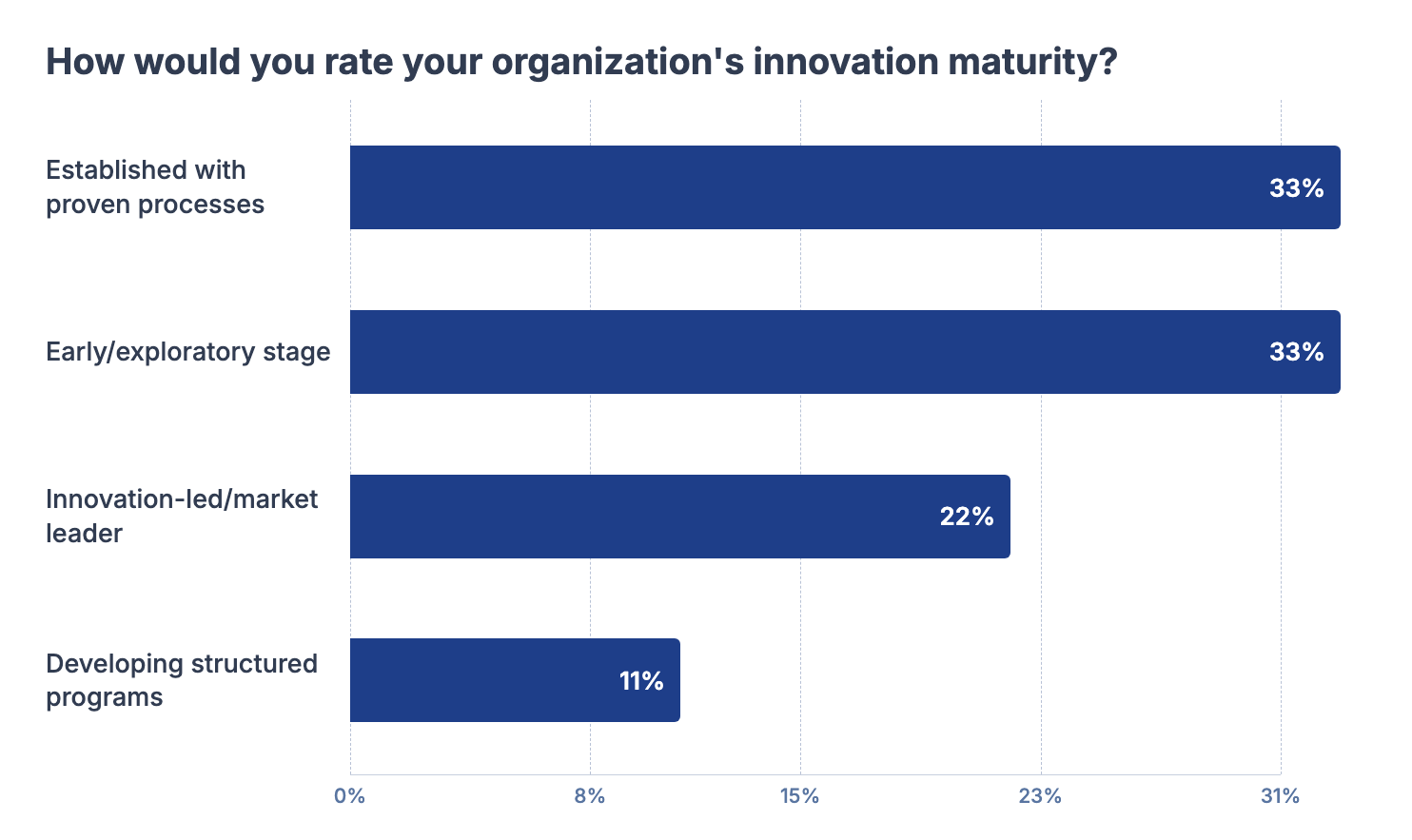
Among corporate innovation leaders’ organizations, innovation maturity is evenly distributed across two key stages. 33% of our audience’s organizations have established innovation maturity with proven processes, while another 33% are still in the early or exploratory stage.
A further 22% are innovation-led or position themselves as market leaders. The remaining 11% are still developing more structured innovation programs.
The spread of innovation maturity reflects the breadth of innovation in the U.S., rather than a single dominant approach. While many organizations continue to strengthen their established frameworks, a comparable volume remains focused on experimentation and discovery of new opportunities, helping sustain a healthy pipeline of future growth.
This aligns with the country’s standing as the world’s third-most-innovative economy in the Global Innovation Index. The U.S. is home to 22 of the world’s leading innovation clusters, where strong collaboration among industry, research institutions, and startups continues to support innovation at every stage of development.
How are corporation innovation leaders' teams primarily structured?
93% of corporate innovation leaders outsource to external partners, while 6% have adopted a hybrid model for their innovation team, and 1% have decentralized across business units.
Outsourcing leads the way:
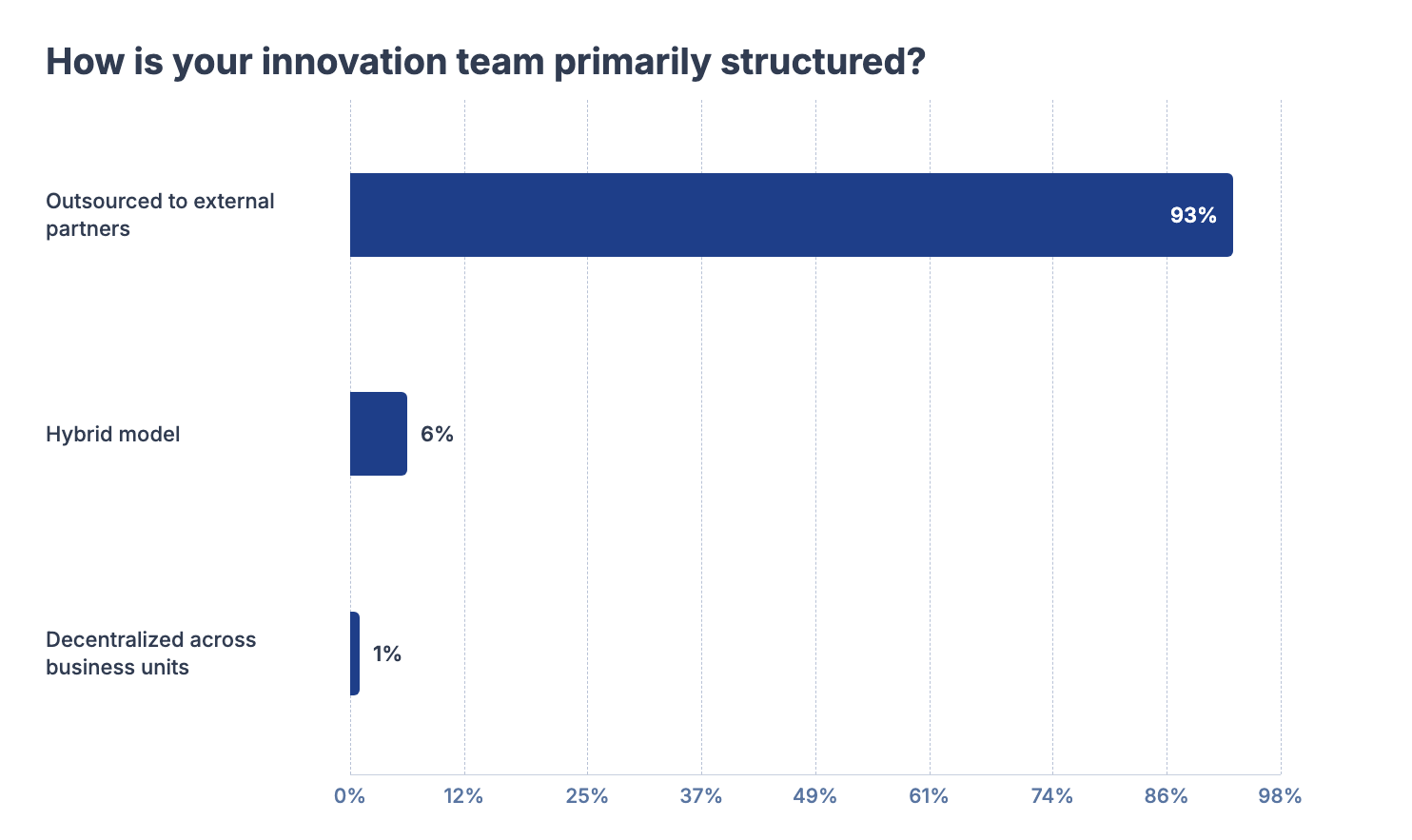
Corporate innovation leaders’ teams are overwhelmingly associated with outsourced models, with 93% relying primarily on external partners. This strong concentration illustrates that many businesses are tapping into specialist expertise, established innovation networks, and outside perspectives to accelerate new ideas and bring capabilities into the organization without building every function internally.
In contrast, 6% focus on hybrid team structures that combine internal resources with external support to balance flexibility with in-house knowledge. Only 1% of conversations revolve around innovation teams that are decentralized across business units, making this the least common organizational model in the data.
While decentralization can encourage localized decision-making and innovation tailored to individual departments, it’s clear that centralized external partnerships remain the preferred approach for many organizations.
What is the primary objective of corporation innovation leaders' programs?
Defending against disruption is an important goal for 22% of corporate innovation leaders, but this isn't a main focus for 50%. And it's not a priority for 12%, while driving new revenue streams is a top priority of corporate innovation programs for 8%, and another 8% are aiming to build long-term strategic optionality and improve internal processes.
Primary objectives focus on core topics:
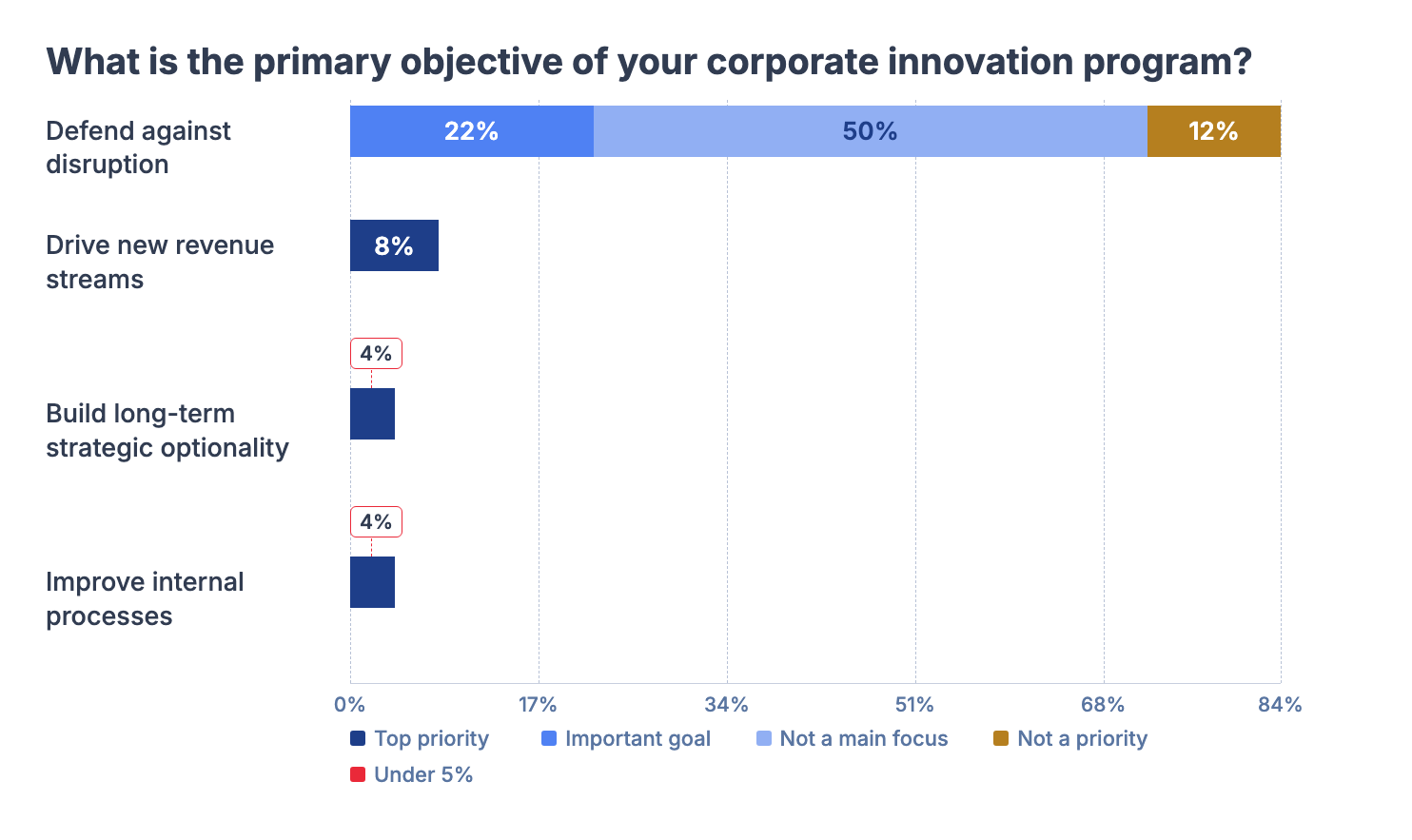
Corporate innovation programs require balancing growth ambitions with operational resilience. Our audience does this in different ways, with 22% prioritizing disruption defense as an important goal. At the same time, disruption defense is not the main focus for 50%, while 12% frame it as not a priority.
Among the strongest growth-oriented objectives, 8% point to driving new revenue streams as their top priority, making it the most prominent primary objective. A smaller but notable share (4%) has the primary objective of long-term strategic optionality, another 4% treat it as the leading priority, while a further 4% place improving internal processes at the top of the agenda.
Evidently, leaders are using innovation to achieve several goals at once. This reflects a broader business shift toward building adaptable capabilities and resilient workforces that can remain competitive during periods of disruption, even when managing disruption is not the primary objective.
What is the biggest funding source for corporation innovation leaders' programs?
Dedicated innovation funds are a significant contributor to 87% of corporate innovation leaders’ programs, and the main funding source for 7%, while external grants or partners are only the main source of funding for 1%, and contribute significantly for a further 1%, and corporate R7D budgets are used significantly by another 1%, and play a minor role in funding for the remaining 1%.
One main funding source stands out:
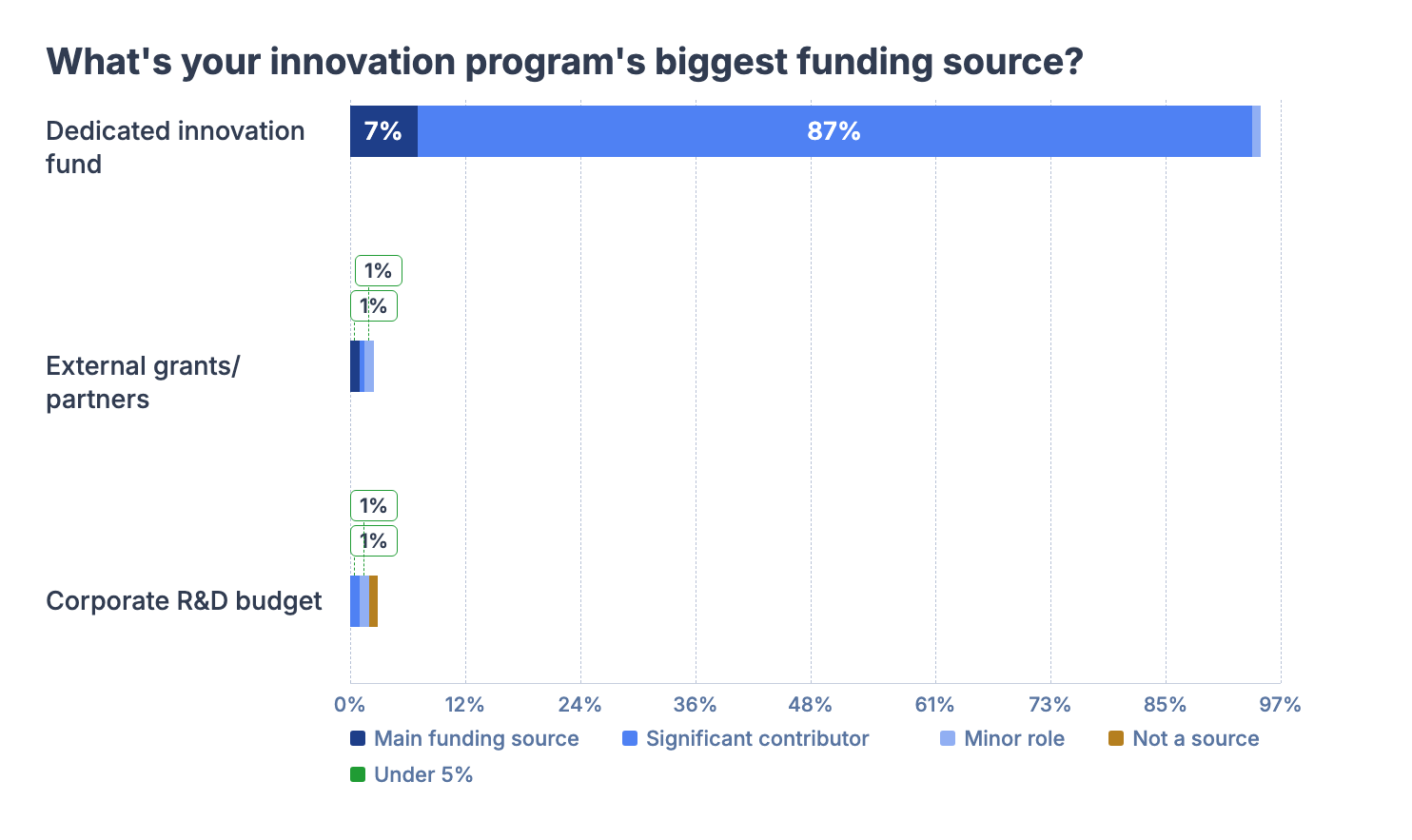
Funding for corporate innovation programs appears to rely most heavily on dedicated innovation funds. While 7% of corporate innovation leaders identify a dedicated innovation fund as their main funding source, 87% cite it as a significant contributor. This makes it obvious that many organizations prefer ring-fenced budgets that provide flexibility to test, develop, and scale innovation initiatives alongside other funding mechanisms.
External grants and partnerships receive comparatively little attention. Just 1% identify them as the main funding source, fewer than 1% describe them as a significant contributor, and another 1% mention them as playing only a minor role. This relatively limited focus on grants is notable given that U. organizations have access to a range of public funding opportunities, including innovation-focused grant programs.
Corporate R&D budgets are also sparingly mentioned, with 1% citing them as a significant contributor, 1% describing them as a minor source, and less than 1% indicating they’re not a source of funding at all.
What is the budget trend for corporation innovation leaders next year?
Innovation budget expectations for the coming year show a limited appetite for flat spending, with fewer than 2% of corporate innovation leaders explicitly expecting budgets to remain unchanged, while 40% actively dismiss the idea, expectations around budget cuts carry more weight, with 9% already planning reductions and a further 18% leaning toward lower spend, although 7% do not consider cuts and 3% firmly rule them out.
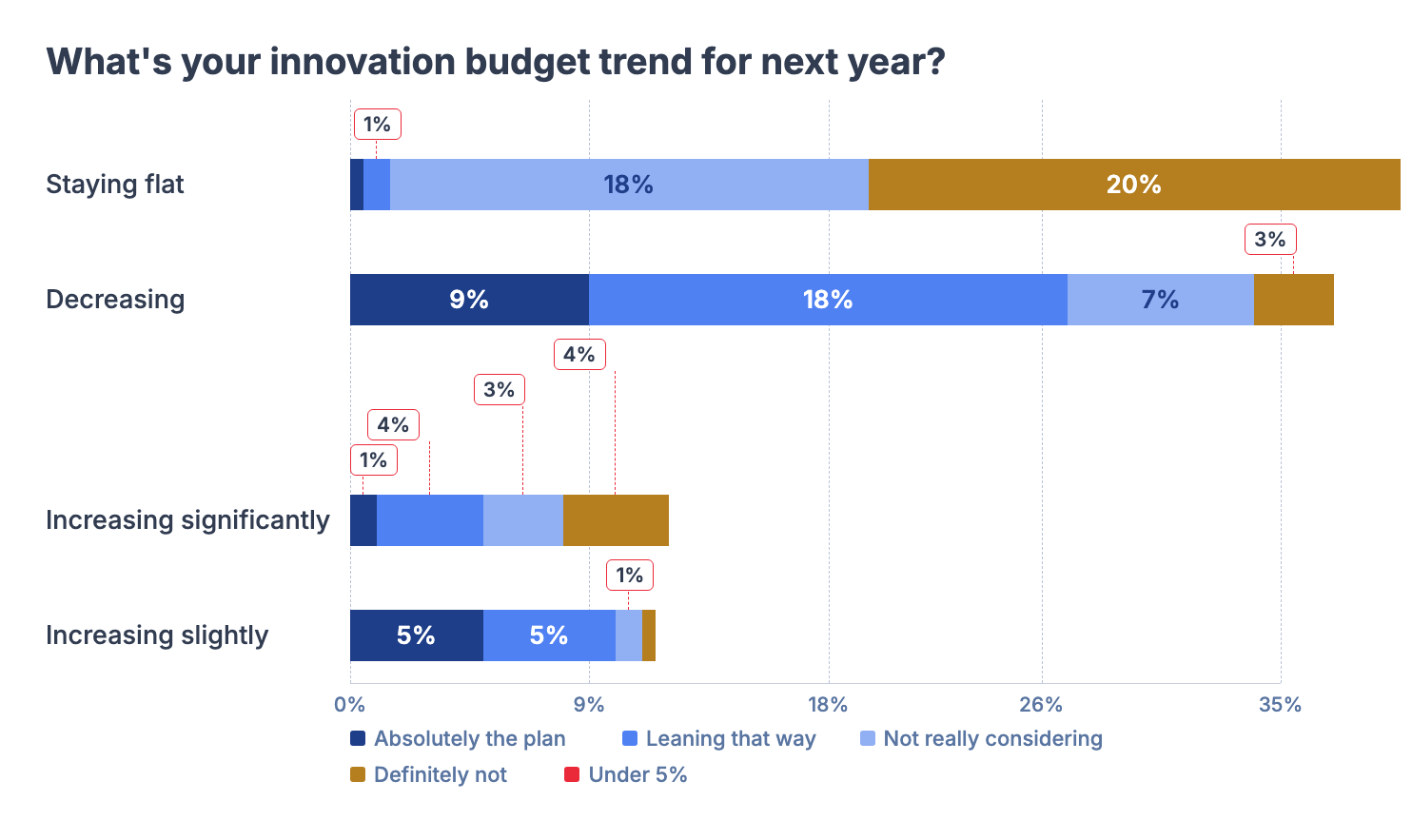
Innovation budget expectations for the coming year reflect a mix of caution and investment. Conversations around flat budgets are relatively limited, with less than 1% of corporate innovation leaders indicating this is absolutely the plan and 1% leaning in that direction. By contrast, 18% don’t really consider keeping budgets flat, while 20% definitely rule it out.
Budget reductions attract greater attention, with 9% identifying a decrease as the definite plan, and another 18% leaning toward lower innovation spending. Meanwhile, 7% are not really considering a decrease, and 3% definitely do not expect budgets to fall.
Growth plans also feature across the data, although at more modest levels. Around 1% of our audience points to significantly increasing innovation budgets as the definite plan, while 4% lean toward a substantial increase. Another 3% are not really considering a significant rise, and 4% definitely are not.
Slight budget increases appear more common, with 5% of leaders identifying this as the definite plan, and another 5% leaning that way. Just 1% are not really considering a slight increase, while less than 1% definitely rule it out.
The overall distribution suggests organizations are carefully weighing investment decisions, reflecting a broader global trend in which innovation spending averages 6.6% of revenue, even though the pace of budget growth has slowed to 3%.
How much of the corporation innovation leaders' budget is allocated to AI-related initiatives?
69% of corporate innovation leaders have allocated less than 10% of their budget to AI-related initiatives, 10% have dedicated between 10 and 25%, 15% between 25-50%, and for 15%, more than 50% of their budget is going towards AI.
AI-related initiatives are taking up budget:
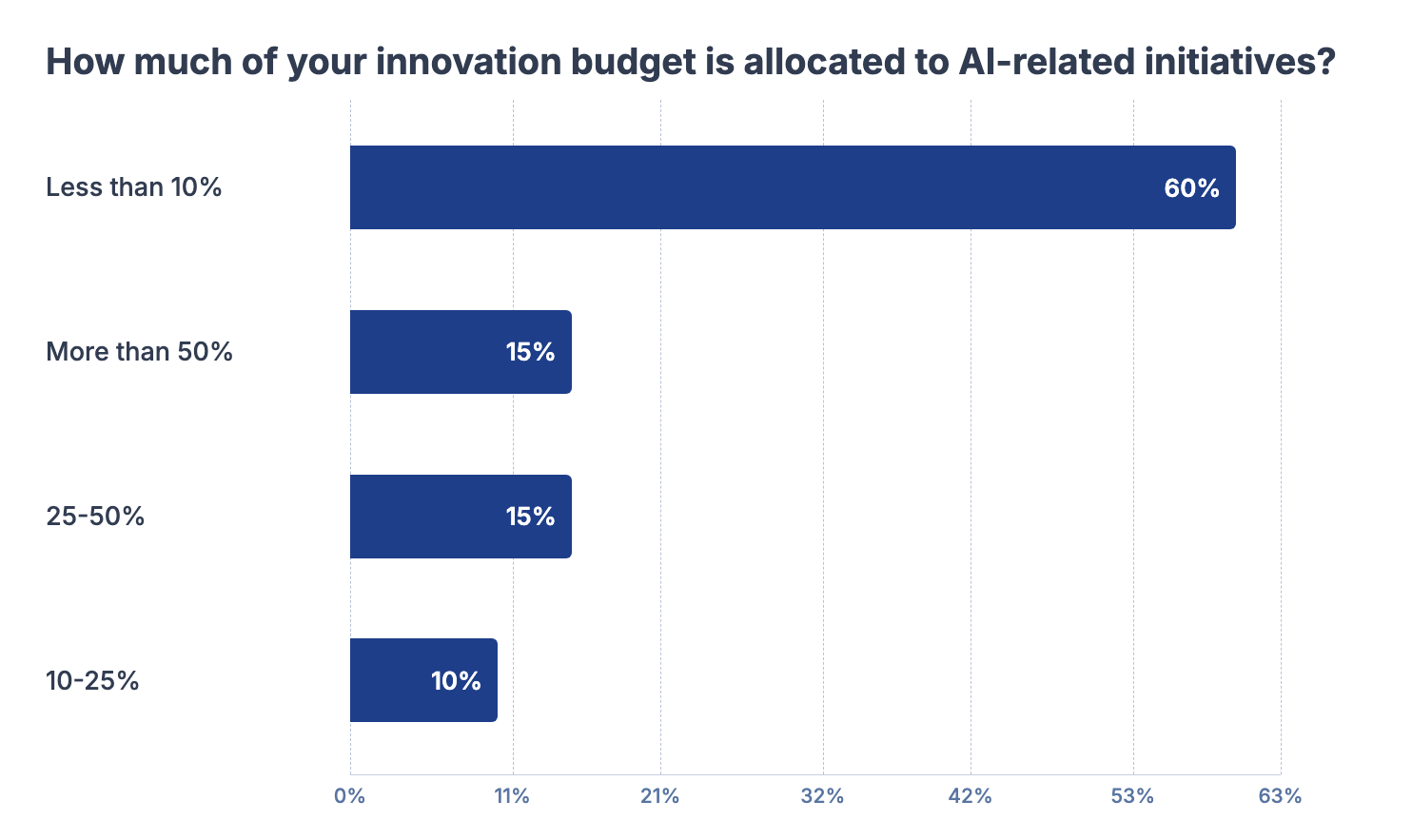
Most of our audience’s AI-related initiatives still account for a relatively modest share of corporate innovation budgets. 60% of corporate innovation leaders' organizations allocate less than 10% of their innovation budget to AI, making it the most common approach by a considerable margin.
At the other end of the scale, 15% dedicate more than half of their innovation budget to AI, while an equal 15% center on allocations between 25% and 50%. A further 10% focus on organizations directing between 10% and 25% of their innovation budget toward AI, emphasizing a broad range of investment strategies.
This variation in budget allocation reflects the different stages of AI adoption across industries. While many businesses are gradually integrating AI, others are accelerating investments as they pursue more ambitious innovation goals. This ties in with wider market trends, where companies generating more than $500 million in annual revenue are spending around 5% of their revenue on AI initiatives, and one in three companies across global markets planned to invest $25 million or more in AI during the past year.
Which technology area is the top innovation priority for corporation innovation leaders?
25% of corporate innovation leaders’ top priority right now is cybersecurity, it’s a strong focus for 48%, and not a main focus for 14%, with another 10% stating it’s not a priority for them, while just 1% are putting a strong focus on artificial intelligence, and no one is prioritizing sustainability or climate tech, or automation and robotics.
Technology priorities are clear:
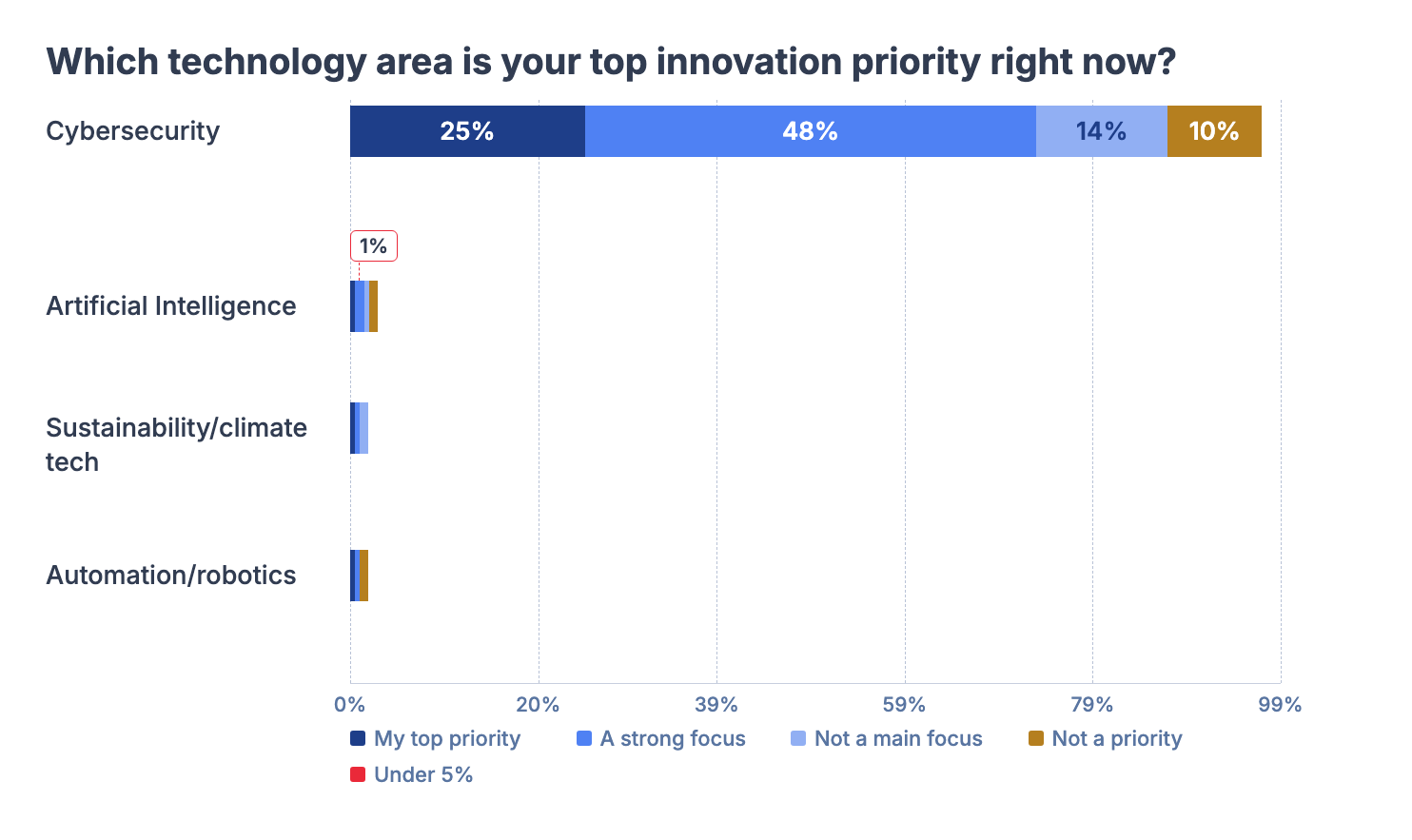
In 2025, Gartner predicted that global end-user spending on information security would reach $212 billion, representing year-on-year growth of 15.1%. Cybersecurity also clearly dominates the current innovation agenda, attracting the greatest volume of attention from corporate innovation leaders. 25% position cybersecurity as the top innovation priority, while a further 48% describe it as a strong focus, making it the standout technology area overall. By comparison, 14% indicate cybersecurity is not a main focus, and 10% view it as not a priority.
Discussion volume about other technologies is much lower. Less than 1% of conversations identify artificial intelligence as the top priority, 1% as a strong focus, and less than 1% as not a priority.
Sustainability and climate technology also appear in less than 1% of conversations as the top priority and in less than 1% as a strong focus. The same pattern is seen for automation and robotics. Fewer than 1% list it as a top priority, while the same small number lists it as a strong focus.
How has AI changed corporation innovation leaders’ strategies this year?
For 38% of corporate innovation leaders, AI has not made any real changes to their strategies as yet, 32% agree that this technology has led to moderate adjustments, 26% have seen a major shift in priorities, and 5% feel it's only had a minor influence so far.
AI is impacting innovation strategies:
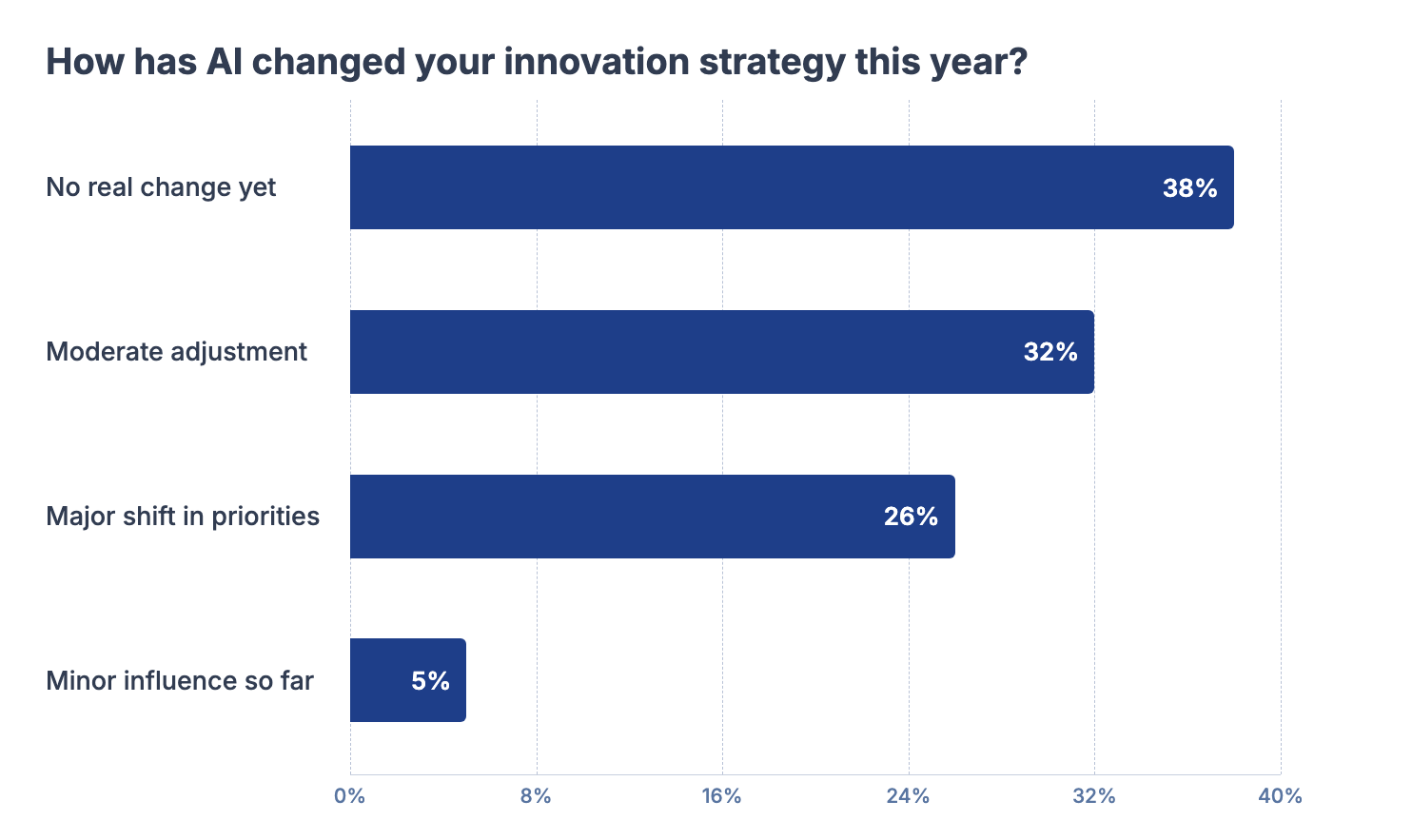
AI is influencing innovation strategies at different speeds, with the largest percentage of our audience indicating that organizations are still taking a measured approach. 38% of corporate innovation leaders report seeing no real change to their innovation strategy so far.
Meanwhile, 32% point to moderate changes already taking shape, while 26% describe AI as driving a major shift in innovation priorities. At the other end of the scale, 5% confirm that AI has had only a minor influence, suggesting that relatively few organizations have experienced only limited strategic impact.
This measured approach is also seen in wider business adoption trends, where AI implementation continues to build momentum rather than accelerate uniformly. U.S. Census Bureau data shows that businesses’ AI usage remained between 17% and 20% from December 2025 to May 2026, while an additional 20% to 23% are expected to adopt AI within the following six months. These volumes reveal that although immediate transformation is not universal, AI continues to gain momentum as an increasingly important driver of corporate innovation strategies.
How confident are corporation innovation leaders in their organization's AI roadmap?
53% of corporate innovation leaders are uncertain about their confidence in their organization's AI roadmap, 46% don't have a clear roadmap whatsoever, and only 1% feel very confident, and a further 1% are somewhat so.
Confidence levels need some work:
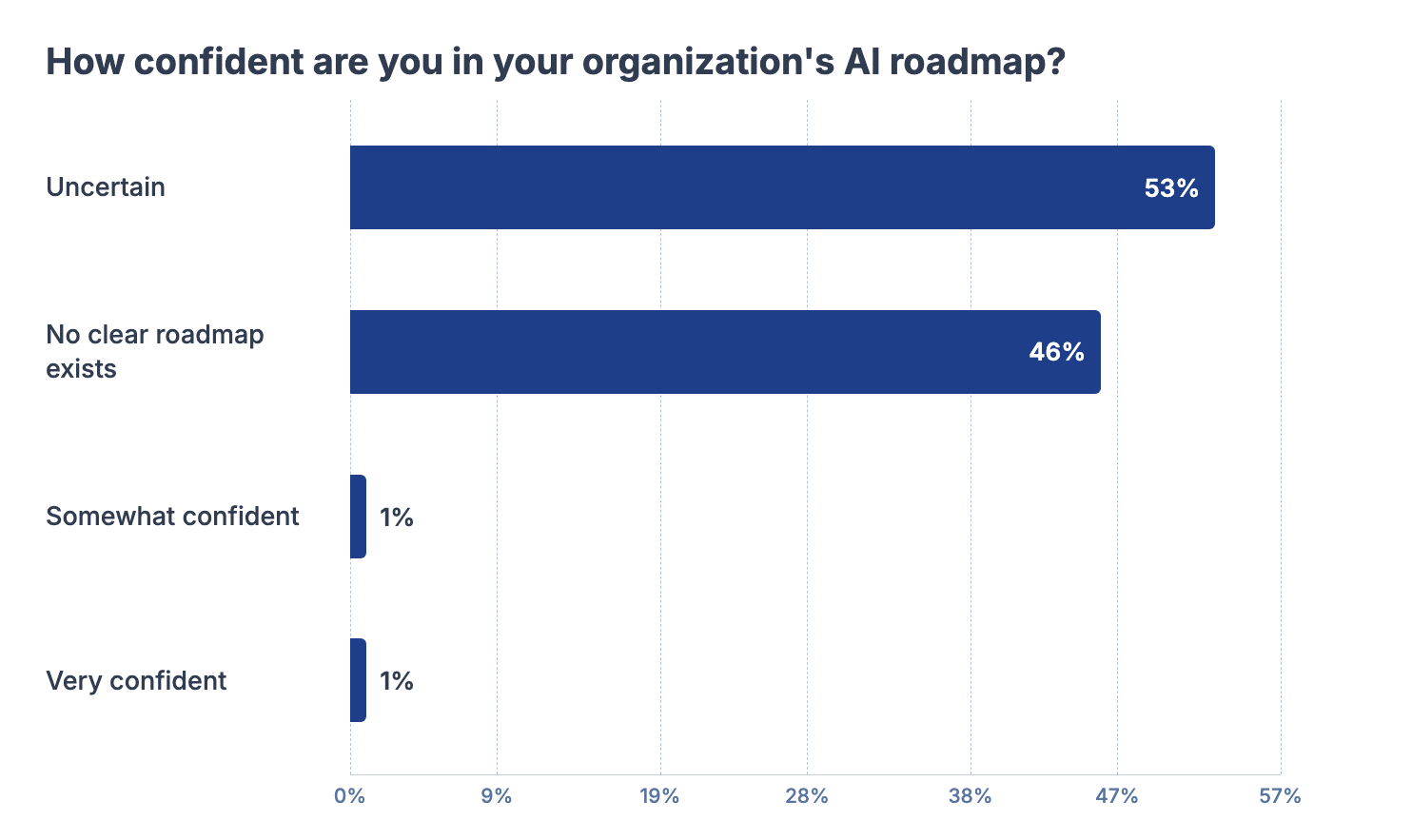
Confidence in organizational AI roadmaps remains a work in progress, with the largest share of our audience uncertain about long-term direction. 53% of corporate innovation leaders say their organizations are unsure about their AI roadmap, making this the most common perspective.
Close behind, 46% currently have no clear AI roadmap. By comparison, just 1%’s organizations organizations are somewhat confident in their AI roadmap, while another 1% are very confident in the direction they have established.
Due to the relatively small volume of conversations expressing confidence, it’s evident that clear governance, investment priorities, and implementation strategies are still taking shape. At the same time, this presents an opportunity for organizations to refine their approach as AI technologies mature. As adoption continues to accelerate, more businesses are likely to transition from uncertainty toward structured roadmaps supporting sustainable innovation and measurable outcomes.
Which AI tools do corporation innovation leaders' teams use most?
40% of corporate innovation leaders’ teams use generative AI like Claude or ChatGPT sometimes, 2% say it's their top choice, and 8% rarely use it, while 1% use custom models as their top choice, and 6% use these sometimes, and 3% sometimes use predictive analytics platforms, 39% are not using any AI tools currently.
AI tool use shows clear preferences:
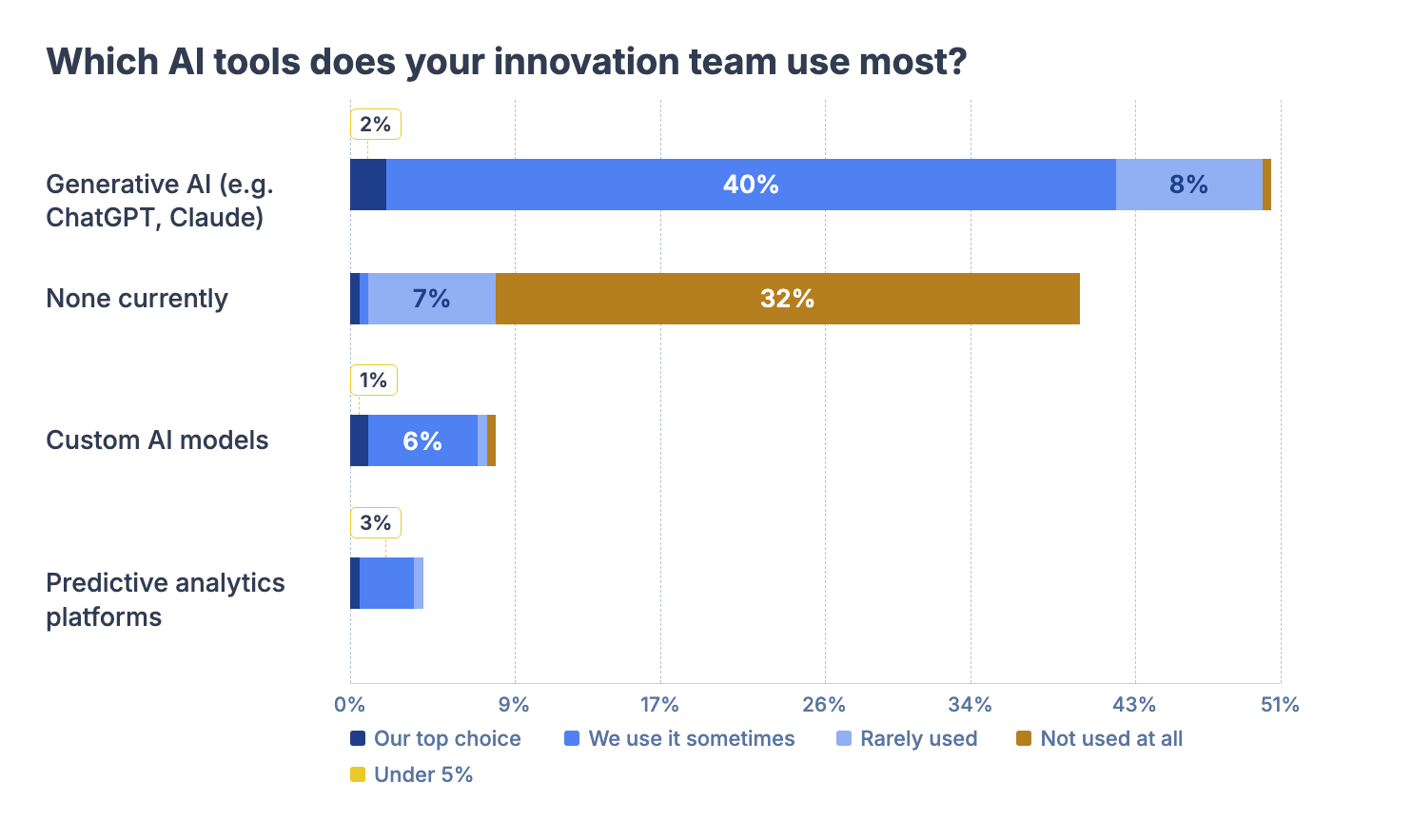
ChatGPT is the most widely used AI tool among workers in 2026, and generative AI tools continue to attract the most discussion among corporate innovation teams. 40% of corporate innovation leaders’ teams use tools such as ChatGPT and Claude sometimes, while they’re a top choice for 2%. A further 8% rarely use generative AI tools, and less than 1% don't use them at all.
32% are not currently using any AI tools, while 7% rarely use AI, and less than 1% use it sometimes. Custom AI models also feature prominently as a top choice: 1% use them occasionally, 6% use them, and less than 1% don't use them at all. 3% of leaders’ teams also use predictive analytics platforms occasionally.
Looking at this balance of conversations, many organizations are integrating readily available AI tools first before expanding into custom models or advanced predictive platforms, highlighting a practical and phased approach to AI adoption.
What primary external engagement model do corporation innovation leaders' organizations use?
For 42% of corporate innovation leaders, corporate venture capital is a strong option for external innovation engagement, but it’s not a focus for 34%, while 24%’s main approach is university or research partnerships. And 1% agree that a corporate accelerator or incubator is a strong option for engagement.
Engagement models rely on three core options:
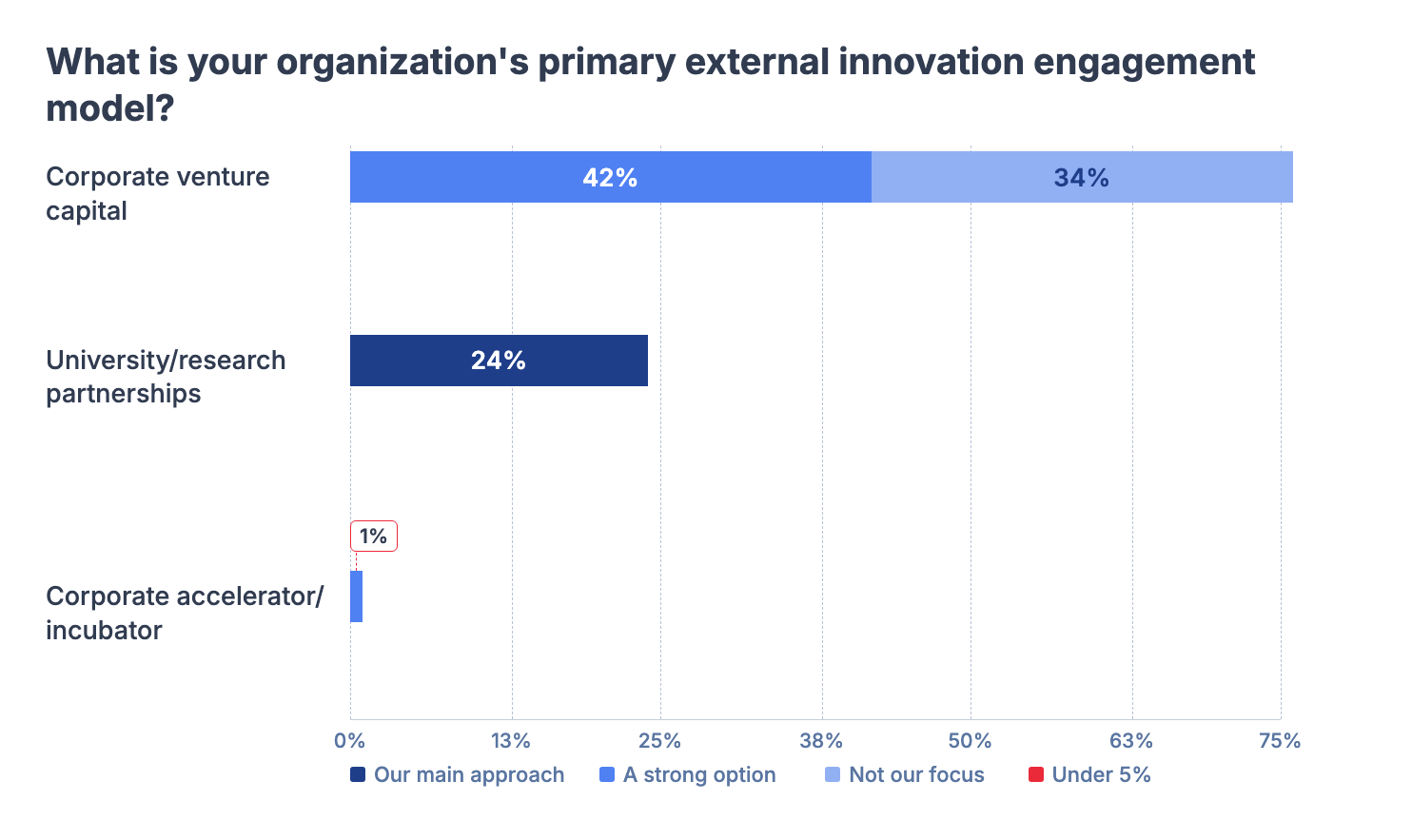
External innovation strategies span a range of approaches at corporate innovation leaders' organizations, with corporate venture capital topping the list. Corporate venture capital is a strong option for 42% of our audience for engaging with external innovation. This reinforces its importance in helping organizations access emerging technologies, startups, and new ideas. At the same time, corporate venture capital is not a focus for 34%, determining that many businesses continue to pursue alternative collaboration models.
University and research partnerships also feature prominently, with 24% citing them as their main approach to external innovation. Meanwhile, 1% rely on corporate accelerators or incubators as a strong option, as they’re a more targeted but still established route for fostering innovation.
Evidently, organizations choose external innovation models based on their strategic priorities and available resources. Corporate venture capital provides direct access to emerging technologies, while university partnerships offer specialist expertise and early-stage research. Accelerators and incubators appear to play complementary roles, creating a flexible approach in which businesses combine multiple collaboration models to drive innovation and future growth.
What approach do corporation innovation leaders' organizations take to working with startups?
53% of corporate innovation leaders run a formal accelerator program as a core strategy to working with startups, 24% use the core strategy of ad-hoc scouting and pilots, 10% see this as an important approach, and 8% consider it a minor approach, while 2% have limited to no startup engagement as their core strategy, and 7% deny this is their approach.
Approaches to startups vary:
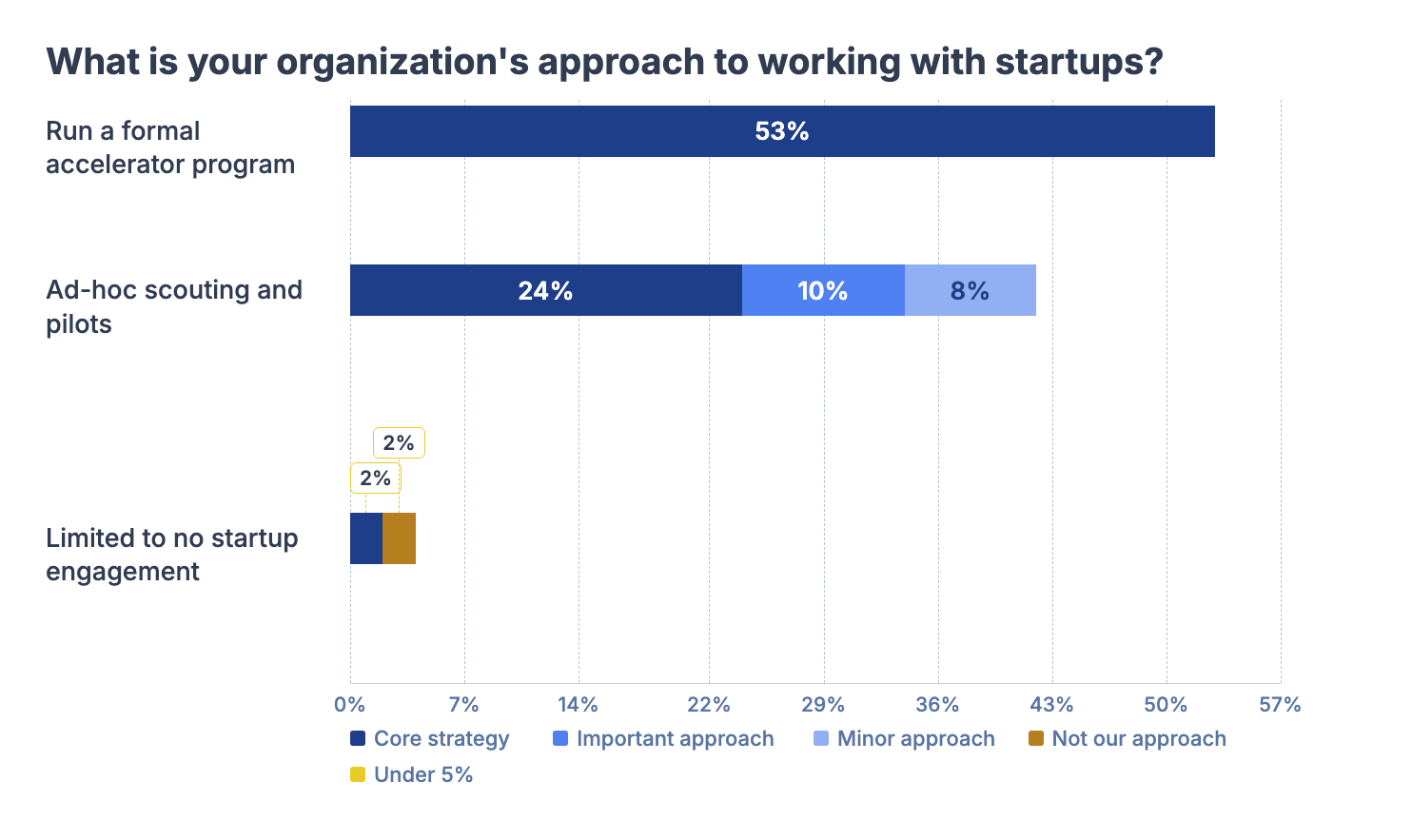
Formal startup engagement programs attract the greatest attention among corporate innovation leaders. 53% run a formal accelerator program as a core strategy, making it the most widely established approach to working with startups. Ad-hoc scouting and pilot projects also play an important role, with 24% relying on them as a core strategy, 10% as an important approach, and a further 8% viewing them as a minor approach.
In comparison, only 2% of conversations focus on having limited or no startup engagement as a core strategy, while another 2% state that avoiding startup engagement is simply not their approach.
This relatively small share of conversations around limited startup engagement shows that external collaboration is now a core part of many innovation strategies. Overall, organizations are combining structured programs with targeted partnerships to explore new technologies, speed up innovation, and stay competitive.
How do corporation innovation leaders primarily source promising startups?
51% of corporate innovation leaders primarily source promising startups via accelerator programs, 39% rely on VC or investor networks, and 10% on internal scouting, while no one mentions inbound applications in this context.
Sourcing takes a multi-prong approach:
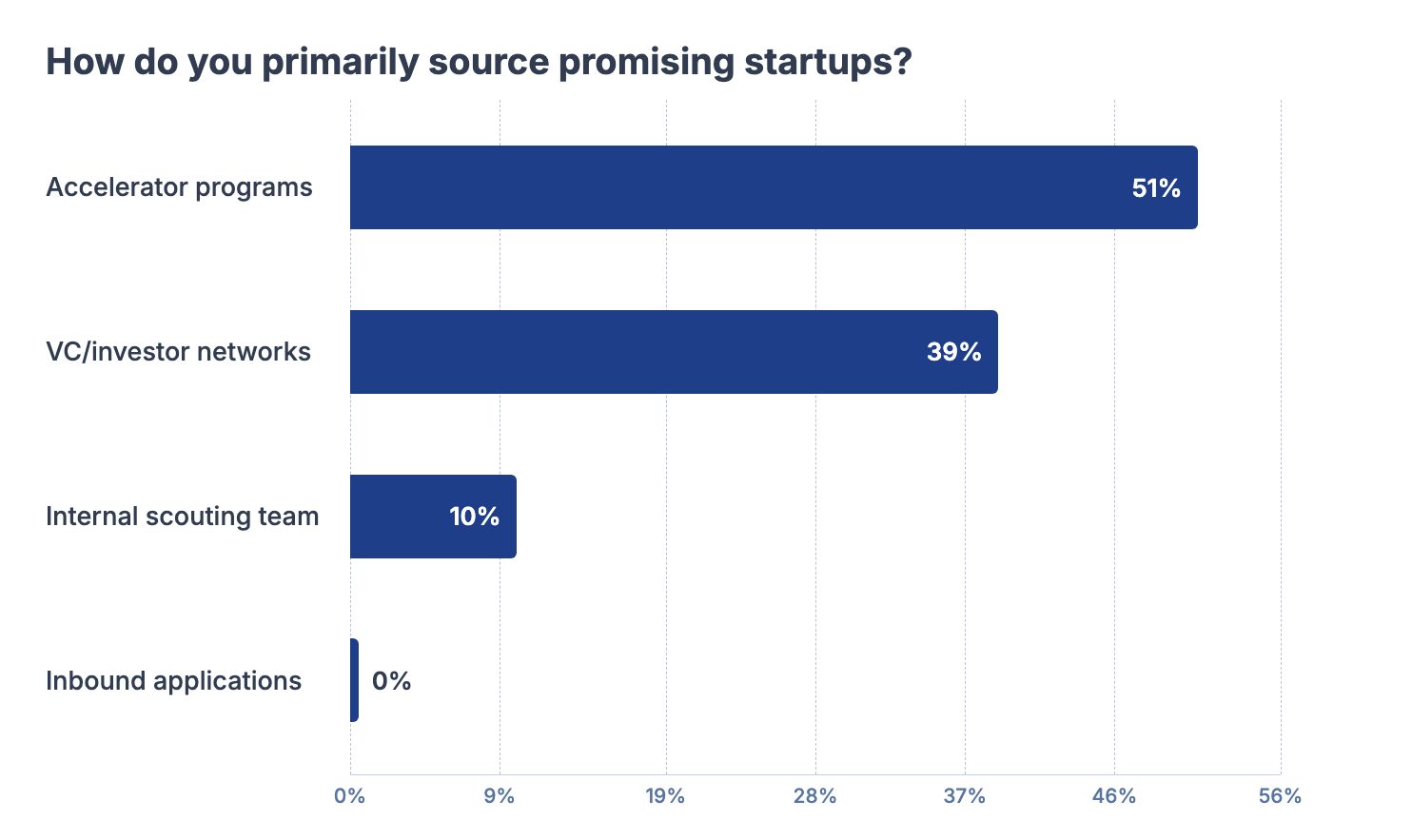
Corporate innovation leaders rely on several channels to identify promising startups, with accelerator programs attracting the most attention. For 51% of our audience, accelerator programs are the primary source of startup opportunities, making them the leading pathway for discovering emerging businesses and new technologies, and facilitating growth.
Venture capital and investor networks also play a significant role for 39%, reinforcing the importance of established investment ecosystems in connecting organizations with high-potential startups. Meanwhile, 10% rely on internal scouting teams as the primary approach to sourcing innovation opportunities. By comparison, 0% of conversations identify inbound applications as the primary source, showing that organizations prefer a more proactive approach to identifying promising ventures.
Clearly, corporate innovation leaders are prioritizing active engagement and carefully developed partnerships over passive application processes, helping organizations build stronger innovation pipelines and accelerate access to emerging technologies.
Which external partner delivers the most value to corporation innovation leaders' efforts?
Venture capital firms definitely deliver the most value for 23% of corporate innovation leaders’ efforts, and 26% agree they add significant value; however, 19% feel the value they add is limited, and 15% say they deliver little value, compared to the 10% who cite startup accelerators as delivering value, and 4% who share the same sentiments about universities and research labs.
External partner value is measurable:
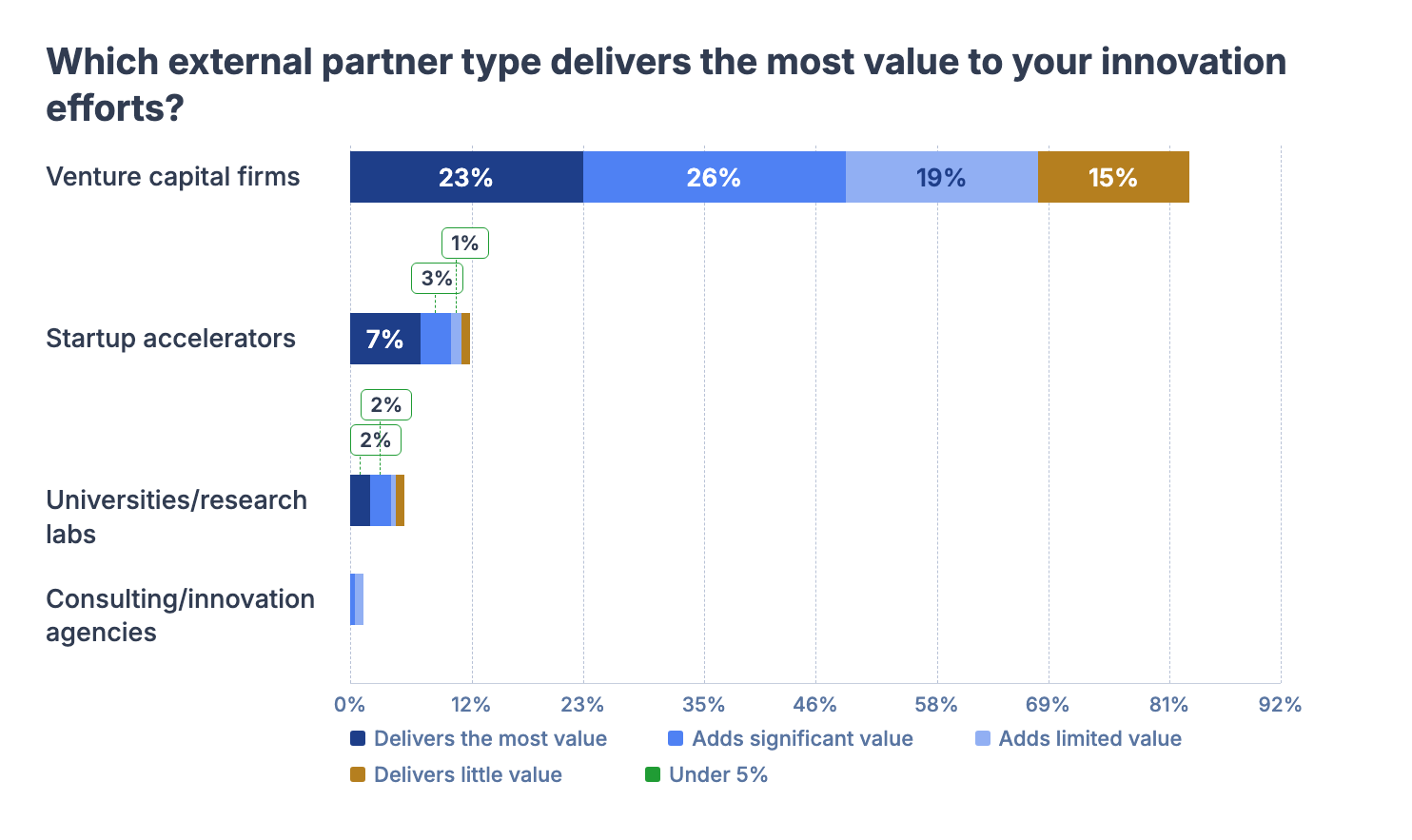
Venture capital firms emerge as the most influential external partners for corporate innovation leaders, with 23% identifying them as delivering the most value. A further 26% note that they add significant value, while 19% feel their contribution is limited, and 15% view their impact as relatively small. This broad spread shows how venture capital plays a consistently visible role across innovation ecosystems, often acting as both a funding engine and a strategic connector.
Startup accelerators contribute a smaller but still meaningful share of perceived value, with 7% of our audience pointing to them as the most valuable partner type and 3% saying they offer significant value. Only 1% feel they offer limited value, while almost no conversations (below 1%) focus on them delivering little value.
Universities and research labs account for a more niche contribution, delivering the most value for 2% and adding significant value for another 2%, alongside less than 1% who feel they offer limited value and 1% who feel they offer little value.
Consulting and innovation agencies appear least prominent, with no conversations recorded on this topic. This makes it obvious that for our audience, there is a partner ecosystem in which venture capital leads in perceived impact, while other collaborators provide more targeted or specialized innovation support.
How many active startup partnerships do corporation innovation leaders' teams manage?
93% of corporate innovation leaders’ teams manage more than 30 active startup partnerships, while just 7% manage between 1 and 5, putting the majority on the higher end of the scale.
More active startup partnerships are commonplace:
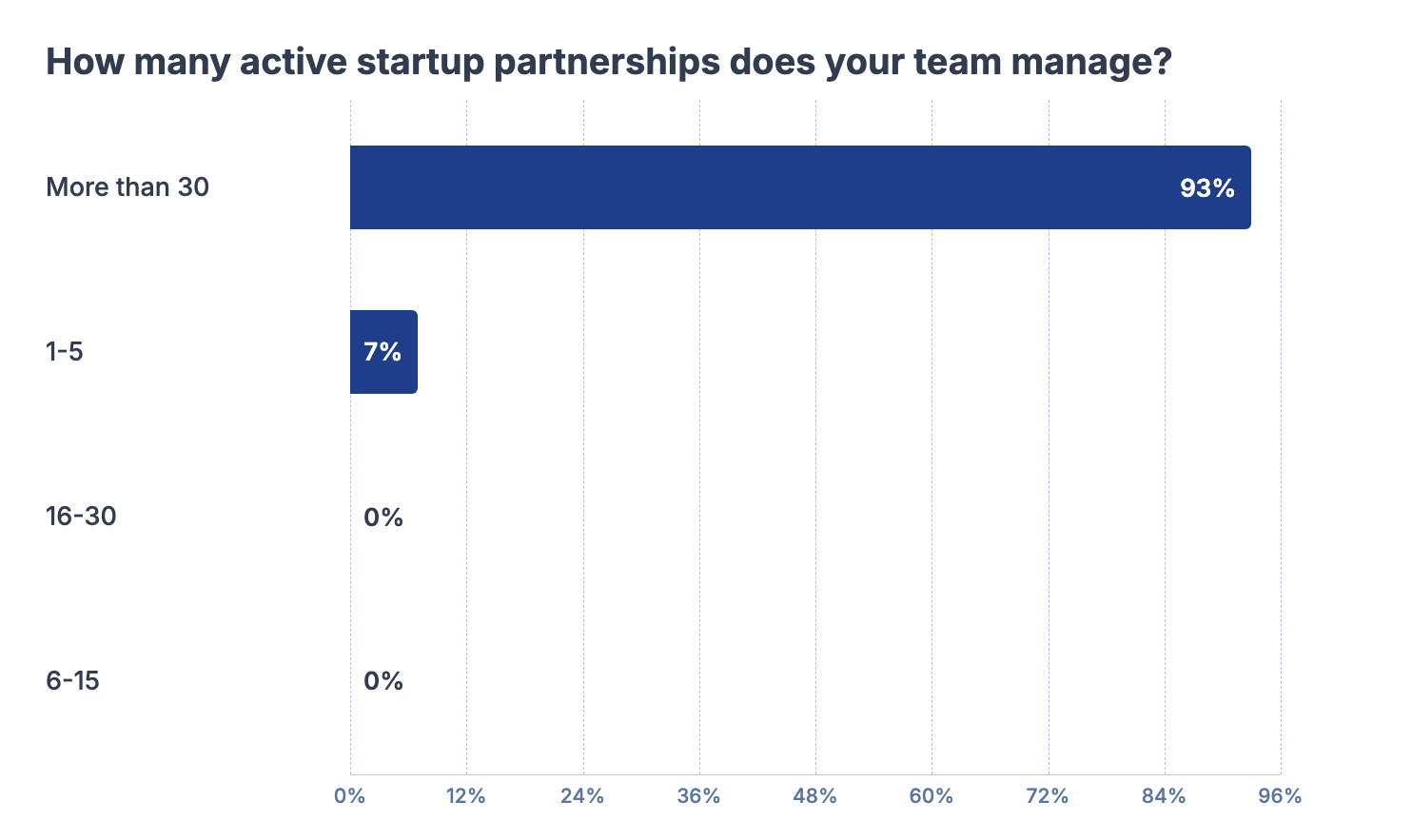
A clear majority of corporate innovation leaders’ teams are managing startup partnerships at a significant scale. 93% of our audience’s teams oversee more than 30 active startup partnerships, putting a strong emphasis on broad collaboration with emerging businesses.
By comparison, 7% manage between 1 and 5 partnerships, while none fall into the 6-15 (0%) or 16-30 (0%) partnership ranges.
The high volume of partnerships aligns with the strength of the U.S. startup ecosystem. The U.S. Census Bureau tracks more than 5.1 million new business applications each year, while an estimated 1.56 million formal tech and scalable startups operate nationwide, cementing the country’s position as the world’s leading startup ecosystem.
How often do corporation innovation leaders pilot new emerging technologies?
51% of corporate innovation leaders pilot new emerging technologies quarterly, 40% do so annually, 5% rarely, and the remaining 5% are continuously piloting new tech.
New emerging tech pilots are prolific:
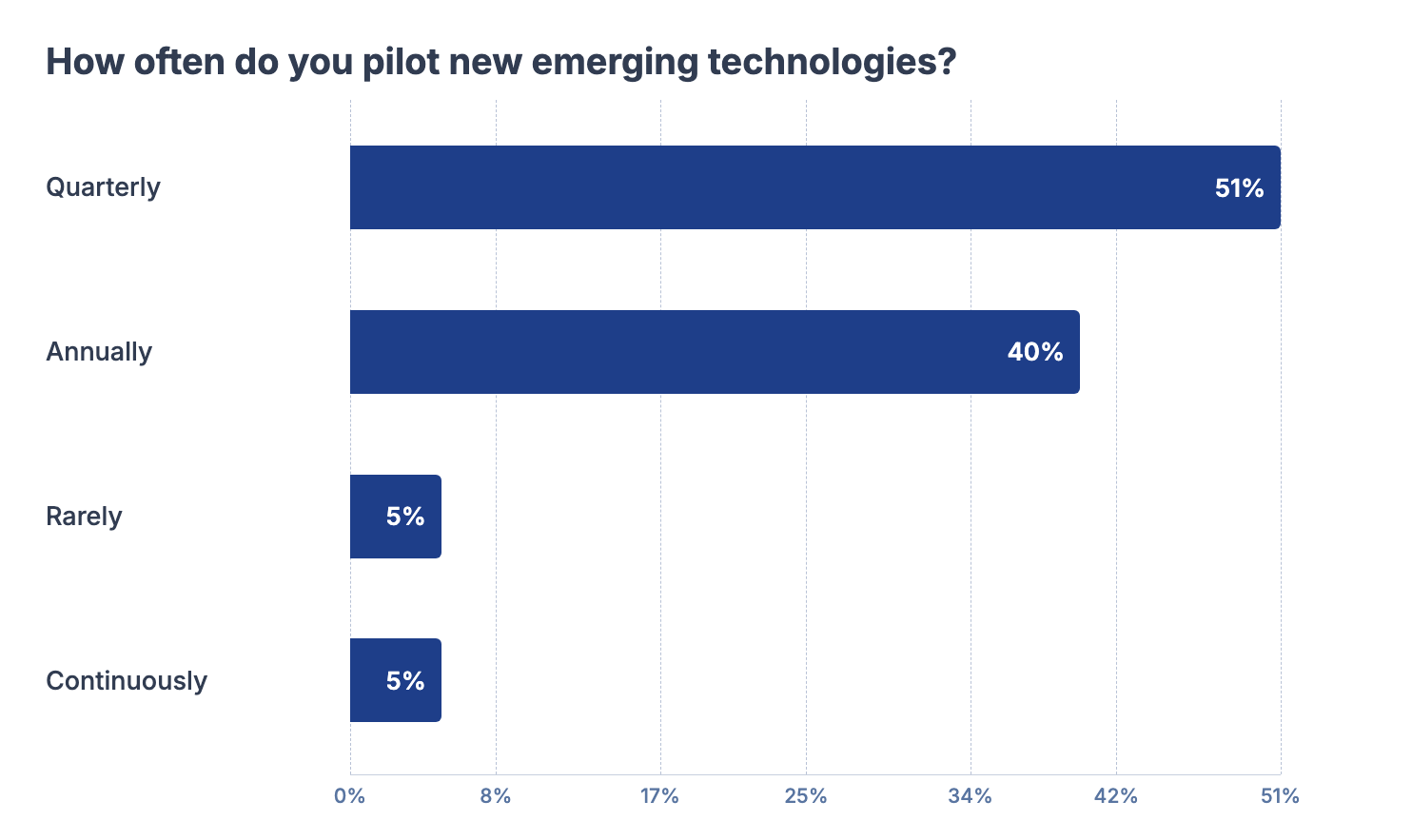
Corporate innovation leaders maintain a steady rhythm when testing emerging technologies. 51% pilot new technologies on a quarterly basis, making it the most common approach. Annual pilot programs also account for a substantial share at 40%, while 5% rarely pilot emerging technologies, and another 5% do so continuously.
The distribution reflects a balance between regular experimentation and more measured adoption strategies. Quarterly pilot programs can help organizations evaluate innovations without disrupting day-to-day operations, while annual testing may align with budgeting, planning, and broader transformation initiatives.
Although continuous piloting represents a smaller share of conversations, it points to organizations with the capacity to integrate innovation into ongoing operations. At the same time, the relatively low volume of conversations around rarely testing new technologies suggests that most corporate innovation teams recognize the value of consistently exploring emerging solutions to remain competitive and uncover new opportunities.
How long does it take corporation innovation leaders to move ideas from concept to pilot?
For 51% of corporate innovation leaders, it typically takes between 3 and 6 months to move an idea from concept to pilot, and for 49%, it takes between 6 and 12 months.
Progress pace is split:
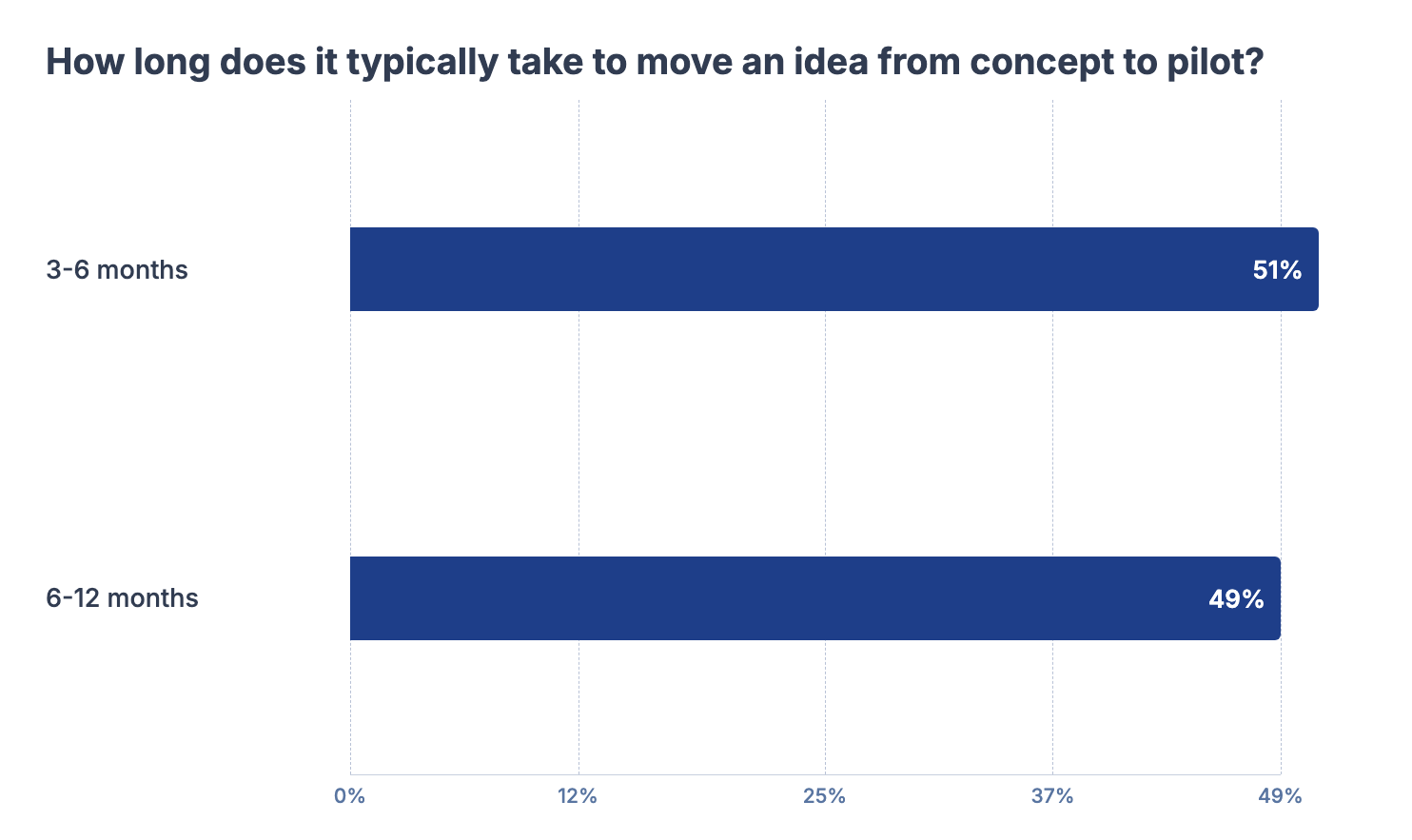
Corporate innovation leaders have a near-even split in how quickly ideas progress from concept to pilot. 51% of our audience have a 3-6 month timeline, making it the slightly more common approach and reflecting an emphasis on faster validation cycles. The remaining 49% have a 6-12 month timeframe.
This mirrors broader innovation trends. Related findings show that 96% of executives view developing new ideas as essential to long-term success. At the same time, 72% of companies allow innovations to stall due to a lack of a formalized process or clear ownership. This helps explain why both 3-6 month and 6-12 month timelines remain common, as organizations continue to refine how innovation is prioritized and brought to implementation.
What blocks faster innovation cycles at corporation innovation leaders' companies?
Approval bottlenecks are a major obstacle for 27% of corporate innovation leaders’ cycles, somewhat of a blocker for 46%, and a minor issue for 22%, while legacy IT systems cause major obstacles for 5%.
Bottlenecks are the biggest blockers:
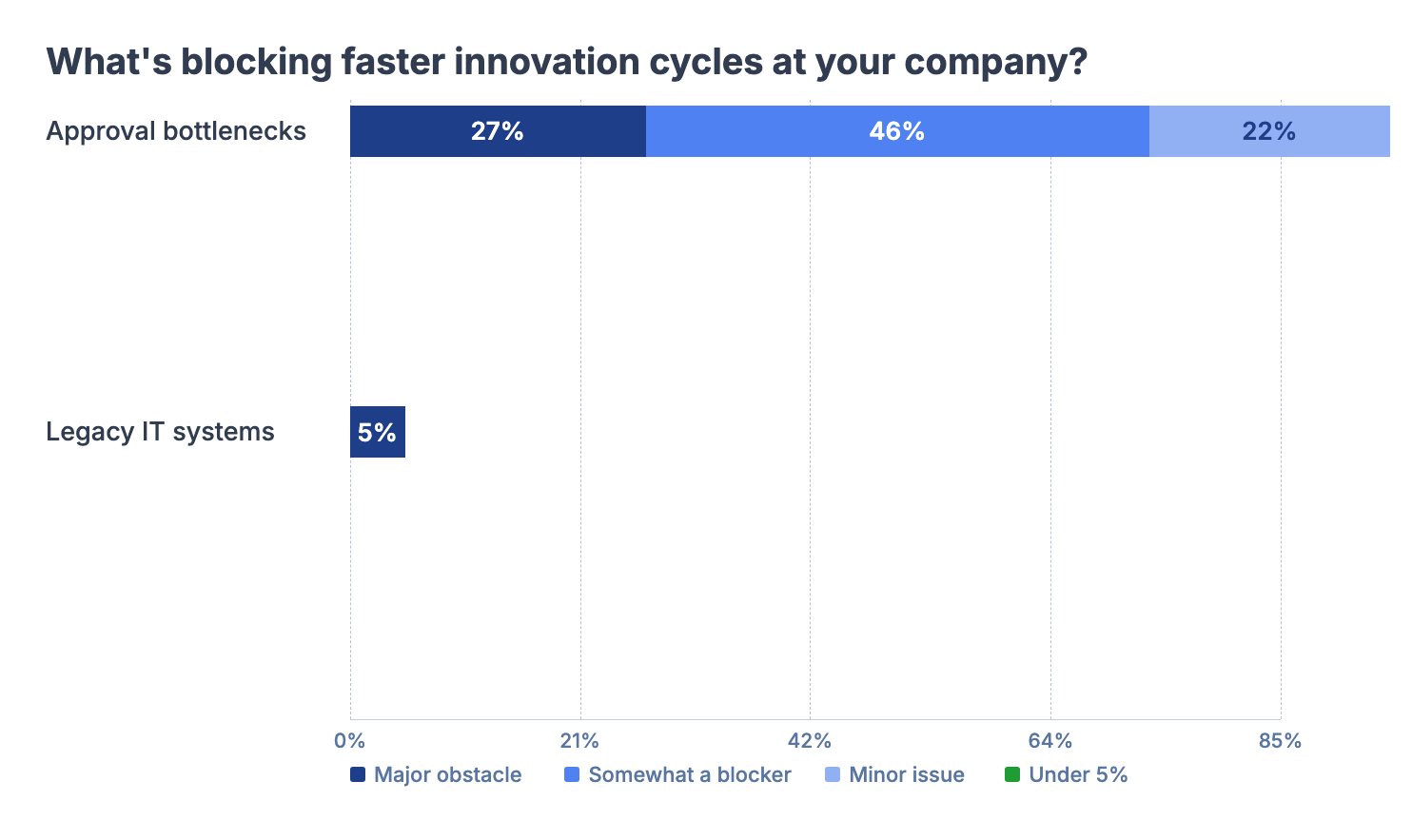
Approval processes emerge as the most common factor slowing innovation cycles. 46% of corporate innovation leaders say that approval bottlenecks are somewhat of a blocker in their company, making this the largest share overall. A further 27% identify them as a major obstacle, while 22% view them as only a minor issue. Comparatively, just 5% agree that legacy IT systems are a major obstacle, proving that organizational processes are more likely than technology infrastructure to delay innovation efforts.
Research also indicates that bottlenecks reduce the performance of innovation systems by limiting potential productivity gains. As a result, streamlining approvals and improving internal workflows could help organizations accelerate innovation cycles while better leveraging existing capabilities. Especially given that relatively few conversations identify legacy IT as the primary barrier.
What KPI matters most to corporation innovation leaders for evaluating success?
Revenue from new products is a very important KPI for corporate innovation leaders when measuring success, and somewhat important for 20%, and for 40%, speed to market is a very important evaluation metric.
KPIs focus on two main areas:
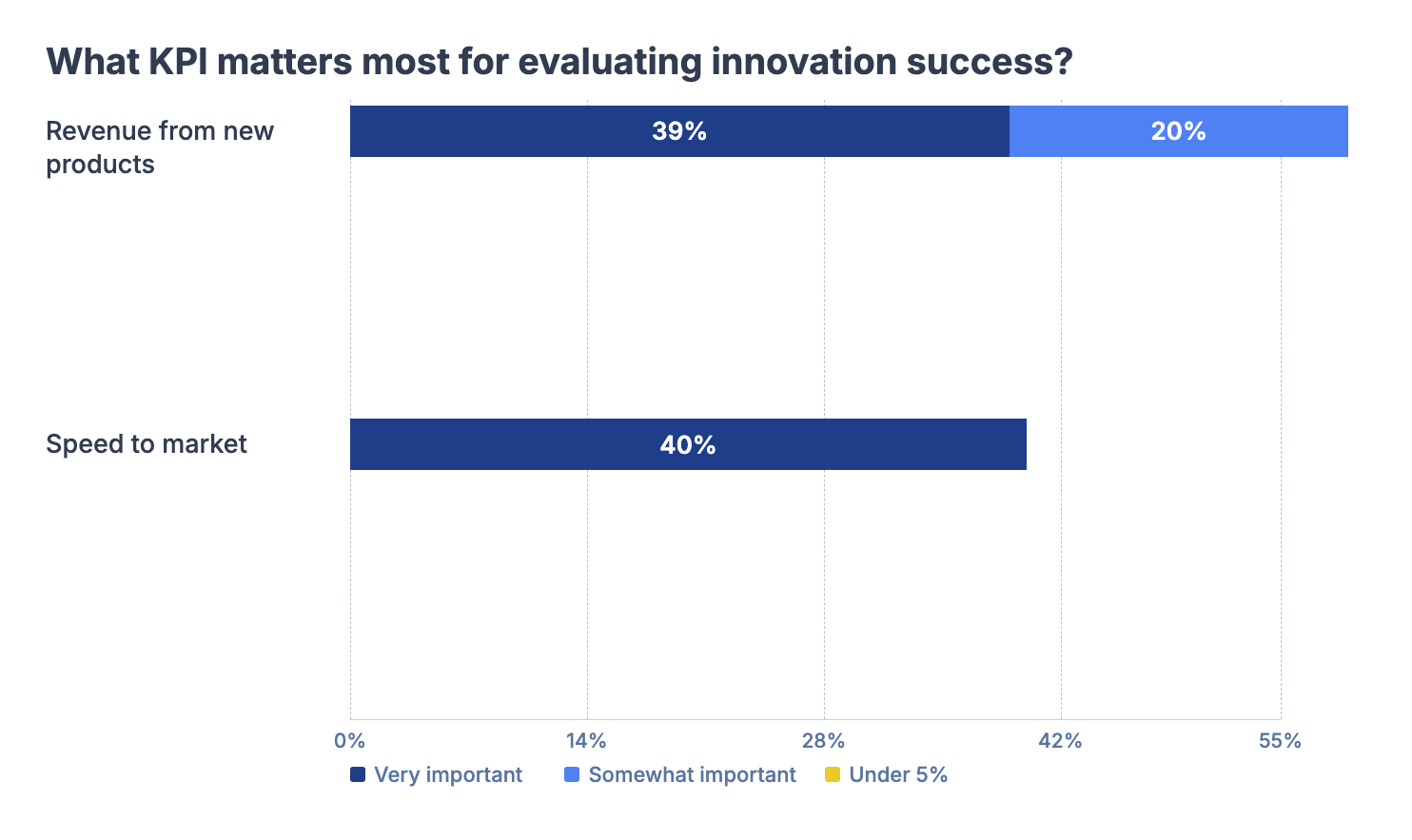
Revenue generation from new products emerges as a key lens for evaluating innovation success. It’s a very important KPI for 39% of corporate innovation leaders, and a further 20% feel it is somewhat important. This combined share shows a strong attention to commercial outcomes, where the ability to translate ideas into measurable financial returns remains a central expectation of innovation programs.
Speed to market is also a major priority, with 40% of our audience identifying it as very important. This indicates a significant focus on accelerating innovation from development to real-world deployment, reflecting the competitive pressure to respond rapidly to emerging opportunities and shifting customer needs.
How do corporation innovation leaders measure ROI on investments?
Cost savings is used by 40% of corporate innovation leaders to measure ROI on investments, 14% use strategic learning value, and 6% direct revenue impact, but the remaining 40% don’t formally measure ROI.
Not everyone is measuring ROI:
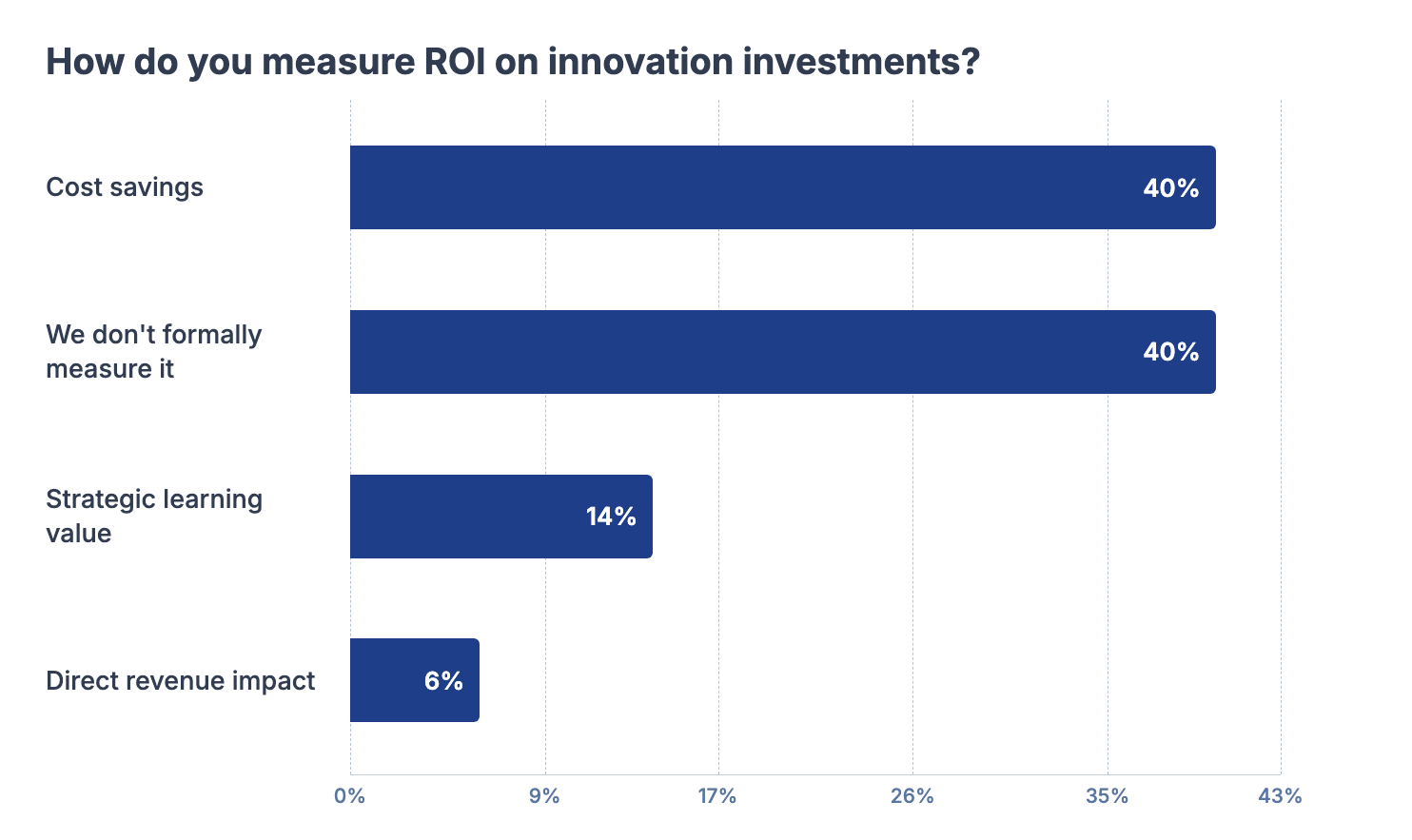
Approaches to measuring innovation ROI vary considerably, with two methods attracting equal attention. 40% of corporate innovation leaders’ organizations measure ROI through cost savings, making operational efficiency one of the most common evaluation methods. Another 40%’s organizations do not formally measure ROI, likely because structured evaluation frameworks are still evolving.
14% of our audience focuses on strategic learning value, recognizing the importance of knowledge, capability building, and long-term innovation potential. Meanwhile, 6% of conversations identify direct revenue impact as the primary ROI measure.
Based on these numbers, organizations are balancing short-term operational gains with long-term strategic goals. Strong interest in cost savings emphasizes efficiency, while the large share without formal measurement reveals that many innovation programs are still developing their performance metrics. Strategic learning also remains a key measure, reflecting the value organizations place on experimentation and building long-term competitive advantage.
How much annual revenue is from products or services launched in the last three years at corporation innovation leaders' organizations?
For 10% of corporate innovation leaders, less than 5% of annual revenue comes from products or services launched in the last three years, 56% say they get a small portion here, but 8% get almost none, while those earning more than 30% of their revenue number 16% who get a significant portion, 8% a small amount, and 2% with virtually nothing.
Newer products aren’t topping revenue scales yet:
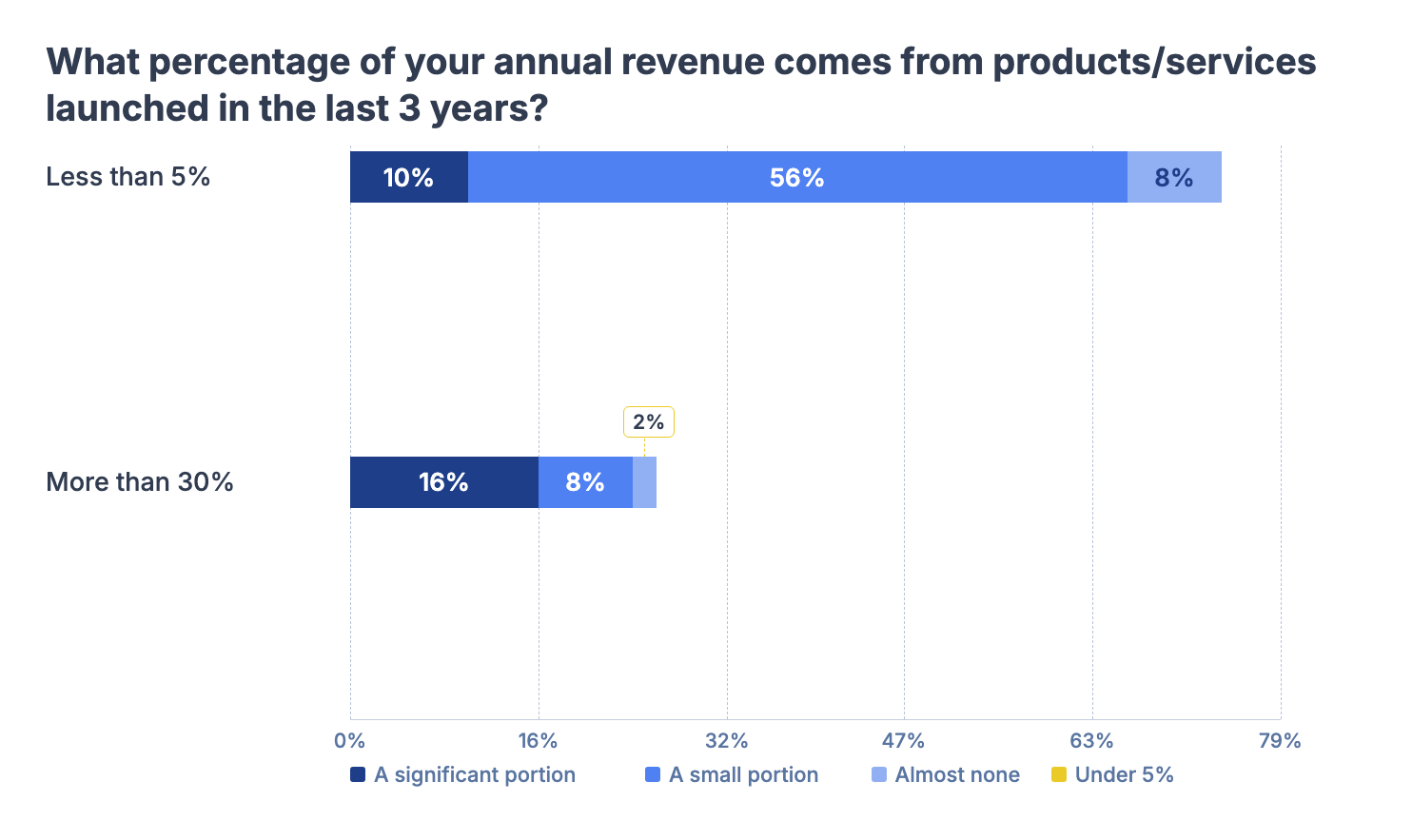
Annual revenue from products and services launched within the last three years varies considerably across organizations, though lower contributions are bigger talking points. For 56% of corporate innovation leaders, less than 5% of annual revenue comes from recent launches, making up a small share of overall revenue. Another 10% associate revenue below 5% with a significant portion of business performance, while 8% say that new offerings contribute almost no annual revenue.
At the other end of the scale, 16% point to products and services launched within the last three years, which generate more than 30% of annual revenue and represent a significant portion of business performance. Finally, 8% describe this level as a small portion, while 2% indicate that it accounts for almost none.
Our audience’s organizations are clearly at different stages of innovation maturity. Many are still building momentum from recent launches, while others are already seeing substantial returns. This is on target with expectations outlined in the McKinsey Global Survey. The survey stated that by 2026, around half of global revenue would come from products, services, and businesses that didn’t exist in 2021. This illustrates just how important continual innovation is in staying relevant in the market.
What is the biggest barrier in corporation innovation leaders' organizations?
Insufficient budget is a significant barrier for 60% of corporate innovation leaders, it’s the main barrier for 4%, a minor barrier for 5%, but not a barrier for 4%, while 23% are hindered by a risk-averse culture, 2% significantly challenged by slow internal processes, and 2% don't find a lack of executive sponsorship any kind of barrier whatsoever.
Barriers are budget-driven:
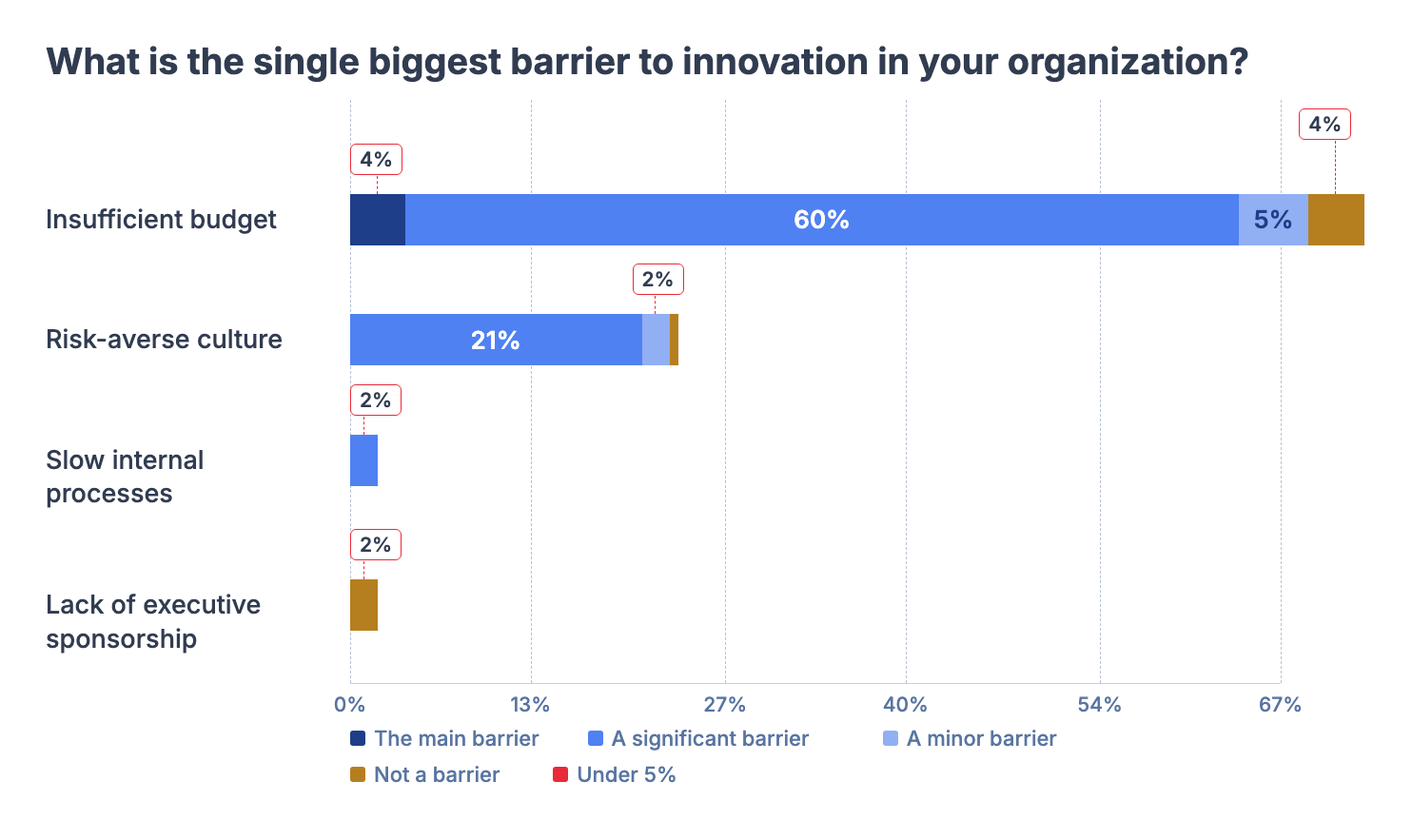
Budget constraints are the biggest barriers to innovation for corporate innovation leaders. 60% of our audience identifies insufficient budget as a significant barrier, making it the most widely recognized challenge. A further 4% describe limited budgets as the main barrier, while 5% view funding as a minor barrier, and for another 4%, it’s not a barrier at all.
Beyond financial considerations, 21% agree that a risk-averse culture is a significant barrier, with 2% describing it as a minor issue and 0% suggesting it is not a barrier. Elsewhere, 2% identify slow internal processes as a significant barrier, while another 2% say that a lack of executive sponsorship is not a barrier. This puts the focus firmly on a lack of budget rather than on internal processes or ecosystems.
What is the biggest opportunity for corporation innovation leaders ahead?
Sustainability innovation is the top opportunity for 42% of corporate innovation leaders, and 13% see it as a promising future area, while AI-driven products are the biggest opportunity for 21%, promising for 8%, and less important for 2%, and ecosystem or startup collaboration is tops for 6%, and new business models lead the way for 4%.
Opportunities for innovation are diverse:
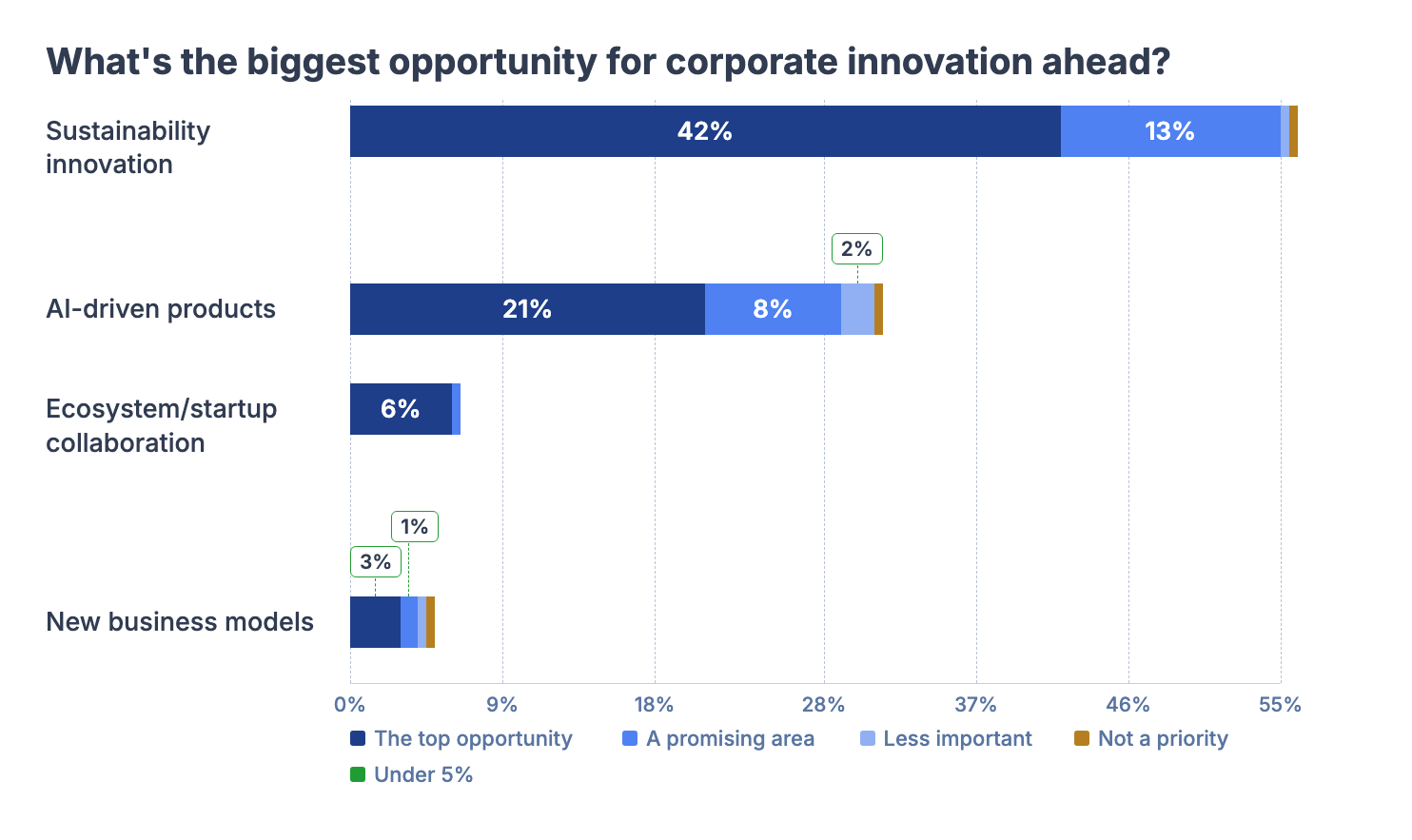
Sustainability innovation is the biggest opportunity for corporate innovation leaders. This isn't unexpected when you consider that the global green technology and sustainability market is projected to grow from $23.10 billion in 2024 to $79.65 billion by 2030. 42% of our audience see it as the top opportunity, while a further 13% describe it as a promising area. Less than 1% consider sustainability innovation less important, and there’s almost no discussion (0%) suggesting it’s not a priority.
AI-driven products also feature prominently, with 21% viewing them as a top opportunity, 8% as a promising area, 2% as less important, and less than 1% indicating they are not a priority.
A further 6% of our audience identifies ecosystem and startup collaboration as the top opportunity, while less than 1% view it as a promising area. New business models receive comparatively less attention, with 3% viewing them as a top opportunity and 1% as a promising area.
What is the top risk for corporation innovation leaders going into 2027?
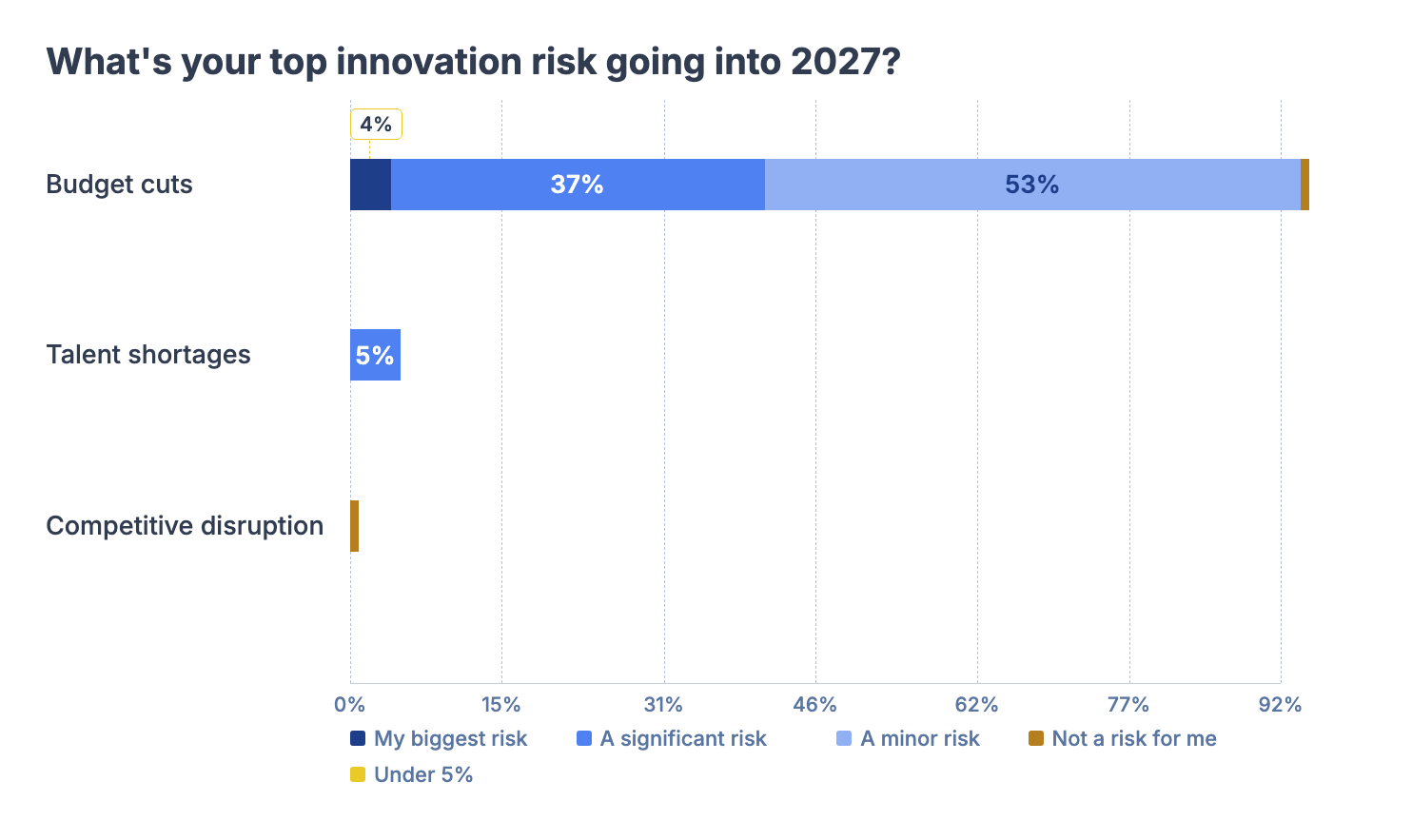
Budget cuts are the biggest risk for 4% of corporate innovation leaders going into 2027, 37% see these cuts as a significant risk, and 53% as a minor one, while talent shortages are a significant risk for the remaining 5%.
Risk focuses on funding:
Recent proposals to reduce U.S. federal research funding have raised questions about the future pace of research and development, with potential implications for both public- and private-sector innovation.
Understandably, then, budget constraints emerge as the most frequently discussed innovation risk heading into 2027. They are the biggest risk for 4% of corporate innovation leaders, a significant risk for 37%, and a minor risk for 53%. On the other hand, just 5% see talent shortages as a significant risk, while almost no discussion (less than 1%) focuses on competitive disruption as a risk.
U.S. corporation innovation leaders shaping the next wave of industry growth
Corporate innovation in the U.S. is evolving through a balance of disciplined investment and long-term experimentation. These findings show that organizations are strengthening external partnerships, steadily integrating AI, and prioritizing technologies and initiatives that support future growth while delivering measurable business value. Although budget pressures and approval bottlenecks continue to slow progress for some, innovation remains firmly on the strategic agenda.
Overall, the results point to companies refining how they innovate, collaborate, and scale new ideas to stay competitive in an increasingly fast-moving market.
About the data
Sourced through our partner's social listening platform using publicly available data from an independent sample of 1,176,763 opinions of Corporate Innovation Leaders in the U.S. across X, Quora, Reddit, Bluesky, TikTok, and Threads. Responses are collected within a 95% confidence interval and 5% margin of error. Results are derived from what people describe online, from opinions expressed, and not actual questions answered by people in the sample.

The State of Innovation Readiness 2026
Read Now -> Where do organizations really stand on innovation? We surveyed over 1,000 professionals from corporations, government bodies, and universities to find out. Download the full report to get the insights.

PLUG AND PLAY AROUND THE WORLD
Discover our global locations
We have a community of experts all over the world. We work as a bridge between Silicon Valley and the rest of the world, making innovation open to anyone, anywhere.