How Thread AI Cut Ricoh's Facilities Report Time From Hours to 3 Minutes
Ricoh’s Facilities Management business oversees thousands of buildings and hundreds of thousands of assets, such as elevators, boilers, and air handlers. Every asset needs a repair-or-replace decision, and those decisions depended on field engineers manually compiling inspection results, repair histories, and expert knowledge from unstructured, often handwritten Japanese documents.
Thread AI built a system on its Lemma platform that extracts data from those documents and generates consistent, auditable investment reports for a single project ID, reducing report preparation time from hours to about three minutes.
This is the story of their collaboration.
Results
per report vs. hours
per report vs. hours
run-to-run score variance
run-to-run score variance
of reports improved in quality
of reports improved in quality
Partner

Ricoh, founded in Tokyo in 1936, grew from an office printer maker into a digital services company serving about 200 countries.
Startup

Thread AI helps enterprises and federal agencies run AI workflows with controlled autonomy, powered by its Lemma platform.
Facilitator

Plug and Play is a global innovation platform connecting startups, corporations, investors, governments, and universities.
How Plug and Play Brought Ricoh & Thread AI Together
Junko Hayashida, Director of Partner Success, Japanese Partnerships, at Plug and Play, made the introduction in October 2025, when Ricoh and Thread AI met virtually. A few weeks later, both parties attended Plug and Play’s November Summit 2025 in Sunnyvale, California, where they met in person.
Hear from our partner:
“Thread AI allows us to build cutting-edge internal and external products that leverage best-in-class models, connecting our systems and services to a range of model and agent architectures through one agnostic infrastructure. What that unlocked for us is concrete: our real challenge was never a shortage of expertise, but that our expertise didn’t scale evenly across sites and reviewers.
Lemma let us build that judgment and apply it consistently, with every recommendation traceable to the source evidence. Our time-to-value on new AI functionality is accelerated because of the infrastructure powering the Lemma platform.”
— Shun Tanaka, VP, R&D, Ricoh

How It Happened
- To automate the labor-intensive process of gathering, interpreting, and analyzing thousands of facility management documents and records.
- To standardize investment decision-making by making expert knowledge repeatable, traceable, and auditable across sites.
- To combine structured enterprise data with unstructured information such as inspection reports, drawings, photos, and handwritten notes, enabling more complete decision support.
- To evaluate whether AI orchestration could provide the governance, human-in-the-loop controls, and auditability required for production enterprise environments.
- To establish a reusable foundation that could eventually support additional Ricoh workflows beyond Facilities Management.
- Data extraction: Field teams upload files to cloud storage. The system detects new or changed files, extracts findings, and links each record to the right building and piece of equipment. Deterministic parsers handle known formats; AI handles the long tail of unusual ones, including handwriting and photos. Linkage runs as a three-step cascade:
- Reference tables of IDs and aliases resolve most records with no AI calls.
- An AI agent with read-only access proposes a mapping only when a miss occurs.
- A person approves any new linkage rule before it is saved, so the costly path gets rarer over time.
- Report generation: For a given project ID, the system retrieves all related data, normalizes it, and computes scores and trends in code before any AI is involved. A tightly controlled chain of AI prompts then writes the report, with every claim tied to a source and missing evidence stated rather than filled in. Ricoh’s experts can edit prompts and thresholds as part of the configuration. Every run is logged so that any past report can be replayed and explained.
- Hours of manual assembly → ~3 minutes per report, across thousands of completed runs.
- Generation latency down 43% (224s → 127s).
- 89.6% of reports showed improved quality.
- Run-to-run score variance down 74% (0.312 → 0.080); adding unstructured data cut variance a further 52% (0.168 → 0.080).
- Proven at scale across thousands of buildings, tens of thousands of pieces of equipment, hundreds of projects, and thousands of work tickets.
- Decisions now follow the same rubric and evidence standards across reviewers and sites.
- Real inspection findings are cited instead of age-based defaults.
- Data gaps are quantified: a report can state how much a score would shift if a missing fact were known.
- Previously unusable files are now searchable and linkable by both people and AI.
The Opportunity
Ricoh viewed this initiative as an opportunity to validate how AI orchestration could be applied to complex enterprise workflows operating at scale. Ricoh’s original expectations were:
From a broader strategic perspective, Ricoh was not simply looking for a point solution. We believe the value does not come from AI models alone, but from how AI can be integrated into real business processes, connecting data, business rules, human decision-making, and enterprise systems to drive meaningful business outcomes. Through this initiative, Ricoh sought to explore how AI orchestration could provide the foundation for making this possible at enterprise scale.
This project also demonstrated the value of Plug and Play’s ecosystem in connecting Ricoh with emerging technologies and startups such as Thread AI, creating opportunities to explore and develop new enterprise use cases through collaboration.

The Solution
Thread AI built two pipelines, using AI where judgment is required and deterministic code everywhere else.
The Outcomes
Measurable Results
Process Improvements

The Takeaways
Partner Takeaways (Ricoh)
Ricoh’s challenge was never a lack of expertise, but that expertise did not scale evenly across sites and reviewers. The system lets them apply that judgment consistently, with every recommendation traceable to its source evidence, and it speeds up time-to-value for new AI functionality.
Startup Takeaways (Thread AI)
Thread AI has partnered with Ricoh to build AI-powered workflows that automate and enhance facilities management reporting by combining agentic AI, deterministic processes, and human-in-the-loop oversight. Built to integrate with Ricoh’s existing systems and architecture, these workflows can be embedded directly into Ricoh’s product suite.
The engagement has also enabled Ricoh’s engineering teams to independently develop and extend AI-powered workflows on the platform, creating a foundation for broader adoption of AI across multiple business use cases. As the partnership continues, Thread AI and Ricoh are expanding their pipeline of opportunities to deliver practical, scalable AI solutions to customers. Thread AI and Ricoh’s engineering teams have developed a strong partnership to build AI-powered workflows and features for Ricoh and its customers.


Hear from the startup:
“Our work with Ricoh shows what’s possible when production-grade AI meets deep domain expertise. Our engineering teams have worked side by side, combining Ricoh’s facilities and technical knowledge with Thread AI’s platform to build cutting-edge solutions that turn decades of unstructured, often handwritten inspection records into consistent, auditable investment decisions.
Plug and Play was a key part of this collaboration, introducing our two teams and making a partnership with this kind of real-world impact possible.”
— Jen Hilibrand, VP, Applied AI, Thread AI
November 4, 2025
First introductory call between Thread and Ricoh.
November 19, 2025
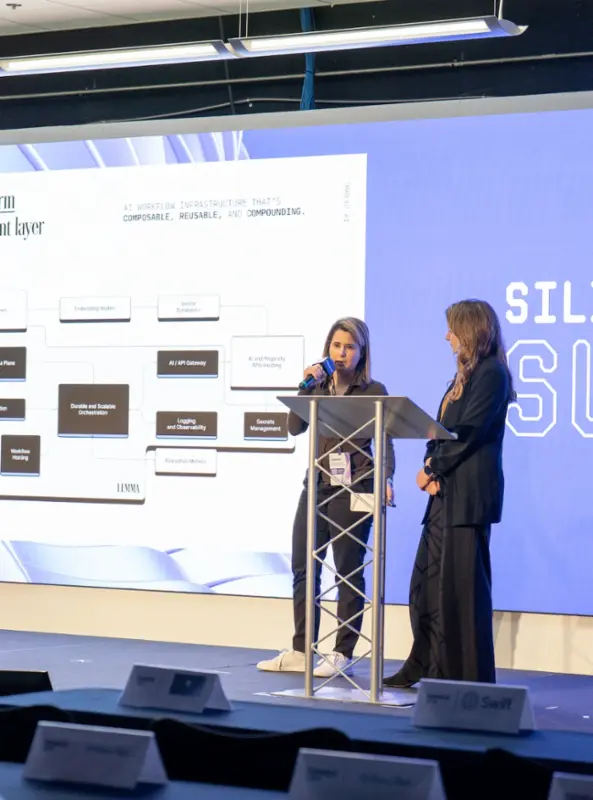
Second conversation between Thread and Ricoh at Plug and Play's Silicon Valley November Summit 2025.
January 14, 2026
Whiteboarding session with Thread Applied AI team.
January 19, 2026
NDA executed.
January 22, 2026
Additional whiteboarding sessions.
January 25, 2026
First draft/iteration of initial Co-Build proposal.
March 10, 2026
Finalized Co-Build proposal.
April 1, 2026
Kickoff of Co-Build into Annual project.
July 21, 2026
Ricoh senior stakeholder aligned on the impact and success of the project; expansion discussions began.
Related Insights



Discover our global locations
We have a community of experts all over the world. We work as a bridge between Silicon Valley and the rest of the world, making innovation open to anyone, anywhere.