To find out what 2,178,556 opinions of innovation leaders in corporations, government, or universities in the U.S. were about AI adoption, we utilized AI-driven audience profiling to synthesize insights from online discussions over 12 full months ending September 23, 2026. The results reveal what innovation leaders in corporations, government, and universities think about these issues and offer insight into the factors impacting AI adoption across the country.
articleOct 26, 2026
AI Adoption Statistics: U.S. 2026
Artificial intelligence is attracting investment across the U.S., with organizations exploring its potential to change how they operate, compete, and develop new capabilities. Yet deciding where AI fits within an organization raises practical questions about technology choices, workforce readiness, and the resources needed to support adoption.

Index
- Methodology and data.
- Across all opinions, 57% of innovation leaders in corporations, government, or universities describe their organization as making progress in AI adoption, 27% as fully adopted, 12% as in the early stages, and 4% as not yet started.
- New products or revenue streams are a top priority for 12% of innovation leaders (important for 9%, minor for 9%, not a goal for 5%); better service experience is a top priority for 9% (important for 14%, minor for 6%, not a goal for 5%); productivity gains are a top priority for 5% (important for 8%, not a goal for 3%); and cost reduction is a top priority for 3% (not a goal for under 1%).
- AI agents account for 67% of tool mentions (14% essential, 34% frequently used) and coding assistants for 27%. AI built into existing software (2%), predictive analytics (2%), custom or in-house models (1%), and general chatbots and assistants (1%) each account for 2% or less.
- IT and cybersecurity is where 54% of innovation leaders in corporations, government, or universities are seeing the most use of AI; 17% are seeing it in data analysis and decision-making, 16% in research and development, 10% in content creation, 2% in customer, citizen, or student services, and 1% see AI adoption driving operations and process automation.
- At 35% of innovation leaders in corporations, government, or university organizations, a CEO, president, or agency head is clearly in charge of AI adoption strategy; they are likely responsible for 24%, have some involvement for 2%, and are not responsible for less than 1%; at 19% of organizations, a CIO or CTO is clearly in charge and likely responsible for 9%, while a chief AI or data officer is clearly in charge for 6% and likely responsible for 1%.
- 64% of innovation leaders in corporations, government, or universities dedicate less than 10% of their innovation budget to AI adoption, 33% dedicate between 10 and 25%, and 3% more than 50%.
- While 69% of innovation leaders in corporations, government, or universities do not yet measure the success of AI adoption, 28% measure success in time saved, 2% in cost savings, and 1% measure success in revenue or funding growth.
- 31% of innovation leaders in corporations, government, or universities report a strong positive return from AI adoption, 28% have broken even, 18% report a negative return, and 17% a modest positive return; 5% say it is too early to tell. Separately, when describing outcomes, 33% cite some positive results, 32% mixed or unclear outcomes, 18% no benefit, and 17% significant impact.
- About 90% describe no formal change management approach. Of all opinions, 9% rate support as good in that group, 52% as limited, and 28% as none. Incentives and recognition: 2% best possible support, 3% good, 2% limited, 1% none.
- 44% of innovation leaders in corporations, government, or universities rate their staff readiness for AI adoption as neutral; 27% think their staff is somewhat ready, and 2% rate them as very ready; however, 25% don’t feel their staff is ready for AI adoption at all, and another 3% feel they are somewhat unready.
- 72% of innovation leaders in corporations, government, or universities are not yet addressing staff resistance to AI adoption; 21% have encountered little resistance, and 6% are using transparent communication to address resistance, while 1% rely on upskilling and communication to break through the barriers.
- The main barrier to AI adoption for 3% of innovation leaders in corporations, government, or universities is a skill or talent gap; this is also a significant barrier for 35% and a minor barrier for 27%, but not a barrier for 3%; 10% face significant barriers due to security and privacy concerns, and 4% find these a minor hindrance; 6% are significantly barred by data quality or access, and a further 5% find this a minor barrier to AI adoption, while 1% find cultural resistance to pose a minor barrier.
- 50% of innovation leaders in corporations, government, or universities have no governance framework in place yet for AI adoption, 7% have informal guidelines only, and under 1% have a framework in development; in contrast, 43% already have a fully established AI adoption governance framework.
- Legal and compliance teams absolutely own governance decisions about AI adoption for 16% of innovation leaders in corporations, government, or universities; 14% agree they are likely responsible, and 9% are somewhat involved, but 8% don’t assign them responsibility; for 13%, the IT or security team is absolutely responsible, and likely responsible for 13%, while a dedicated AI governance board is absolutely responsible for AI adoption for 7% and likely responsible for 10%, but not responsible for 3%, individual departments are likely responsible for 1%, and 2% put responsibility firmly on executive leadership.
- 91% of innovation leaders in corporations, government, or universities have no monitoring in place yet for live AI systems, but 5% rely on human review of AI outputs, 4% use continuous automated monitoring, and under 1% only rely on user feedback about AI adoption.
- While 47% of innovation leaders in corporations, government, or universities don't yet have formal vetting processes for AI tools before adopting them, 41% pilot these tools in sandbox environments, 8% conduct formal security reviews, 4% rely on case-by-case IT approval, and 1% vet tools using vendor certifications like SOC 2 or FedRAMP.
- Data leakage through AI tools is extremely concerning for 3% of innovation leaders in corporations, government, or universities, and 62% find this somewhat concerning about AI adoption, but it’s not a major concern for 5%; intellectual property exposure isn’t a big concern for 4%, but 19% find this somewhat concerning; and about 2% each feel the same about shadow AI use by staff, vendor or third-party risks, and AI-powered cyberattacks, while fewer than 1% find prompt injection and model attacks extremely concerning.
- The compliance area that most shapes AI adoption for 28% of innovation leaders in corporations, government, or universities is federal guidance and executive orders; this is a significant factor for 28% and somewhat relevant for 21%; data privacy laws are the main influence for 9% and a significant factor for 4%, while for 5%, state AI laws are a significant factor; for 2%, industry rules like HIPAA or FERPA are significant; and for 1%, accessibility requirements play a significant role in shaping AI adoption.
- 23% of innovation leaders in corporations, government, or universities are very confident in meeting compliance for AI adoption, 18% are somewhat confident in doing so, and 16% are neutral; however, 13% are somewhat unconfident in meeting compliance, and 30% are not confident at all.
- Federal and state rules slightly slow AI adoption for 77% of innovation leaders in corporations, government, or universities; 20% are unsure of their impact on adoption, but 2% don’t find these laws to have any effect, and a further 1% find that they accelerate it.
- While 53% of innovation leaders in corporations, government, or universities do not work with startups, 38% rely on direct procurement to engage startups to support AI adoption, 6% utilize venture investment, and 2% use research partnerships for startup engagement.
- Proven results with peers are absolutely essential for 13% of innovation leaders in corporations, government, or universities when assessing a startup as a strong partner for AI adoption, and this is a definite advantage for 59%, but it's not a big factor for 11%, and it doesn't matter much for 9%; while 3% find flexible pricing absolutely essential, another 3% cite strong security and compliance as a definite advantage, 2% share the same opinion about ease of integration, and another 1% about deep domain expertise.
- For 48% of innovation leaders in corporations, government, or universities, startup financial stability is a significant challenge when working with startups on AI adoption, and 4% find this a minor challenge; 23% struggle with integration with legacy systems when working with startups, and 12% find this a minor challenge; 3% cite scaling beyond pilots as the biggest challenge and another 7% agree this poses a significant challenge, while 3% agree security and compliance vetting is a significant challenge too.
- Better data infrastructure would be absolutely essential in helping to accelerate AI adoption for 19% of innovation leaders in corporations, government, or universities, and 4% agree this would help a lot; clearer regulation would be absolutely essential for 15%, for 29%, this would help a lot, it would be somewhat helpful for 3%, but 2% don’t think it is important; 4% agree proven use cases from peers would be essential in speeding up AI adoption, this would help a lot for 13%, and be somewhat helpful for 7%, while 1% agree more funding would be somewhat helpful.
- The state of AI adoption across US corporations, government, or universities.
Methodology & data
Sourced through our partner’s social listening platform using publicly available data from an independent sample of 2,178,556 opinions of innovation leaders in corporations, government, or universities in the U.S. across X, Quora, Reddit, Bluesky, TikTok, and Threads. Percentages reflect the share of opinions expressed in public posts and are not survey responses. The sample is not a probability sample, so confidence intervals and margins of error do not apply. Results are derived from what people describe online, from opinions expressed, and not actual questions answered by people in the sample.
The findings in this report do not come from the Plug and Play (PNP) ecosystem. They are not based on PNP corporate partners, startups, or members, and they do not reflect PNP’s own data or views.
What is the current stage of AI adoption for innovation leaders?
Across all opinions, 57% of innovation leaders in corporations, government, or universities describe their organization as making progress in AI adoption, 27% as fully adopted, 12% as in the early stages, and 4% as not yet started.
AI adoption stages vary:
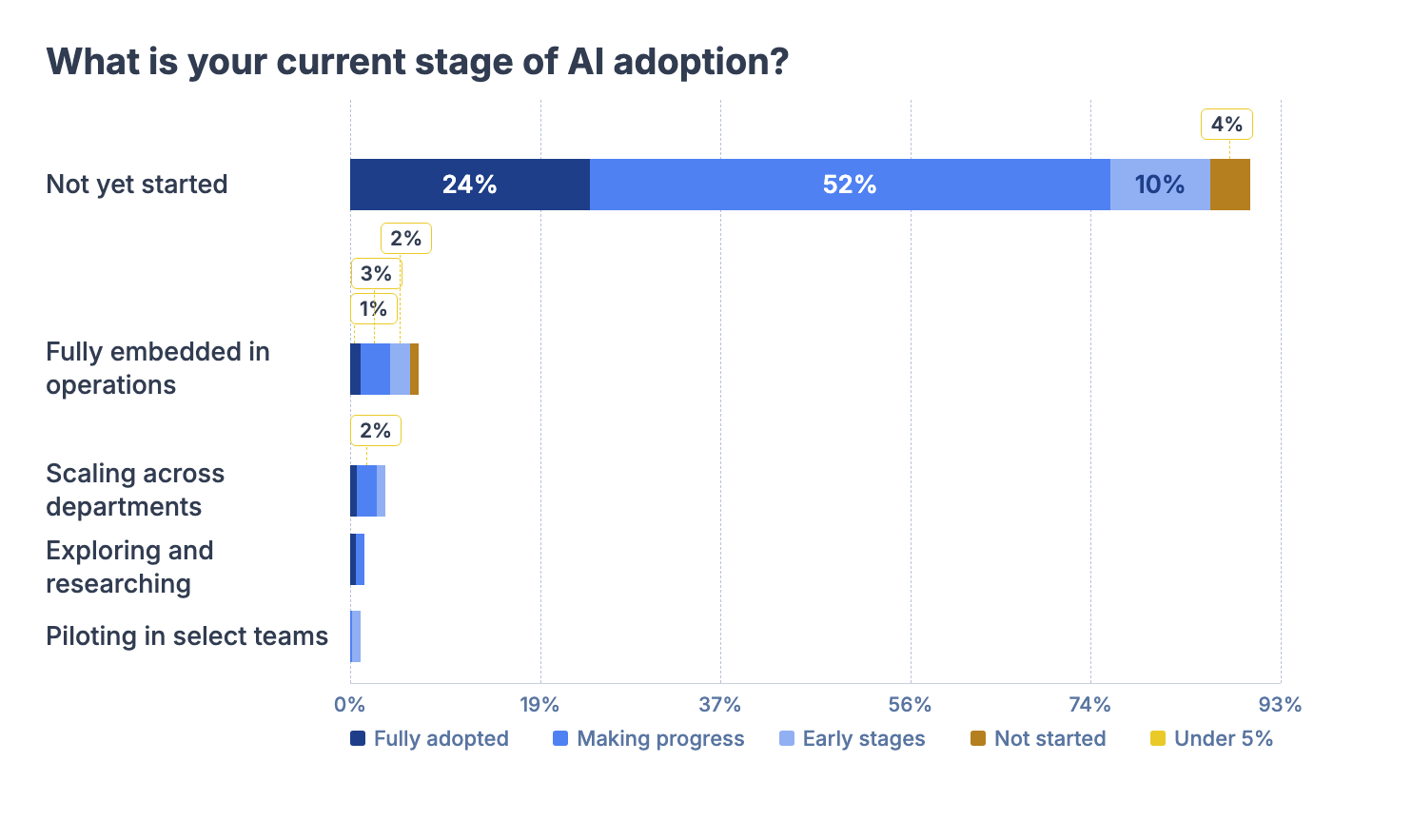
Note: This chart combines two separate questions: adoption stage (bars) and overall adoption status (colors). The colored segments show overall status and should not be read as a breakdown of organizations within each stage. See the text above for overall status figures.
AI adoption in U.S. businesses is estimated to range from 21.7% to 47%, depending on company size and measurement scope. Additionally, eMarketer’s 2026 forecast projects 161.5 million monthly U.S. generative AI users, reflecting the technology’s expanding reach among consumers.
Among innovation leaders in corporations, government, and universities, AI adoption still spans several stages of implementation. Across all opinions, 57% describe their organization as making progress in AI adoption, 27% as fully adopted, 12% as in the early stages, and 4% as not yet started.
Only 7% of opinions place their organization as fully embedded in operations, 2% as scaling across departments, and under 1% each as exploring or piloting.
What is the primary goal driving AI adoption for innovation leaders?
The primary goal driving AI adoption for 12% of innovation leaders in corporations, government, or universities is to develop new products or revenue streams; this is important for 9%, a minor consideration for 9%, but not a goal for 5%; for 9%, better service experience is the top priority, but it's not a goal for 5%, while productivity gains are a top priority for 5%, but not a goal for 3%, and cost reduction is crucial for 3% but not a goal for less than 1%.
Primary goals are not one-size-fits-all:
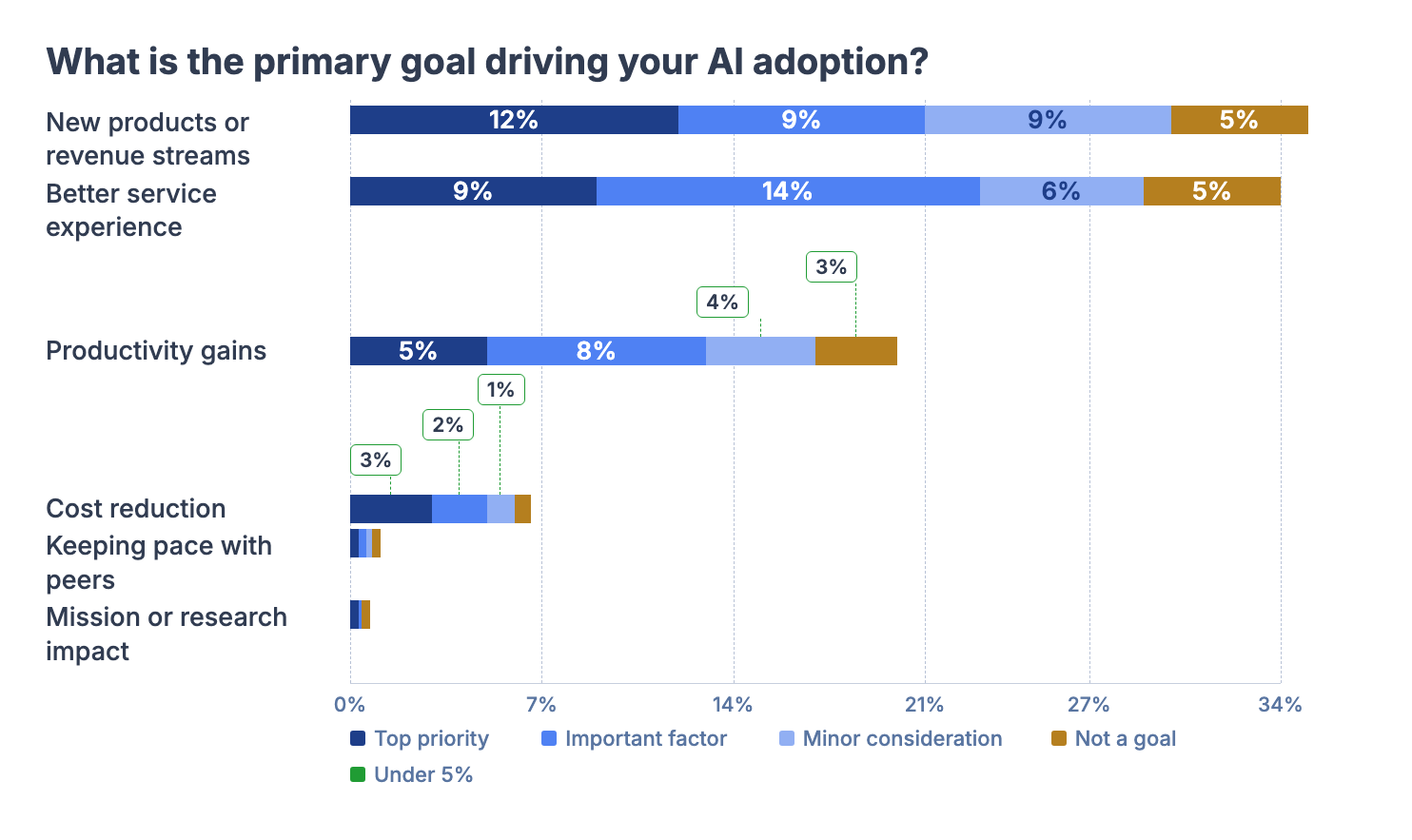
The U.S. government’s AI objectives include economic growth, national security, global competitiveness, and operational efficiency across public and private sectors. Innovation leaders in corporations, government, and universities are also pursuing AI adoption for several business goals. Developing new products or revenue streams is a top priority for 12%, important for 9%, a minor consideration for 9%, but not a goal for 5%.
Better service experience is a top priority for 9% of innovation leaders, important for 14%, a minor consideration for 6%, and not a goal for 5%. Productivity gains are a top priority for 5% of our audience, important for 8%, a minor consideration for 4%, and not a goal for 3%.
Cost reduction ranks lower: 3% name it a top priority, 2% consider it important, 1% treat it as a minor consideration, and less than 1% don’t pursue it.
Keeping pace with peers receives minimal attention: fewer than 1% see it as a top priority, under 1% as an important factor, and under 1% as a minor consideration. Fewer than 1% of our audience state that keeping pace with peers is not a goal.
Fewer than 1% of our audience say mission or research impact is a top priority; under 1% consider it an important factor; less than 1% call it a minor consideration; and less than 1% say it is not a goal. These varying percentages show just how versatile AI can be, and where leaders’ current focus lies.
Which AI tools are most used by innovation leaders in AI adoption?
For 14% of innovation leaders in corporations, government, or universities, AI agents are essential for adoption; 34% use them frequently, 13% occasionally, and 5% rarely; 6% consider coding assistants essential AI tools, 15% use them frequently, 6% occasionally, and 1% rarely; and each of the other tools (AI built into existing software, predictive analytics, custom or in-house models, and general chatbots and assistants) accounts for 2% or less of mentions.
AI agents and coding assistants are the most used AI tools:
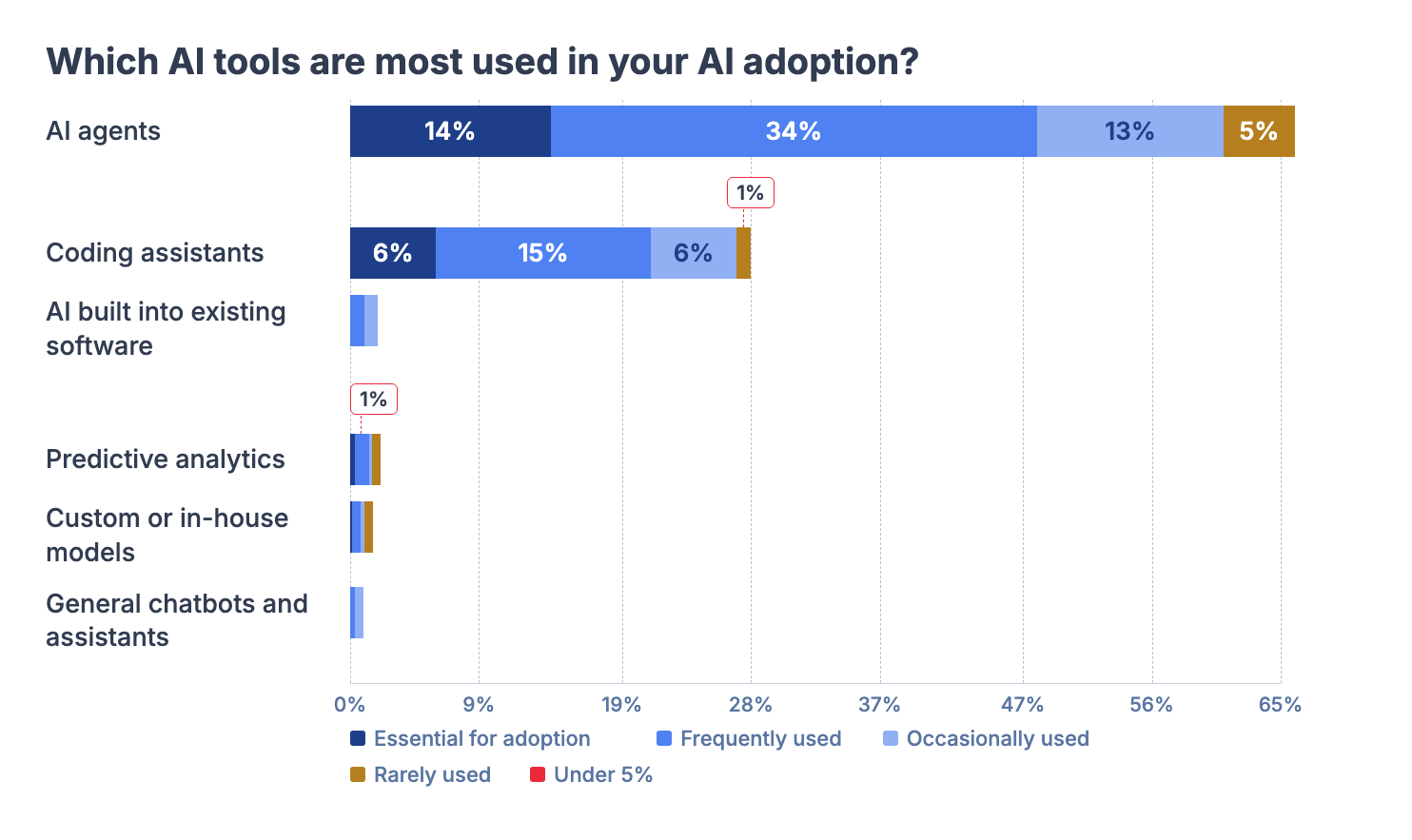
Innovation leaders are using AI agents more than any other tool. They are essential for adoption for 14%, frequently used by 34%, occasionally used by 13%, and rarely used by 5%. Coding assistants also support implementation, as 6% of our audience consider them essential, 15% use them frequently, 6% occasionally, and 1% rarely.
Other tools appear less often across the reported usage categories. AI built into existing software accounts for about 2% of mentions (1% frequently used, under 1% occasionally).
Predictive analytics accounts for about 2% of mentions, mostly frequent use (1%). Custom or in-house models account for about 1% (under 1% frequently, under 1% rarely), and general chatbots and assistants for about 1% (under 1% frequently, under 1% occasionally). These figures are shares of tool mentions, not adoption rates.
Where is AI adoption driving the most use of AI for innovation leaders?
IT and cybersecurity is where 54% of innovation leaders in corporations, government, or universities are seeing the most use of AI; 17% are seeing it in data analysis and decision-making, 16% in research and development, 10% in content creation, 2% in customer, citizen, or student services, and 1% see AI adoption driving operations and process automation.
AI adoption is accelerated by 6 areas:
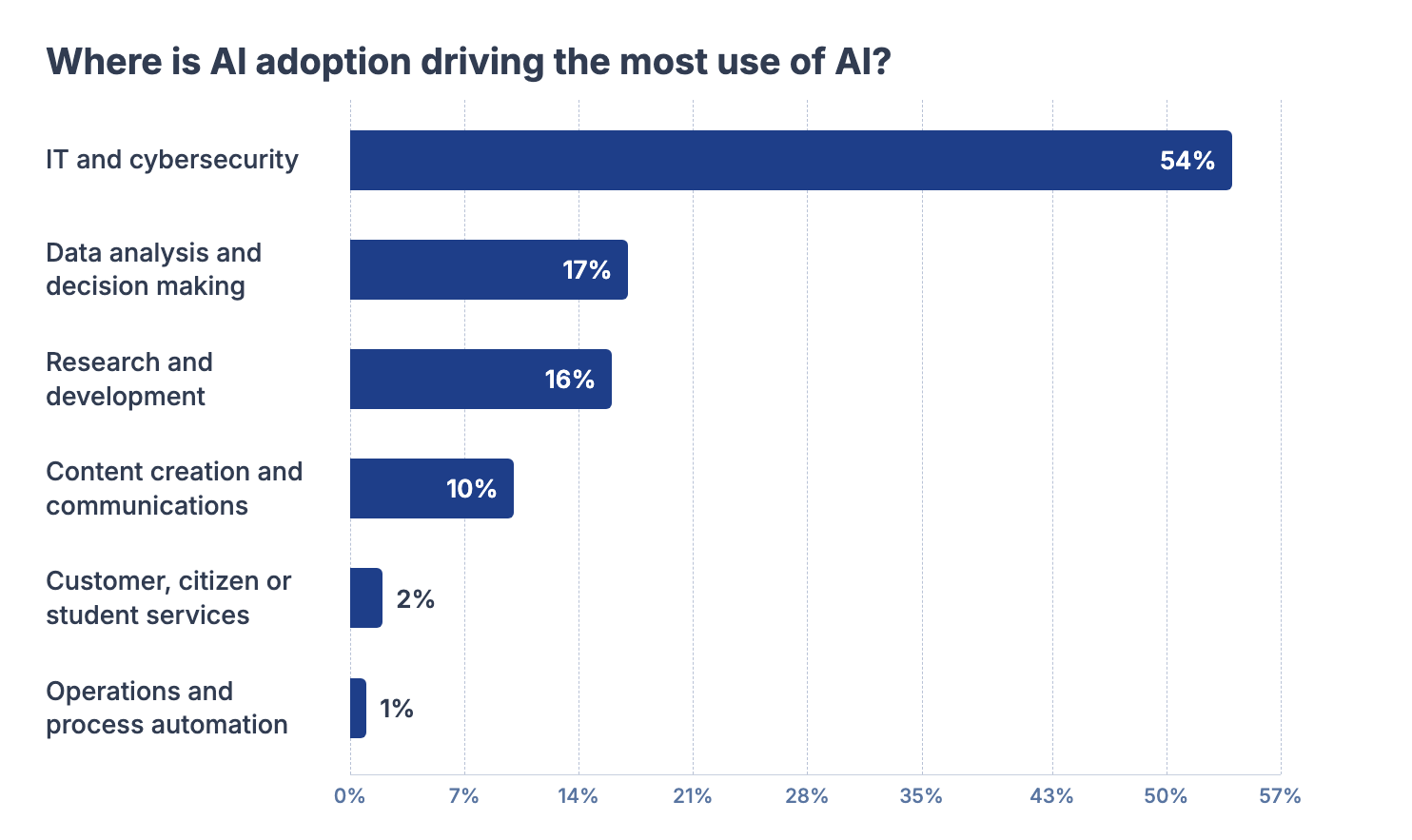
IT and cybersecurity account for the largest share of AI use among innovation leaders in corporations, government, and universities, at 54%. This strong lead reflects how organizations use AI to detect threats, manage risk, and protect digital systems.
Nationwide, security teams are also adopting these tools quickly. According to the SANS 2026 AI Survey, 78% of security practitioners include AI in their security strategy, which is a 28% increase from 2025.
Data analysis and decision-making represent 17% of AI use among innovation leaders, while research and development account for 16%. These applications also show how organizations use AI to interpret information, guide decisions, and support new ideas.
Content creation and communications account for 10% of AI use, offering another practical application for teams that produce information and share updates. Customer, citizen, or student services account for 2%, while operations and process automation represent 1%. Although these areas have smaller shares, they display how AI supports functions beyond technical and analytical work.
Only 2% see AI use in customer, citizen, or student services, even though a better service experience is a top priority for 9% and an important factor for 14%, suggesting ambition is outpacing deployment.
Who leads AI adoption strategy in innovation leaders’ organizations?
At 35% of innovation leaders in corporations, government, or university organizations, a CEO, president, or agency head is clearly in charge of AI adoption strategy; they are likely responsible for 24%, have some involvement for 2%, and are not responsible for less than 1%; at 19% of organizations, a CIO or CTO is clearly in charge and likely responsible for 9%, while a chief AI or data officer is clearly in charge for 6% and likely responsible for 1%.
Responsibility falls to one of five stakeholders (no one reported “no clear owner” ):
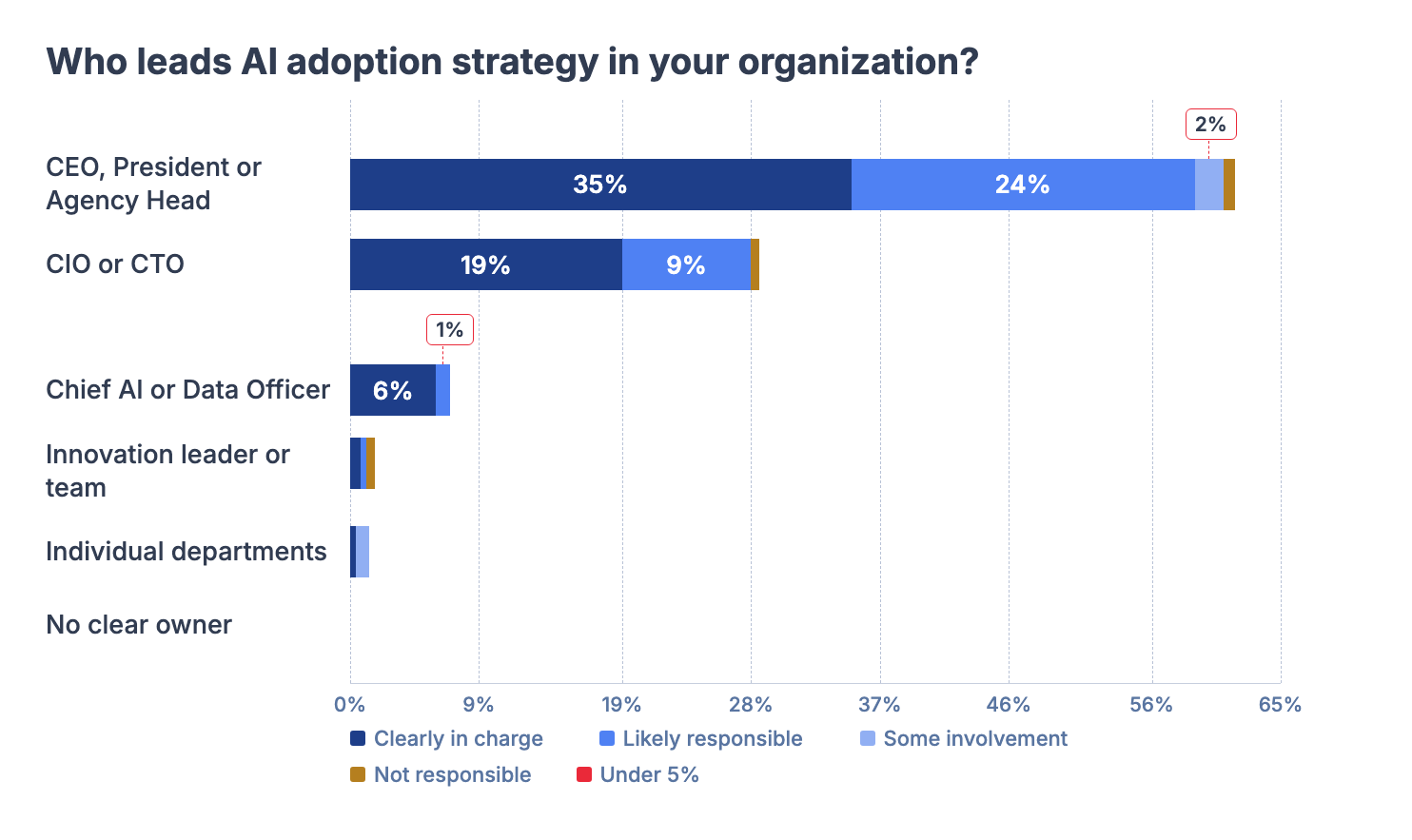
In most innovation leaders in corporations, government, or university organizations, top leadership leads AI adoption strategy. A CEO, president, or agency head is clearly in charge for 35%, likely responsible for 24%, has some involvement for 2%, and is not responsible for less than 1%.
A CIO or CTO is clearly in charge for 19% and likely responsible for 9%, with less than 1% of our audience saying they are not responsible. A chief AI or data officer is clearly in charge for 6% and likely responsible for 1%.
Innovation leaders or teams are clearly responsible for AI adoption strategy in fewer than 1% of cases, and fewer than 1% are likely to be responsible. Under 1% report some involvement, while less than 1% say they are not responsible.
Individual departments are clearly in charge in less than 1% of cases, while almost 1% have some involvement. No one in our audience said they had no clear owner for leading AI adoption strategies within their organization.
AI strategy is primarily an executive responsibility, with technology leaders providing close support. This top-level ownership can help align AI plans with organizational goals, budgets, and long-term priorities.

The Ultimate AI Playbook: 10 Enterprise Deployments Boosting ROI
Read Now -> 10 AI deployments from inside Plug and Play’s partner network – data you won’t find anywhere else.
How much of innovation leaders’ budgets goes to AI adoption?
64% of innovation leaders in corporations, government, or universities dedicate less than 10% of their innovation budget to AI adoption; 33% dedicate between 10 and 25%; and 3% dedicate more than 50%.
Less rather than more budget is allocated to AI:
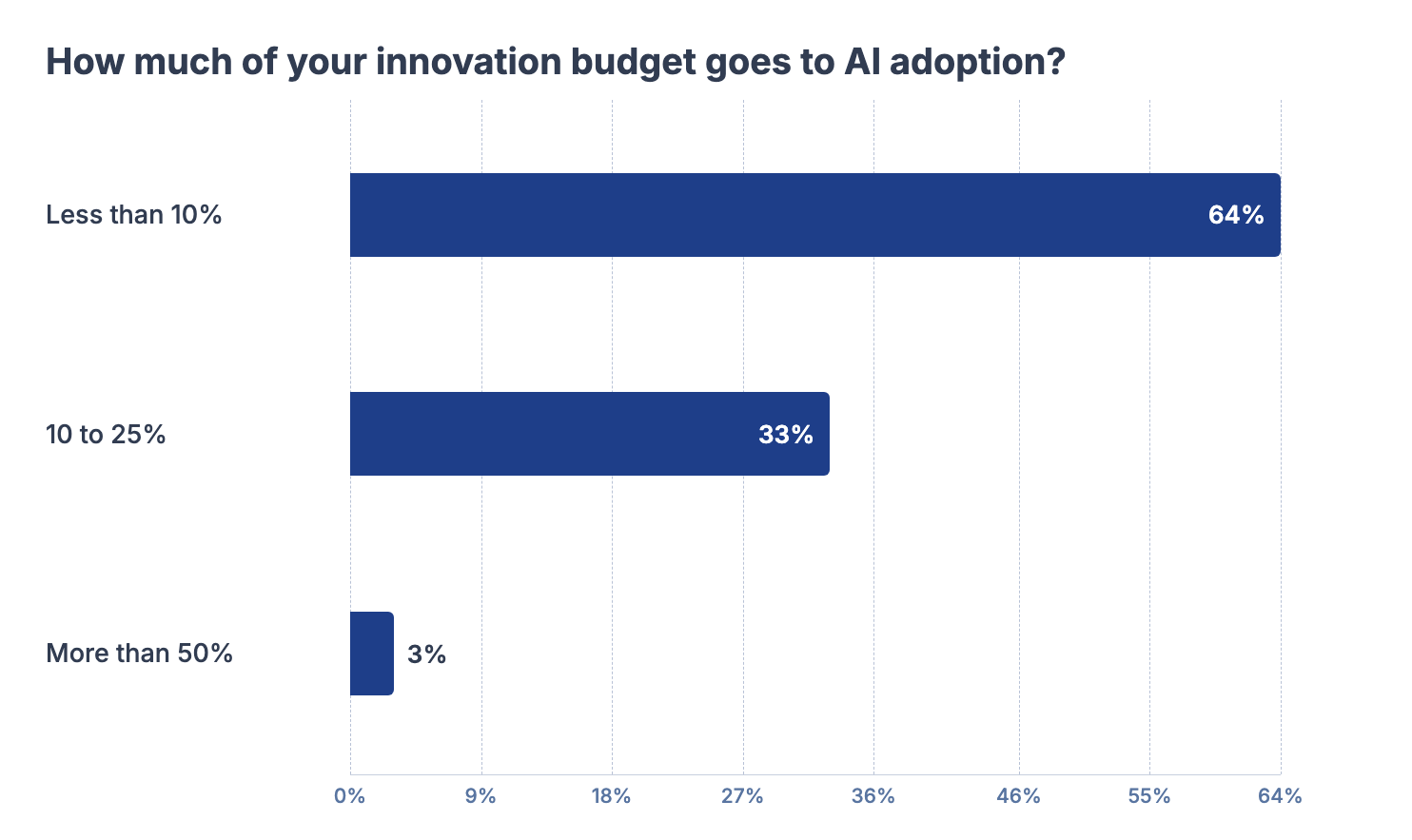
AI adoption budgets remain relatively modest for most innovation leaders in corporations, government, and universities. 64% allocate less than 10% of their budgets to AI adoption, indicating that investment often accounts for a small share of overall spending.
Another 33% dedicate between 10% and 25% of their budget to AI, indicating a more substantial commitment to developing and implementing AI capabilities. Only 3% of innovation leaders allocate more than 50% of their budgets to adoption, so high spending is less common than smaller allocations.
According to AI Business Weekly’s AI spending statistics, global AI spending is predicted to reach $2.59 trillion in 2026, a 47% year-over-year increase. While global investment is expanding rapidly, our audience illustrates that most organizations represented here still devote less than a tenth of their budgets to AI adoption.
How do innovation leaders measure the success of AI adoption?
While 69% of innovation leaders in corporations, government, or universities do not yet measure the success of AI adoption, 28% measure success by time saved, 2% by cost savings, and 1% by revenue or funding growth.
Success is measured in 3 metrics:
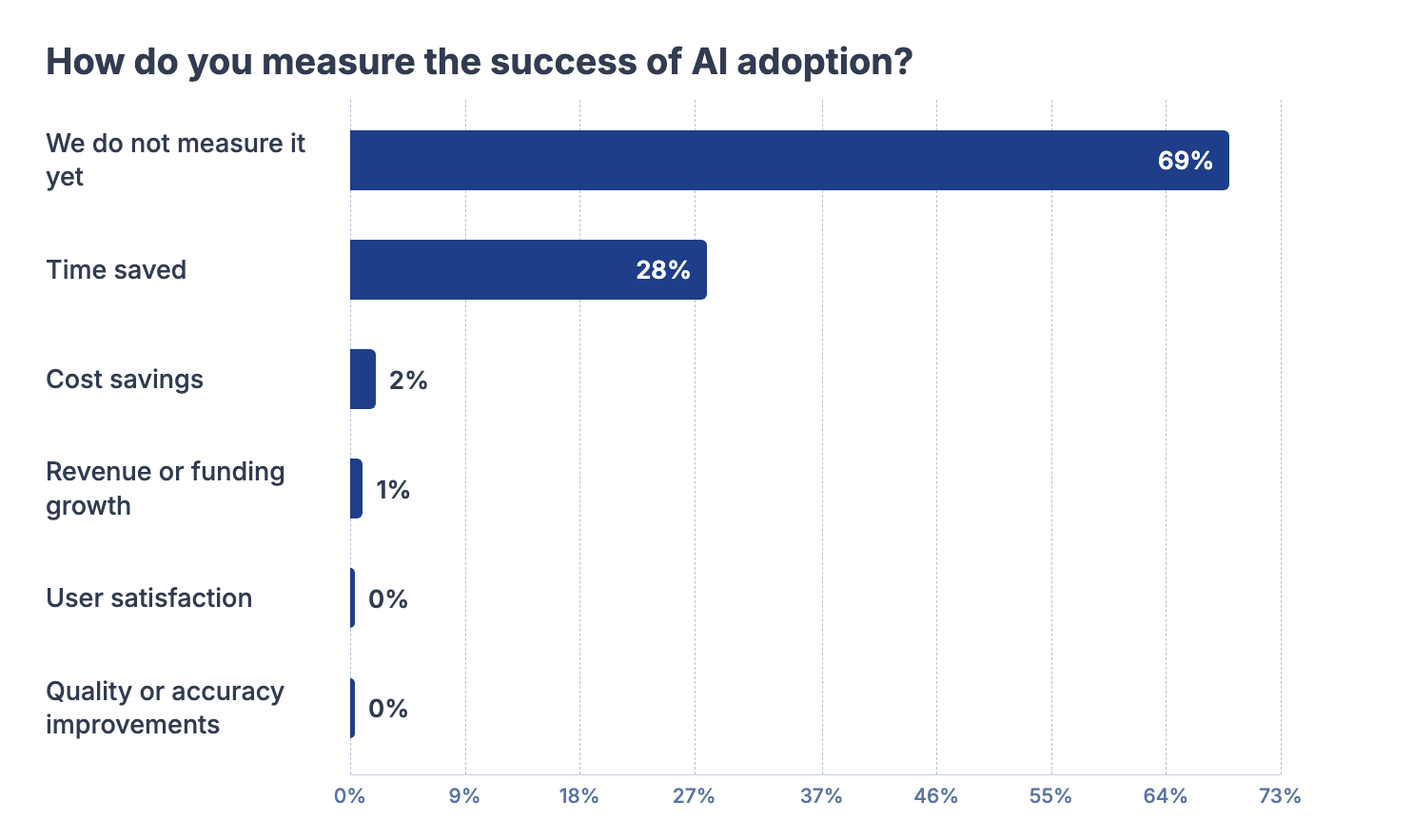
Measuring AI adoption success remains a challenge for innovation leaders in government, corporations, and universities. 69% still do not measure AI adoption outcomes, suggesting many organizations lack a clear way to track results.
Of all opinions, 28% use time saved as the main measure. This focus on efficiency provides a practical way to assess whether AI helps teams complete tasks faster and improve productivity.
Financial and user-focused measures receive much less attention. Cost savings are measured by 2% of innovation leaders, while revenue or funding growth accounts for 1%. Fewer than 1% of opinions cite user satisfaction as a measure, and fewer than 1% cite improvements in quality and accuracy.
Building measurement practices early can help leaders understand which AI tools deliver real value. Clear metrics also make it easier to compare results, improve workflows, and decide where to invest next.
What ROI has AI adoption delivered so far for innovation leaders?
31% of innovation leaders in corporations, government, or universities report a strong positive return from AI adoption; 28% have broken even; 18% report a negative return; 17% a modest positive return; and 5% say it is too early to tell. Separately, when describing outcomes, 33% cite some positive results, 32% mixed or unclear outcomes, 18% no benefit, and 17% significant impact.
ROI is still very mixed:
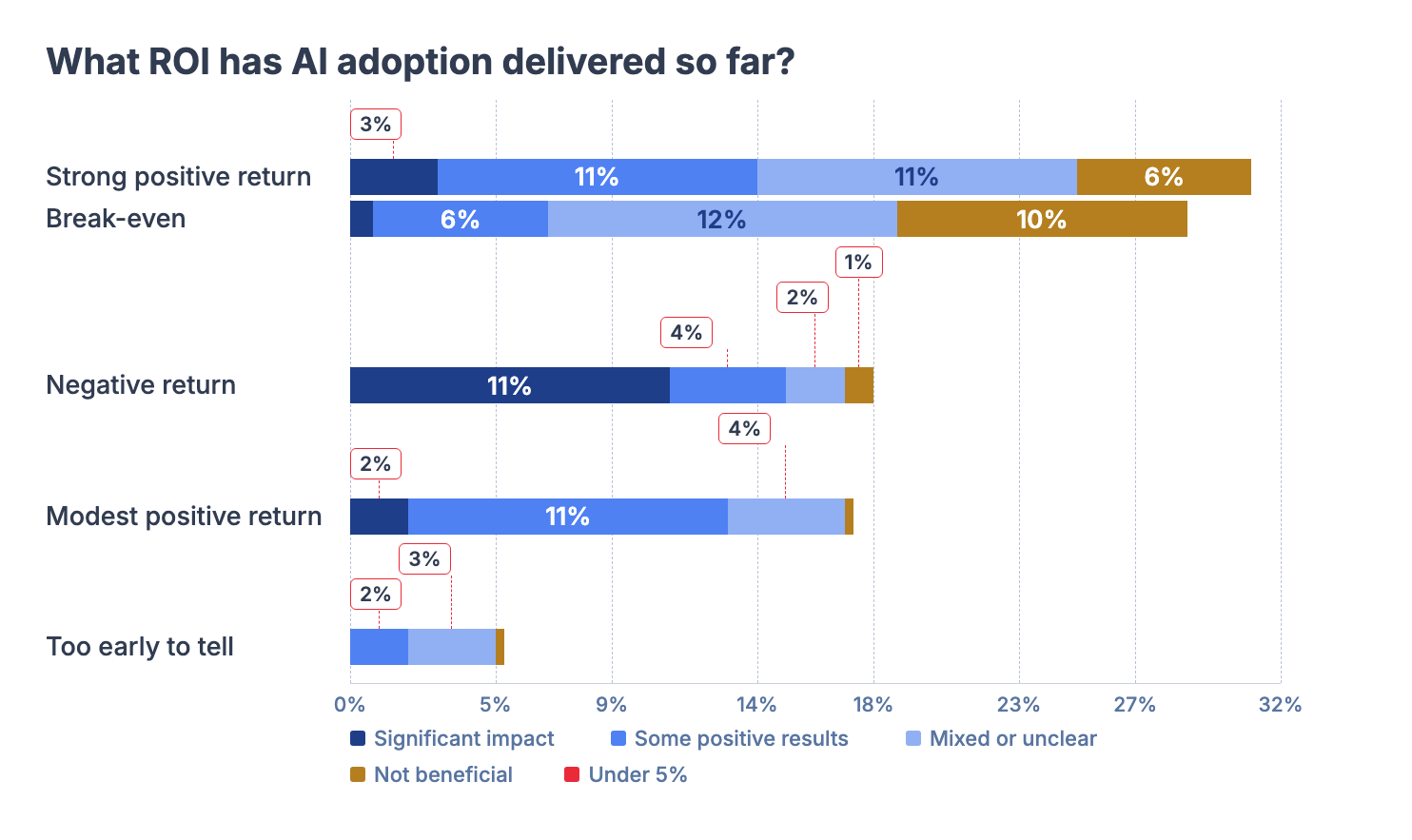
Note: This chart combines two separate questions: overall return (bars) and reported outcomes (colors). The colored segments show how outcomes were described across all opinions and should not be read as a breakdown of respondents within each return category. See the text above for overall return and outcome figures.
IBM research found that only 25% of AI projects deliver their expected ROI, and that returns from AI adoption vary widely among innovation leaders across corporations, government, and universities.
The largest group, 31%, reports a strong positive return, while another 17% report modest positive returns. 28% say they have broken even, 18% report negative returns, and 5% say it is too early to tell. Reported outcomes show a similar spread: 33% cite some positive results, 32% mixed or unclear outcomes, 18% no benefit, and 17% significant impact.
What change management approach best supports AI adoption for innovation leaders?
About 90% describe no formal change management approach. Of all opinions, 9% rate support as good in that group, 52% as limited, and 28% as none. Incentives and recognition: 2% best possible support, 3% good, 2% limited, 1% none.
A need for formal change management support is evident:
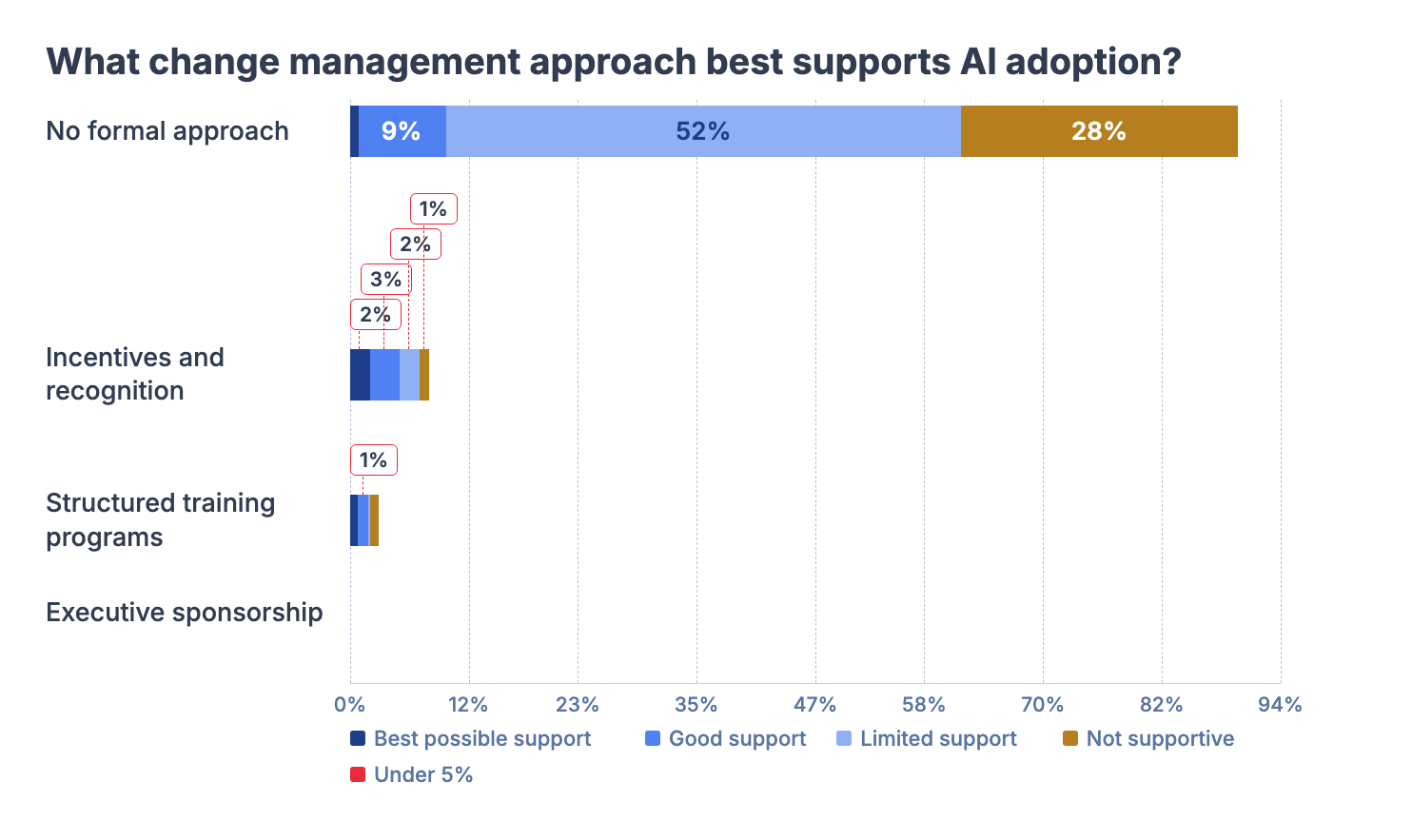
Change management plays an important role in how innovation leaders in corporations, government, and universities experience AI adoption. Where no formal approach exists, less than 1% report the best possible support, while 9% describe support as good. However, 52% receive limited support, and 28% find the approach unsupportive.
Other approaches receive smaller shares across the support categories. For incentives and recognition, 2% of innovation leaders report the best possible support, 3% report good support, 2% report limited support, and 1% report no support.
Less than 1% rate structured training programs as the best possible support, 1% as good support, fewer than 1% as limited support, and less than 1% as not supportive. Executive sponsorship has negligible responses (0.1% good support).
The data points to an opportunity for organizations to strengthen AI adoption through clearer change plans, practical training, and recognition that helps employees adjust to new ways of working.
How would innovation leaders rate staff readiness for AI adoption?
44% of innovation leaders in corporations, government, or universities rate their staff readiness for AI adoption as neutral; 27% think their staff is somewhat ready, and 2% rate them as very ready; however, 25% don’t feel their staff is ready for AI adoption at all, and another 3% feel they are somewhat unready.
Staff readiness is mostly neutral:
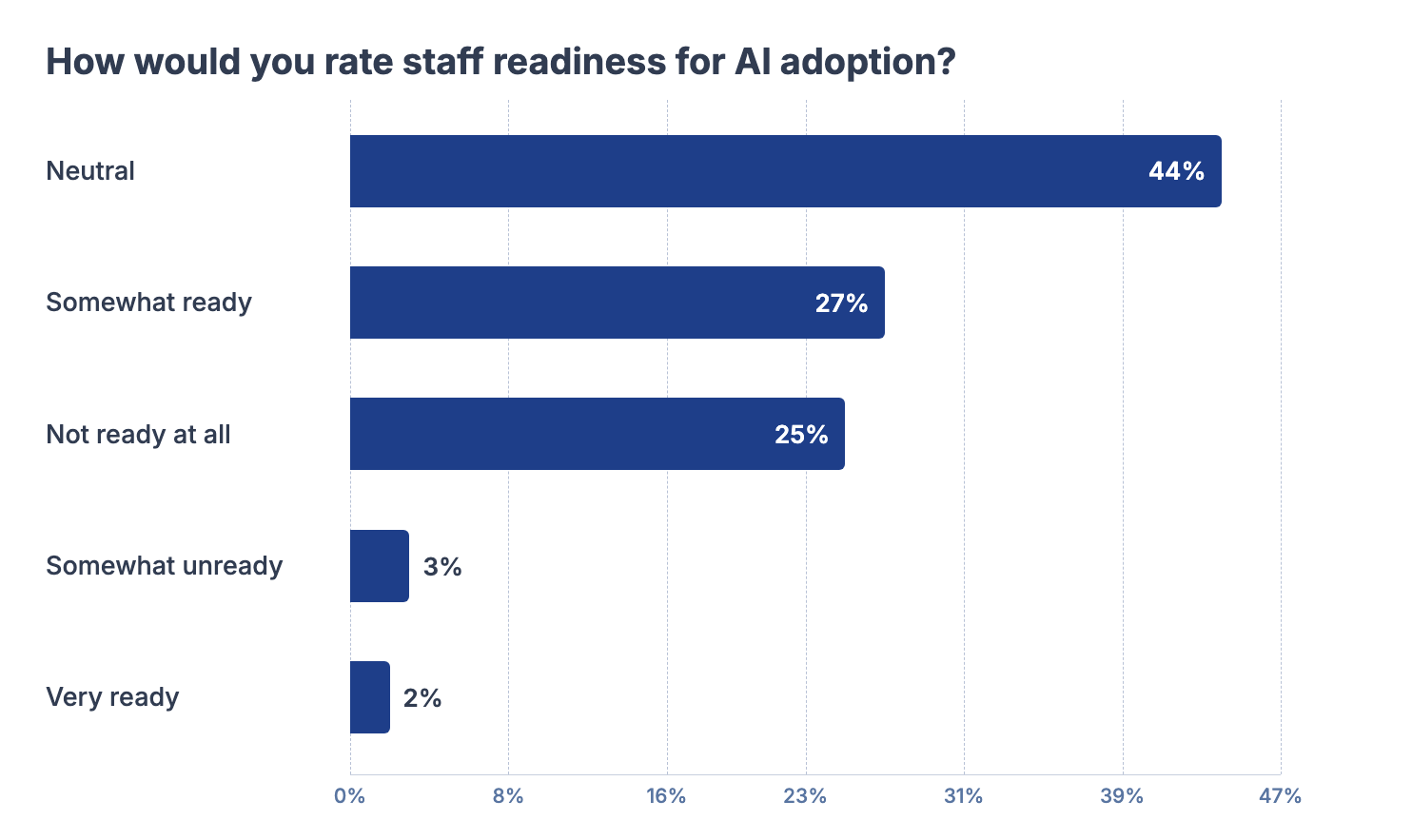
Staff readiness for AI adoption is still developing across many organizations. At 44%, the largest group of innovation leaders rates their staff adoption as neutral. Another 27% say their staff is somewhat ready, while 25% believe they are not ready at all. Only 3% of our audience describe staff as somewhat unready, and 2% consider them very ready.
Workplace use remains uneven across the United States. Gallup’s research on AI adoption finds that four in 10 U.S. employees never use AI at work, while only three in 10 use it at least weekly. Limited exposure can make it harder for employees to build confidence and understand how AI fits into daily tasks. However, clear guidance, hands-on learning, and opportunities to practice with relevant tools can help organizations strengthen staff readiness and support wider adoption.
How are innovation leaders addressing staff resistance to AI adoption?
72% of innovation leaders in corporations, government, or universities are not yet addressing staff resistance to AI adoption; 21% have encountered little resistance; 6% are using transparent communication to address it; and 1% rely on upskilling and communication to break through the barriers.
Most leaders are not yet addressing resistance:
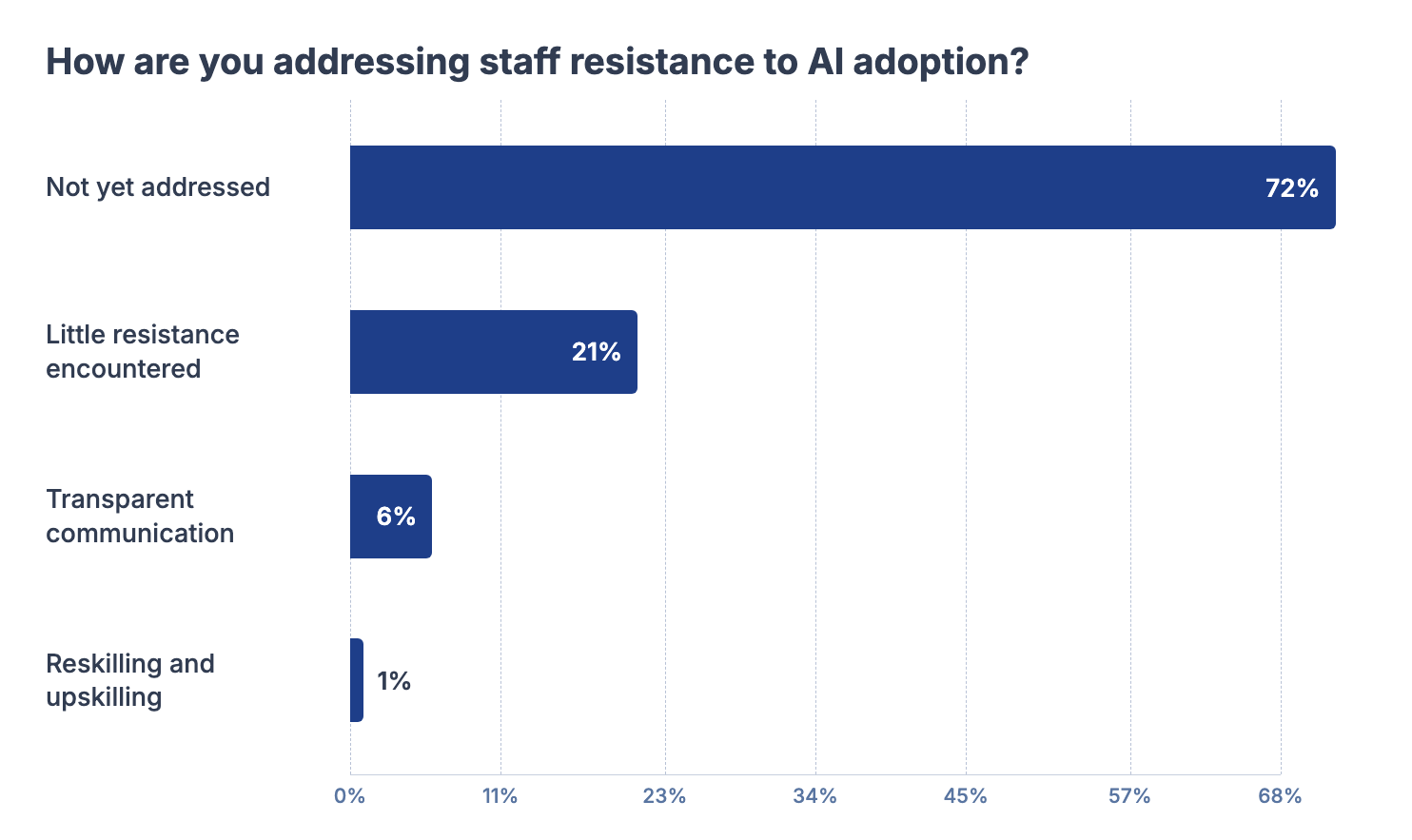
HR Dive’s report on employee resistance to AI notes that nearly half of CEOs say their employees are resistant or even hostile to the technology. Yet 72% of innovation leaders in corporations, government, or universities have not yet addressed resistance with their staff, which may reflect inaction or simply little perceived resistance.
Meanwhile, 21% encounter little resistance, indicating that some teams adopt AI without major pushback. Another 6% use transparent communication to address concerns, helping employees understand why AI is being introduced and how it may affect their work. Reskilling and upskilling account for just 1% of approaches, leaving room for organizations to offer more practical support as AI becomes part of everyday tasks.
What is the biggest barrier to AI adoption that innovation leaders face?
The main barrier to AI adoption for 3% of innovation leaders in corporations, government, or universities is a skill or talent gap; this is also a significant barrier for 35% and a minor barrier for 27%, but not a barrier for 3%; 10% face significant barriers due to security and privacy concerns, and 4% find these a minor hindrance; 6% are significantly barred by data quality or access, and a further 5% find this a minor barrier to AI adoption, while 1% find cultural resistance to pose a minor barrier.
Barriers to adoption span six areas, led by skills gaps:
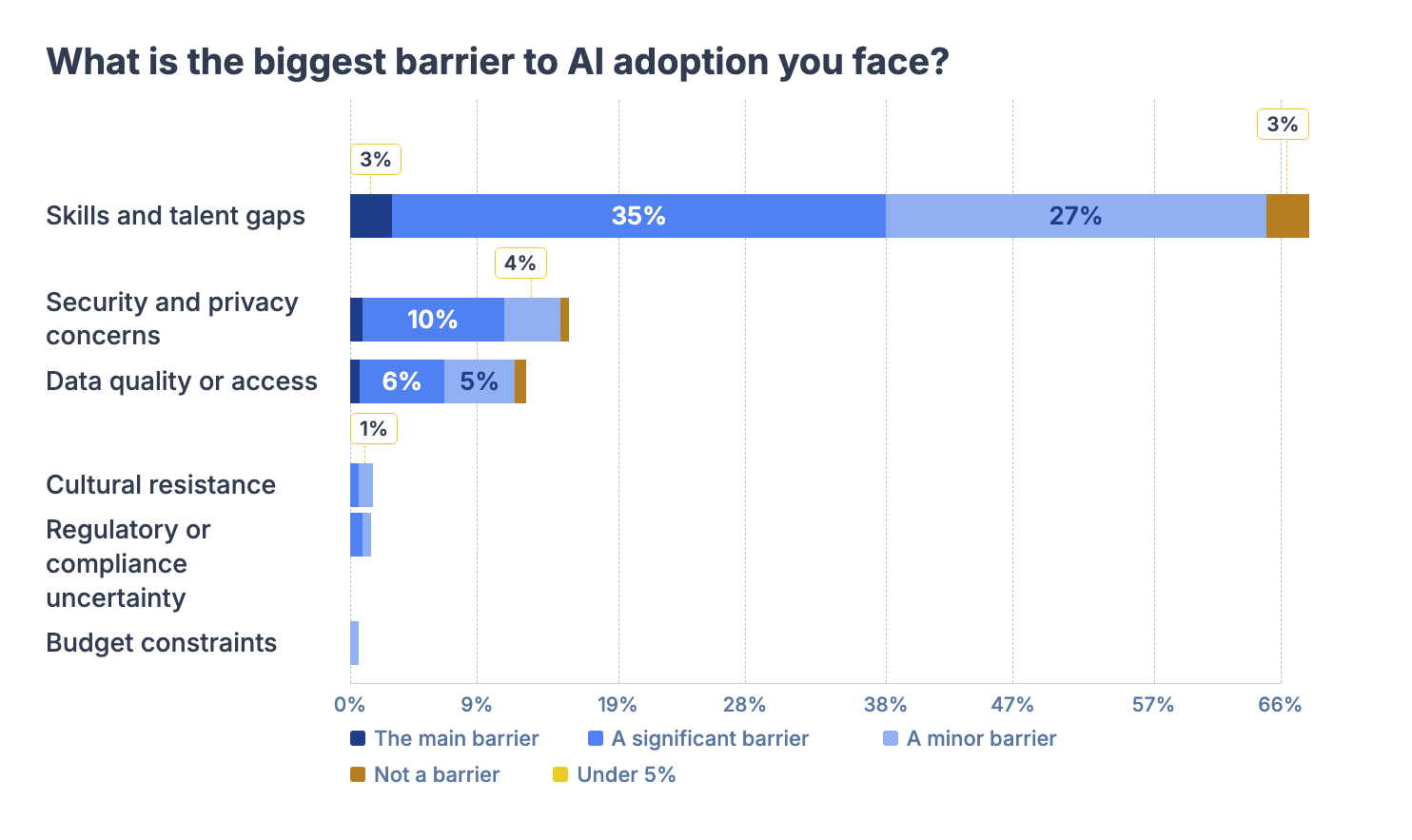
Skills and talent gaps stand out as the biggest barrier to AI adoption for innovation leaders in corporations, government, or universities. They are the main barrier for 3%, a significant barrier for 35%, and a minor barrier for 27%, while 3% say they are not a barrier. This reveals that limited expertise can slow progress even when organizations are ready to invest in AI.
Supporting this trend, McKinsey’s research on technology talent shortages found that 46% of AI leaders identify skills gaps as a major obstacle to adoption, while job postings for agentic AI roles rose almost 1,000% from 2023 to 2024.
Security and privacy concerns are a significant barrier for 10% and a minor one for 4%, while less than 1% name them as the main barrier. Data quality or access is the main barrier for less than 1%, a significant barrier for 6%, a minor barrier for 5%, and not a barrier for fewer than 1%.
Cultural resistance is a significant barrier for less than 1% and a minor barrier for 1%. Regulatory or compliance uncertainty is a significant barrier for fewer than 1% of innovation leaders and a minor barrier for less than 1%. Finally, budget constraints are a minor barrier for under 1%.
How mature is the governance framework for AI adoption among innovation leaders?
50% of innovation leaders in corporations, government, or universities have no governance framework in place for AI adoption yet; 7% have only informal guidelines; and under 1% have a framework in development. In contrast, 43% already have a fully established AI adoption governance framework.
Governance maturation is split:
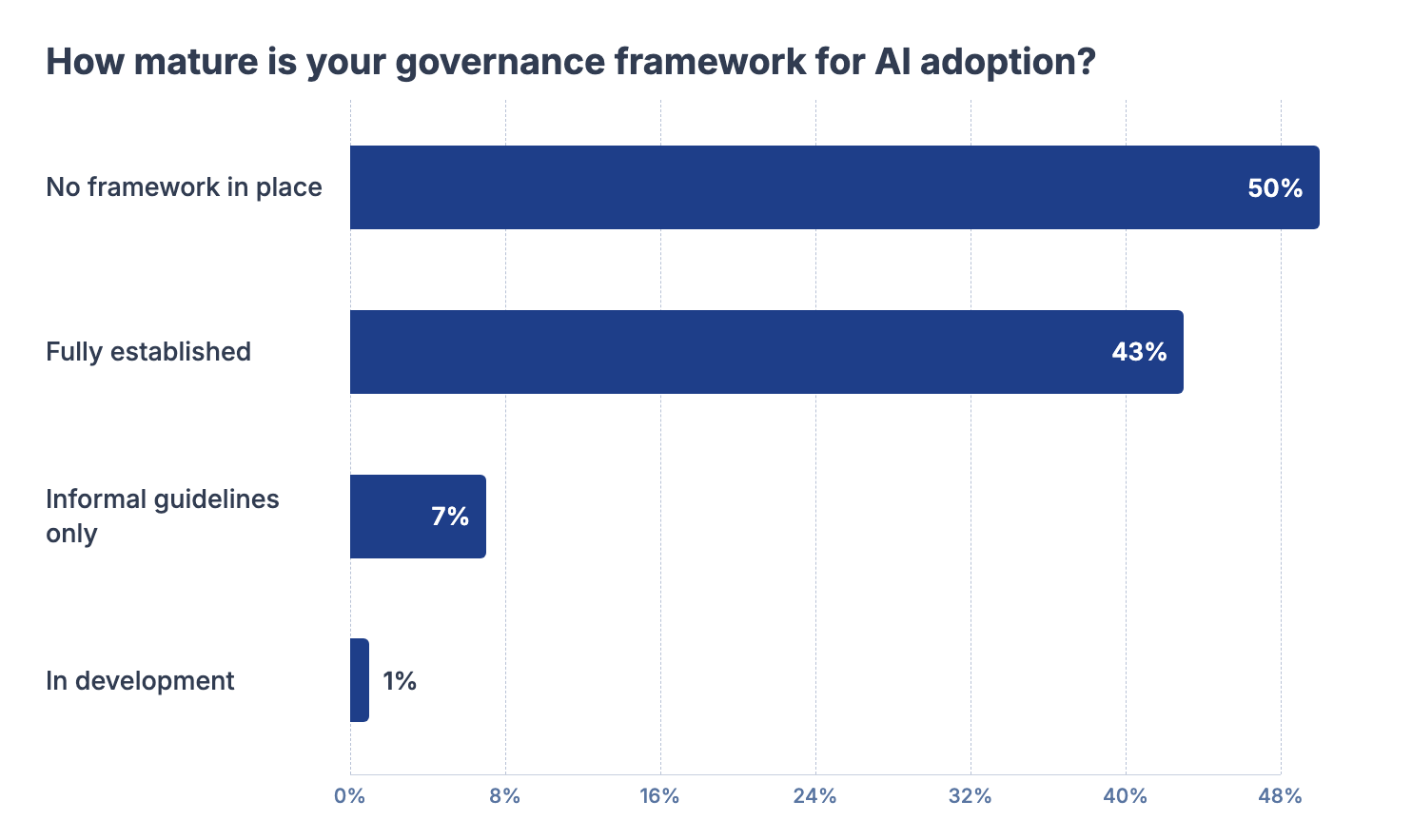
AI governance remains an area for development among innovation leaders in corporations, government, and universities. 50% of their organizations lack a framework to guide AI adoption.
However, 43% have a fully established AI governance framework, revealing that many organizations already have formal structures to guide their approach. Another 7% rely solely on informal guidelines, meaning their AI practices have some direction but lack the support of a fully established framework.
Fewer than 1% of innovation leaders are developing their governance framework, suggesting that relatively few organizations are building formal arrangements from scratch. For innovation leaders, the next step is to turn informal practices into consistent policies or introduce a formal framework where none exists. Strong governance can help organizations manage risks, clarify decision-making, and give teams a more consistent basis for adopting AI across departments.
Who owns governance decisions in innovation leaders’ AI adoption?
Legal and compliance teams absolutely own governance decisions about AI adoption for 16% of innovation leaders in corporations, government, or universities; 14% agree they are likely responsible, and 9% are somewhat involved, but 8% don’t assign them responsibility; for 13%, the IT or security team is absolutely responsible, and likely responsible for 13%, while a dedicated AI governance board is absolutely responsible for AI adoption for 7% and likely responsible for 10%, but not responsible for 3%, individual departments are likely responsible for 1%, and 2% put responsibility firmly on executive leadership.
Ownership is distributed across the board:
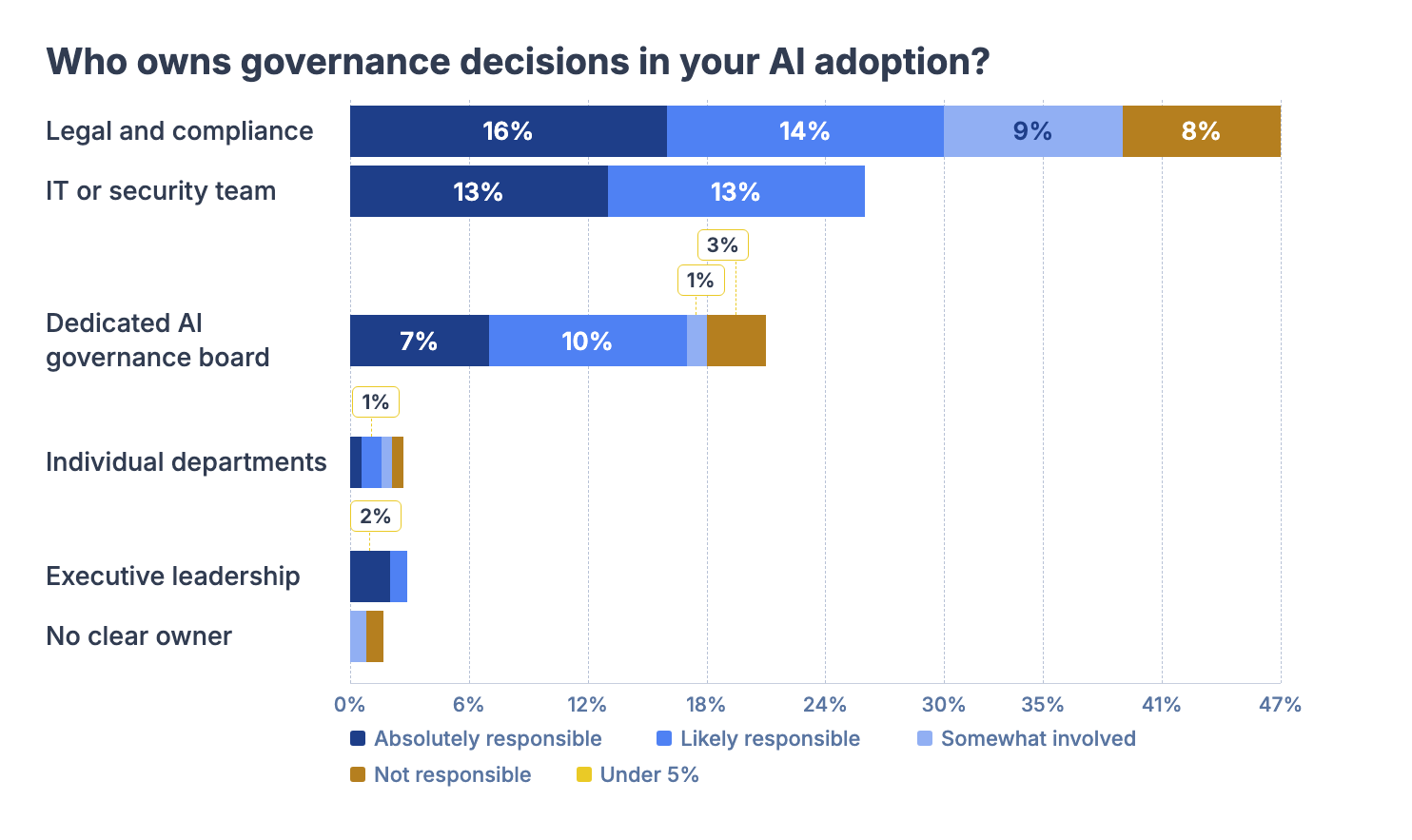
Legal and compliance teams play a central role in AI governance decisions among innovation leaders in corporations, government, or universities. They are absolutely responsible in 16% of cases and likely responsible in 14%, while 9% describe them as somewhat involved, and 8% say they are not responsible. IT or security teams also have a clear role, with 13% identifying them as absolutely responsible and another 13% as likely responsible.
Dedicated AI governance boards provide another layer of oversight. They are absolutely responsible in 7% of cases and likely responsible in 10%, while 1% describe their involvement as somewhat limited and 3% say they are not responsible.
Individual departments have minimal ownership: fewer than 1% of innovation leaders assign them absolute responsibility, 1% identify them as likely responsible, under 1% report some involvement, and fewer than 1% say they are not responsible.
Executive leadership is absolutely responsible in 2% of cases and likely responsible in just under 1%. Meanwhile, fewer than 1% report no clear owner as somewhat involved, and just under 1% as not responsible, indicating that governance responsibilities are generally assigned rather than left undefined.
How do innovation leaders monitor AI systems once adopted?
91% of innovation leaders in corporations, government, or universities have no monitoring in place yet for live AI systems, but 5% rely on human review of AI outputs, 4% use continuous automated monitoring, and under 1% only rely on user feedback about AI adoption.
Monitoring is not yet the norm:
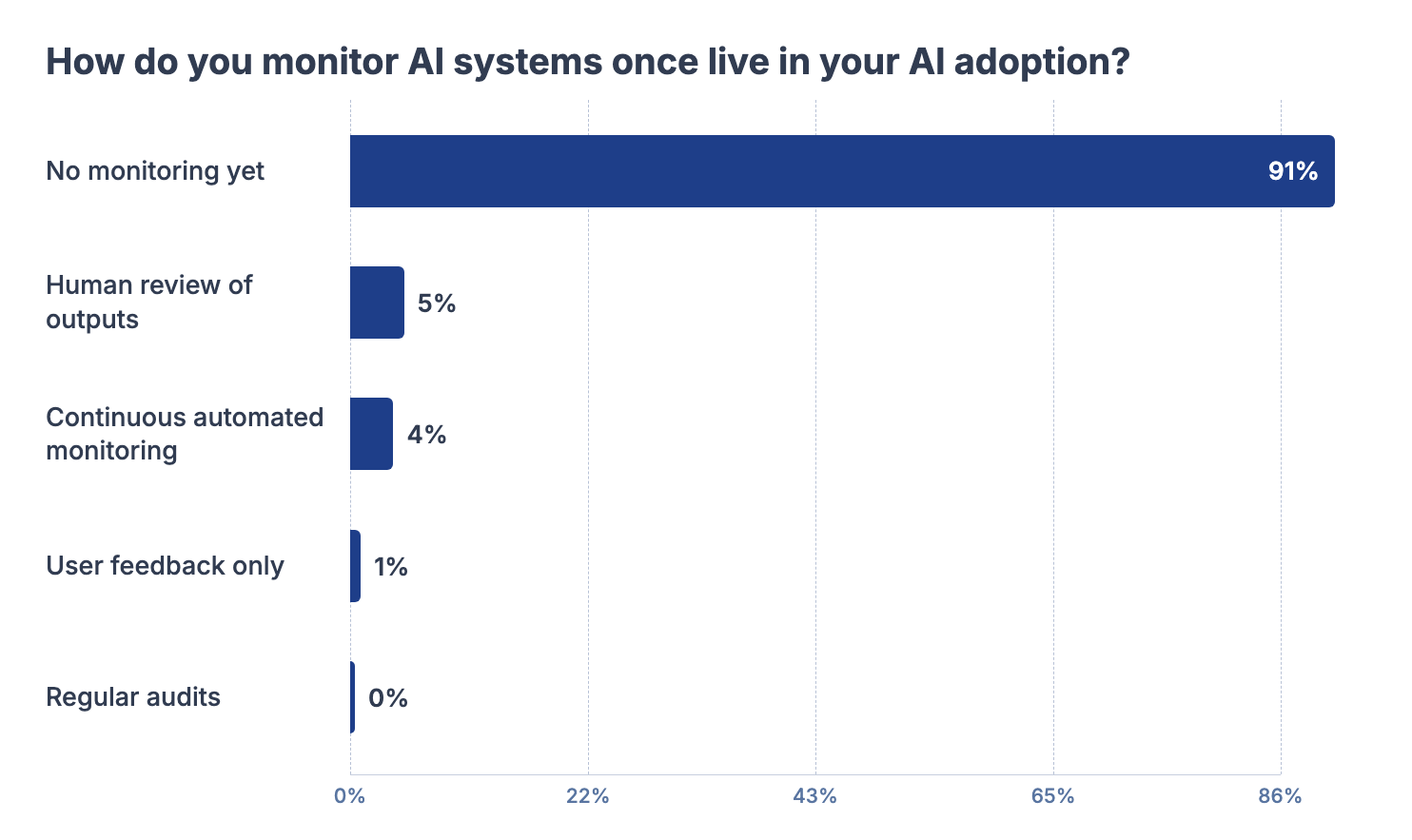
Innovation leaders are still building their monitoring practices once AI systems go live. 91% report no monitoring yet, suggesting many organizations focus first on launching AI tools rather than tracking performance afterward. Even so, the remaining approaches show a clear interest in stronger oversight.
Human review of outputs is the most common active method, used by 5% of innovation leaders. This approach lets people check AI results for accuracy, fairness, and practical usefulness before issues affect customers or decisions. Continuous automated monitoring follows at 4%, offering real-time insight into system behavior and helping teams spot changes quickly.
User feedback only accounts for under 1%, giving organizations direct input from the people who use AI tools every day. Regular audits currently stand at under 1%, offering an opportunity to add structured reviews that examine performance, safety, and compliance over time.
As AI adoption matures, organizations can move beyond fixed checks and use real-time AI observability and adaptive feedback loops to keep live systems reliable. Combining human review, automation, user feedback, and audits can create a practical path toward confident, responsible AI use.
While 43% of innovation leaders report a fully established governance framework, 91% have no monitoring in place, and 47% have no formal vetting for AI tools. This suggests governance frameworks may exist on paper before they are put into practice.
How do innovation leaders vet AI tools for security before AI adoption?
While 47% of innovation leaders in corporations, government, or universities don't yet have formal vetting processes for AI tools before adopting them, 41% pilot these tools in sandbox environments, 8% conduct formal security reviews, 4% rely on case-by-case IT approval, and 1% vet tools using vendor certifications like SOC 2 or FedRAMP.
Vetting AI tools follows different processes:
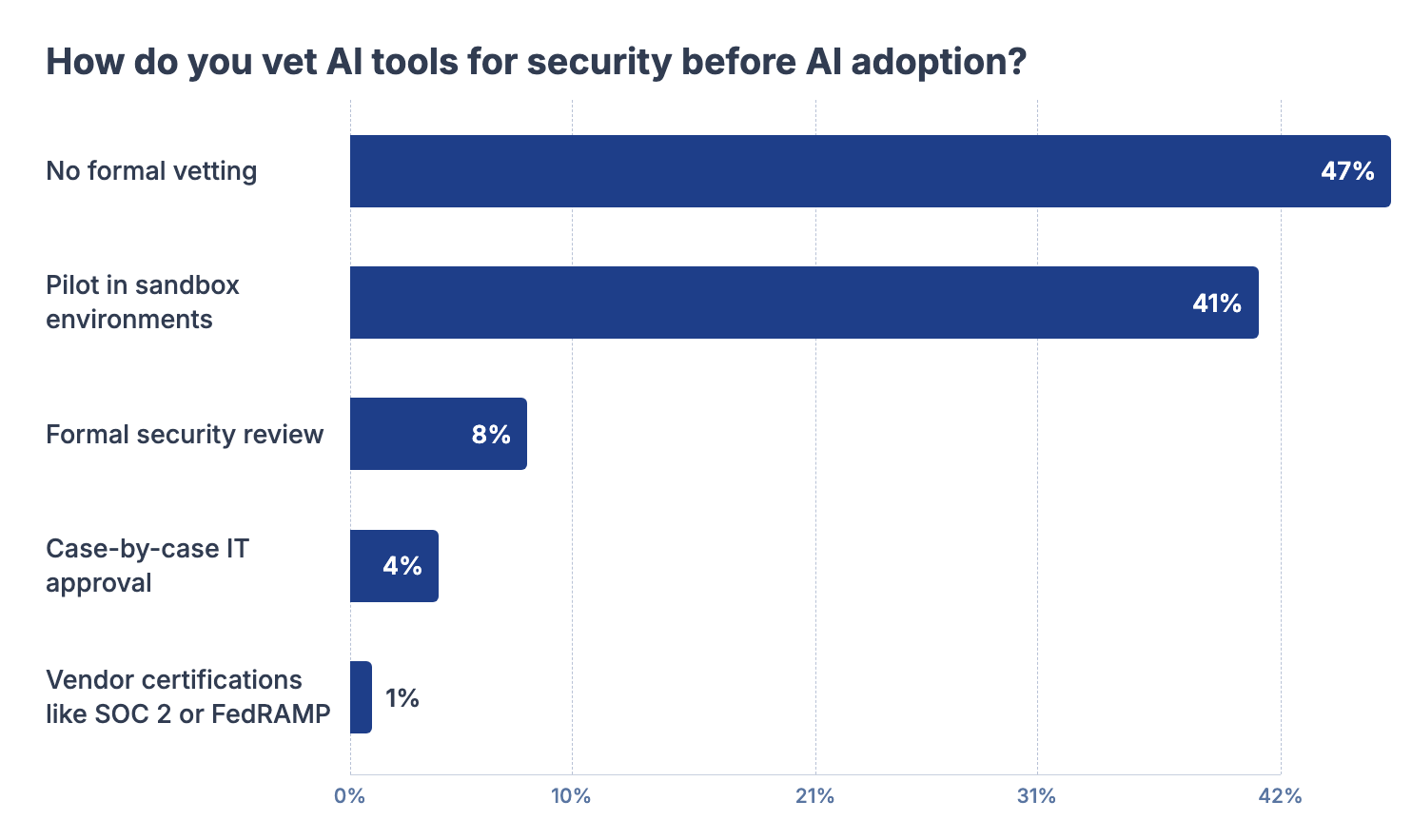
Before adopting AI tools, innovation leaders in corporations, government, or universities use several methods to assess security, though formal processes are still developing. 47% use no formal vetting, meaning many organizations bring AI tools into their workflows without a set security review. At the same time, 41% pilot tools are in sandbox environments, where teams can test performance and spot risks without affecting live systems or sensitive data.
Formal security reviews are used by 8% of innovation leaders. This approach gives security teams a structured way to assess vendor practices, data handling, and potential vulnerabilities before rollout. Case-by-case IT approval accounts for 4% of approvals, allowing IT teams to evaluate each tool based on its intended use and level of risk.
Vendor certifications such as SOC 2 or FedRAMP represent 1%. Although small, this group shows that some organizations rely on independent standards to confirm that providers meet recognized security and compliance requirements.
Which security threat concerns innovation leaders most in AI adoption?
Data leakage through AI tools is extremely concerning for 3% of innovation leaders in corporations, government, or universities, and 62% find this somewhat concerning about AI adoption, but it’s not a major concern for 5%; intellectual property exposure isn’t a big concern for 4%, but 19% find this somewhat concerning, and shadow AI use by staff, vendor or third-party risks, and AI-powered cyberattacks have 2% somewhat concerned, less than 1% find prompt injection and model attacks extremely concerning.
Security threats are myriad:
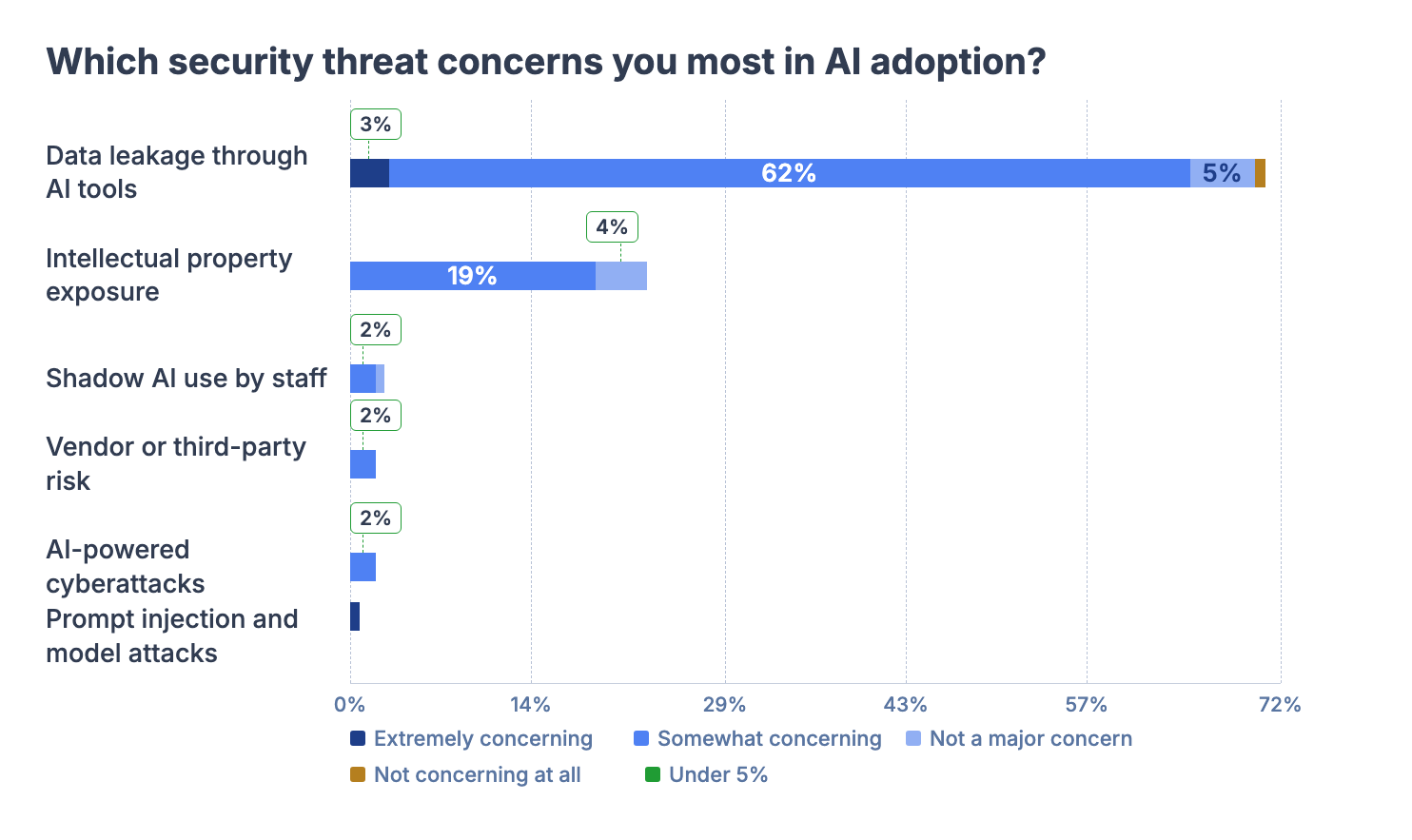
Data leakage through AI tools is the leading security concern among innovation leaders in corporations, government, and universities. 3% find it extremely concerning, 62% somewhat concerning, 5% not a major concern, and less than 1% not concerning at all.
This strong focus is understandable as AI tools often handle sensitive information. A Metomic report found that 68% of firms have experienced data leaks linked to the use of AI tools, while only 23% have formal security policies in place.
Intellectual property exposure is another notable issue. 19% of innovation leaders see it as somewhat concerning, while 4% say it is not a major concern. Protecting proprietary ideas, research, and business information remains important as teams use AI to create and share content.
Shadow AI use by staff concerns 2% of innovation leaders somewhat, with under 1% saying it is not a major concern. Vendor or third-party risk is somewhat concerning for 2% of our audience, and AI-powered cyberattacks are also somewhat concerning for 2% as well. Prompt injection and model attacks are extremely concerning to under 1%.
Which compliance area most shapes AI adoption for innovation leaders?
The compliance area that most shapes AI adoption for 28% of innovation leaders in corporations, government, or universities is federal guidance and executive orders. This is a significant factor for 28% and somewhat relevant for 21%; data privacy laws are the main influence for 9% and a significant factor for 4%, while for 5%, state AI laws are a significant factor; for 2%, industry rules like HIPAA or FERPA are significant; and for 1%, accessibility requirements play a significant role in shaping AI adoption.
Compliance areas play a major role in AI adoption:
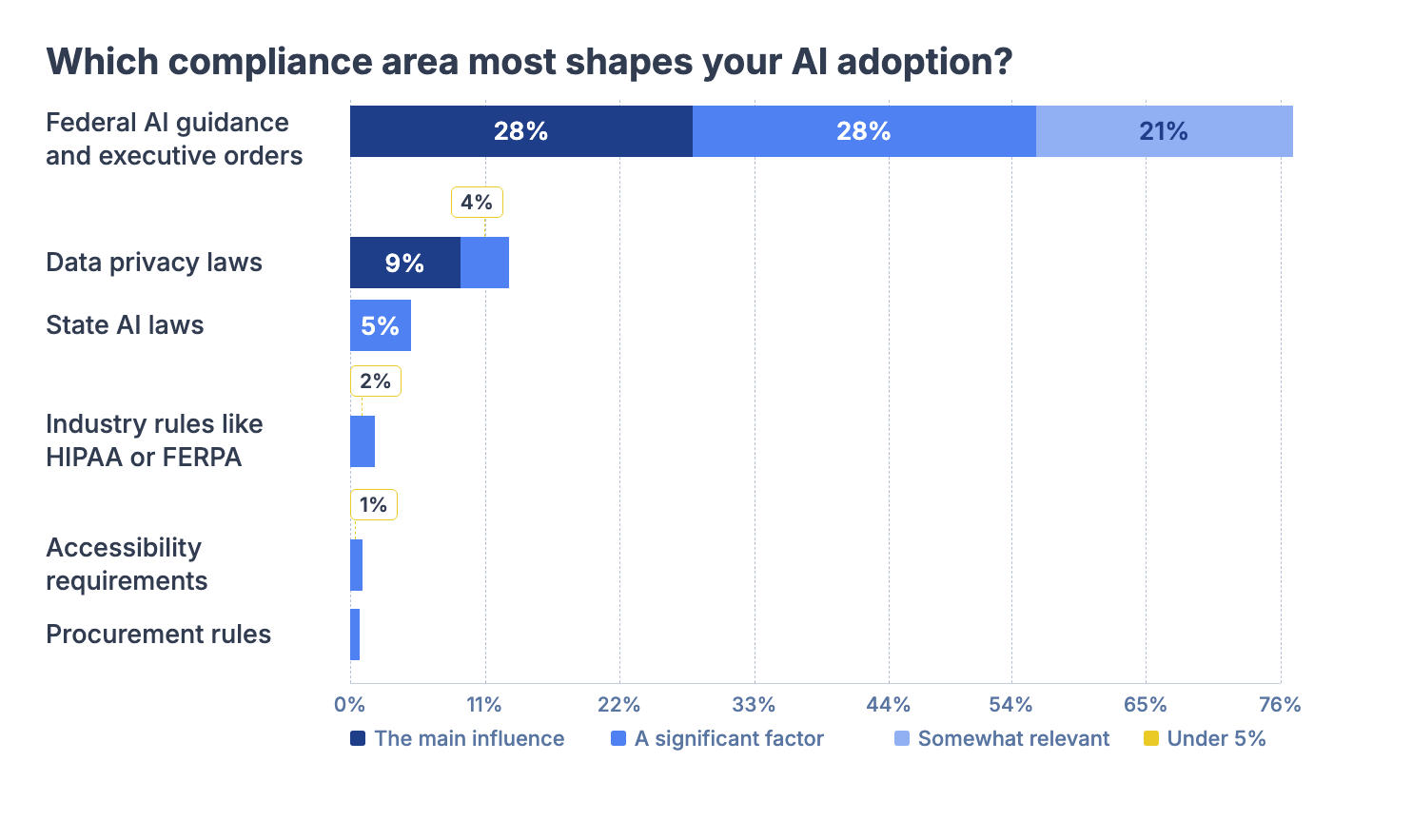
Federal AI guidance and executive orders shape AI adoption more than any other compliance area for innovation leaders in corporations, government, or universities. 28% cite them as the main influence, another 28% as a significant factor, and 21% as somewhat relevant.
America’s AI Action Plan supports this direction through three policy pillars, including accelerating innovation, building AI infrastructure, and leading international diplomacy and security.
9% of innovation leaders identify data privacy laws as the main driver of compliance, while 4% view them as a significant factor. These rules help organizations handle personal information responsibly as AI systems collect, process, and generate data.
State AI laws are a significant factor for 5% of respondents, indicating that local requirements add another layer of guidance for organizations operating across regions. Industry rules such as HIPAA or FERPA influence 2%, particularly where AI touches healthcare or education information.
Accessibility requirements are a significant factor for 1% of innovation leaders, encouraging the development of AI tools that people with different needs can use effectively. Procurement rules influence fewer than 1% of decisions, yet they still guide how organizations select and purchase AI solutions.
How confident are innovation leaders in meeting compliance for AI adoption?
23% of innovation leaders in corporations, government, or universities are very confident in meeting compliance requirements for AI adoption; 18% are somewhat confident; 16% are neutral; 13% are somewhat unconfident; and 30% are not confident at all.
Confidence levels are variable:
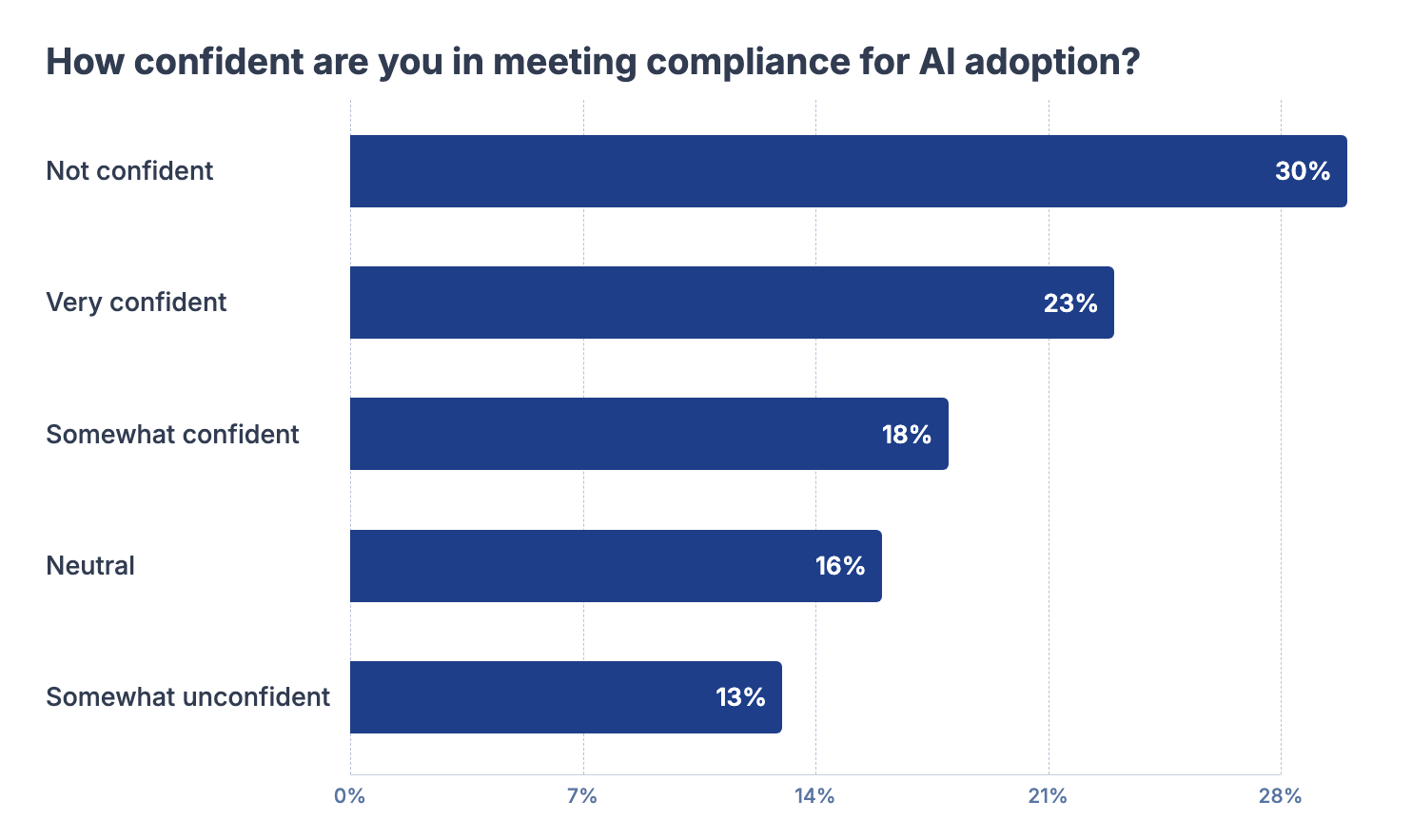
Confidence in meeting AI compliance is mixed among innovation leaders in corporations, government, and universities. 23% are very confident, demonstrating that some organizations already have the policies, knowledge, and processes needed to adopt AI responsibly. Another 18% of our audience are somewhat confident, suggesting they understand the requirements but may still be strengthening internal practices.
Neutral views account for 16%, meaning these leaders are still deciding how prepared their organizations are. Meanwhile, 13% are somewhat unconfident, often because AI rules, data privacy expectations, and security needs continue to evolve quickly.
Slightly more leaders lack confidence (43%) than have it (41%). The largest group, 30%, is not confident. This points to a real opportunity for organizations to invest in clearer governance, staff training, and practical compliance support. Building these foundations can help teams move from uncertainty to informed action.
How do federal and state rules affect AI adoption for innovation leaders?
Federal and state rules slightly slow AI adoption for 77% of innovation leaders in corporations, government, or universities; 20% are unsure of their impact on adoption, but 2% don’t find these laws to have any effect, and a further 1% find that they accelerate it.
AI laws and rules have several impacts:
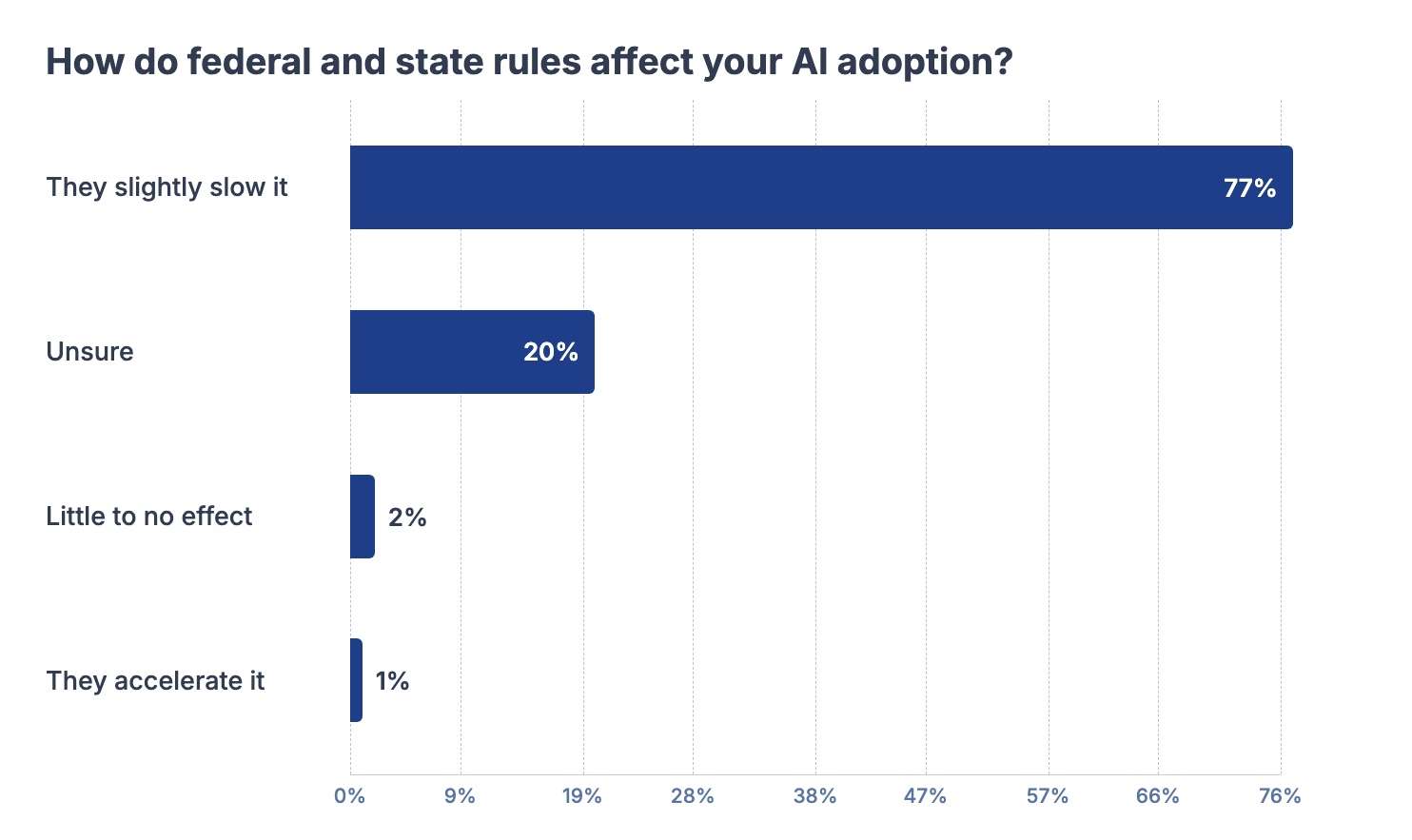
Federal and state rules are widely seen as slowing AI adoption among innovation leaders in corporations, government, or universities. 77% agree these requirements slightly slow their progress, suggesting compliance tasks can add time to evaluating and implementing AI tools. This ties into uncertainty about compliance readiness, as organizations must understand which rules apply and how to meet their obligations before expanding AI use.
Another 20% are unsure how federal and state rules affect their adoption efforts, indicating that their impact is not always clear. Meanwhile, 2% report little to no effect, showing that regulation does not create a noticeable barrier for every organization. Just 1% say these rules accelerate AI adoption, making this the least common view.
Rather than stopping progress, regulation appears to encourage a more careful approach. Organizations that build compliance into their AI strategies early can adopt new tools with greater clarity, protect sensitive information, and keep innovation moving in a responsible direction.
How do innovation leaders engage startups to support AI adoption?
While 53% of innovation leaders in corporations, government, or universities do not work with startups, 38% rely on direct procurement to engage startups to support AI adoption, 6% use venture investment, and 2% use research partnerships to engage startup.
Startup engagement comes mainly from three sources:
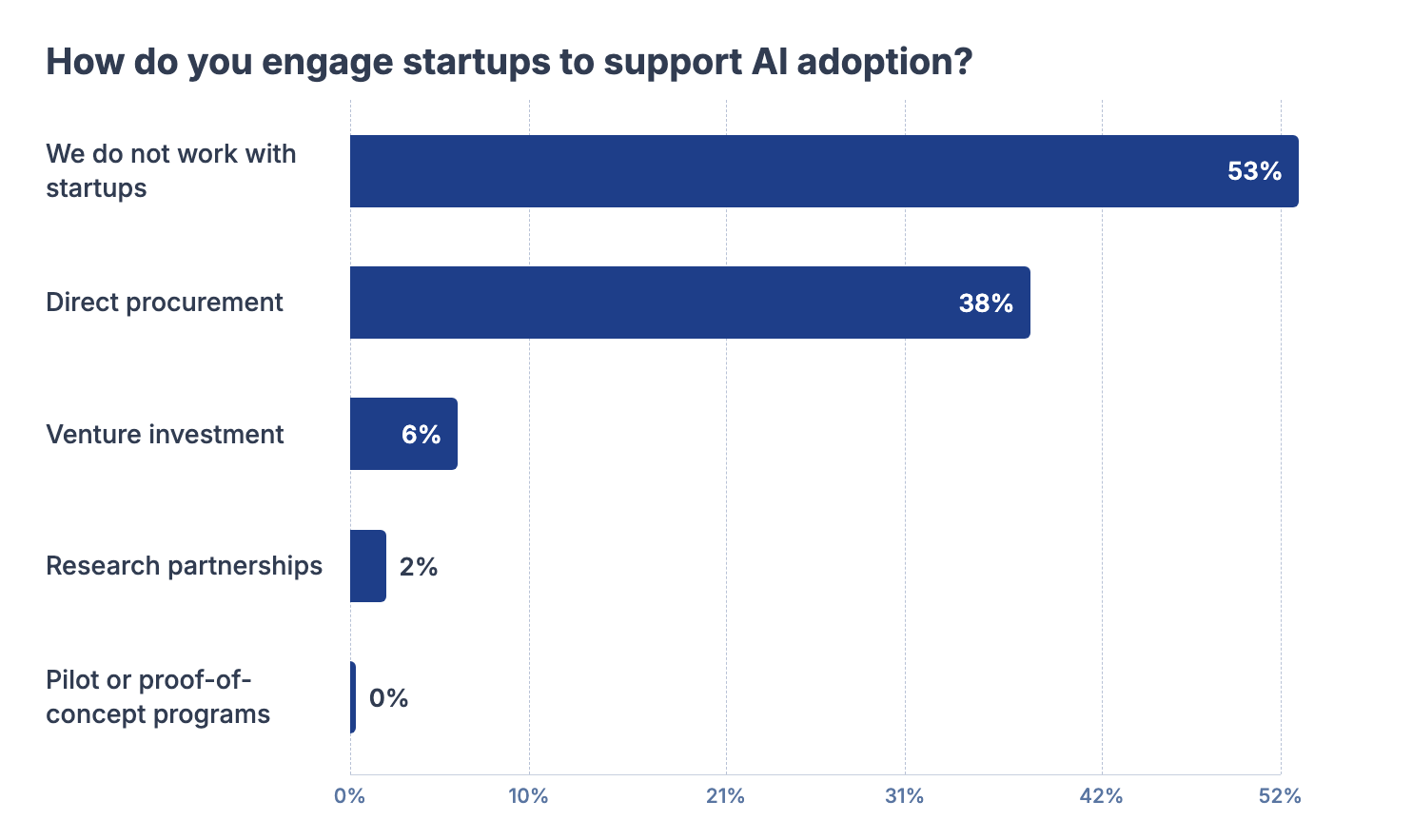
Innovation leaders in corporations, government, or universities use several routes to work with startups as they adopt AI, although direct partnerships are still developing. 53% do not work with startups, suggesting that many organizations rely on internal teams or established vendors for AI capabilities. This also leaves room for leaders to explore the fresh ideas and specialized tools startups often bring.
Direct procurement is the most common engagement model, used by 38%. Through this approach, organizations buy AI products or services directly from startups, gaining access to new technology while giving emerging companies a clear route to market.
Venture investment accounts for 6%, letting organizations support promising startups financially while building relationships with their teams. Research partnerships make up 2%, connecting businesses with startups to explore new AI methods, test ideas, and develop practical solutions together.
Pilot or proof-of-concept programs stand at under 1%. These programs can be especially valuable because they let organizations test a startup’s AI solution on a small scale before committing to a full rollout.
Findings on startup selection criteria and challenges reflect the full range of opinions on startups, not only those from organizations that work with them.
What makes a startup a strong partner for innovation leaders in AI adoption?
Proven results with peers are absolutely essential for 13% of innovation leaders in corporations, government, or universities when assessing a startup as a strong partner for AI adoption, and this is a definite advantage for 59%, but it's not a big factor for 11%, and it doesn't matter much for 9%; while 3% find flexible pricing absolutely essential, another 3% cite strong security and compliance as a definite advantage, 2% share the same opinion about ease of integration, and another 1% about deep domain expertise.
Startup strengths are myriad:
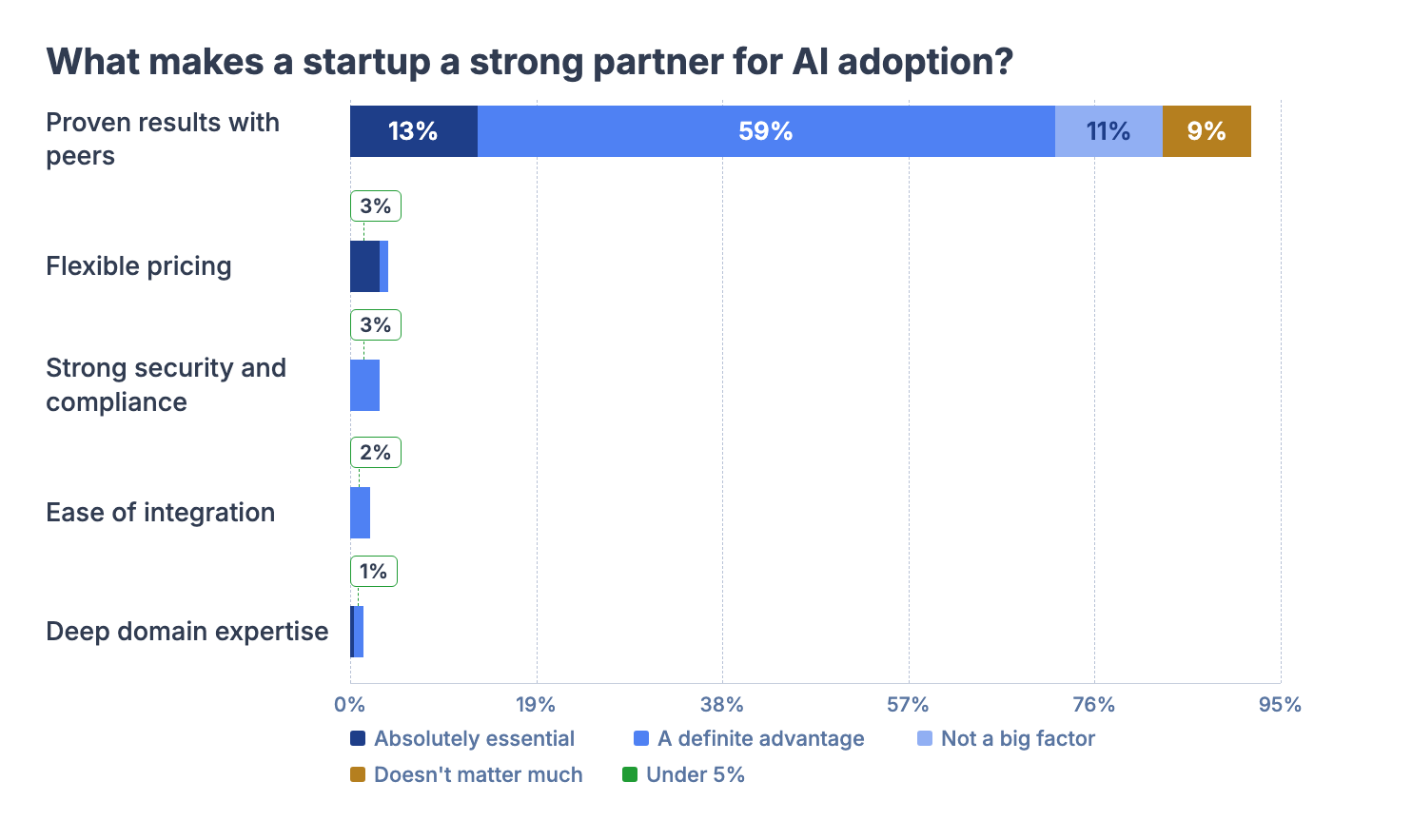
When choosing AI startup partners, innovation leaders in corporations, government, or universities most value evidence that a solution already works, for 13%, proven results with peers are essential; 59% see them as a definite advantage; 11% don’t see them as a big factor; and 9% feel they don’t matter much. Seeing success at comparable organizations helps teams trust that a startup can solve real business problems.
Flexible pricing is absolutely essential for 3%, with under 1% calling it a definite advantage. Affordable, adaptable pricing makes it easier for organizations to start using new AI tools without a large upfront commitment.
Strong security and compliance are a definite advantage for 3% of our audience, supporting safe data handling and regulatory readiness. Ease of integration is a definite advantage for 2%, helping new tools fit smoothly into the systems teams already use.
Deep domain expertise is absolutely essential for less than 1% of innovation leaders and a definite advantage for 1%. Specialized industry knowledge can still improve how well an AI solution fits specific needs. As AI-driven enterprises continue to shape entrepreneurship, demonstrated results remain the clearest sign of a strong startup partnership.
What is the top challenge for innovation leaders working with startups on AI adoption?
For 48% of innovation leaders in corporations, government, or universities, startup financial stability is a significant challenge when working with startups on AI adoption, and 4% find this a minor challenge; 23% struggle with integration with legacy systems when working with startups, and 12% find this a minor challenge; 3% cite scaling beyond pilots as the biggest challenge and another 7% agree this poses a significant challenge, while 3% agree security and compliance vetting is a significant challenge too.
Startup challenges largely focus on finances, systems, and scaling:
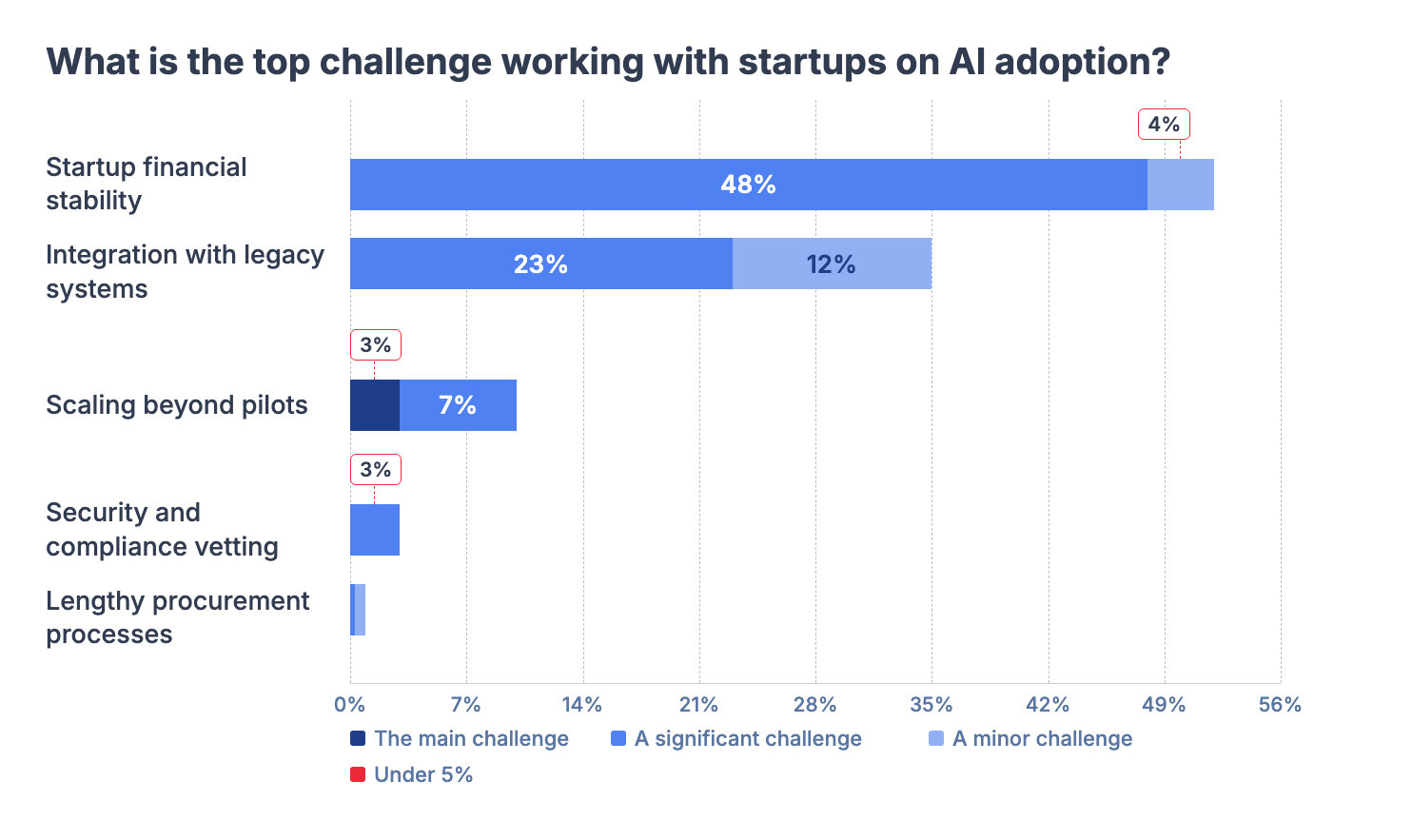
Financial stability is the top challenge for innovation leaders in corporations, government, or universities working with startups on AI adoption. 48% call it a significant challenge, and 4% see it as minor. Startups often need steady funding to continue developing products, support customers, and grow after early success, especially during the difficult period known as the valley of death.
Integration with legacy systems is another major concern. 23% of innovation leaders describe it as a significant challenge, while 12% see it as a minor challenge. Older systems may not connect easily with modern AI tools, so organizations need careful planning to link new solutions to existing workflows.
Scaling beyond pilots is the main challenge for 3% and a significant challenge for 7%. A successful small test does not always translate smoothly into company-wide use, so teams need a clear expansion plan.
Security and compliance vetting is a significant challenge for 3%, requiring thorough checks before AI tools handle sensitive information. Lengthy procurement processes are a significant challenge for less than 1% and a minor challenge for under 1%. While less common, faster purchasing steps could help organizations begin valuable AI partnerships sooner.
What would most accelerate AI adoption for innovation leaders?
Better data infrastructure would be absolutely essential in helping to accelerate AI adoption for 19% of innovation leaders in corporations, government, or universities, and 4% agree this would help a lot; clearer regulation would be absolutely essential for 15%, for 29%, this would help a lot, it would be somewhat helpful for 3%, but 2% don’t think it is important; 4% agree proven use cases from peers would be essential in speeding up AI adoption, this would help a lot for 13%, and be somewhat helpful for 7%, while 1% agree more funding would be somewhat helpful.
AI adoption acceleration needs are clear:
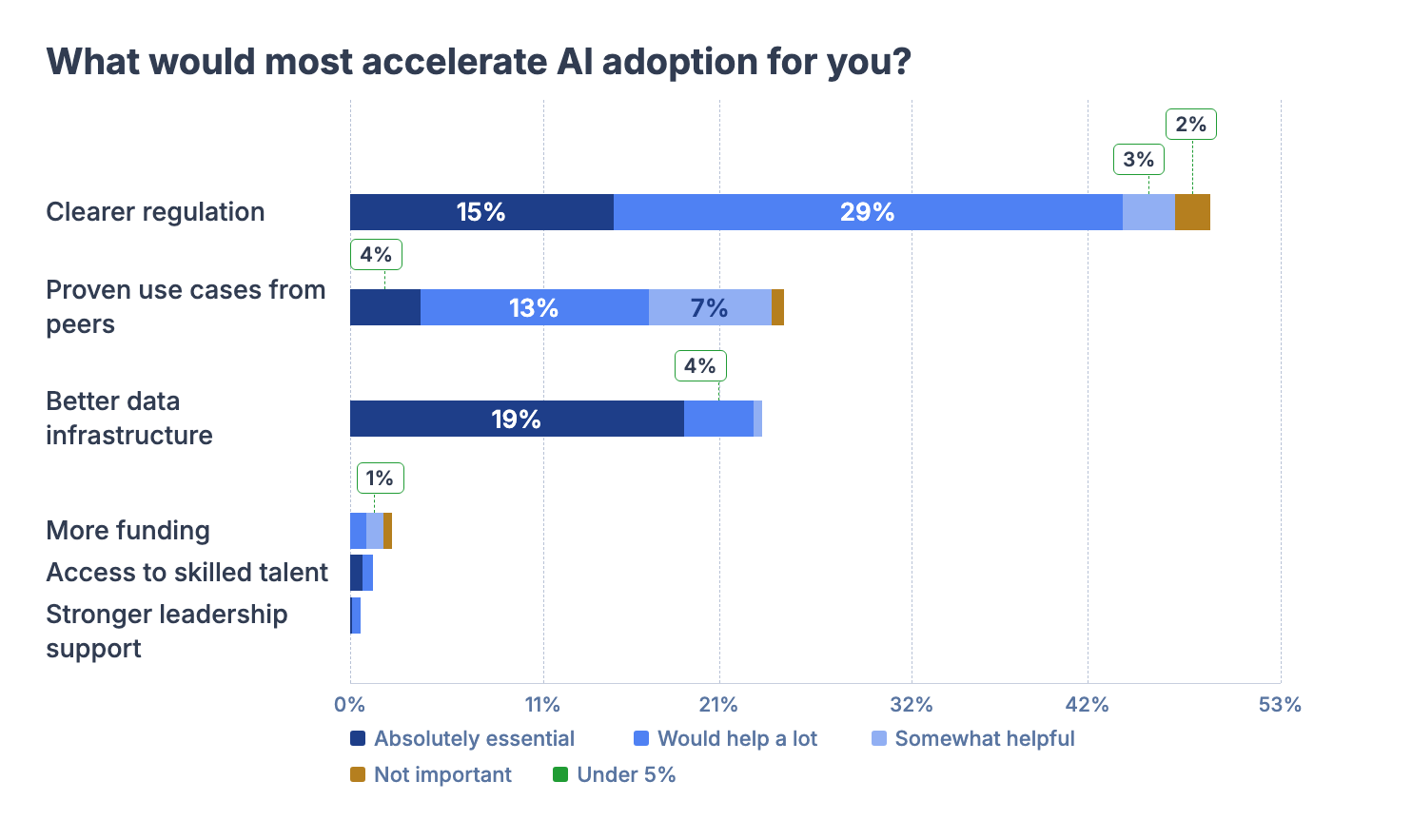
Clearer regulation is a leading factor that could accelerate AI adoption among innovation leaders in corporations, government, or universities by helping organizations make adoption decisions with greater confidence. It is absolutely essential for 15%, while 29% agree it would help a lot. Another 3% consider it somewhat helpful, and for 2%, it is not important.
Better data infrastructure is also a priority, with 19% of innovation leaders calling it absolutely essential, 4% saying it would help a lot, and less than 1% finding it somewhat helpful. Proven use cases from peers would help a lot for 13%, are absolutely essential for 4%, are somewhat helpful for 7%, and less than 1% consider them unimportant.
More funding would help a lot for under 1%, be somewhat helpful for 1%, and be unimportant for less than 1%. Access to skilled talent is absolutely essential for under 1% and would help a lot for less than 1%. Strong leadership support receives negligible responses, with under 1% calling it absolutely essential and less than 1% saying it would help a lot. These lower percentages put the focus firmly on regulation, use cases, and data infrastructure as being the keys to increased adoption.
Skills and talent gaps are the biggest barrier to adoption (35% significant, 27% minor), yet access to skilled talent is cited as an accelerator by under 1%.
The state of AI adoption across US corporations, government, & universities
These statistics show that AI adoption among corporations, government, and universities in the U.S. is progressing, but many still face challenges with implementation, staff readiness, and skills shortages. Weak measurement practices, governance gaps, and security concerns also make it harder to assess results and scale successful initiatives.
Clearer regulation, stronger data infrastructure, and practical support for employees could help innovation leaders adopt a more effective, secure, and sustainable approach.

PLUG AND PLAY AROUND THE WORLD
Discover our global locations
We have a community of experts all over the world. We work as a bridge between Silicon Valley and the rest of the world, making innovation open to anyone, anywhere.