To find out what 193,903 opinions of innovation leaders in government or universities in the U.S. were about academic and research AI councils, we used AI-driven audience profiling to synthesize insights from online discussions over 12 full months ending on September 23, 2026, with a high level of statistical confidence. The results reveal sentiments that include how these councils operate, the tools they endorse, and the areas where they see the greatest need for oversight.
articleOct 16, 2026
Academic & Research AI Councils Statistics: U.S. 2026
Academic and research AI councils provide universities and government bodies with a formal structure for overseeing the introduction and use of AI across the institution. They bring policy decisions closer to the technical realities of implementation, while giving leaders a clearer way to assess emerging risks. As AI use expands, these councils can help organizations move from scattered experimentation toward more coordinated governance. For institutions taking a broader strategic approach, building an AI center of excellence can provide a stronger framework for that work.

Index
- Methodology and data.
- 88% of innovation leaders in government or universities’ academic & research AI councils meet weekly, and 12% meet on an ad hoc basis.
- For 51% of innovation leaders in government or universities, the chief AI or data officer is often the chair for academic & research AI councils, and a cross-functional committee often chairs for 18%, while for 31%, the CIO or CTO is always the chair for these councils.
- 96% of innovation leaders in government or universities see academic & research AI councils using AI most for research and data analysis, and 4% see the most use in citizen or student services.
- According to 19% of innovation leaders in government or universities, the AI tools that academic & research councils most endorse are generative AI assistants, while another 32% agree these tools are generally endorsed, 30% say they are somewhat supported, 15% find that generative AI assistants are rarely endorsed, and just 2% see AI research copilots as generally endorsed.
- 73% of innovation leaders in government or universities’ academic & research AI councils track AI compliance using automated monitoring tools, and 27% rely on legal counsel review.
- While 5% of innovation leaders in government or universities agree that federal AI directives are most influential in shaping academic & research councils, 67% find they have a significant impact, and 4% that they have some influence, with just 5% seeing them as having minimal effect; 5% find export controls to be most influential, and 9% agree they have significant impact, 1% name HIPAA as the most influential regulation, and another 1% FERPA as having a significant impact.
- For 30% of innovation leaders in government or universities, research theft is a top concern for academic & research AI councils, a major concern for 51%, and a minor concern for 18%, with data leakage not voiced as a concern by anyone.
- 68% of innovation leaders in government or universities’ academic & research councils vet AI security by vendor certifications, and 32% vet them with an internal security review.
- Key insights from academic and research AI councils.
How often do academic & research AI councils meet for innovation leaders?
88% of innovation leaders in government or universities’ academic & research AI councils meet weekly, and 12% meet on an ad hoc basis.
Regular oversight keeps AI governance moving:
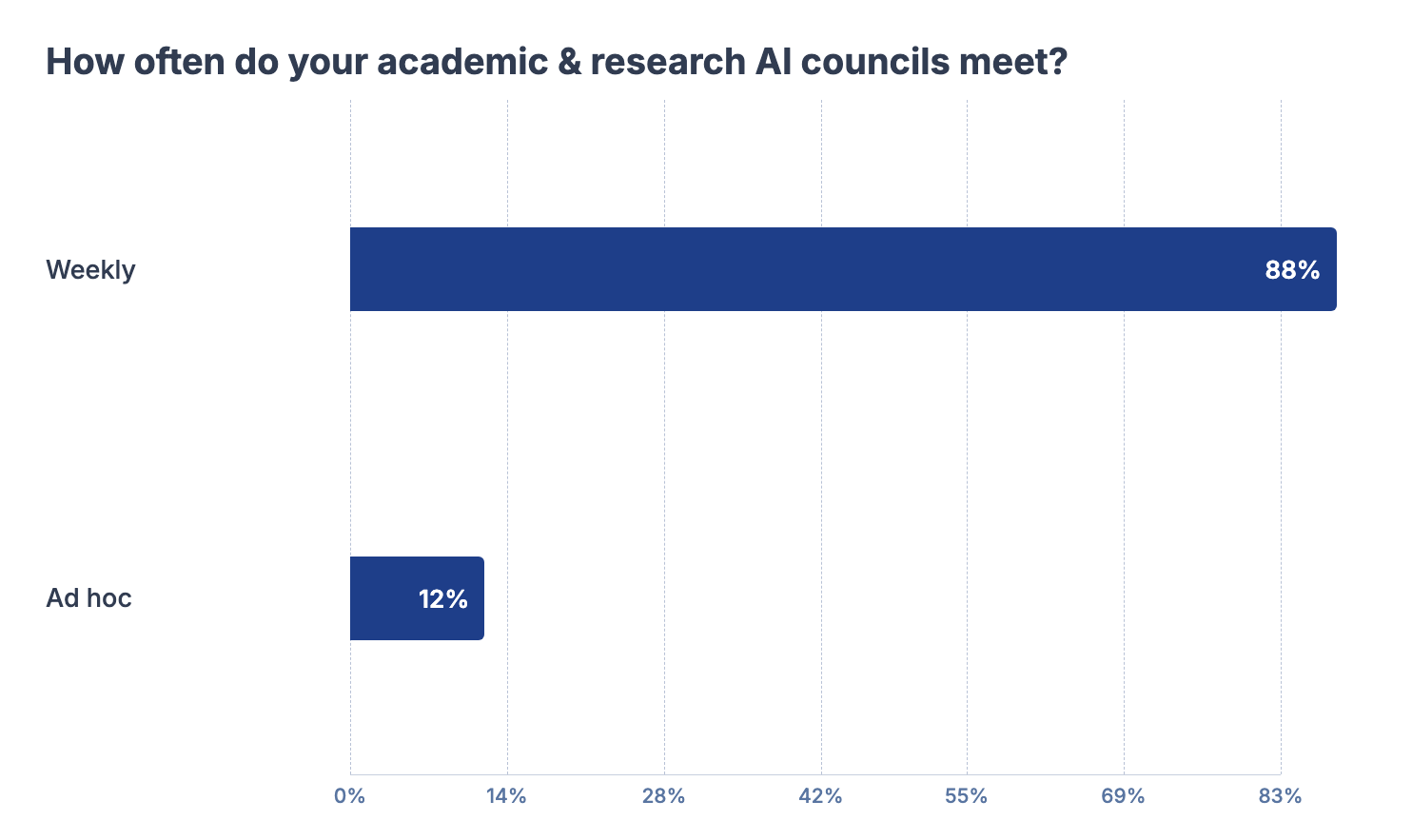
Academic and research AI councils meet frequently for most innovation leaders in government or universities, with 88% saying their council meets weekly. A weekly schedule points to councils operating as active working groups, with regular contact helping keep policy decisions and implementation aligned as AI use develops across the institution. Frequent meetings also provide leaders with a forum to surface new issues early and compare how different parts of the organization are handling AI.
The need for that level of oversight is clear in the Digital Education Council’s 2026 AI in Higher Education Global Survey findings. Although 64% of faculty globally had participated in AI literacy training, only 17% of students in the U.S. and Canada believed their instructors were well-equipped to guide them in using AI. The gap between training activity and student confidence shows why institutions may need regular forums to review how AI guidance is working in practice and where further support is needed.
The remaining 12% of our audience meets on an ad hoc basis. For these councils, meetings may be triggered by specific decisions or emerging issues, allowing leaders to bring the right people together when a clear need arises rather than following a fixed schedule.
Who chairs academic & research AI councils for innovation leaders?
For 51% of innovation leaders in government or universities, the chief AI or data officer is often the chair of academic and research AI councils, and a cross-functional committee chair for 18%, while for 31%, the CIO or CTO is always the chair of these councils.
Chairing is a shared responsibility:
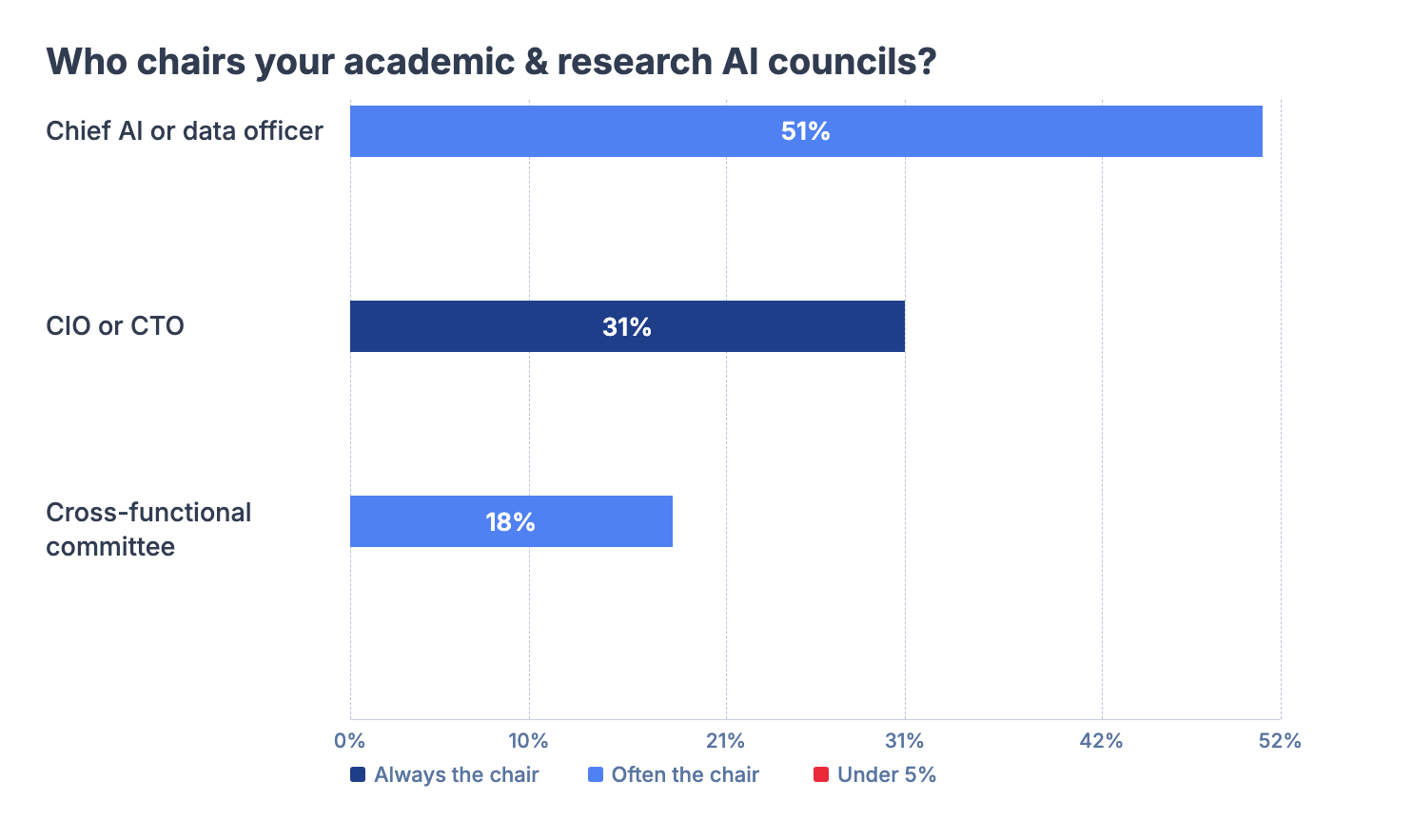
Academic and research AI councils are most commonly chaired by senior AI or data leaders, according to innovation leaders in government or universities. Chief AI or Data Officers take the chair for 51%. Their role gives them a natural connection to the policies and data questions councils need to address, while also keeping governance close to the people already responsible for AI strategy across the institution.
CIOs or CTOs chair the council in 31% of cases. A new study on the impact of AI on work in higher learning found that IT holds decision-making authority for work-related AI policies and guidelines at 53% of institutions, while institution-wide leadership does so at 59%. This helps explain why technology executives are so prominent in council leadership, since they already sit close to the systems and implementation decisions that turn AI policy into practice.
The remaining 18% use a cross-functional committee as chair. This gives institutions a way to spread oversight across several areas and bring different perspectives into the same decision-making process, which can be particularly useful when AI affects academic work as well as institutional operations.
Where do academic & research AI councils see most AI use?
96% of innovation leaders in government or universities see academic & research AI councils using AI most for research and data analysis, and 4% see the most use in citizen or student services.
AI use is concentrating on where it can have the biggest impact:
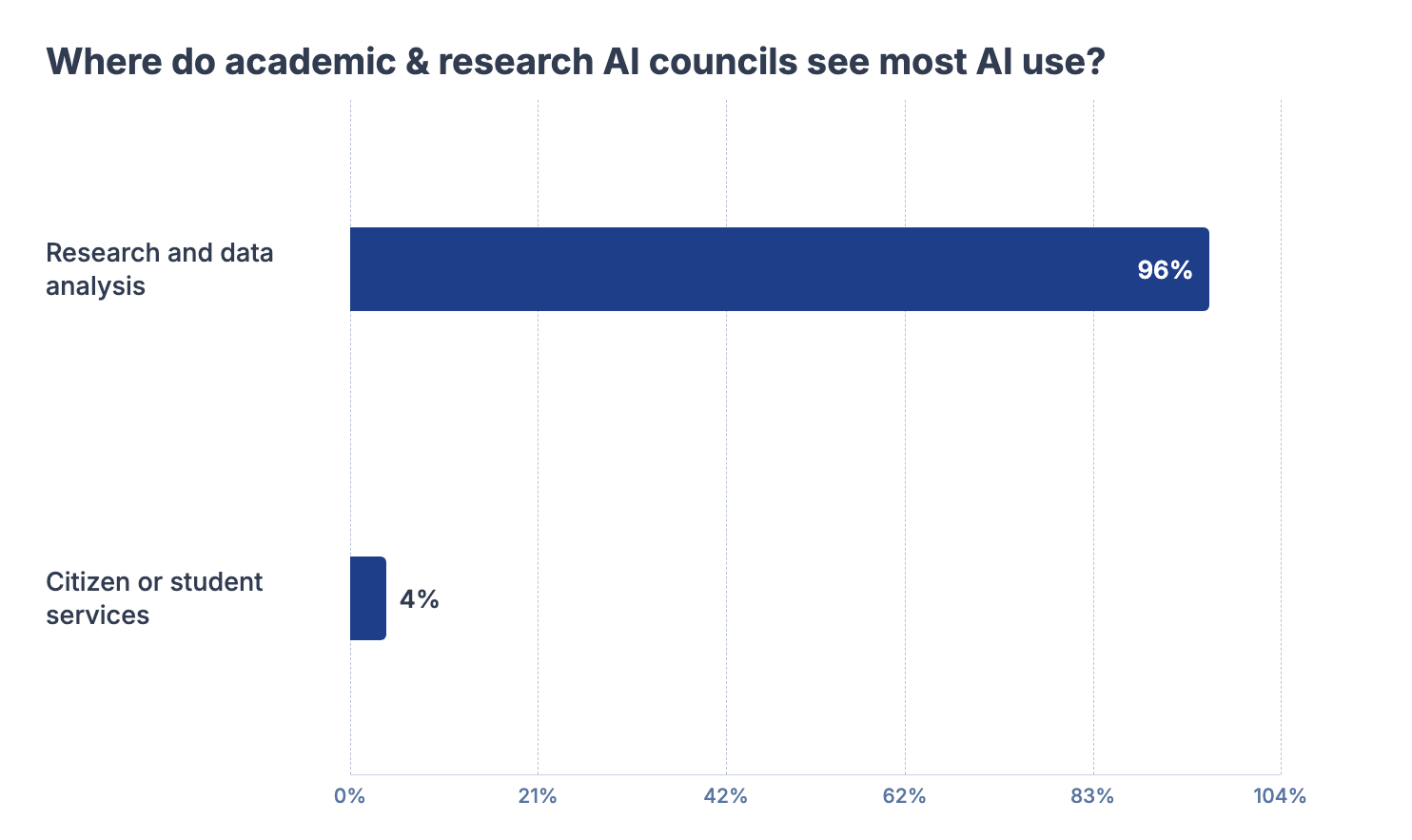
Academic and research AI councils see the greatest use of AI in research and data analysis, according to 96% of innovation leaders in government or universities. AI can support work that involves finding evidence and processing large volumes of information. It can also help researchers identify patterns that would otherwise take far longer to uncover.
Nature’s 2026 The State of AI Use Among Researchers survey shows that heavier reliance on AI is concentrated among earlier-career researchers. 11.4% with fewer than three years’ experience and 12.3% with three to ten years’ experience rely primarily or exclusively on AI tools to find relevant research instead of traditional academic databases or library systems. This points to a generational shift in research habits, with newer researchers more likely to build AI directly into their evidence discovery from the start.
Citizen or student services account for just 4% of AI use in our audience. These public-facing applications demand high levels of accuracy and consistency, which may make councils more cautious about direct AI interaction with students or citizens. Poor guidance or incorrect information can quickly damage the user experience.

Innovation for Universities: Growing Future Unicorn Companies
Read Now -> Discover the strategies to cultivate next-generation entrepreneurs and game-changing startups
Which AI tools do academic & research AI councils most endorse?
According to 19% of innovation leaders in government or universities, the AI tools that academic & research councils most endorse are generative AI assistants, while another 32% agree these tools are generally endorsed, 30% say they are somewhat supported, 15% find that generative AI assistants are rarely endorsed, and just 2% see AI research copilots as generally endorsed.
Councils are backing tools with the widest practical reach:
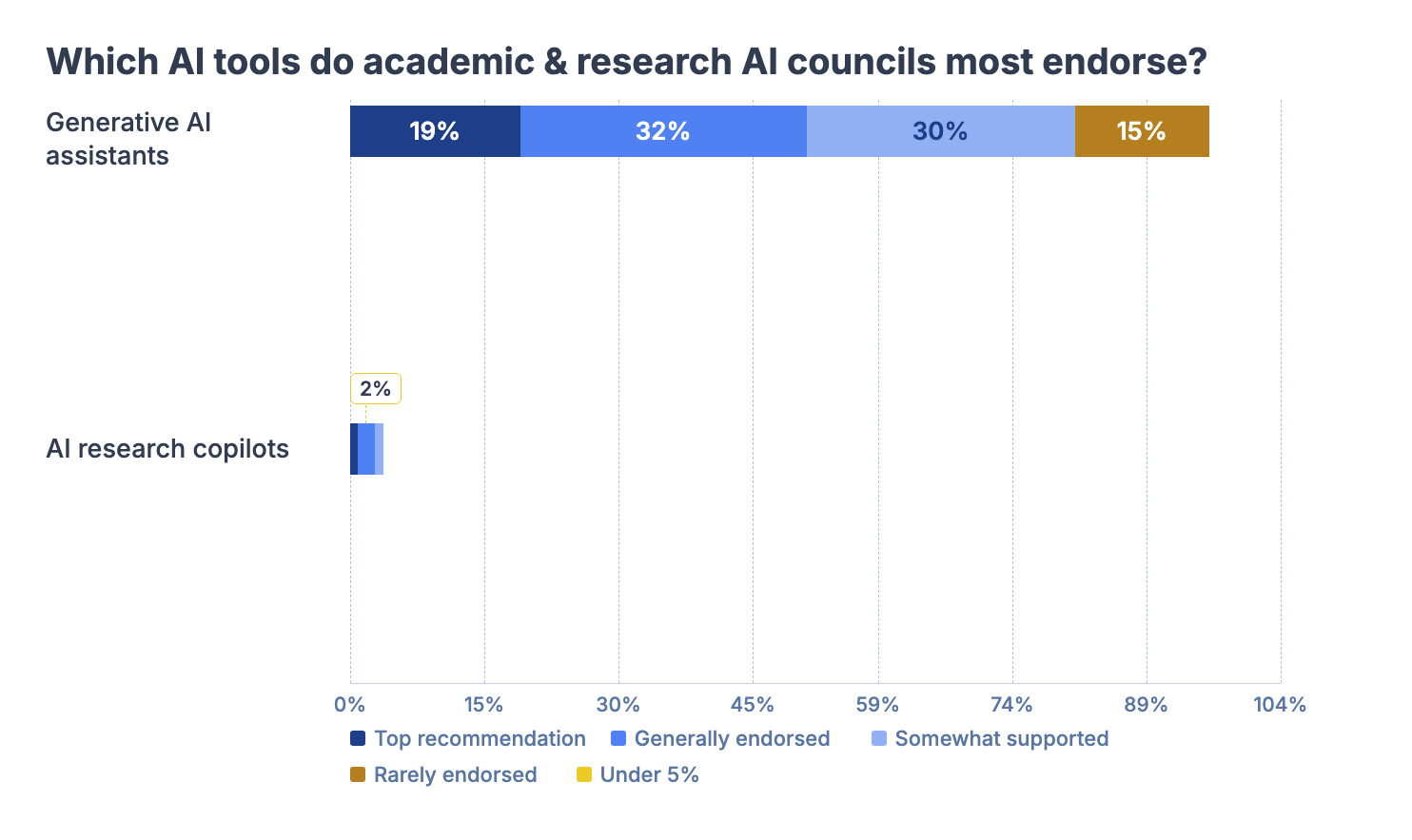
Academic and research AI councils show broad support for generative AI assistants, according to innovation leaders in government or universities. They are the top recommendation for 19%, generally endorsed by 32%, somewhat supported by 30%, and rarely endorsed by 15%. Support is widespread, but it is clearly not unconditional.
The U.S. Department of Education’s AI guidance stresses the importance of keeping humans in control of AI-supported decisions and using these systems to support professional judgment rather than replace it. This kind of oversight gives councils a reason to support generative AI assistants while still setting clear boundaries around how they are used.
AI research copilots attract far less support. Fewer than 1% make them their top recommendation, 2% generally endorse them, and fewer than 1% somewhat support them. Councils may be more cautious with tools that sit closer to the research process itself, where errors in evidence, sourcing, or analysis can directly impact research quality and integrity.
How do academic & research AI councils track AI compliance?
73% of innovation leaders in government or universities’ academic & research AI councils track AI compliance using automated monitoring tools, and 27% rely on legal counsel review.
Compliance is becoming a continuous job:
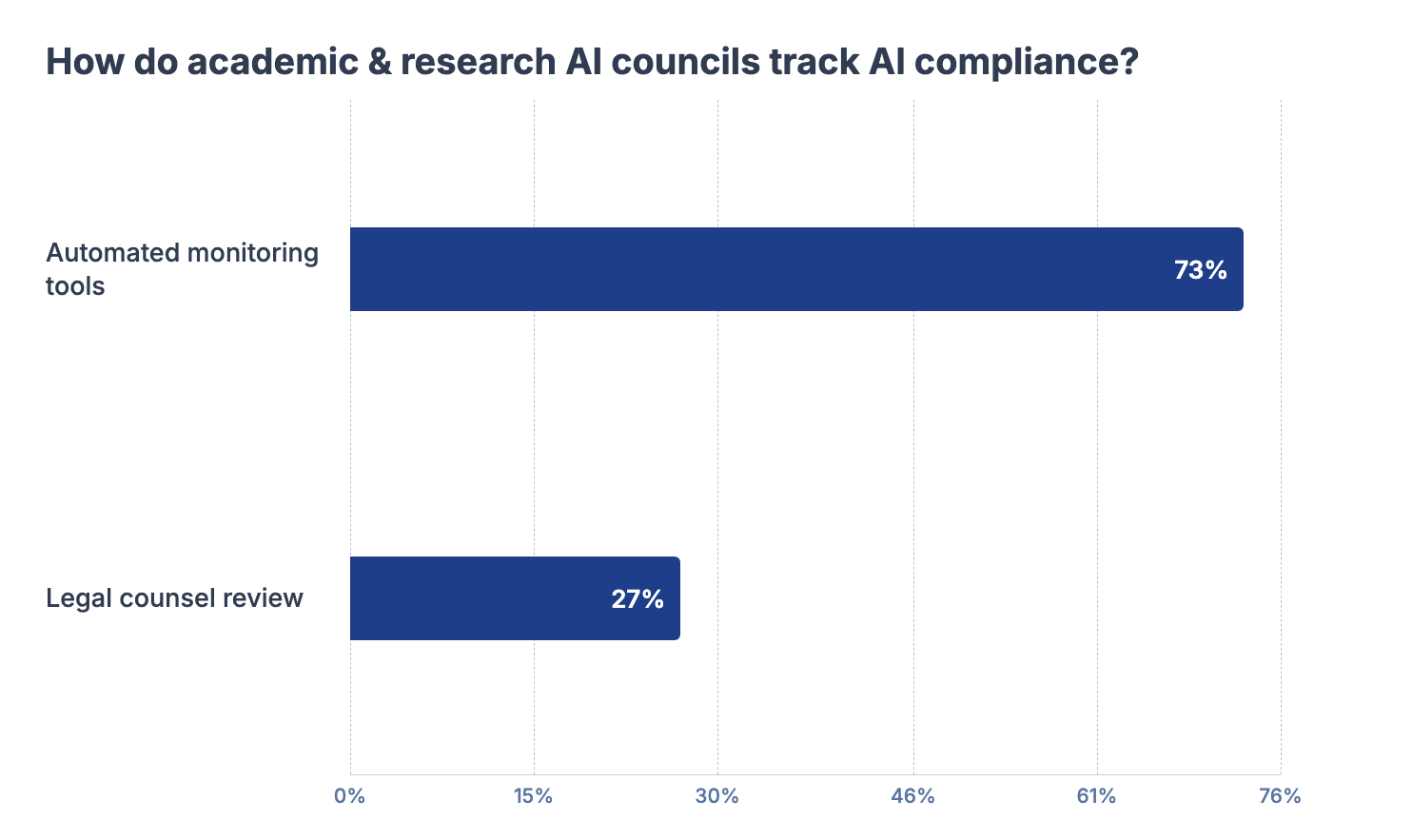
Academic and research AI councils most commonly track AI compliance through automated monitoring tools, according to innovation leaders in government or universities. 73% use these systems, giving councils a scalable way to check whether AI use remains within institutional policies as adoption grows. Automated monitoring can also surface problems earlier, before they become harder to manage.
The National Institute of Standards and Technology’s OSCAL framework shows how this can work in practice. It is designed to convert policies and regulatory requirements into machine-readable formats and to automate monitoring and assessment of whether system controls are working as intended. For councils, this means compliance can be checked more consistently across systems, with human attention focused on the exceptions that need interpretation or action.
The remaining 27% of our audience relies on legal counsel review. This gives councils access to human judgment when AI use raises questions around policy interpretation or regulatory obligations. Legal review can be especially valuable when a compliance issue poses broader institutional risk and requires a decision that cannot be reduced to an automated alert.
Which regulation most shapes academic & research AI councils?
While 5% of innovation leaders in government or universities agree that federal AI directives are most influential in shaping academic & research councils, 67% find they have a significant impact, and 4% that they have some influence, with just 5% seeing them as having minimal effect; 5% find export controls to be most influential, and 9% agree they have significant impact, 1% name HIPAA as the most influential regulation, and another 1% FERPA as having a significant impact.
External rules are setting the boundaries for institutional AI:
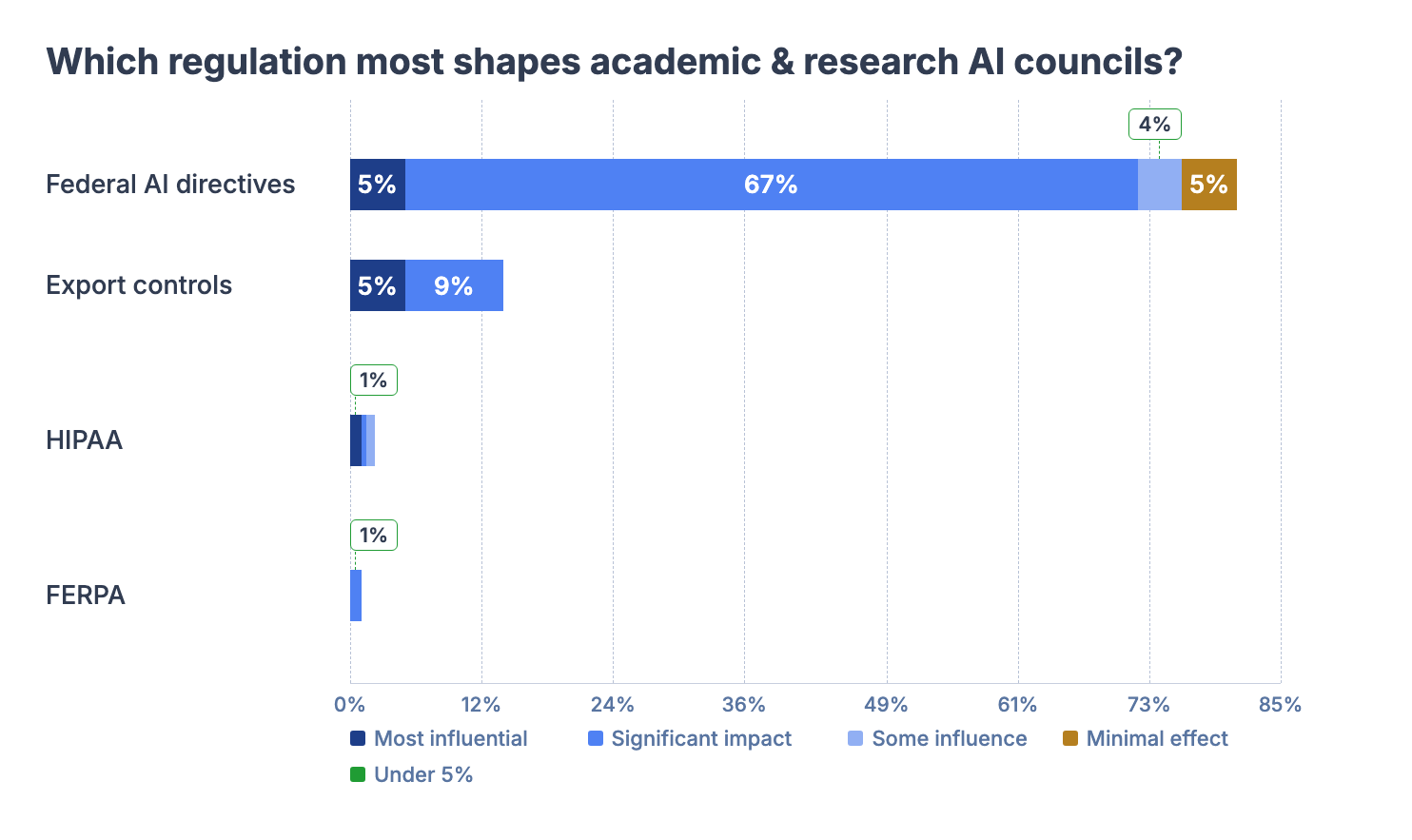
Federal AI directives are the regulation that most shapes academic and research AI councils. They are the most influential for 5% of innovation leaders in government or universities, have a significant impact for 67%, see some influence for 4%, and have only a minimal effect for 5%. A 2026 global Delphi study on GenAI governance in higher education places national guidance above institutional policy, with universities expected to align local rules with broader government direction. Federal directives set the parameters within which councils develop institutional AI policy.
Export controls are the most influential regulation for 5% and have a significant impact for 9%. Their influence is likely to be concentrated in research involving controlled technologies or international collaboration, where access to certain AI capabilities or technical information may be subject to additional restrictions.
HIPAA has a much narrower reach, with 1% calling it most influential and less than 1% reporting significant impact or some influence. Its relevance rises where AI is used with protected health information, particularly in medical research or university health settings.
FERPA has a significant impact for 1%. Its role is more specific to AI use involving student education records, making it especially relevant where councils oversee systems connected to student data.
What is the top security concern for academic & research AI councils?
For 30% of innovation leaders in government or universities, research theft is a top concern for academic & research AI councils, a major concern for 51%, and a minor concern for 18%, with data leakage not voiced as a concern by anyone.
The assets institutions create are becoming harder to protect:
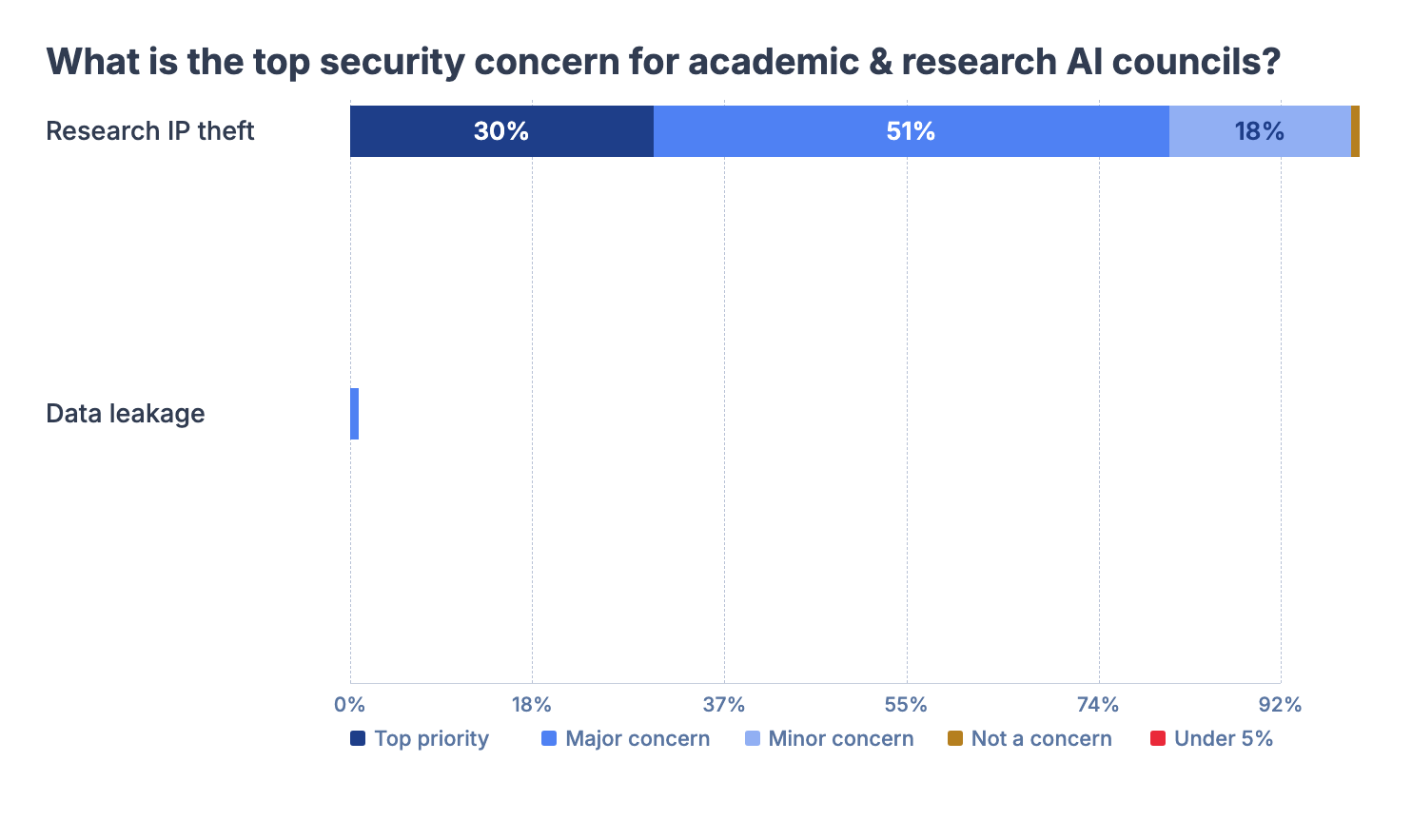
Research IP theft is the top security concern for academic and research AI councils. 30% of innovation leaders in government or universities rank it as their top priority, while 51% call it a major concern. Another 18% see it as a minor concern, and less than 1% say it is not a concern, showing how widely research security now sits on the governance agenda.
A 2026 report from the Society of Corporate Compliance and Ethics says universities are facing growing U.S. national security scrutiny around espionage and intellectual property theft on campus. It also notes that federal agencies increasingly expect institutions to know where sensitive research is held and how it is protected, especially in areas such as advanced computing and AI. This raises the stakes for councils around who can access sensitive research and how high-value assets are protected during collaboration.
Data leakage is a major concern for less than 1% of our audience. Councils may see this as a more manageable operational risk because institutions can address it through access controls and clear rules around how data is handled. The bigger challenge comes when sensitive research is deliberately taken or moved outside approved channels, where the damage can be much harder to contain.
How do academic & research AI councils vet AI security?
68% of innovation leaders in government or university academic & research councils vet AI security through vendor certifications, and 32% through internal security reviews.
Security vetting starts with independent assurance:
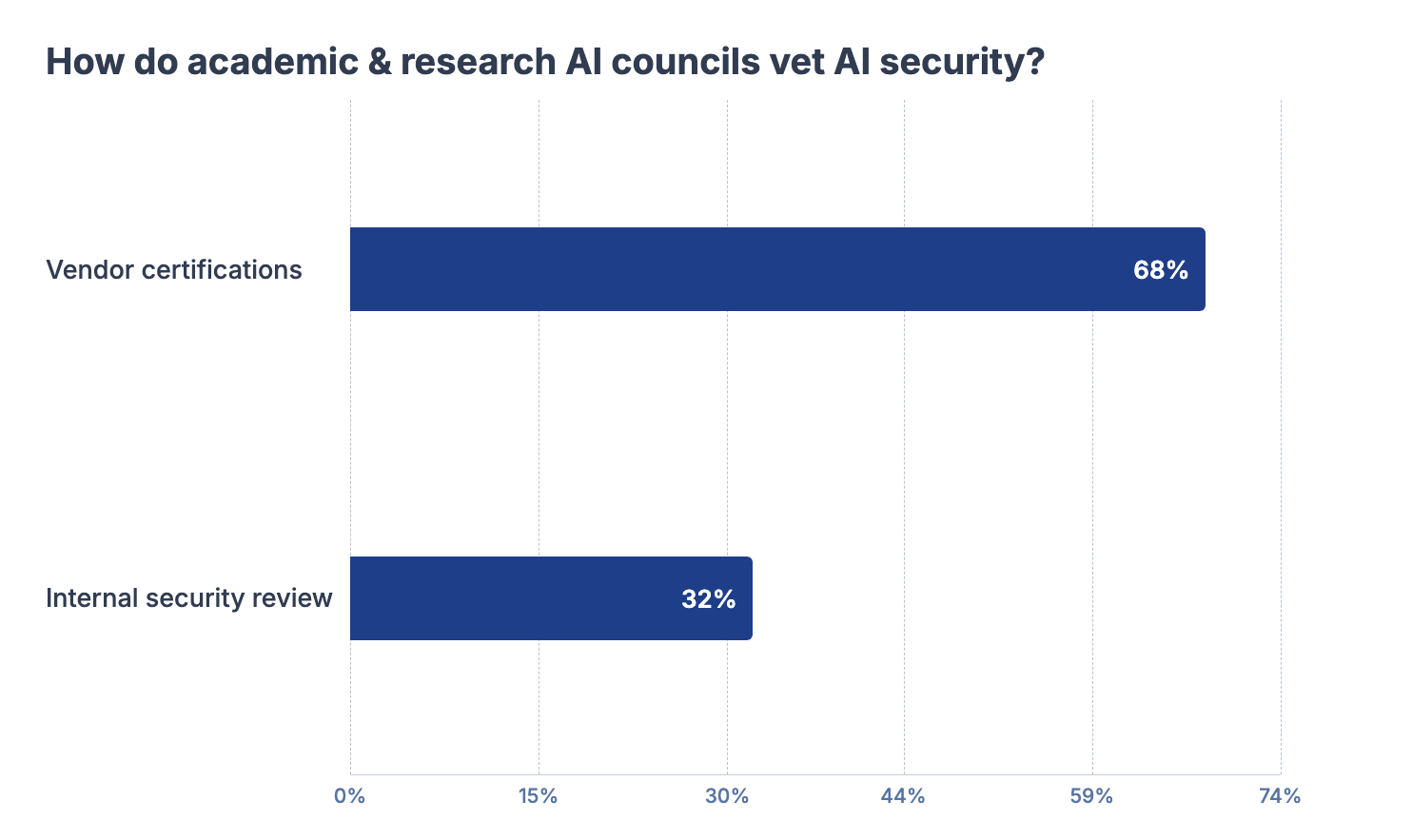
Academic and research AI councils most commonly vet AI security through vendor certification. 68% of innovation leaders in government or universities rely on these credentials, giving councils a standardized way to check whether a provider meets recognized security requirements before its tools are approved for use.
The Cybersecurity and Infrastructure Security Agency (CISA) recognizes third-party security attestations such as ISO 27001, SOC 2 Type 2, and CMMC as valid evidence in vendor security assessments, with suitable certification allowing parts of the detailed review to be streamlined. This gives vendor certifications real weight with councils by providing independently assessed evidence of security controls while reducing duplicate checks.
The remaining 32% of our audience uses an internal security review. This gives institutions greater control over the assessment and allows them to test a vendor against their own systems and risk thresholds. Internal review can be especially useful where standard certifications do not cover how an AI tool will handle sensitive institutional data in practice.
Key insights from academic & research AI councils
Our analysis of opinions from innovation leaders in government and universities shows that academic and research AI councils are taking on a much more operational role. They're now part of how institutions make day-to-day decisions about AI, with governance increasingly tied to security and compliance.
The broader picture is one of institutions trying to keep innovation moving while putting clearer controls around how AI is introduced and used. Plug and Play helps universities strike that balance, connecting them with startups, corporate partners, governments, foundations, and expertise to accelerate innovation. Watch the video below to see how:

PLUG AND PLAY AROUND THE WORLD
Discover our global locations
We have a community of experts all over the world. We work as a bridge between Silicon Valley and the rest of the world, making innovation open to anyone, anywhere.